Understanding Marketing — Behavioural Science, Data, and the Machine I Built to Serve It
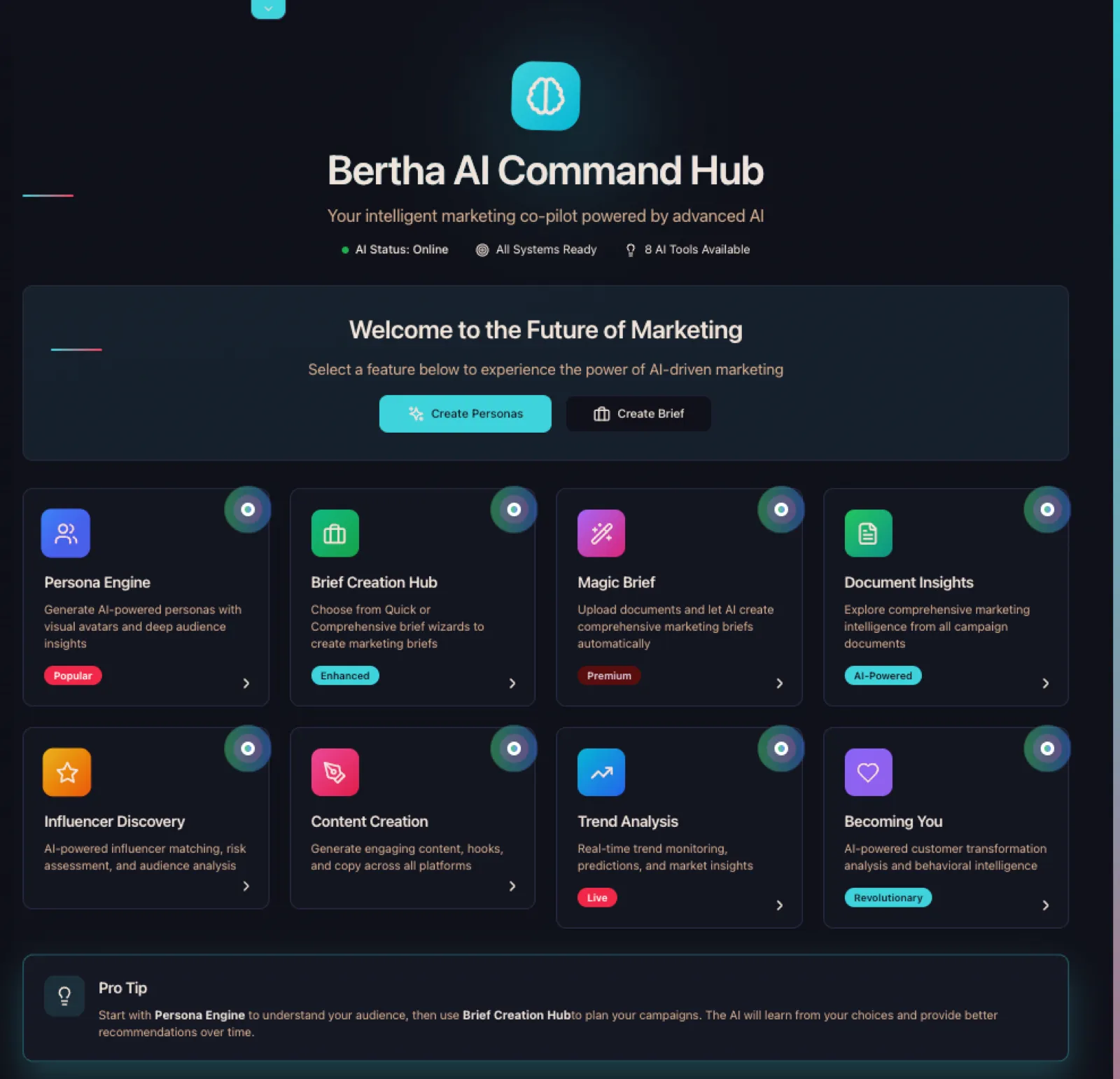
I didn't train as a marketer — I came to it from the technology side, as an engineer, enterprise architect and CTO. And I spent a year of eighteen-hour days — on top of three years of planning, prototyping and iterating — building a product whose whole purpose was to make marketers faster, sharper and more themselves. This is the honest, and deliberately technical, account of what that taught me. To encode marketing into nineteen microservices I had to actually learn it — cohorts and segments, activation and retention, RFV scoring and propensity models, mental availability and category entry points, attribution and LTV-to-CAC, System 1 and the 60/40 rule. What follows is what those things really are, written as if a marketer were reading over my shoulder — with enough explainer that anyone can follow — and the honest reason Bertha stalled on resourcing rather than merit — built, shelved, undecayed, and waiting.
On building a product for a craft I came to from the outside — and learning the discipline well enough to encode it, one microservice at a time.
I did not train as a marketer. I came to it from the other side of the house entirely — as an engineer and technologist, a technology strategist and enterprise architect, a consultant and a CTO.
I ought to get that on the table before anything else, because for one year of my life — eighteen-hour days, seven days a week, and I mean that close to literally, stacked on top of three years of planning and prototyping before it (showing and telling, gathering feedback, iterating, and iterating again), four years all told from the first rough sketch to the thing that finally ran — I built a product whose entire purpose was to make marketers faster, sharper, and more themselves. It went through more ideations than I can neatly count before it settled into the shape it holds now. There is a particular vulnerability in that arrangement, and it is the most instructive thing about the whole endeavour. You are building a machine to elevate people who can do, natively and by instinct, a thing you had to learn from a standing start. Every design decision is a small act of presumption. Who are you, exactly, to encode a craft you were never formally trained in?
The answer, it turned out, was: someone willing to go and learn it properly. Because here is what I had underestimated most. The microservices, the storage, the API integrations, the multi-LLM routing and the observability — all the parts a technologist points to when asked what he built — were the easy half. That is just engineering, and engineering I know. The real product, the hard and genuinely irreplaceable part, was the brain: the flow and the process by which raw data becomes a crafted persona, then a crafted strategy, then a crafted piece of communication — output built to resonate with a real human being, rather than the boilerplate hooks and interchangeable taglines most people picture when they hear the word “marketing.”
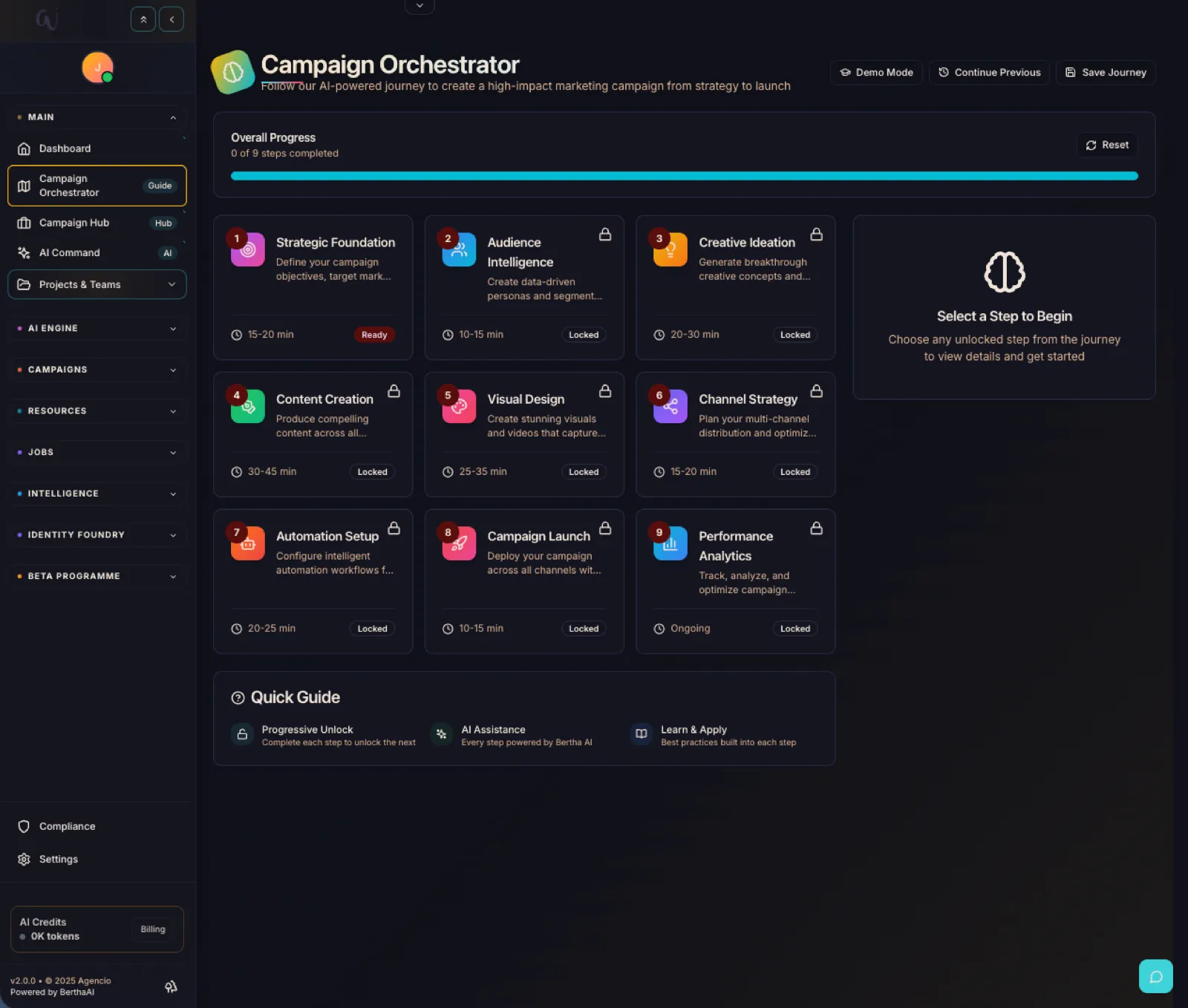
Because marketing is far more than a tagline. It is a data-driven attempt to understand how a person actually thinks, behaves and acts — and to meet them at the right moment, in the right way, with the right thing. Building that — the cognition, not the plumbing — was the year of my life. This essay is a tour of it. It is more technical than most things I write, on purpose, because the request I kept hearing was show me you actually understand it. So I will — using the real words a marketer uses, and explaining each one as I go, so that whichever side of the divide you are reading from, you can follow. The product is called Bertha — an Agency OS, nineteen microservices carrying a brand from raw customer data to measured impact, built on a patent-filed stack over three years. It never quite reached the market, for reasons I will come to and will not dress up. But it was built. It is there. And the year I spent learning to respect the discipline was worth more than the launch that didn’t come.
I. You cannot build for a craft you hold in contempt
There is a default posture the technologist takes toward marketing, and I knew it well because I had held it myself. It goes: marketing is just persuasion, persuasion is just a bag of tricks, and tricks are exactly what a clever machine automates away. It is a comfortable posture. It flatters the engineer and costs him nothing. It is also the single most reliable way to build a bad marketing product — because a tool built from contempt betrays itself in everything it does. It treats the copy as filler to be generated by the yard. It treats the audience as a resource to be strip-mined. It hands the marketer a firehose of confident mediocrity and calls it acceleration. And the marketer — who can tell, because telling is the craft — sets it down and never picks it up again.
So before a line of Bertha was worth writing, I had to move, in strict order, through three positions. First to understand marketing — the machinery, the segments and funnels and channels. That part a technologist can manage; it is just systems. Then to appreciate it — to grasp that beneath the machinery sat real judgement, not reducible to rules. And finally to admire it — to concede without reservation that there was a genuine art here, worthy of the same respect I give good engineering. That last step is not sentiment. It is an engineering prerequisite. You cannot build a tool that elevates a craftsman until you have admitted, fully, that there is a craft.
What follows — the behavioural science, the data layer, the growth plumbing, the strategy — is the map of what I had to learn before I had earned the right to build any of it.
II. The substrate — behavioural science, or why people actually act
Everything in marketing sits on top of a single stubborn fact: people do not decide the way they say they decide. This is the domain of behavioural science, and it is where I spent the most humbling hours, because it is a real science with real literature and most of what I thought I knew about persuasion turned out to be folklore.
The foundation is Daniel Kahneman’s distinction between two modes of thinking. System 1 is fast, automatic, intuitive and emotional — it runs the vast majority of your day and nearly all of your purchases, deciding before you are aware there was a decision. System 2 is slow, effortful and logical — the part you think is in charge, and which mostly arrives after the fact to justify what System 1 already chose. The naive marketer (and the naive engineer building for one) addresses System 2: here are the features, here is the spec sheet, be persuaded. The good marketer speaks to System 1 — to the feeling, the association, the split-second — and lets System 2 rationalise it later. Encoding that meant Bertha could not just generate arguments; it had to generate feeling, and know the difference.
On top of that sit the mechanics of influence, most cleanly catalogued by Robert Cialdini: reciprocity (we feel obliged to return a favour), social proof (we do what we see others doing), authority, scarcity, liking, commitment and consistency, and later unity. These are not tricks — or rather, they are only tricks in the hands of someone who despises the audience. Used honestly they are simply how humans are built, and ignoring them is like building a bridge while ignoring gravity.
But the piece of behavioural science that reshaped Bertha most was the empirical marketing science of the Ehrenberg-Bass tradition — Byron Sharp’s How Brands Grow and the work around it. Two ideas in particular. The first is mental availability: the probability that a brand comes to mind in a buying situation. Brands do not grow mainly by making their existing customers more loyal; they grow by being thought of by more people, more often, in more situations. The second is category entry points (CEPs) — the specific cues and moments that trigger a category need in the first place. “Something quick for the kids’ dinner” is a CEP; the brand that is mentally linked to that moment wins it before persuasion even begins. There is even an iron law here — the double jeopardy law — that smaller brands suffer twice over, having both fewer buyers and slightly less loyal ones, which quietly kills the popular strategy of “we’ll just make our niche love us harder.”
None of this was intuition. I had to read it, and then I had to decide how a machine could hold it without flattening human motive into a cartoon. That is what the persona engine and the “becoming you” behavioural-intelligence module were really for.
III. The data layer — segments, cohorts, and knowing who you are talking to
Marketing has to point behavioural science at someone, and before you can point it anywhere you need data — which is where I met a whole vocabulary I had blithely assumed was one simple thing. Data has provenance: it matters enormously who gathered it, and how close they stand to the real human it describes.
First-party data — the stuff you gathered yourself, from your own audience, with their knowledge — is the gold standard, and in a world of tightening privacy law and dying third-party cookies it only grows more valuable. The further you travel from that first column, the cheaper and more plentiful the data becomes, and the less trustworthy and legally comfortable. Bertha was built to run on the first column wherever it could — the CRM, the owned channels — because that is where both the accuracy and the ethics live.
With data in hand, the job is to make sense of it, and here the vocabulary turns precise — and even a lot of practitioners are loose with it. Two words in particular are constantly confused, and Bertha could not afford to confuse them.
A segment is a group of people defined by shared attributes — enterprise customers in Singapore, women aged 25–34, lapsed high-spenders. It is a static slice of the market by characteristic. A cohort is different: it is a group defined by a shared event in a shared window of time — everyone who first purchased in March, everyone who signed up the week you ran a given campaign. The distinction matters enormously, because a cohort lets you watch how a group behaves over time as it ages — the retention curve, the percentage of that March cohort still active one, three, six months later. Segments tell you who someone is; cohorts tell you what happens to a group after a shared beginning. Confuse the two and your analytics lie to you.
The workhorse of customer segmentation is RFV scoring — Recency, Frequency, Value (you will also see it as RFM, where the M is Monetary; same idea). You score every customer on how recently they last bought, how frequently they buy, and how much value they represent, and those three numbers sort a shapeless contact list into meaningful groups: your best customers, your at-risk regulars, your one-time strangers. It is decades old, unglamorous, and still one of the highest-return moves in the whole discipline. Bertha’s CRM mining — across Salesforce, HubSpot and Monday.com — was RFV at its core, feeding churn prediction (a model estimating the probability a given customer is about to leave) and propensity models more broadly (a propensity model just predicts the likelihood of any action — to buy, to upgrade, to lapse). This is the moment where behavioural science becomes arithmetic: you take the soft truth that people act on feeling and you make it a score you can act on at scale.
IV. Similar, and yet each of us unique
Somewhere in the middle of the data work, a truth crept up on me that I had not expected from a discipline I’d assumed was cynical. Marketing, taken seriously, is one of the most honest mirrors we have of human nature — and what it shows is a paradox. In the aggregate we are remarkably similar: the behavioural laws hold, System 1 fires the same way in nearly everyone, the biases and the category entry points are broadly shared. And yet each of us is unique, irreducibly so — to the point that the very message which delights one person will actively repel another, with every shade of indifference in between.
That is the exact place a boilerplate hook goes to die. The same words are not the same message to two different people. Tone, timing, format, channel, the mood of the moment — all of it decides whether a thing lands as a welcome insight or an unwelcome intrusion. So the real skill of marketing, the thing beneath all the frameworks, comes down to four alignments held at once: the right communication, to the right person, at the right time, in a format they will happily digest — and ultimately act upon. Get any one of the four wrong and the other three are wasted. That is far harder than it sounds, and it is data-driven precisely because you cannot guess your way to it across millions of people who are each their own exception.
This is why personas mattered, and why Bertha’s persona engine was never cosmetic. A persona is a disciplined, data-grounded model of a kind of person — their motivations, their frictions, the moments they are open and the moments they are closed — built so that communication can be shaped to them rather than sprayed at everyone. Personalisation done well is not surveillance, and it is not a mail-merge with a first name pasted in. It is respect at scale: the attempt to treat a stranger as the particular person they are rather than the statistical average of a million others. Encoding that — the crafting of real communication to a modelled human, made to capture the imagination rather than fill a slot — was the hardest and most human thing in the whole platform, and the part I am proudest of.
V. The plumbing of growth — funnels, activation, attribution
Once you know who you are talking to, you have to move them somewhere, and the model for that movement is the funnel — awareness at the wide top, then consideration, then conversion, then loyalty at the narrow bottom, with people falling out at every stage. A useful sharpening of it is Dave McClure’s AARRR, the only framework in this essay named after a pirate: Acquisition (they arrive), Activation (they first experience the core value), Retention (they come back), Referral (they bring others), Revenue (they pay). Five stages, each independently measurable, each a place a campaign can win or bleed.
Of those, activation is the one most people underrate and the one I came to obsess over. Activation is the moment a new user first genuinely experiences what the product is for — the so-called “aha moment” — and it is usually operationalised as a specific, measurable early action that strongly predicts whether they will still be around in three months. The textbook (semi-apocryphal) example is a social network discovering that users who reach a certain number of connections within their first week almost never churn — so the entire onboarding is bent toward driving that one action. Find your activation metric and you have found the lever that moves retention, and retention is where the money actually lives. Getting Bertha to reason about a client’s activation event, rather than just their top-of-funnel traffic, was one of the genuinely hard problems.
And hovering over all of it is the question that haunts every marketer: attribution — which touchpoint actually gets the credit when someone finally converts. Was it the ad they saw six weeks ago, the email yesterday, or the search they’d have done anyway? Last-click attribution gives all the credit to the final touch and is comfortingly simple and usually wrong. Multi-touch attribution spreads the credit across the journey. Marketing-mix modelling (MMM) goes top-down and statistical, inferring each channel’s contribution from aggregate spend and outcome data. There is no perfect answer — attribution is closer to forensic accounting than to physics — and the final arbiter of whether any of it is working is a single ratio: LTV to CAC, the lifetime value of a customer against the cost to acquire them. Spend more to win a customer than they will ever be worth and no amount of clever creative saves you; a healthy business generally wants that ratio comfortably above three-to-one. This is the number that turns marketing from an art department into a P&L, and it is the number Bertha’s closing feedback loop existed to protect.
And that word — loop — is the last technical idea that matters, because marketing is not a line that ends at a sale. It is a cycle: launch, measure, learn, iterate, and — when the numbers are honest enough to admit a thing simply is not working — tear it up and start again. The measurement is not bureaucracy; it is the nervous system. Without it you are not marketing, you are guessing with a budget. Everything upstream — the personas, the copy, the channel plan — only earns the name strategy once it is wired to feedback that can tell you, unsentimentally, whether it worked, and give you the evidence to do the next round better.
VI. The art that would not automate
I have made marketing sound, so far, like a system — and much of it is. But sitting in the middle of the system is the thing I had most badly underestimated: the craft of the material itself. The copy, the hook, the image, the rhythm of a line that makes a stranger stop scrolling. I had assumed this was the easy, automatable part. It is the hardest part.
The gap between a line that works and a line that merely reads is enormous, and it is not closed by brute force or by more tokens. It is closed by taste — and taste is precisely the faculty a machine does not have and a good marketer does. A model can generate a thousand headlines; it cannot reliably know which one is too clever, which lands and which dies, which respects the reader’s intelligence and which insults it. That judgement is tacit, built from a lifetime of calibration, and it lives below the waterline of language where no training set fully reaches. The most Bertha could honestly do was give a person with taste far more shots at goal, far faster — a hundred drafts to react to instead of three — and never once pretend the tool had the taste itself. The lesson generalises to everything I build: a tool that removes the human’s judgement does not produce good work faster; it produces confident mediocrity faster, which is worse than slow honesty because it manufactures the appearance of quality where none exists.
VII. The game above the craft — positioning and the long game
Above the material sits strategy, and its classic spine is STP — Segmentation, Targeting, Positioning. You divide the market (segmentation), choose which parts to pursue (targeting), and then do the most important and least understood thing in all of marketing: positioning — deliberately owning a distinct place in the customer’s mind relative to the alternatives. Positioning is not what you say about your product; it is the slot you occupy in someone’s head when they aren’t thinking about you. Ries and Trout wrote the book on it decades ago and it has aged barely a day.
The strategic lesson that most changed how I thought, though, was the work of Les Binet and Peter Field — The Long and the Short of It — and its famous 60/40 rule: across a large body of evidence, the most effective marketing splits its budget roughly sixty per cent to long-term brand building (broad, emotional, slow-compounding, growing mental availability) and forty per cent to short-term sales activation (targeted, rational, immediate response). Starve the brand half to chase this quarter’s leads and you win the quarter and slowly bleed the business. Almost every founder’s instinct — mine included — is to pour everything into activation because you can see it working. Learning why that is a trap was one of the more expensive pieces of education Bertha gave me, and it is baked into how the whole platform balances a campaign.
And there is one more piece of machinery worth making plain, because it is where all this strategy finally turns into instructions someone can act on — the brief. Outsiders tend to picture a single document. In practice there are usually three, nested, and knowing the difference between them is part of knowing the trade. The marketing brief holds the strategy: the objective, the audience, the positioning, the measure of success. From it descend two more — a media brief, telling the planners where and when the message runs, and a creative brief, telling the makers what to say and how. One root, two branches, three documents that must stay in step; and one of the quieter things Bertha did was draft all three from a single strategic input, so they could never silently drift apart.
VIII. How you actually learn a craft that isn’t yours
I want to be precise about how all of this was learnt, because it is not how people imagine.
It did not come from a course; courses give you the vocabulary, which is the cheap part. It came from three things layered together. From reading — the research papers, the behavioural-science canon, the marketing-science literature most practitioners have never opened and most engineers do not know exists. From people — the seminars I sat in, the experts I sought out and quietly pestered, the practitioners who could tell me in a sentence why a thing I was certain of was wrong. And above all from building, which I have come to believe is the deepest form of reading there is.
Here is the thing nobody tells you: you do not truly understand a craft until you try to make a machine perform it, because only then are you forced to account for every scrap of tacit judgement the expert never bothered to make explicit. The marketer knows, without knowing that they know, that this headline is a hair too clever. Ask them the rule and they cannot give it, because there isn’t one — there is a lifetime of calibrated instinct. Try to encode it and you meet, head-on, exactly how much of the craft lives below the waterline. Every place Bertha struggled was a place where I had discovered, the hard way, another pocket of judgement I could accelerate but never replace. That, more than any paper, is where the real understanding came from — not from mastering the craft, but from mapping its edges by repeatedly running a machine into them.
And there was a feedback loop wrapped around my own education, not just around the product. All the way along the journey, Bertha was pressure-tested by working CMOs and marketers — the very people she was built to serve — who prodded at her, pushed back, and told me bluntly where she rang false. That was its own measure-and-iterate cycle, only pointed at me rather than at a campaign: every objection was a lesson, every a real marketer would never do that a correction to my model of the craft. Because the truth underneath is simple. To build for practitioners you have to understand them; and to understand them you have to understand the craft they live inside. There is no shortcut around that. You earn it in conversations, over and over, from the people who already have it.
And the closest, most exacting of those loops was at home. I would be dishonest — and, frankly, in some trouble — if I did not say so plainly: I am married to a marketer, and a very good one. Ten years together, and it was she, long before any book or seminar, who first opened the door onto this whole world of media, digital and strategy — a world in which she plainly excels and I, at best, visit with permission. She holds the degree and the master’s, has taught the subject as a professor, and has served all along as the ongoing canary for the platform — forever poking to see whether I really understood a thing or was merely fluent in its vocabulary. More than a few of my confident hypotheses she took apart, kindly and completely, and left in pieces on the kitchen table; every one of those demolitions made the work better. (Thank you, darling — if you are reading this.)
And let me be clear about motive, because it matters. I did not build marketing software because of her. Watching that world through her, I saw something a technologist cannot unsee: that artificial intelligence is an exceptional fit for a great deal of marketing technology. Marketing is data-driven, pattern-rich, endlessly iterative, and built on modelling human behaviour — which is very nearly a description of what modern AI does best. The fit is almost suspiciously neat, and that, not sentiment, is why I built.
None of which means the marriage is a happy one yet. Right now it is more of a rocky dating dance. The field is full of tools that are badly written and badly designed — AI bolted onto marketing by people who understood neither — producing exactly the confident mediocrity I warned about above. But the early awkwardness is a phase, not the verdict. Handled with respect, this technology is a booster to the craft, not a replacement for it — an amplifier that will, in the end, make good marketers formidable and the union solid. I could see that coming. And I could see the harder thing coming too: that an industry going quite happily about its business was about to be reshaped, ready or not. I was not, for a single moment, unaware of what was on its way. And I knew that impact was coming precisely because, by then, I understood the industry — not its every detail or its decades of inside baseball, and not the way someone who has worked it for twenty-five years understands it, but deeply enough to read the direction of the wind and grasp what a technology like this would do to it. You do not need a career inside a thing to see the wave about to break over it; sometimes the clearest view belongs to the person who arrived from another discipline entirely.
IX. The same obsession, wearing another mask
I have built another machine since, and on paper it looks like the opposite of a marketing platform. Signal Fabric — the engine inside Agencio Predict — is a quant-trading system: a prediction platform that turns market evidence into governed, self-improving trading decisions. Finance, not creative. Rules and probabilities, not personas and copy. And yet the longer I worked on it, the more I realised I was building the same machine in a different disguise.
Because what is a market, underneath? It is behaviour. A market is nothing but the aggregated, priced, second-by-second feedback of human beings acting on fear and greed and hope and memory — the very same System 1 and System 2, the same herding and loss-aversion and social proof I had studied for Bertha, only now expressed as a live tape of numbers instead of a click on an ad. A price is a sentence the crowd is speaking. To model a market is to model a mind — millions of them at once, arguing in public. If you are going to build a machine to trade, you quickly find you are not really building a finance tool at all; you are building a behavioural one, pointed at the most honest and unforgiving feedback signal humans produce.
That was the quiet revelation of building both. Marketing tries to shape behaviour and read whether it moved; trading tries to read behaviour and price where it will move next. Same coin, opposite faces. The obsession underneath my whole portfolio was never really marketing, or trading, or governance — it was human behaviour: how we think, how we act, how we can be understood, met, and, where it is honest to do so, moved. Bertha reads the individual and crafts the message. Signal Fabric reads the crowd and prices the move. Beneath them is one appetite — to build systems that understand people well enough to act, and are governed well enough to be trusted while they do.
There was a second seed, too, of a wholly different kind — and it hides in that word governed. Building Bertha meant securing Bertha: a sprawling, multi-tenant platform holding other people’s data, which had to be locked down, made auditable, and rendered genuinely trustworthy before it could go anywhere near an enterprise. Solving that, out of sheer necessity, showed me the shape of another problem entirely — and sowed the seeds of what became Silo, the layer your AI can’t lie to. But that is another topic completely in itself, and a fiendishly clever one, if I do say so myself. A story for another day.
X. Why it stalled — told straight
Now the part I will not spin, because spinning it would betray the one thing I actually care about.
Bertha did not stall because the idea was wrong or the build was weak. It stalled for a reason almost boringly common among genuinely ahead-of-their-time products: resourcing. A product of that size needs a team, and I had only a small circle around me. They were able and I was grateful for them — but the keystone role, the one fusing the deep engineering with the marketing understanding with the strategy, was not one any of them could take from me. And when the same person holds the irreplaceable seat and carries the balance sheet, self-funding the whole thing, the arithmetic has a known ending. Something has to give. It did.
And make no mistake about the weight of the thing. This was not a lightweight app idling on a free tier. Bertha’s nineteen microservices carried a cloud bill of around two thousand US dollars a month simply to keep the lights on — before a single salary, before a line of new work, before a penny of revenue. That is not a hobby project; that is a small business’s worth of infrastructure, funded from one pocket. A serious platform has a serious metabolism, and metabolisms have to be fed whether or not the market has arrived yet. Running that burn indefinitely, alone, while also being the only person who could move the product forward, is precisely the trap I walked into — and precisely the one I would never walk into again.
There is no shame in that story, though it took me a while to say so without wincing. It is not a product killed by the market; it is one starved by its dependence on a single pair of hands. And the lesson it left is exact, and I have carried it into everything since: do not be the sole keystone and the sole balance sheet at the same time. Bring the judgement that cannot be delegated — but not while also being the only wallet in the room. That is not a lesson about marketing. It is a lesson about how ambitious things actually get built, and it cost me a year to learn properly.
XI. Why it isn’t dead
And yet — she is still there.
That is the strange gift of software. Bertha did not decay in a warehouse or rust in a field. She sits, dormant, on a stack that has aged remarkably little, with the redeploy scripts written, tested and waiting; she can wake at full scale on command — spun down precisely so that the hungry metabolism I described is not eating a balance sheet while it waits. The three years of engineering did not evaporate when the funding did — they are held, intact, ready to be recycled the moment the conditions are right: a team around the keystone, and a balance sheet that isn’t only mine.
There is a quieter turn here too, which I have written about in The Giant Under the Snow. Four years ago, when Bertha’s first iterations took shape, an autonomous marketing organisation on a multi-LLM routing core sounded like science fiction to most people I described it to. Today the industry has walked, step by step, right up to where I was standing when I started. Being early is not the same as being wrong. It is frequently the same as being alone — which is a different problem, and a resourcing one. See above.
XII. What it was really for
So here is what a year of eighteen-hour days building a marketing product taught a technologist who came to marketing from the other side of the house.
It taught me the real machinery of the craft — System 1 and mental availability, cohorts and RFV, activation and attribution, positioning and the 60/40 rule — well enough to build for it honestly rather than to automate it away. It taught me that the tacit judgement of an expert, the taste, is the most valuable and least automatable thing in any domain, and that the honest job of a tool is to multiply it, never to counterfeit it. And it taught me that the surest way to understand a discipline is to try, humbly and at length, to build for the people who have already mastered it — because only then does the machine force you to find every hidden pocket of skill.
So did I come out of it a marketer? I would not claim the title in a room full of people who spent their careers earning it — and yet I am no longer sure the flat denial is honest either. I have had the deep schooling, all of it, because I had to; I was pressure-tested by CMOs and marketers along the whole journey and came out the other side still standing. Perhaps I am a kind of marketer after all — just one whose education was about as far from classical as it is possible to be. And I loved every minute of it: the people, the process, and, in its proper place, the technology that facilitated it all. What I know for certain is this — I learnt the craft deeply enough to admire it and to build for it well, and that progression, understand, appreciate, admire, in that order and no skipping, is the one thing I would insist on to anyone setting out to build a tool for a craft that isn’t their own.
Bertha may yet have her second act. But even if she never wakes, the year was not a loss. You do not have to master a craft to fall in love with it. You just have to respect it enough to learn its real machinery, build something that would make its masters faster — and admit, cheerfully and for the record, that the taste was always theirs and never the machine’s.
And so a closing word to the marketers I have come to know, across all your different specialisms — the brand strategists and the growth leads, the copywriters and the data analysts, the CMOs who pressure-tested my work and were kind enough not to spare my feelings. I respect what you do, deeply and now from the inside of the attempt. I am grateful for everything you taught me. This one was written in your honour — by an outsider who came to admire the craft you have given your careers to, and who finds himself, a little unexpectedly, a small part of the trade after all.
A note on the shelf
The reading behind Bertha runs through the terrain any serious student of the field eventually crosses. On how buyers actually behave — Byron Sharp’s How Brands Grow and the Ehrenberg-Bass work on mental availability and category entry points; on the mechanics of influence — Robert Cialdini’s Influence; on the two systems doing the deciding — Daniel Kahneman’s Thinking, Fast and Slow; on why psychological logic so often beats economic logic — Rory Sutherland’s Alchemy; on the long-versus-short balance of budget — Binet and Field’s The Long and the Short of It; on positioning — Ries and Trout; and, for the craft of the material itself, the old masters like Ogilvy, who respected the audience long before anyone called it behavioural science. The engineering — nineteen microservices, multi-LLM smart routing, the governance, the redeploy scripts — is documented on Bertha’s own page. And the lesson that a tool must multiply human judgement rather than counterfeit it is the one I keep arriving at from every direction — see also The Things I Learnt Building Signal Fabric.