The Room Where No One Can Tell You You're Wrong
From the strongman to the boardroom to the hiring filter, every failing system fails the same way — it quietly removes the people who could have told it the truth. The single mechanism beneath collapse, at three scales.

From the strongman to the boardroom to the hiring filter, every failing system fails the same way: it quietly removes the people who could have told it the truth.
Here is a puzzle worth sitting with.
Why do powerful, intelligent, lavishly-resourced systems — nations with every advantage, companies with every resource, leaders who can plainly see the cliff edge — so often drive serenely over it anyway? It is tempting to reach for the easy answers. Stupidity. Greed. Hubris. And those play their parts. But they are not sufficient, because the wreckage of history is littered with the clever and the well-advised, people and institutions who had access to every fact they needed and went over the edge regardless, often while insisting the road ahead was clear.
The honest answer is stranger and more structural than any failure of intelligence. The systems that fail have, almost without exception, done the same quiet thing first. Long before the visible collapse, they performed an invisible amputation. They removed — gently, rationally, often without anyone noticing the moment it happened — their own capacity to be told they were wrong.
They built a room in which no one could correct them. And then, comfortable at last, surrounded only by agreement, they made the catastrophic decision that the absent voices would have caught.
This is not a metaphor about one kind of failure. It is, I have come to think, the single mechanism beneath a great many of them — the same disease expressed at the scale of a nation, a company, and a single human mind. It is worth following down through those three scales, because the pattern is identical at each, and recognising it at the large scale is what lets you catch it at the small one, where it is doing its quiet work in your own organisation, and possibly in your own head.
The Room With No Mirrors That Talk Back
Start at the largest scale, where the stakes make the mechanism unmistakable.
We tend to imagine the corrupt strongman as a creature of pure appetite — a man who surrounds himself with loyalists out of vanity, or paranoia, or a taste for flattery. That reading is comforting because it makes him stupid, and stupidity is reassuring; we are not stupid, so it cannot happen to us. But it badly misreads what is actually going on, and the truth is far more unsettling, because it is rational.
Every independent voice the strongman removes is not a vanity purge. It is the deliberate severing of a correcting wire. The auditor who is defunded, the judge who is replaced, the journalist who is pressured into silence or exile, the rival who is removed from the room — these people are almost never eliminated for what they have done. They are eliminated for what they could say. Each one is a potential source of the sentence the strongman cannot tolerate: this is a mistake. Remove enough of them and you have not merely consolidated power. You have built a room with no mirrors that talk back — a chamber in which every surface returns your own reflection, nodding.
It feels, from the inside, like the summit of control. No friction. No dissent. No inconvenient arithmetic. And it is, in fact, the beginning of the end, because a state that has silenced everyone capable of correcting it has also silenced everyone capable of warning it. The watchdogs were never the enemy of the regime. They were its immune system, and it has spent its strength dismantling them. What follows — the looted treasury, the starved institutions, the slow severing of the loop that turns a country’s effort back into its own prosperity — is not bad luck. It is the entirely predictable result of a system that made itself impossible to correct and then, predictably, was not corrected.
The tyrant does not fall because no one saw the cliff. He falls because he had already removed everyone who was allowed to mention it.
The Same Room, With Better Coffee
Now zoom in, and watch the same architecture assemble itself in a place with no menace at all — just discomfort, and the very human wish to avoid it.
A company is, among other things, a machine for making decisions, and like any such machine its quality depends entirely on the quality of the feedback it allows itself. And here the identical room gets built, plank by plank, by people who would be horrified to be compared to a kleptocrat — because at this scale the motive is not malice. It is comfort.
There is the founder who hires only loyalists, mistaking agreement for alignment. There is the chief executive who promotes the people who say yes and quietly routes the difficult ones toward the exit, not through any grand design but because the difficult ones are, well, difficult. And then there is the subtlest version of all, the one that does the most damage precisely because it looks like nothing: the manager who hires, again and again, a mirror of themselves.
Not out of malice. Out of the oldest instinct there is. The familiar feels safe; the different feels risky. The candidate who thinks as you think, who reminds you pleasantly of yourself, who would have made the same calls you made, feels like a good hire — feels, in the warm and unexamined way these things feel, simply right. And so, one comfortable decision at a time, an organisation fills with reflections. Each mirror-hire removes a potential dissenter before they ever arrive — not by silencing them, which would at least be visible, but by never letting them through the door in the first place. It is the cleaner method. There is no purge to point to, no martyr, no scandal. There is only a slow, genial narrowing, until the room is full of people who would all have made the same mistake, congratulating one another on their agreement.
This is the moment the connection becomes impossible to unsee. The bribe and the mirror-hire are the same instinct wearing different suits. Both sever the feedback loop. Both build the room in which the comfortable decision never has to meet the correcting one. The strongman does it with menace and the manager does it with warmth, but the systemic result is precisely identical: an institution that has, without ever quite deciding to, removed its own capacity to be told it is wrong.
And so the company that hires its own reflection is not committing a different sin from the captured state. It is committing the same sin in miniature — a micro-reflection of the macro pattern, complete with the same fatal endpoint. The immune system is gone. The drift is now free to compound, because everyone who might have named it has been, ever so politely, selected out.
The Smallest Room of All
Shrink the scale once more, to the dimensions of a single skull, and the room is still there.
We build it for ourselves with the same materials and the same motive. The feed curated, gently, to return our own opinions in a slightly more flattering font. The friendships that calcify, over the years, into a mutual-reassurance society. The advisers chosen — if we are honest — less for the sharpness of their judgement than for the reliability of their support. Each is a small act of the same architecture: the deliberate, comfortable removal of the voice that might say you have got this wrong.
It is the accountability asymmetry at the scale of one person — the universal human tendency to optimise the input that feels good over the input that is true. We can all see it in the dictator and the deluded boss. It is considerably harder to see in the mirror, which is the entire problem, because the mirror, by now, has been carefully arranged to agree with us.
I am not exempt, and neither, I suspect, is anyone reading this. The instinct to assemble a comfortable room is not a flaw of bad people. It is a default setting of all people, which is exactly why it is so dangerous, and why catching it requires structure rather than mere good intentions.
Why the Quiet Room Is Always Dying
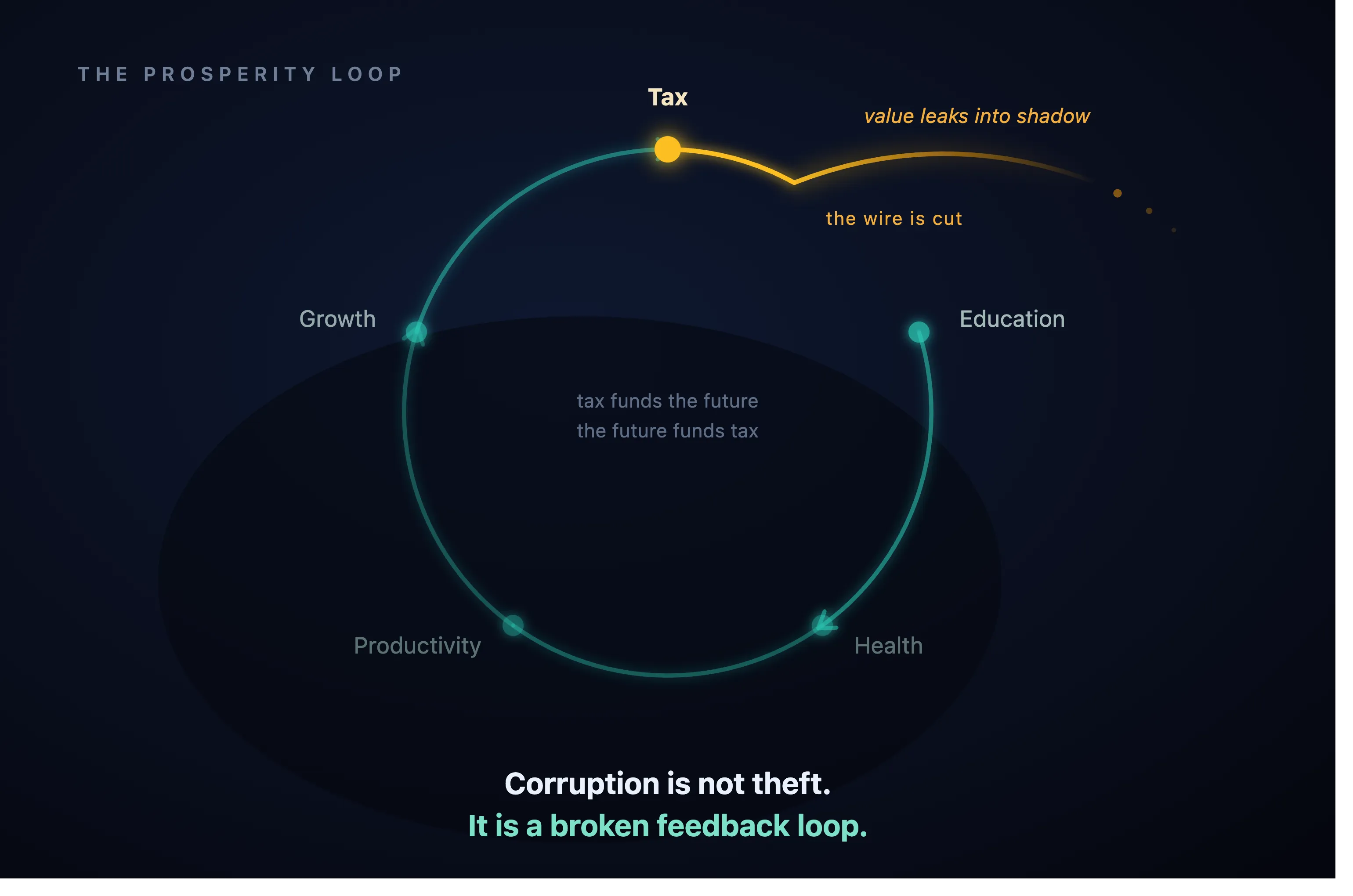
Here is where this stops being a collection of cautionary tales and becomes a single law — the one, I think, that sits beneath a great deal of what I have been writing about.
A system that cannot be corrected cannot learn. And in a world that refuses to stop changing — which is the only world there has ever been — a system that cannot learn is already dying. It simply has not been told yet, because it has removed everyone who could tell it.
This is the thread that runs through every modern failure of organisations I can think of, and through every other piece in this sequence. The architecture that could not be revised because it was designed to a fixed and final target. The strategy that could not adapt because it was written once and handed down rather than instrumented to sense and respond. The hiring machine that rejected the future because it was trained, exhaustively, on the past. The prosperity that never compounded because the loop feeding effort back into the nation had been quietly cut. Pull back far enough and they are all the same story, told at different magnifications: a correcting loop, severed, so that the system could enjoy the comfort of never being contradicted — right up until the comfort killed it.
The cruel joke is that the severed loop feels like strength. No friction, no argument, no awkward meetings, total control. The quietest organisations, the ones where everyone agrees and the leader is never challenged, often look — from the inside, and sometimes from the outside — like the healthiest. They are the most advanced cases of the disease. The silence is not peace. It is the sound of a system that has finished removing everyone who could have saved it.
The Corrected, Not the Virtuous
It would be easy, at this point, to slide into a sermon about good companies and bad ones. I want to resist that, because it is precisely the wrong frame, and an informed reader would see through it in a heartbeat. The companies that manage this well are not morally superior. Many of them are, on plenty of measures, difficult places — demanding, abrasive, imperfect in ways that are well documented. The thing to admire is not their virtue. It is their structure. They are not the good companies. They are the corrected ones, and even that they manage only imperfectly, and never permanently.
Picture a spectrum. At one end, the organisation that has deliberately engineered the correcting voice into its machinery. At the other, the sealed room where dissent has been designed out entirely. Almost every company is somewhere on that line, and — this is the uncomfortable part — most are drifting toward the sealed end, because that is the direction comfort pulls.
At the self-correcting end sit a handful of instructive examples, and I offer them with their warts attached, because the warts are the point. Pixar built a device called the Braintrust — a group of fellow storytellers convened to tell a director, with brutal candour, that the film in front of them is broken. Its single most important rule is that the Braintrust has no authority: it can name the problem but cannot dictate the fix, which is precisely what lets the director hear the criticism without defending against it. It is a beautifully engineered correcting loop — and Pixar is still a company that has had creative droughts and a serious leadership-conduct reckoning. Not a saintly studio. A structurally candid one. Amazon embeds the same instinct in its “disagree and commit” principle — the explicit instruction that you must voice your dissent before the decision is made, then commit fully once it is — alongside the famous six-page memo read in silence, a ritual designed to stop the most senior voice in the room from simply steamrolling the rest. This is the same Amazon with a long record of criticism over how it treats the people in its warehouses. Both things are true. It is not a kind company. It is, on certain decisions, a self-correcting one.
The most instructive example of all is the one that sits at both ends of the spectrum, a decade apart. Under Andy Grove, Intel practised what he called “constructive confrontation” — juniors were not merely permitted but expected to challenge their seniors, and the firm’s survival turned on a moment when it listened to the uncomfortable signal and abandoned the memory business that had defined it for the microprocessor that would make it. Grove wrote a book called Only the Paranoid Survive, which is really a book about keeping the correcting loop open. And then, in the fullness of time, the same company stopped listening. It missed mobile. It missed the shift that AI would bring. The firm that had been the textbook case of corporate self-correction became the textbook case of the sealed room — proof, written across its own history, that the loop is not a personality trait you possess but a discipline you can lose. No one holds it open forever.
At the far, sealed end of the spectrum sit the cautionary giants. I studied Kodak as a case study at Cambridge, and the detail that has never left me is that Kodak did not miss the digital revolution for lack of seeing it. Kodak invented the digital camera, in 1975, inside its own laboratories. The correcting signal was not absent. It was sitting in the building, and the structure could not let it change the decision, because the decision the signal implied — the cannibalisation of a fabulously profitable film business — was the one thing the room had been arranged never to hear. The same shape recurs in the other famous collapses: the engineers who saw the smartphone coming, the executives who watched streaming arrive, the analysts whose memos went unread. These were not stupid companies blind to the future. They were companies in which the future was visible to someone, and the loop that should have carried that someone’s voice to the decision had already been quietly cut. And at the very furthest end lie the genuine pathologies — the firms where dissent was not merely unwelcome but actively punished, where the room was sealed deliberately and the people who tried to speak were removed. Those stories tend to end not in decline but in prosecution.
The lesson of all of them, the survivors and the casualties alike, is humbling rather than triumphant. The strong companies are not better people than the weak ones. They are, for a time, better at keeping the correcting voice in the room. And “for a time” is the whole of it.
This is the same law that runs through everything else worth saying about systems that have to survive a changing world: the work is never finished. Keeping the loop open is not an achievement you unlock and bank. It is a discipline you sustain against the constant, comfortable, gravitational pull toward the quiet room — and the moment you decide you have mastered it is, reliably, the moment you have begun to lose it.
The Tell
If it helps to have a diagnostic, the pattern announces itself at every scale through the same handful of symptoms, and they are worth learning to read — in your country, in your company, and, with rather more courage, in yourself.
When did a fact you did not like last actually change a decision? Not get acknowledged, not get politely noted — actually change it. If you cannot remember, the loop may already be cut.
Who, in the room where the decisions are made, is genuinely free to disagree — and, more to the point, do they still dare? An organisation can keep its dissenters on the payroll long after it has trained them out of dissenting. Their presence is not the point. Their nerve is.
When did you last hire, promote, or befriend someone who could meaningfully challenge you, rather than someone who would comfortably confirm you?
And the master question, the one that subsumes the rest: how does this system respond when it is told it is wrong? Because the health of any system — a state, a company, a marriage, a mind — can be measured with reasonable accuracy by a single quantity. Its tolerance for being contradicted. Everything else is downstream of that.
Engineering the Voice That Disagrees
The good news, and there is some, is that the fix is the same at every scale, and it is not a matter of character. You do not solve this by resolving to be more open-minded, any more than a country solves corruption by urging its officials to be more virtuous. Good intentions are no match for the gravitational pull of comfort. The answer, as it always is in these pieces, is structure — deliberately building the correcting voice back into the system so that it does not depend on anyone’s mood on a given afternoon.
At the level of the company, it means hiring for difference rather than resemblance — treating the candidate who would challenge you not as a risk to be filtered out but as the single most valuable thing you can bring through the door. It means protecting the people whose job is to disagree — the auditor, the red team, the awkward questioner — and giving them genuine independence and genuine teeth, rather than the ceremonial kind. It means rewarding the person who was right and unpopular over the person who was agreeable and wrong, which is harder than it sounds, because the agreeable are so much pleasanter to be around. And it means institutionalising the correcting loop so thoroughly that it keeps working even when the leader, on a bad day, would rather it didn’t.
At the level of the self, it means the same act of deliberate discomfort: keeping at least one person close who is conspicuously not a reflection, and — the hard part — actually listening when they tell you something you would prefer not to hear.
The honest feedback loop, like the honest state, is not a moral luxury affordable only by the secure. It is the mechanism of survival, and the systems that endure are not the ones that achieved the most control. They are the ones that deliberately, structurally, against every comfortable instinct, kept alive their own capacity to be told they were wrong.
Keep Someone in the Room
So the strongman, the struggling chief executive, the manager hiring his own reflection, and the rest of us curating our agreeable little worlds are all, in the end, doing the same thing. Building a room. Removing the mirrors that talk back. Trading the discomfort of correction for the comfort of agreement, and calling the result strength.
It is never strength. It is the first and most decisive move in the long, quiet business of failing — the amputation that precedes the collapse by years, performed so gently that no one quite notices the moment the system lost the ability to save itself.
The most durable nations, the most enduring companies, and the wisest people are not the ones who never erred. They erred constantly; everyone does. They simply never finished building the room. They kept someone in it who was allowed to say the unwelcome sentence, and — rarer and harder still — they kept the capacity to hear it.
Because the skill was never avoiding the mistake.
It was keeping alive the voice that could name it.