Strategy Is Becoming Software
The same strategy now lives across five lenses, five layers, and one adaptive loop. Why the strategy that used to be a noun in a deck is becoming a verb encoded in a system that senses, decides, and learns.
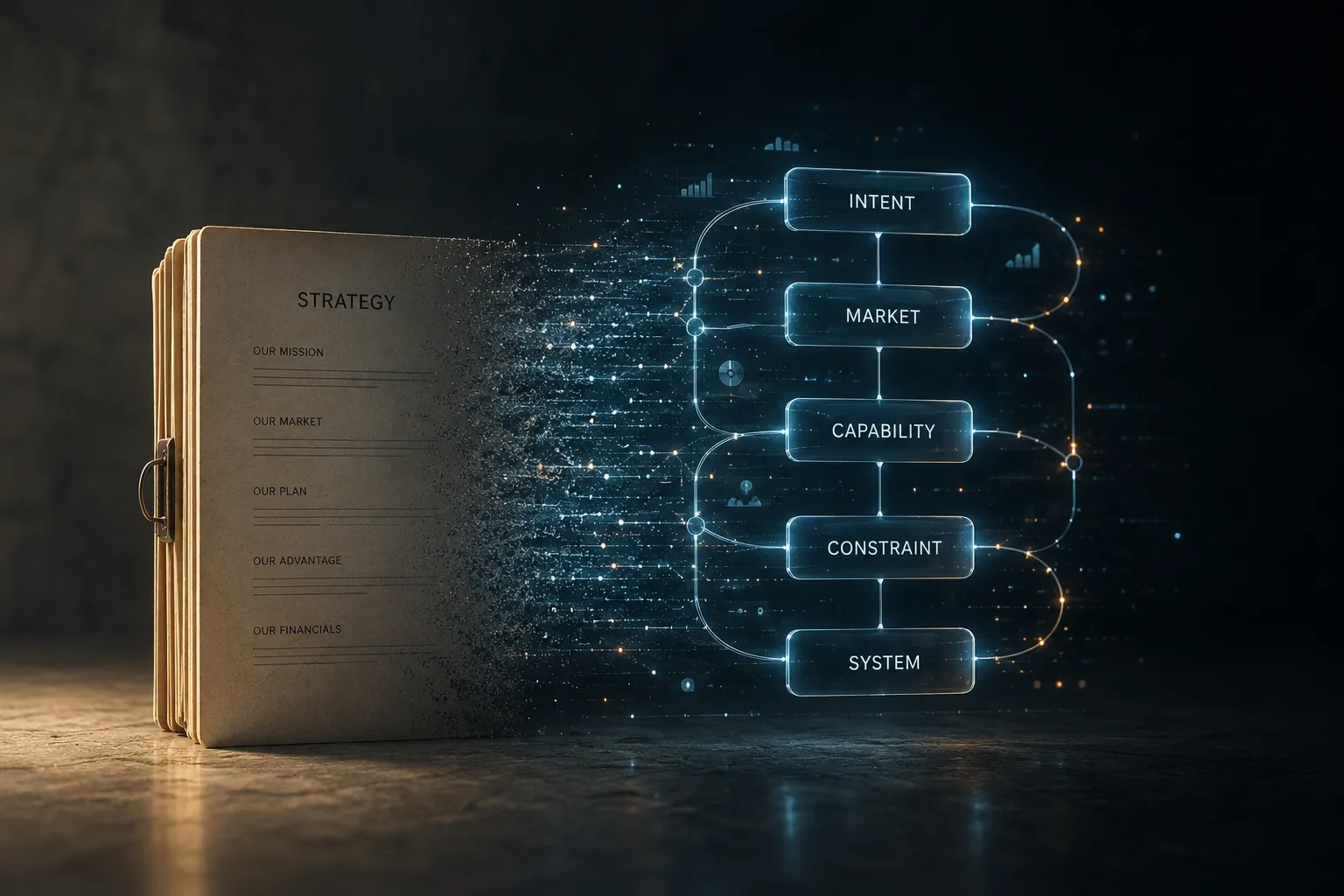
The same strategy now lives across five lenses, five layers, and one adaptive loop.
There is a quiet lie at the centre of how most companies talk about strategy.
The lie is that there is a strategy — a single, settled thing, written down, agreed, owned. A deck. A document. A noun.
Spend any time in the room where strategy is actually made and you discover something different. There is no single strategy. There are five people looking at the same object and each seeing a different, equally true face of it. The CEO sees a destination. The CMO sees a market. The CTO sees what can be built. The CFO sees what it costs and when it pays. And Legal — increasingly — sees what is even permitted to exist.
None of them is wrong. That is the whole problem, and the whole craft. Strategy is not the victory of one of these views over the others. It is the reconciliation of all five — and in the era of AI, that reconciliation is no longer written into a document. It is built into a system.
A strategy that cannot survive contact with finance, law, capability and the market was never a strategy. It was a wish with formatting.
I should say where I am standing, because it shapes what I can see. I have spent my career moving between these seats — as a founder, a CTO, a builder of products, and earlier, at Linklaters, close enough to the legal machinery of large enterprises to learn that the constraint layer is not an afterthought but a design input. I have built a trading platform and a marketing platform that were, in the end, attempts to do the thing this article is about: to take a strategy out of a document and encode it into something that thinks. This is what I learned from trying.
The Five Lenses
Start with the people, because strategy is first an argument between points of view.
The CEO sees intent. Why we exist, where we are going, what we refuse to become. This is the north star — and the CEO’s real job is not to hold the best of the five views but to hold the tension between them, to keep four powerful, partial truths in productive conflict without letting any one of them win outright.
The CMO sees the market. What is wanted. Demand, promise, positioning, the shape of the customer’s desire. This is the outside-in view, and in the AI era it has quietly become a discipline of data and models as much as of message — the CMO now owns a stack, not just a brand.
The CTO sees capability. What is possible. What can actually be built, how fast, with what moat. This is the inside-out view, the supply of capability against the CMO’s pull of demand. Value is created only where these two meet; everything else is preamble.
The CFO sees capital. What it costs, when it pays, in what order it can happen. This is the lens that converts ambition into sequence — and it is the one founders underestimate at their peril. The CFO is gold, and the person you most need on your side, because nothing happens to either engine without them. A brilliant capability and a hungry market are both inert until someone decides they can be afforded, and in what order. The CFO turns “good idea” into “funded idea,” which is the only kind that exists.
Legal sees permission. What you are allowed to do. Data rights, intellectual property, model liability, regulatory exposure, the contracts that bind and the ones that protect. For most of corporate history this lens sat at the end of the process — a sign-off, a gate, the department that said no after everyone else had said yes. That has changed, and AI changed it. When your product is trained on data, generates content, makes decisions, and carries liability for all three, the question of what is permitted shapes what can be built — which means Legal has moved from the back office to the critical path. The constraint is now a design input, not a final inspection. This is the part my time at Linklaters taught me that no architecture course ever could: the cleverest system that is not allowed to exist is worth precisely nothing.
Here is the device worth remembering, because it is where the drama lives. Each lens, left alone, fails in its own characteristic way.
The CTO alone builds what cannot be sold. The CMO alone sells what cannot be built. The CFO alone optimises the company into a careful, profitable stasis. Legal alone de-risks it into irrelevance. And the CEO alone inspires without grounding — a magnificent destination with no road to it. Strategy is the thing that stops any one of these failure modes from winning. It is reconciliation, not conquest.
Why Strategy Dies in Translation
Now watch what happens to a strategy as it travels between these five people.
In the traditional model, the stack is a waterfall. Intent is set at the top. It cascades down: the CEO briefs the market view to the CMO, who briefs requirements to the CTO, who is constrained by the CFO, who is bounded by Legal, who hands something to the people who execute it. A one-way flow, top to bottom, each hand-off a translation, each translation a loss.
By the time the strategy reaches the work, most of it is gone. Not through malice or incompetence, but through the simple physics of translation: every time intent passes from one lens to another, fidelity leaks. The CMO hears the CEO’s intent and renders it as a campaign. The CTO hears the campaign and renders it as a backlog. The thing that is finally built is a translation of a translation of a translation — and it shows.
This is the target-state fallacy in a new costume. A strategy written once and handed down assumes the world will hold still long enough for the cascade to complete. It never does.
It is also why large transformations fail so spectacularly and so expensively. They are the waterfall taken to its extreme — a vast strategy, defined at the top, pushed down through every layer over years, arriving at the bottom as something nobody recognises and the market no longer wants. The leakage is not a bug in the process. It is the process.
The Strategy Stack
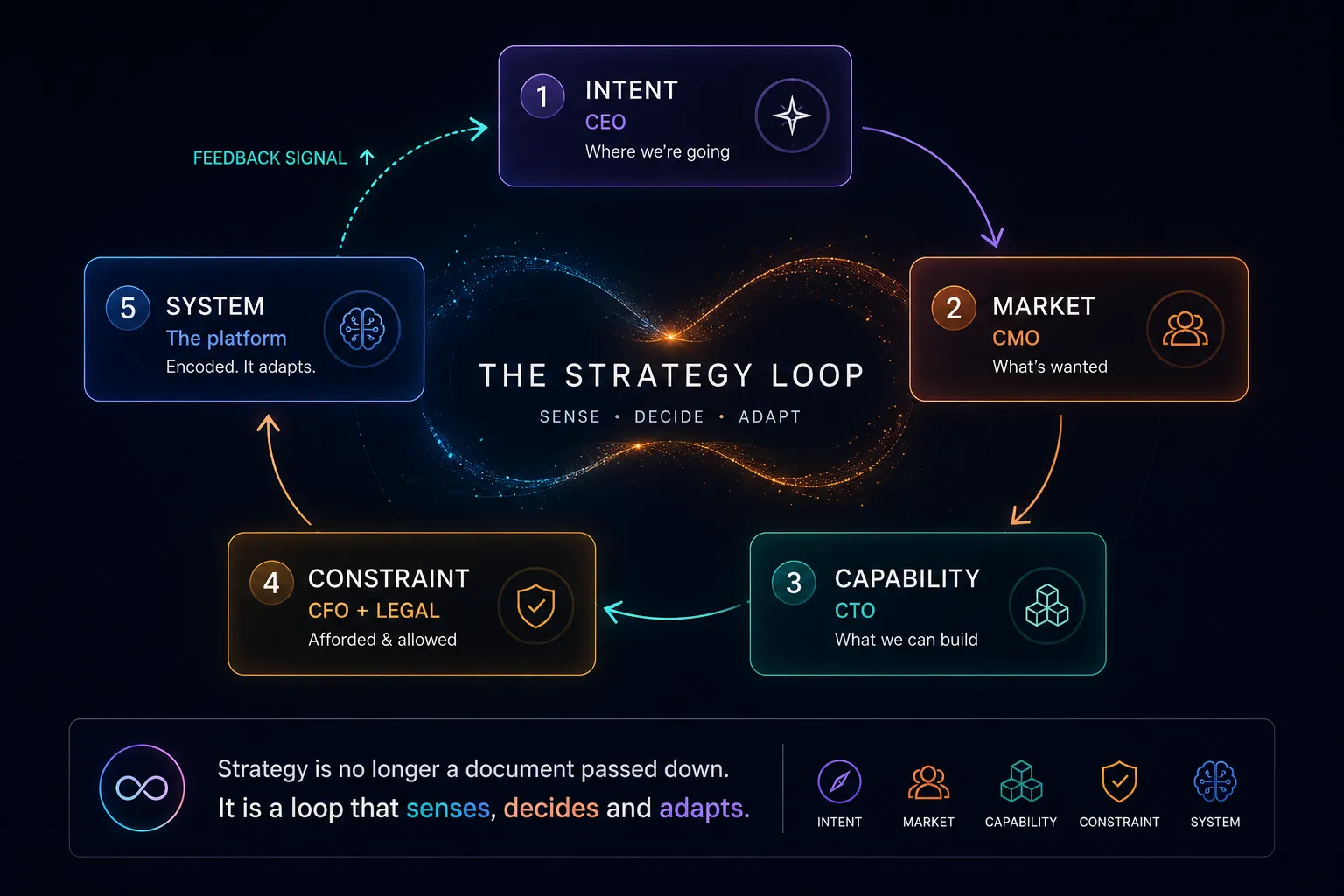
So far the five lenses describe who sees. The deeper structure is where strategy lives as it becomes real — and it resolves into five layers.
Layer one: Intent. The CEO’s north star. The why.
Layer two: Market. The CMO’s demand. Who we serve and what we promise.
Layer three: Capability. The CTO’s supply. What we can build and own.
Layer four: Constraint. The CFO’s capital and Legal’s permission, fused into a single layer — the envelope of the affordable-and-allowed that everything real must fit inside. This is the layer most strategy decks pretend does not exist, and the one against which most strategy quietly dies.
Layer five: System. This is the new one. The layer AI created. The point at which strategy stops being a description of what should happen and becomes a machine that makes it happen — and adapts as conditions change.
The first four layers have always existed. The fifth is the revolution, and it is the reason the title of this piece is not a metaphor.
The New Layer: Strategy Becomes Software
Here is what I mean, concretely, because I have built it.
A trading platform that merely holds a strategy is a document with extra steps. A trading platform that thinks strategically is something else: it encodes the thesis, reads the regime it is operating in, senses when conditions have changed, and re-allocates without waiting for a quarterly review to tell it the world has moved. The strategy is not written on a wall and consulted occasionally. It is running, continuously, in code — sensing, deciding, adapting.
A marketing platform that thinks works the same way. It does not execute a campaign that a human designed six weeks ago and will review in six weeks’ time. It senses demand as it shifts, runs continuous experiments, and moves spend toward what is working faster than any committee could meet to discuss it. The strategy is not a plan that the platform obeys. The strategy is the platform.
This is what “strategy is becoming software” actually means. Not that software supports strategy — it always has. But that strategy itself, the thing that used to be a noun in a document, is becoming a verb encoded in a system: something that senses, decides, and revises in a loop, at a speed and granularity no human cascade can match.
A strategy you have to convene a meeting to change is already out of date. A strategy encoded into a system that senses and adapts is never finished — and never stale.
From Waterfall to Loop
This is the structural shift, and it is the single idea worth carrying out of the whole piece.
The five-layer stack used to be a waterfall — intent flowing down, fidelity leaking at every step, the bottom forever lagging the top. The System layer breaks the waterfall and closes it into a loop. Because a system that senses reality feeds signal back up — straight to Intent. The platform that reads the market is telling the CEO what the market is doing. The product that logs every interaction is telling the CTO what capability matters and the CMO what demand is real. The strategy is no longer written once and pushed down. It is instrumented, and it learns.
In the loop, the layers stop being a hierarchy and become a circuit. Intent shapes the system; the system senses the world; the world’s signal returns to intent; intent adjusts. Strategy stops being a destination you march toward and becomes a position you continuously hold against a moving world — which is the same lesson, arriving once more, that this entire series has circled: in continuous change, the artefact is never the asset. The ability to keep revising it is.
And this relocates the strategist’s leverage entirely. It used to lie in writing the strategy — the insight, the deck, the bet. It now lies in building the system that runs and evolves the strategy. The best strategic act is no longer a brilliant document. It is a well-instrumented loop.
Collapsing the Stack
Which brings us to the rarest advantage in the whole system, and it is not the one people expect.
Founders often have one unfair advantage. Not genius. Not certainty. Not a better strategy than anyone else. Compression. Fewer hand-offs. Less translation loss. A shorter distance between intent and execution — because more of the five lenses live closer together, sometimes in a single head.
Most organisations lose their strategy to the five hand-offs — intent to market to capability to constraint to execution — leaking at each one, because the five lenses sit in five different people who translate imperfectly between each other. The leakage is structural. You cannot meeting your way out of it.
But when enough of those lenses sit close enough together, the leakage can be removed rather than managed. The founder who is also the technologist can hold capability and intent together without translation. Add the builder’s hands and intent becomes the thing customers touch. Add genuine fluency in the constraint layer — the capital sense to sequence it and the legal sense to know what is permitted before you build it — and the distance between what we mean to do and the system that does it collapses to almost nothing.
That is not a case for being a generalist — the earlier pieces in this series were clear that trying to sit in every seat is a trap, not a triumph. It is a claim about a specific, narrow superpower: compression. The ability to shorten the path between intent and system until strategy stops leaking on the way down.
I have spent a career chasing exactly that compression — as a founder and technologist, as a product builder, and, from my time close to the legal machinery at Linklaters, with a respect for the constraint layer that most builders acquire only after it has hurt them. It is why, for me, building a platform and forming a strategy became the same act. The platform is not the implementation of the strategy. The platform is the strategy — encoded, instrumented, and able to learn.
What This Means for You
This is meant to be useful, so here is what to take from it, whichever lens is yours.
If you are the CEO: your job is not to author the strategy and hand it down. It is to hold the five lenses in tension and to insist that the strategy be instrumented — built into systems that feed reality back to you — rather than written once and filed. Stop asking “what is our strategy?” and start asking “what is our strategy sensing, and how fast can it adapt?”
If you are the CMO or CTO: you are the two engines, and your real task is to stop translating across the wall between you and start sharing the loop. Demand and capability are now the same data flywheel — usage trains capability, capability improves the product, the product wins the market, the market generates usage. Build that loop together or watch competitors who do outrun you.
If you are the CFO: you are no longer just funding the strategy — you are sequencing the loop. The shift from build-once to sense-and-adapt changes what you are buying: not a finished asset but a living capability. Budget for the loop, not the launch.
If you are in Legal or risk: move to the front of the build. The constraint layer is now a design input, and the organisations that treat you as an early collaborator rather than a final gate will build faster and safer than the ones who bolt you on at the end.
And if you are a founder: your rarest advantage is the ability to collapse the stack — to hold enough of the lenses in one head that intent becomes system without leaking through five hand-offs. Use it. Build the strategy; do not just write it.
The Strategy You Can No Longer Write Down
So here is where it lands.
For as long as there have been companies, strategy has been a thing you decided and then executed — a noun you wrote down and a long, lossy effort to make the world match the page. Five lenses argued it into being; five layers carried it, leaking, toward the work.
That model is ending, not because strategy stopped mattering but because the world stopped holding still long enough for a written strategy to survive its own descent. In its place is something stranger and more powerful: strategy as a living system, sensing and adapting in a loop, encoded into the platforms that run the business rather than described in the documents that gather dust beside it.
The companies that win the next decade will not be the ones with the best strategy deck. They will be the ones whose strategy is no longer a deck at all — whose intent has been built directly into systems that sense, decide, and learn faster than the world can change around them.
Strategy is becoming software.
Not because software replaces judgement. But because judgement now has to be encoded into systems that can sense, decide and adapt faster than any document ever could.
The strategist’s job is no longer to write the future down.
It is to build the thing that keeps discovering it.