You Cannot Hire the Future Through a Filter Trained on the Past
The hiring pipeline is a machine for converging on the average — and the people who would elevate you are precisely the ones it is built to reject. Why that happens, what it costs, and how to find them anyway.

The hiring pipeline is a machine for converging on the average — and the people who would elevate you are precisely the ones it is built to reject. Here is why, and how to find them anyway.
Let me start by conceding the part that is fair, because the rest of this argument depends on it.
Some filters are legitimate. There are hard, binary facts that genuinely disqualify a candidate, and screening on them is not bias — it is honesty. The right to work in the country. The language fluency the role actually demands. A mandatory licence, certification or clearance. Genuine, non-negotiable presence where the work truly requires it.
These are not the problem. My only plea about them is one of basic courtesy: state them first. At the very top of the advert, in plain language, before anyone invests an hour of hope in an application they were never eligible to make. I have been on the receiving end of the alternative — the hard “no” buried at the bottom, or discovered only at screening, after the time was already spent — and it is a small, avoidable cruelty. A good process front-loads its honest nos.
So: legitimate gates, stated early. Agreed. Now set them aside — because they are not where the machine goes wrong.
Everything that comes after the legitimate gates is where it goes wrong. And it goes wrong in a very particular, very expensive way: it does not lose talent at random. It loses it directionally — systematically rejecting the non-standard excellent while waving through the standard adequate. It is, in effect, a machine for converging on the average. And you cannot build the future out of the average.
First, Let Us Kill the Myth
You have probably heard that 75% of CVs are automatically rejected by software before a human ever sees them. It is the most-quoted figure in the whole conversation, and it is invented. It traces back to a startup that shut down in 2013 and never published a study. There is no source. It is a decade-old marketing line laundered into a fact.
I mention this not to defend the systems but to be the honest voice in a room full of mythology — because the truth is worse than the myth, and it does not need exaggerating. Most applicant tracking systems do not secretly delete you; they rank and sort, and the genuine automatic rejections are usually based on explicit knockout questions a recruiter set, like work authorisation. Which, you will notice, are exactly the legitimate hard gates from a moment ago. The horror story of the rogue robot deleting brilliant people is fiction.
The real story is quieter, more human, and far harder to fix: a chain of reasonable people and reasonable tools, each making a small, sensible compromise, that together produce a system tuned to reject the very people you most need.
The technology was never the villain. I know that partly from a beer garden. Twelve years ago, in my local, I spent an evening with one of the people who had built an early applicant tracking system, and even then, a pint in, he had his reservations. He understood precisely what these systems were good at — sorting volume at a speed no human could match — and precisely what they were quietly bad at: the candidate who did not look like the last one. He saw the trade-off being made long before the rest of us were forced to live inside it. The builders often did. It was everyone downstream, optimising relentlessly for speed, who sanded the doubt away.
The Dilution Cascade
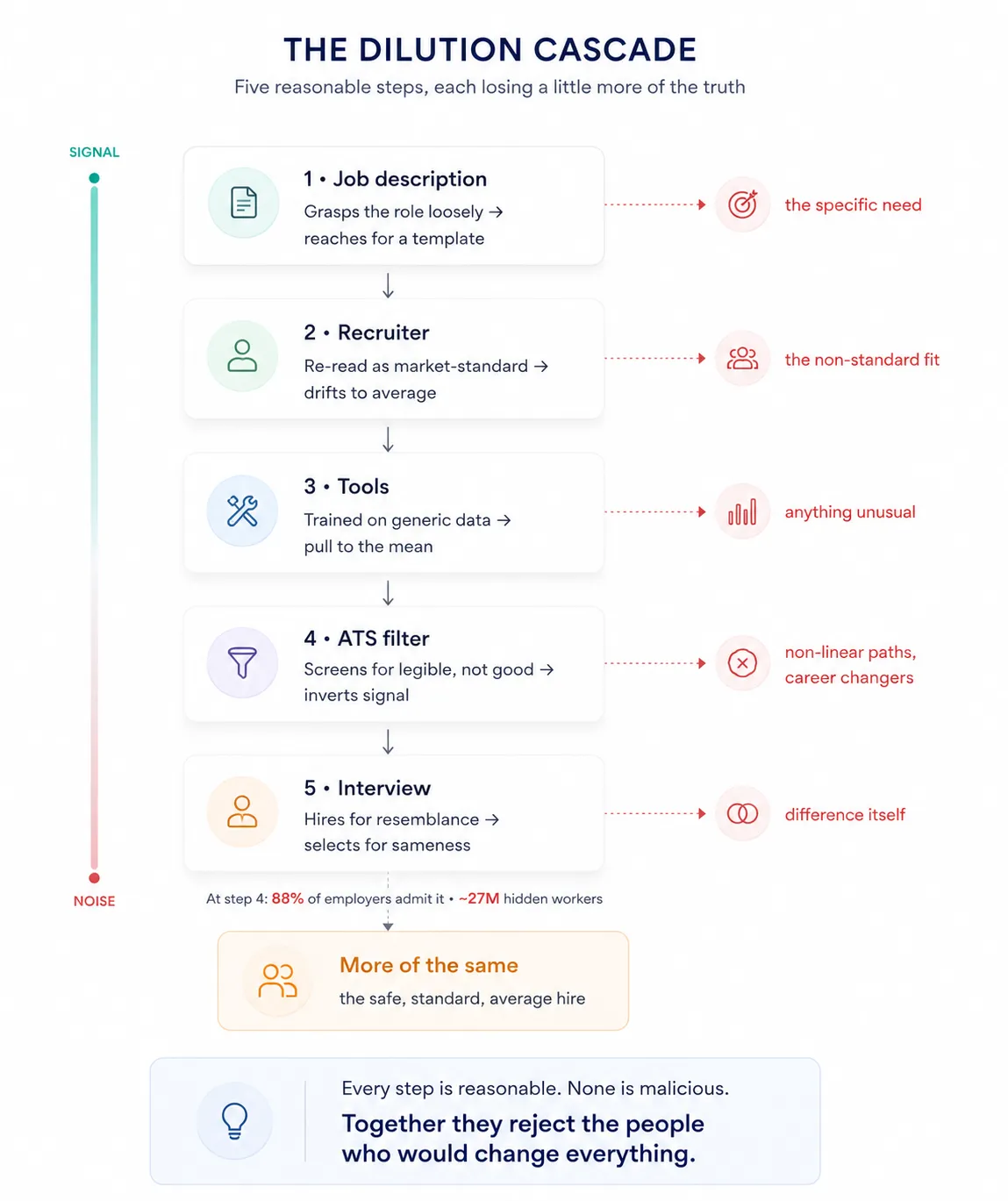
Here is how the signal degrades — not in one catastrophic step, but in five reasonable ones, each losing a little more of the truth.
The job description is written by someone who does not fully understand the role. Especially now, when roles are fracturing and elevating faster than anyone can keep up with. Faced with a fuzzy, specific need, the author reaches for a familiar template to make it “understandable.” The precise, differentiating requirement becomes a generic list of competencies. First loss.
The recruiter re-reads it through what they have seen online. They add their own model of what the role “should” be, drawn from every similar role they have placed and every market-standard JD they have absorbed. The description drifts, gently, toward the average of all roles like it. Second loss.
The tools regress everything to the mean. The JD generators, the keyword optimisers, the platforms promising to find you the perfect candidate — they are trained on a corpus of generic job descriptions and generic CVs, and so they pull everything toward the centre of that corpus. The tools that promise to help you stand out are, structurally, machines for homogenisation. Third loss.
The filter screens for what is legible, not what is good. And this is the worst loss, because it does not merely lose signal — it inverts it. The Harvard Business School and Accenture “Hidden Workers” study, surveying 2,250 employers across the US, UK and Germany, found that 88% of them admitted that qualified, high-skilled candidates were screened out simply because they did not exactly match the job description’s language. For middle-skilled roles, 94%. The same research estimates more than 27 million people in the US alone are “hidden workers” — willing, able, and systematically filtered out. The mechanism is exactly the inversion that matters: the systems reward continuous employment, exact titles, and keyword density, and so they punish non-linear paths, career changers, carers returning to work, and the unusual combinations that make a person genuinely valuable. One analysis of a thousand rejected CVs suggested nearly half the rejections had nothing to do with ability at all — they were formatting, parsing, and arbitrary filter failures — and that systems routinely auto-rank-down a candidate for being a single year short of a stated experience requirement. Fourth loss.
The interviewer hires for resemblance. Whoever survives the filter meets a human who, under time pressure, tends to favour the candidate who reminds them of the last person who worked out — affinity dressed up as culture fit. Even the survivors are selected for sameness. Fifth loss.
By the end of this cascade, the specific, differentiated, elevated person the role actually needed has been translated, averaged, filtered and pattern-matched into someone safe, standard, and just like the last hire. The machine worked perfectly. That is the problem.
The Cost Nobody Can See
Here is the part that ties this to every hard decision a business makes about risk.
Hiring is the one function where everyone optimises the cost they can see and ignores the cost they cannot. The cost of a bad interview — an hour wasted on someone unsuitable — is visible, irritating, and immediately felt. So the entire pipeline is engineered to minimise it: filter hard, filter early, reduce the false positives.
But the cost of a false negative — the brilliant, unusual, elevating candidate who was filtered out before any human saw them — is invisible. You never meet them. You never know what they would have built. The cost is real and often enormous, and it is also completely unmeasured, because you cannot grieve a hire you never knew you missed.
So the machine optimises the cost it can see and is structurally blind to the one that actually matters. It trades away the rare and the exceptional to avoid the mild irritation of the occasional wasted hour. It is the unpriced risk, wearing a lanyard. And the cruelty of it is precise: the more unusual and valuable the candidate, the more certain the filter is to reject them — because their value is, by definition, the part that does not fit the box.
The Accountability Asymmetry
There is a reason this persists even when everyone knows it exists. And it is not stupidity — it is incentive.
Hiring managers are punished for false positives. They are almost never punished for false negatives.
Hire someone who turns out to be poor, and everyone can see the mistake. There is a name attached to it. Meetings are held. Questions are asked. Fail to hire the person who would have transformed the business, and nobody notices at all. The loss is real, but invisible — and invisible losses do not end up on anyone’s review.
So the system learns a simple, rational lesson: avoid visible mistakes. The safest candidate becomes the most attractive candidate — not because they are the best, but because they are the least likely to create accountability. And so the organisation slowly fills with people who can defend the decision to hire them rather than people who can change the trajectory of the company.
The future rarely looks safe. That is why the future so often gets filtered out.
The Doom Loop
If that was the state of play before AI, AI has poured petrol on it.
Adoption is now near-total: a Stanford study following 3.4 million people and four million applications found that around 90% of US employers now use AI screening tools to sort and rank candidates — and, crucially, most rely on the same small handful of third-party vendors. That shared dependence creates something genuinely new and genuinely dangerous: an algorithmic monoculture. The same study found that people applying to multiple roles screened by the same vendor were more likely to be rejected from every single one — about one in ten applicants who sent four applications were rejected everywhere they applied. Not rejected by judgement. Rejected by correlation. The same model, making the same call, everywhere at once.
Then add the arms race. Candidates now use AI to write CVs and cover letters; employers use AI to screen them. The result, as one hiring-platform chief executive put it, is an “AI doom loop” — the first time both sides have been miserable at once. Because when everyone tailors with the same tools against the same job descriptions, the output converges: the applications all start to sound the same, until, in his words, you cannot tell anyone apart. A machine writing to a machine, in the dialect of generic. Signal collapses to noise on both sides.
And the human backstop is thinner than you would hope. By one survey, fewer than a third of companies keep full human oversight on every AI rejection; a meaningful share let the tool reject at any stage with no human review at all. Even where a human is in the loop, they may not help: a University of Washington study found that people shown biased AI recommendations mirrored them — following the machine’s skewed picks around 90% of the time, even when they were capable of recognising the bias. The human in the loop becomes a rubber stamp for the machine’s convergence. Little wonder only 8% of job seekers believe AI screening makes hiring fairer.
Why the Filter Cannot See the Future
Step back, and the deepest flaw comes into focus — the one in the title.
Every part of this machine is built from the past. The JD corpus the tools learned from is yesterday’s roles. The “successful candidate” profile is your last decade of hires. The ATS rules encode the careers that already happened. The whole apparatus is a faithful, high-speed reproduction of the organisation you used to be.
But the entire argument of the moment — the fracturing of roles, the rise of judgement over output, the shift from credential to capability, the need to elevate teams rather than replicate them — is that the talent you now need has changed shape. You are trying to hire the future. And you are running every candidate through a filter trained, exhaustively, on the past.
This is the same thread that runs through everything else I have been writing in the journal section of my pages. The Future Has No Target State argued that architecture can no longer be designed to a fixed end-point; The CTO Is the First Executive Role to Break traced how a single leadership role is fracturing across systems; Strategy Is Becoming Software showed strategy itself turning from a document into a living, adapting loop. Each is a version of one law: inherited structures, built to be finished, fail under continuous change. Hiring is simply the most personal instance of it — a structure built to reproduce the past, straining against a present that has already moved. It is exactly the kind of problem the more thoughtful labs are now beginning to turn their attention to: not how to filter faster, but how to find differently.
You have built a precision machine to reject your own future. Because the people who would elevate you are, by definition, the ones who do not match a profile built from people who came before them. If they fit the old filter, they would not be the elevation.
That is not a flaw you can tune away. It is the nature of the thing.
A filter trained on the past will always, faithfully, return more of the past.
So How Do You Actually Find These People?
Here is where I want to change gear, because diagnosis without a way forward is just complaint — and there is a way forward. If the inbound funnel is a filter that converges on the average, then the answer is not to tune the filter. It is to stop relying on it as your primary source at all.
The shift is from filtering to finding. A funnel is subtractive — it starts with everyone and removes. Finding is additive — it starts with no one and seeks. The best people you will ever hire are very often not in your funnel, because the genuinely excellent are usually employed, not desperate, and not spraying applications into portals. You do not filter your way to them. You go and find them.
Source, do not post-and-pray. Treat LinkedIn and its like not as a place to advertise and wait, but as a search engine for evidence of the work. Hunt for the thing people have actually built, shipped, written or spoken about — not the title they hold. Read how someone reasons in public; that tells you more than any CV bullet. Reach the people who are not applying, because the ones worth most rarely are. This is outbound, deliberate, one-at-a-time courtship — the opposite of the funnel, and it scales worse, which is exactly why it works: it forces you to look at people as individuals rather than rows.
Follow the public record of how people think. Open-source contributions, side projects, essays, talks, the answers someone gives in a community. This is demonstrated capability rather than claimed credential — the actual work, visible, ungameable by a keyword optimiser. The person who builds in public has handed you a richer signal than any application form was ever going to capture.
Go where people do the work, not where they apply for it. Hackathons, build weekends, meetups, and the small “think-and-build” gatherings where people make things together in a room. You learn more watching someone reason through a problem for two hours than from any number of structured interviews, because you see judgement under real conditions rather than rehearsed answers. Demonstrated beats described, every time.
Use proximity and serendipity on purpose. The casual meetup. The conference corridor. The introduction over coffee — or, as it happens, the beer garden. These are not soft alternatives to “real” recruiting; they are how a startling amount of the best hiring has always actually happened, because they let you see a person think in the wild, unfiltered and unperformed. Engineer more of these into your life and your team’s, deliberately, rather than leaving them to chance.
Mine trusted judgement — but guard against the echo. The strongest single signal is still a specific, credible person saying “this one is exceptional, and here is precisely why.” But referrals carry a trap that is the very disease this article is about: your network is itself a filter, and a network that only ever refers people like itself rebuilds the monoculture by hand. So lean on referrals for judgement — the texture a filter cannot capture — while consciously reaching beyond your own circle for difference.
Treasure the great headhunter — they are the thesis made human. A genuinely good headhunter is worth their weight in gold, and the reason is everything this article has been about. The best ones do not run a funnel; they hold a map. They understand the role deeply enough to know which signals are real and which are noise, they can tell a proxy from a true requirement, and they go and find the person rather than waiting to filter them. They are search over subtraction, performed by a human who actually gets it — and that craft is rare, hard-won, and worth paying handsomely for.
It is worth being honest that this is a different job from the volume game some recruitment runs on, and the difference is not the person — it is the incentive. When a comp plan rewards speed-to-fill and the fee that comes with it, it quietly trains anyone toward the template that converts fastest, and the template is the average. The great headhunter has either escaped that incentive or refuses to serve it, and does the slower, deeper work of understanding before searching. So the move is not to be cynical about recruiters — it is to recognise and reward the ones doing the real craft, and to fix the incentives that push good people toward the fast, generic result. Pay for understanding, not for throughput, and you will get more of it.
Point AI at finding, not rejecting. This is the constructive turn, because the same technology breaking the funnel can rebuild it — if you aim it the other way. Used as a rejection tool, AI narrows the field to keyword-matches and reproduces the past. Used as a discovery tool, it can do something the old funnel never could: surface the non-obvious but genuinely relevant — the person whose unusual background maps onto your need in a way no human had the time to spot. There is an encouraging early signal here: in one field experiment, candidates who went through an AI-led interview screen had a 53% success rate in subsequent human interviews, against just 29% for those screened the traditional CV way — suggesting that when AI is used to find capability rather than to filter credentials, it can widen the aperture rather than narrow it. Same tool. Opposite intent. Entirely different result.
And If You Must Use the Funnel
Most organisations cannot abandon the inbound pipeline entirely, so here is how to stop it quietly rejecting your future.
State your real gates first, honestly, at the top — and stop dressing your preferences up as gates. “Five years of experience” and “this exact title” are not hard requirements; they are proxies, and bad ones. Treat them as soft signals, not knockouts.
Optimise for the false negative, not just the false positive. Once a quarter, have a human actually read a sample of the rejected pile. The cost you cannot see is the only one worth auditing.
Interview for difference and judgement, not resemblance. The question is not “does this person remind me of the last good hire?” but “can this person do something the last good hire could not?”
And shorten the chain. The dilution cascade is a series of lossy hand-offs between people who each understand the role a little less. The single most powerful fix is to keep the person who actually understands the role close to the funnel — writing the real requirement, reading the real applications — instead of delegating it down through five translations until the signal is gone. Compress the distance between the need and the search, and the leakage falls away.
But there is a hopeful trap hiding inside that fix, and it is worth naming kindly. Putting the role-owner back in the loop only helps if they bring the thing the machine cannot. The hope is that they carry the deep, specific understanding the cascade keeps losing. The risk — and it is a gentle, human one — is that they reach for the same shortcut everyone upstream did, open a chat window, ask it to draft a job description for a senior whoever, and accept the confident, fluent, beautifully-formatted result as if the thinking were done. It feels like progress. It often is not. Generic that reads like insight is the hardest kind to catch.
A human in the loop is only worth it if they add the signal a tool cannot. Presence is not the same as judgement.
This is not a criticism of anyone reaching for AI — it is the single best drafting partner most of us have ever had. It is an observation about how to use it well. AI is a superb amplifier of whatever understanding you bring to it: point it through deep knowledge of the role and it sharpens and accelerates you; point it through a vague brief and it returns a polished average at speed. The same tool widens the gap between the person who understands the role and the person who does not. So the role-owner’s job in the loop is the irreducibly human part — naming the specific, differentiated, hard-to-articulate thing the role actually needs — and then letting the tool amplify that, rather than asking the tool to do the understanding for them. Used that way, the human and the machine each do what they are best at, and the chain gets shorter and stronger at once.
Stop Filtering. Start Finding.
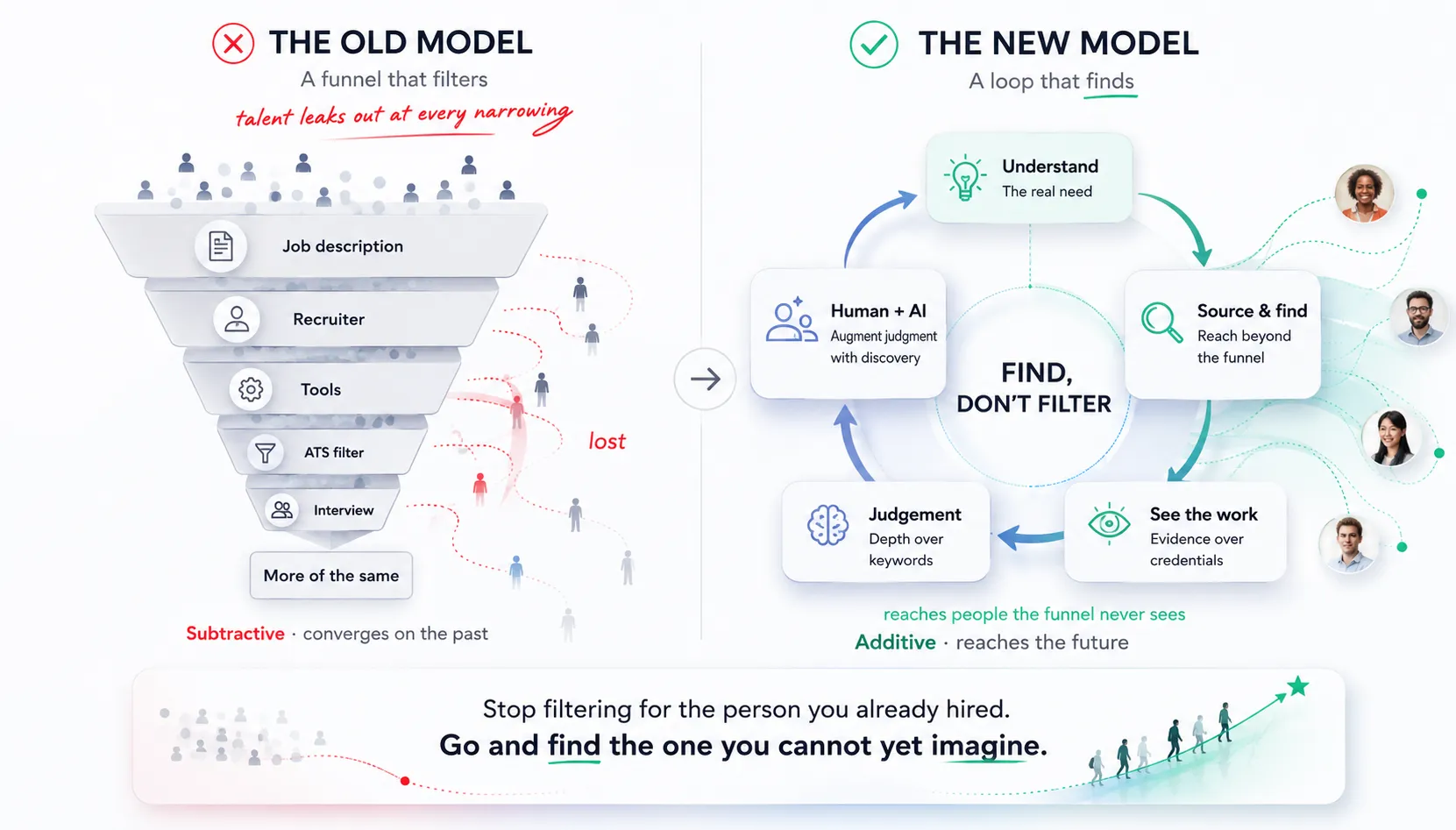
The hiring pipeline most companies run is a beautiful, efficient, high-speed machine for becoming more like they already are. It converges on the average, rejects the unusual, mirrors its own past, and now does all of it at the scale and speed of AI — a monoculture talking to a monoculture in the language of generic.
None of that is malice. It is the accumulated weight of a hundred reasonable compromises, each made to save a little time, that together reject the people who would have changed everything. The builders saw it coming. We optimised the doubt away.
You cannot hire the future through a filter trained on the past. The future does not match your profile, does not use your keywords, and very often is not in your funnel at all.
The people who change companies rarely look like the people who maintain them.
So stop filtering for the person you already hired.
Go and find the one you cannot yet imagine.
From argument to tool
An essay can name the problem; it cannot run the process. So I built the process. hiring-team is an open Claude Agent Skill — a structured, adversarial harness that puts this whole argument to work on a real hiring call: it ranks demonstrated work above claimed credentials, red-teams the decision before it is made, states its hard gates first, and is built to find candidates rather than filter them. It is free, forkable, and yours to trim to your own roles and evidence rules. The repo is here: github.com/thejustinjames/ClaudeSkills.
If you want the short version — the thesis of this essay distilled into a one-page operating guide, typeset as a designed PDF — here it is.