The Diligence That Isn't in the Data Room
Most investments don't fail for the reasons the post-mortem records. The money runs out last — and by the time it does, the thing that actually went wrong was visible months earlier, to anyone who knew where to look.

Most investments don’t fail for the reasons the post-mortem records. The money runs out last — and by the time it does, the thing that actually went wrong was visible months earlier, to anyone who knew where to look.
A friend of mine was given a six-figure cheque to build his business, and then left to it.
He is one of the finest engineers I know. Give him a hard technical problem and he will return something elegant, robust, and quietly brilliant. What he is not — and he would say this himself now — is a businessman. He needed complementing, not just funding. He needed someone beside him who could read a market, hold a scope, and say not that, not yet — and that person never arrived. The money did. The judgement did not.
You can guess the shape of what followed, because it is the most ordinary tragedy in the whole of early-stage investing. Scope crept, because every engineer’s instinct is to build the more interesting thing rather than the necessary one. Purchases were made that a more commercial eye would have queried. And while he was heads-down perfecting the product, the market he was building for shifted under his feet, unnoticed, because no one whose job it was to watch the market was watching. By the time anyone realised — by the time the people who had written the cheque looked up and saw the drift — it was too little, too late. The money had run out.
And here is the line on the eventual post-mortem, the cause of death recorded in the file: ran out of cash.
True. And almost completely beside the point.
Because the cash was not the cause. The cash was the symptom — the final, visible event at the end of a long chain of invisible ones. He did not fail because the money ran out. The money ran out because of everything that had been quietly going wrong for months: the scope no one held, the market no one watched, the complementary judgement no one supplied. The bank balance was simply the last domino, and the only one anyone bothered to write down.
This is not a story about one engineer. It is the most common story in investing — and it is almost never the story the data room would have told you.
The Layer Nobody Prices
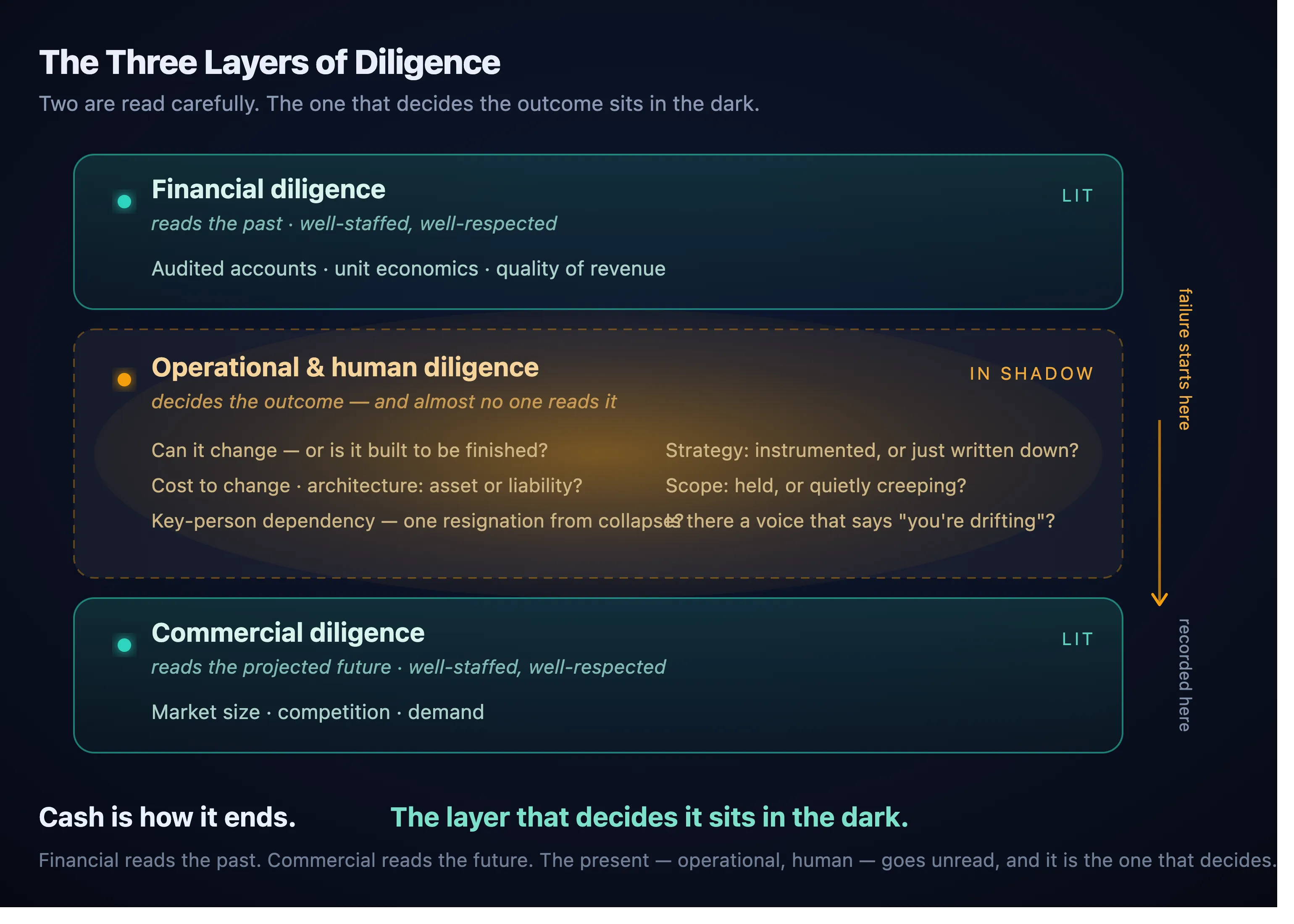
Investing has two well-staffed, well-respected forms of diligence, and a third that decides the outcome and that almost nobody reads.
Financial diligence reads the numbers — the historical accounts, the unit economics, the quality of revenue. It is rigorous and necessary, and it is a record of the past. Commercial diligence reads the market — the size of the opportunity, the competitive landscape, the demand. Also rigorous, also necessary, and largely a story about a projected future. Between the audited past and the projected future sits the thing that actually determines which way the investment goes: the present, operational, human reality of the company. Can it build? Can it adapt? Will it hold its scope, watch its market, and survive the departure of any one person? And almost no one reads that layer, for the simple reason that almost no one on the cap table can.
The failure data makes the blind spot impossible to ignore once you have seen it. The comforting fiction first: the famous “90% of startups fail” figure is a myth, inflated and misapplied. The sober reality is that roughly half of all startups close within five years and around two-thirds within ten. Still brutal odds — and the interesting question is not the rate but the cause.
And the recorded causes are a masterclass in misdiagnosis. Across hundreds of recent shutdowns of venture-backed companies, “ran out of capital” tops the list at around 70%. But — exactly as with my friend — that is where the story ends, not why it began. Look underneath and the real killers appear: poor product-market fit in some 43% of cases, bad timing in 29%, unsustainable unit economics in around a fifth, and team issues in roughly a quarter. Running out of money is the autopsy’s lazy headline. The disease was always upstream — in the market read, the execution, the people, the judgement. There is a reason the oldest cliché in venture capital is that investors back founders, not companies. The trouble is that backing a founder and reading a founder are not the same act, and most diligence does a great deal of the former and almost none of the latter.
Cash is how an investment dies. It is almost never why. The why is visible months earlier — in a layer that financial and commercial diligence are not built to see.
The Same Pattern, Every Time
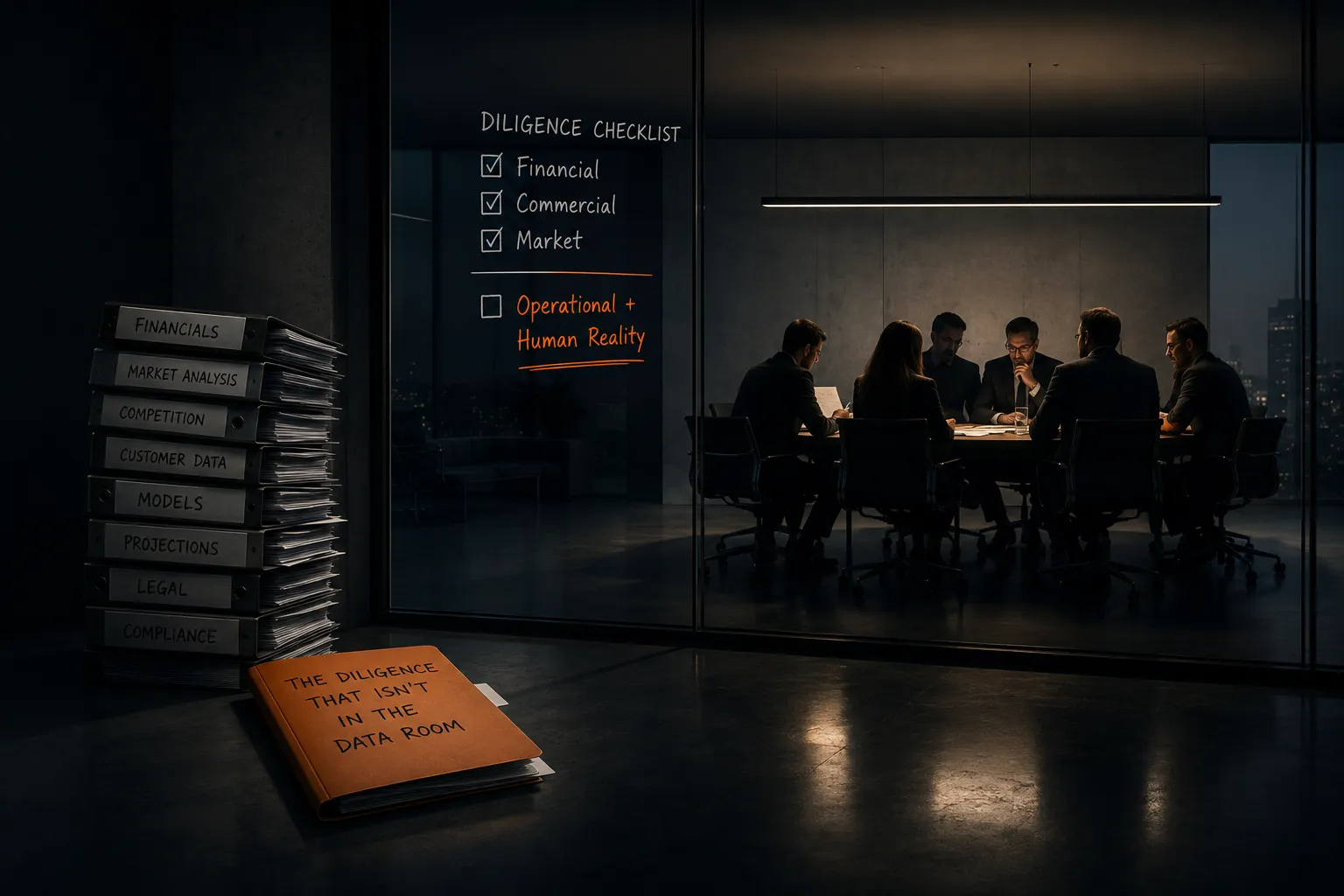
The thing that makes this layer readable — and this is the part that turns diligence from art into something more like a discipline — is that the failures are not a grab-bag of bad luck. They rhyme. They are, very often, the same structural failure wearing different costumes.
A company that cannot adapt as fast as its market moves. A company built to a finished specification it will one day have to rip out and rebuild at catastrophic cost, because nobody asked whether it was built to change. A company that is, in truth, one key person away from collapse — where a single departure takes the entire capability with it, and no diligence ever counted the dependency because it does not appear on a balance sheet. A company whose strategy is a document that was written once and filed, rather than a living thing that senses the market and adapts. A company, like my friend’s, that has no internal voice able to say you are drifting — that took the money and, with it, lost the very correction it most needed.
These are not separate diseases. They are one disease: a severed feedback loop. A company that has lost, or never had, the capacity to be corrected — by its market, by its own people, by anyone — and is therefore flying on instruments it cannot read toward a wall it cannot see. And the crucial point for an investor is this: that failure is legible early, long before it reaches the financials, if you know what you are looking at. By the time it is in the numbers, the company is already dying; it simply has not finished. The whole value of reading the operational layer is that it is a leading indicator, where the financials are a lagging one. You are trying to see the drift while there is still time to correct it — or to decline.
The Closed Circle That Hides It
So why, if this layer is so decisive, does so much capital fly blind through it? Partly because the people who can read it are rare. But mostly because of how the industry is built — and here the honest diagnosis is uncomfortable.
Consider the spectrum of who is actually deploying capital. At one end, the solo angel or direct investor — often doing it for the interest and the thrill as much as the return — with sharp instincts, a good network, and no operating bench at all behind them. In the middle, the family office: patient, capital-rich, increasingly investing directly rather than through funds, and — as the industry itself now openly acknowledges — frequently lacking senior leaders with deep direct-investing experience, so that deal evaluation skews toward surface-level financials and diligence misses the operational risks an experienced operator would catch on sight. The gap between family-office and institutional performance, the advisers themselves admit, often comes down precisely to this operational-infrastructure deficit. And at the far end, the institutional PE or VC firm with the operating partners and the value-creation teams — better resourced, certainly, yet still routinely under-weighting technical and organisational diligence, and still prone to the oldest trap of all: developing the deal narrative early and then shaping the diligence to confirm it. A severed correcting loop, operating inside the diligence process itself.
What unites all three tiers is the deeper structural problem — the circles are tight, closed, and hard to enter. Deals move on warm introductions and pattern-matching to founders who resemble the last winner. It is an efficient machine for sourcing the familiar, and a blind one for everything else. It optimises for the legible surface signals — the pedigree, the polish, the proximity to the network — at precisely the moment it should be reading the underlying ones that actually predict the outcome. It is, if you have read the rest of this series, the hiring-filter problem at the level of capital: a closed loop that converges on what it already knows and screens out the differentiated, both the differentiated company and the differentiated judgement that might have caught what the spreadsheet missed.
The closed circle does not merely keep good founders out. It keeps good seeing out. And the investor pays for that twice — once in the deals they wrongly decline, and once, far more expensively, in the ones they wrongly accept because no one in the room could read the layer where the answer was written.
What to Actually Do
The fix is the same one that runs through everything I have written about systems that must survive a changing world: do not trust the filter to see what the filter was never built to see. Read the layer underneath, deliberately, before you wire the money.
In practice that means treating technical and organisational diligence with the same seriousness as the financial and commercial kind — not as a box-ticking annex, but as the workstream most likely to change the decision. It means asking the questions that never appear in a data room. Is this built to change, or built to be finished? Is the architecture an asset, or a liability with a pleasant user interface and a rising cost to alter? Who is this company one resignation away from losing? Is the strategy instrumented and adaptive, or merely written down? And — my friend’s question, the one that haunts me most — what does this founder lack, and is anyone supplying it, or have we mistaken writing a cheque for building a company?
And it means sampling beyond the closed circle on purpose — treating the differentiated, the non-obvious, the founder who does not resemble the last winner not as a risk to be filtered out but as the place the best, least-contested returns are most likely to hide.
The Question Worth Asking
My friend’s company did not have to fail. The capital was there; the market was real; the engineer was, and is, exceptional. What was missing was never money. It was the one thing money cannot buy and the data room does not contain: someone beside him who could read the part of the business he could not, and who would have said, early enough to matter, you are drifting.
He needed complementing, not just funding. Most companies that fail did. And the tragedy of how capital is so often deployed is that it arrives generously and then leaves the recipient alone — funding the build while starving the judgement, and calling the eventual collapse a money problem when the money was the last thing to go wrong, not the first.
So here is the question I would leave with anyone deploying capital, whoever they are and however they do it — the one worth turning over on the way to the next meeting, or somewhere between the coffee and the kite.
What is the single most important thing about a company you are about to back — the thing that will actually decide whether it works — and who, on your side of the table, can genuinely see it?
If the honest answer is no one — that is not a small gap. That is the gap.