Under This Pressure, Under This Weight, We Are Diamonds
Most companies don't fail because they meet pressure — they fail because pressure reveals the absence of structure. The real geology of diamonds, four lessons it holds for founders, builders and investors, and why cheap memory infrastructure is really just more runway in disguise.
Nobody tells you, when you start out, quite how much of this business — founding, building, investing, any of it — turns out to be the management of pressure. Not the pitch deck. Not the product. Not even, if I am honest, the people, charming and maddening as they are. Just pressure: the sort that sits on the sternum at two in the morning when the runway arithmetic refuses to behave; the sort that creeps into a founder’s voice on a call when they are trying very hard to sound calm about a number that is not, in any sense, calm; the sort an investor carries about with them quietly, writing cheques into the fog and hoping their judgement holds up against time and a market that has never once cared about anybody’s conviction.
But here is the thesis, stated plainly before I let myself wander: most companies do not fail because they encounter pressure. They fail because pressure reveals the absence of structure. Everything that follows is really just an attempt to justify that one sentence with better science than it usually gets.
We don’t discuss this nearly enough. So let us discuss it — and, since I promised you something useful, let us also get the science right, because the metaphor everyone reaches for here is better, stranger, and more instructive than the greetings-card version usually allows.
The carbon was never going anywhere nice on its own
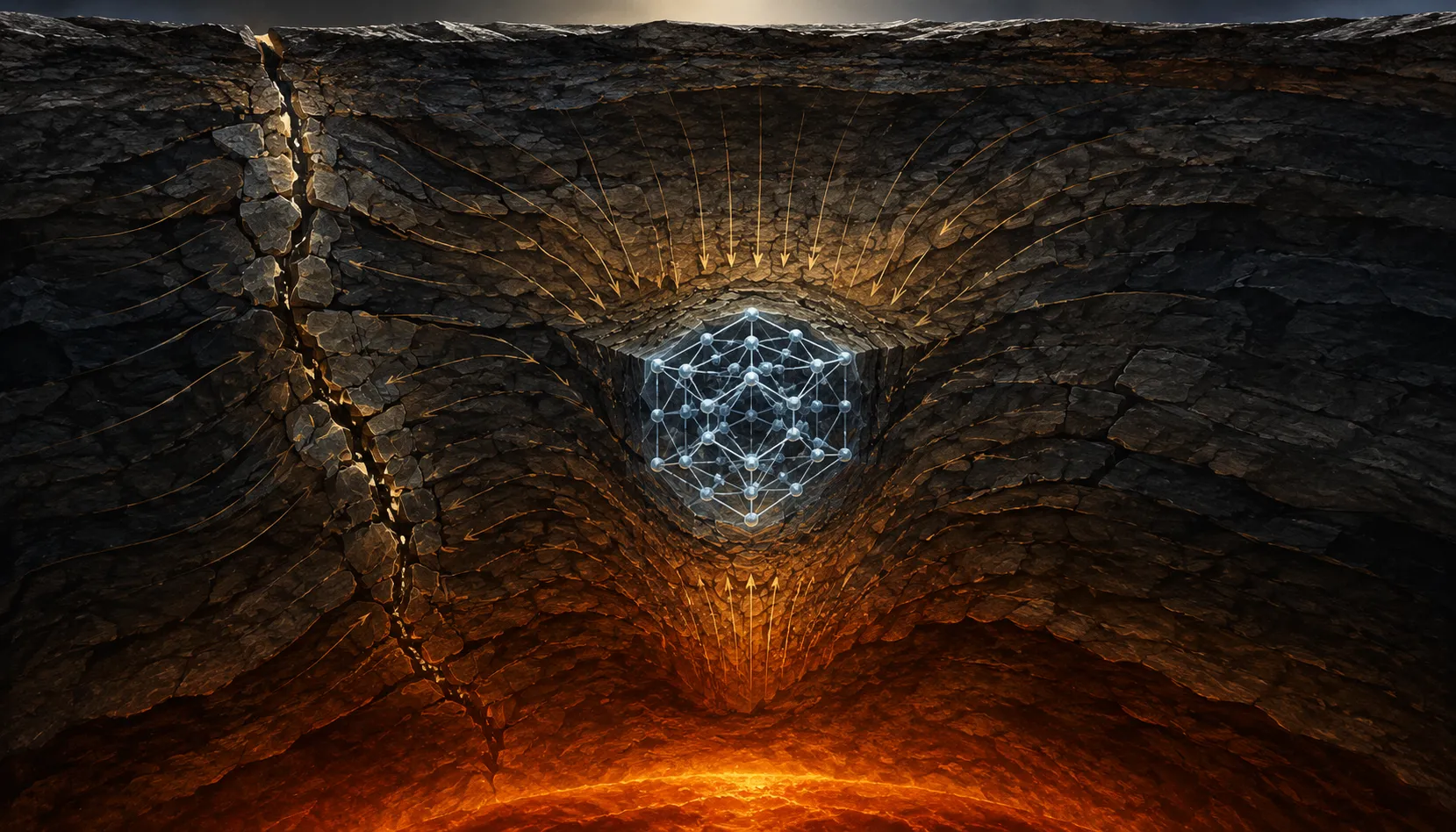
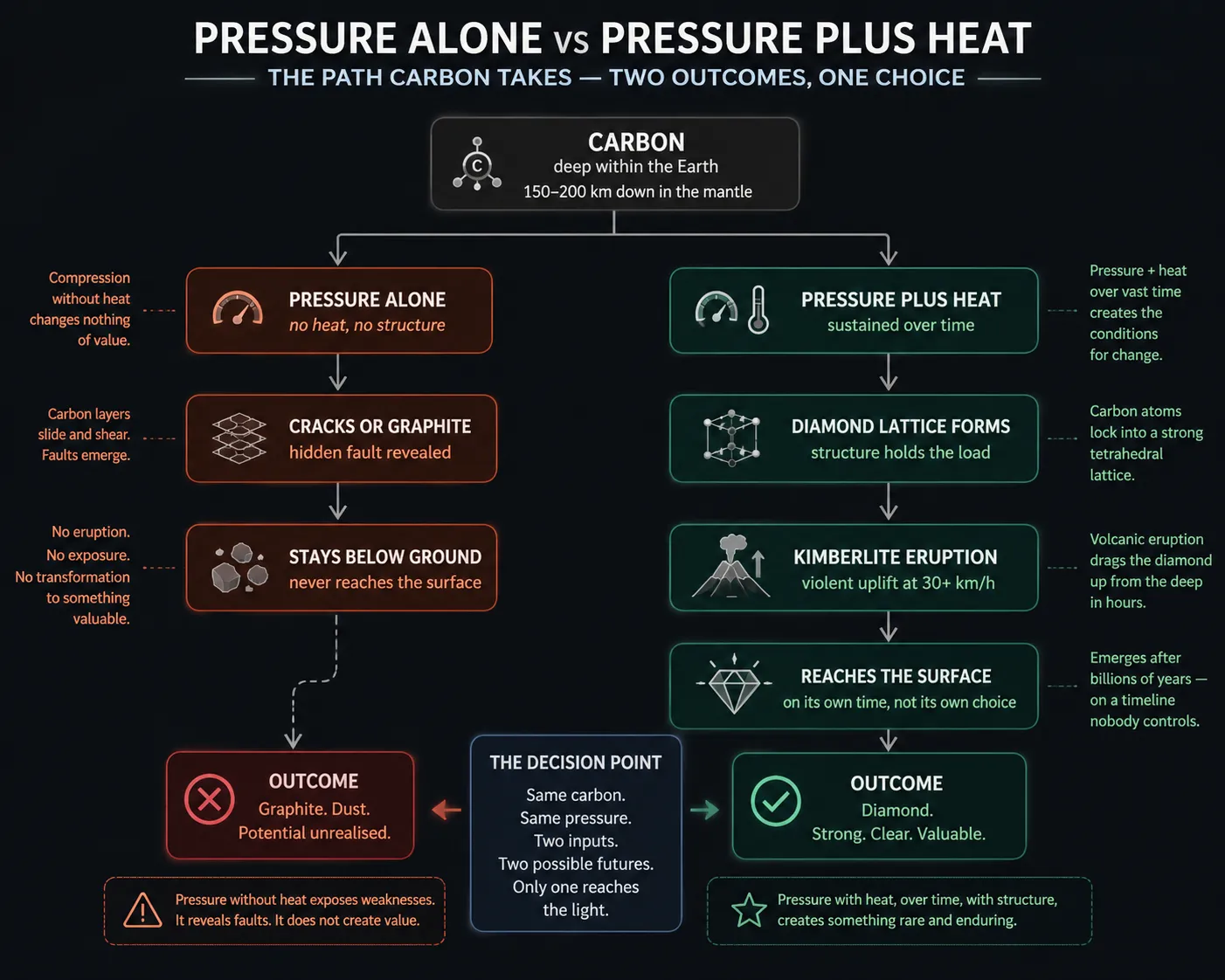
Here is the bit people skip: a diamond is not merely “carbon under pressure.” That’s the executive summary, and like most executive summaries it flattens the interesting part. What actually happens is this — carbon, buried some 150 to 200 kilometres down in the Earth’s mantle, is subjected to both enormous pressure (around 5 gigapascals, if you like your numbers precise, which is to say roughly 50,000 times atmospheric pressure) and searing heat, on the order of 1,000 to 1,400°C. Pressure alone, without that heat, just compacts carbon into something duller — graphite, say, which is the same element wearing entirely the wrong outfit. It is the combination, sustained over geological time — sometimes over a billion years — that persuades carbon atoms to arrange themselves into that famously rigid tetrahedral lattice, each atom bonded to four neighbours, which is what actually makes a diamond hard, clear, and structurally almost stubborn.
And then — this is the part I find genuinely moving, in a piece of rock — the diamond does nothing at all for aeons. It sits there, finished, invisible, doing no one any good whatsoever, until a volatile volcanic eruption called a kimberlite pipe blasts it violently upward at speeds that can exceed 30 kilometres an hour, dragging it from the crushing dark to daylight in a matter of hours. The diamond does not travel to the surface. It is erupted there, practically against its will, by forces entirely outside its control.
I tell you this not to be tediously pedantic (though I concede the risk), but because the accurate version is more useful than the tidy one. It tells us four true things the soft version leaves out.
Four things geology can teach a spreadsheet
One: heat matters as much as pressure. Compression alone produces graphite — soft, flaky, forgettable. It is heat, sustained alongside the pressure, that produces the lattice. Translate that back: the crushing weight of a hard quarter is not, by itself, forming anyone into anything. It’s the combination of pressure plus something generative — real feedback, real reckoning, real change in how the thing is run — that does the forming. Pressure without that heat just produces exhausted people who are technically still compressed and have nothing to show for it.
Two: the lattice has to already be carbon. Diamonds and graphite are made of exactly the same element. The outcome was never about the substance being special; it was about what structure that substance was allowed to hold under load. This is, I think, rather more comforting than the mythology of “special people rise to pressure.” You are not being tested for some rare essential diamond-ness you either have or lack. You are carbon, like everyone else under pressure. What differs is the lattice — the operating rhythm, the craft discipline, the written thesis — that holds your shape while the heat and weight do their work.
Three: nobody erupts themselves. This is the one I actually want you to remember. The diamond does not decide, after its billion years, that it’s ready now, thank you, and stroll to the surface. It is thrown there by something bigger than itself, at a moment it does not choose, at a violence it does not control. Which is to say: you do not get to schedule your own vindication. The down round ends, or the product finally clicks, or the fund returns — on a timeline that is not yours, triggered by forces you don’t run. Your job, the only job actually available to you, is to be carbon organised properly when the kimberlite finally arrives. Not to will the eruption. To be ready for it.
Four: pressure reveals existing faults. This is the lesson the tidy version of the metaphor conveniently leaves out, and it is the one that matters most, so let us not skip it. Not everything under pressure becomes a diamond. Some things crack.
Geologists know this better than anyone: stress does not only create, it also exposes. A fault line that sat hidden and harmless in stable rock for millennia becomes visible — often catastrophically — the moment real load is applied. The rock was never as sound as it looked. The pressure didn’t put the fault there. It simply found it.
Organisations are much the same, and this is where the metaphor stops being decorative and starts being genuinely diagnostic. Pressure reveals the conversation nobody wanted to have. The dependency everyone quietly knew about and nobody scheduled time to fix. The founder doing three jobs because the third hire never happened. The investor holding a conviction they believed sincerely but never actually wrote down, and so cannot now defend to themselves. The culture that worked beautifully when revenue was easy and mysteriously stopped working the first quarter it wasn’t.
This is uncomfortable, but it is also the useful part, so I won’t soften it: pressure is less often a creator than a revealer. It rarely introduces a weakness that wasn’t there. It simply removes the ambiguity about whether it was. The lattice, in other words, isn’t only what turns carbon into diamond — it’s the thing whose absence turns rock into rubble, on exactly the same day, under exactly the same load.
What the lattice actually is, for you specifically
For founders: your lattice is your operating rhythm — the weekly review you don’t skip, the metric you check even when it hurts, how you talk to your team on the bad days rather than only the good ones. Build it before the pressure arrives, the way the mantle doesn’t wait for the carbon’s permission to apply heat.
For the people actually building the thing — engineers, designers, the craftspeople — your lattice is your craft discipline. The tests you write when nobody’s watching. The documentation left for whoever inherits your code, a small kindness to a stranger you’ll never meet. The refusal to ship something fragile because the deadline was shouting louder than your judgement. Craft is what holds shape precisely when the temptation to cut corners is highest — which, not coincidentally, is exactly when the heat is on.
For investors: your lattice is your thesis — written, specific, revisited on purpose rather than merely felt. It is what lets you distinguish a founder under generative pressure, forming into something, from a company that is simply breaking. Conviction without a written thesis is a mood wearing a suit. Conviction with one is closer to a compass — and compasses, unlike moods, still work when it’s dark.
A note on cost, since structure has always had one
There is an obvious objection lurking under all of this, and I’d rather name it than pretend it isn’t there: structure is easy to prescribe and expensive to build. The weekly review, the documentation, the written thesis — all of it takes time, and for a great many of the people reading this, time is the one input with no more supply left to find. The solo founder doing sales, product, and support before lunch does not have a spare afternoon for lattice-construction. Neither does the operator running lean, nor the investor doing five other people’s jobs inside a two-person fund.
This is, I think, the genuinely new thing about the last couple of years, and it is worth being precise about rather than breathless. AI tooling has quietly changed the economics of exactly this problem — not by doing the founder’s job for them, but by absorbing the memory and follow-through overhead that used to require a junior hire nobody could yet afford. The promise made on a call three weeks ago, the decision that quietly reversed last quarter’s, the commitment that’s still open and nobody’s tracking it — that overhead used to live entirely in someone’s head, or it didn’t get tracked at all. Increasingly, it doesn’t have to.
I built a small tool for myself for exactly this reason, called Sidekick — it listens to my professional conversations and turns them into memory I can actually check rather than half-remember, and drafts the follow-through in my own voice rather than leaving it to evaporate. I mention it not as a pitch — genuinely not; if it works for me, that is already good enough, and if it’s useful I’ll happily bring it along as a cookie in my pocket into client work rather than sell anyone on it. What I actually want to make is the narrower, more useful point: the category matters more than my particular tool in it. Tooling like this is a way of buying back the lattice at a price a solo operator can actually afford, without hiring a junior to hold your memory for you at a moment when every hire is a real bet and every penny — and I do mean every penny — counts.
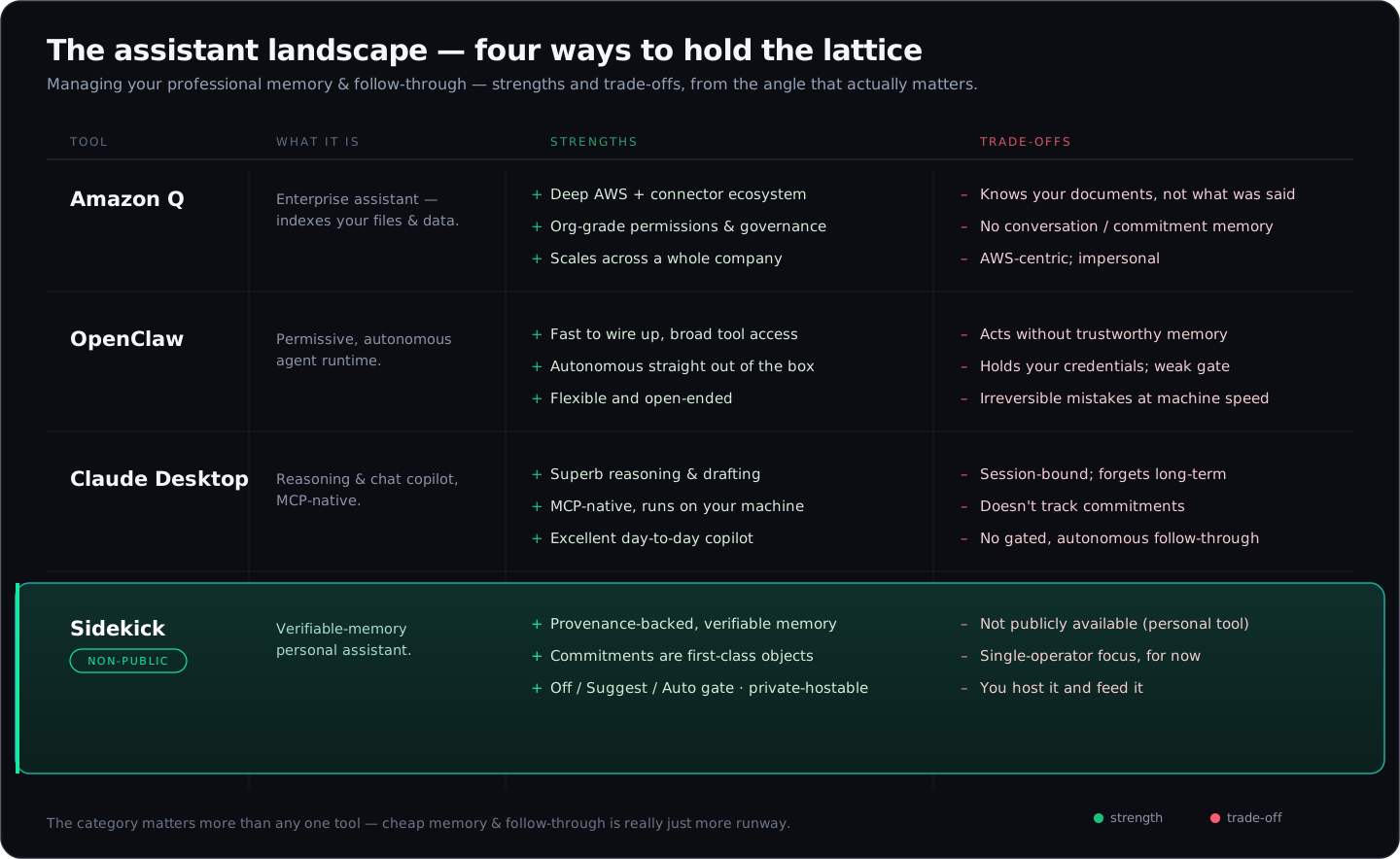
It won’t build your operating rhythm for you, and it certainly won’t write your thesis. But it can hold the parts of the lattice that are pure memory and follow-through — the joints, if you like, rather than the load-bearing beams — freeing whatever hours you have left for the parts that actually require judgement. That’s not resilience, and it isn’t grit either. It’s cheaper infrastructure. Which, in this business, is very nearly the same thing as more runway.
What survives isn’t the point
None of this makes the pressure feel good, and I would think rather less of this piece, and of you, if I pretended otherwise. There will be stretches — weeks, sometimes whole disheartening seasons — that are simply weight, full stop, with no shimmer anywhere in evidence. That is real. Don’t let anyone, including this essay, talk you out of how hard hard actually is. A billion years is a genuinely long time to be crushed carbon with no evidence anything is happening — and some of that carbon, as we’ve now established, does not make it.
The remarkable thing about a diamond is not that it survived the pressure. The Earth is full of things that survived the pressure — most of them dull, most of them rubble, most of them nothing anyone would dig for. The remarkable thing is that it emerged with a structure capable of carrying the load.
That is the real lesson. Not resilience. Not grit. Structure.
The routines. The discipline. The craft. The people. The thesis. The habits you built when nobody was watching, on the ordinary Tuesday when nothing was testing them yet.
Pressure does not create those things in the moment it arrives. It only ever reveals whether they were there already.
So if the weight feels heavy right now, don’t focus entirely on the pressure. Focus on the lattice.
Because when the eruption finally comes — and it always arrives on a schedule nobody controls — the question will not be whether you endured the dark.
The question will be what the dark turned you into.
The memory-and-follow-through joints of the lattice are exactly what I built Sidekick to hold. See Sidekick →
And there is a second edition of this problem arriving faster than most people are ready for. This whole essay has been about the structure that holds a person under load — but the things now acting on our behalf increasingly aren’t people at all. When an autonomous agent is the one under pressure — moving at machine speed, holding real credentials, one bad inference from real damage — the same law holds without mercy: pressure finds the fault, or the lattice holds. That is exactly why I built Silo — the layer your AI agents can’t lie to, watching them from the silicon up, so that the instant one of them cracks under load, the structure sees it before the damage does. Structure, it turns out, is the only thing that scales — for carbon, for founders, and now for the agents. Meet Silo → silo.red