Saksi
Conversation becomes executable memory.
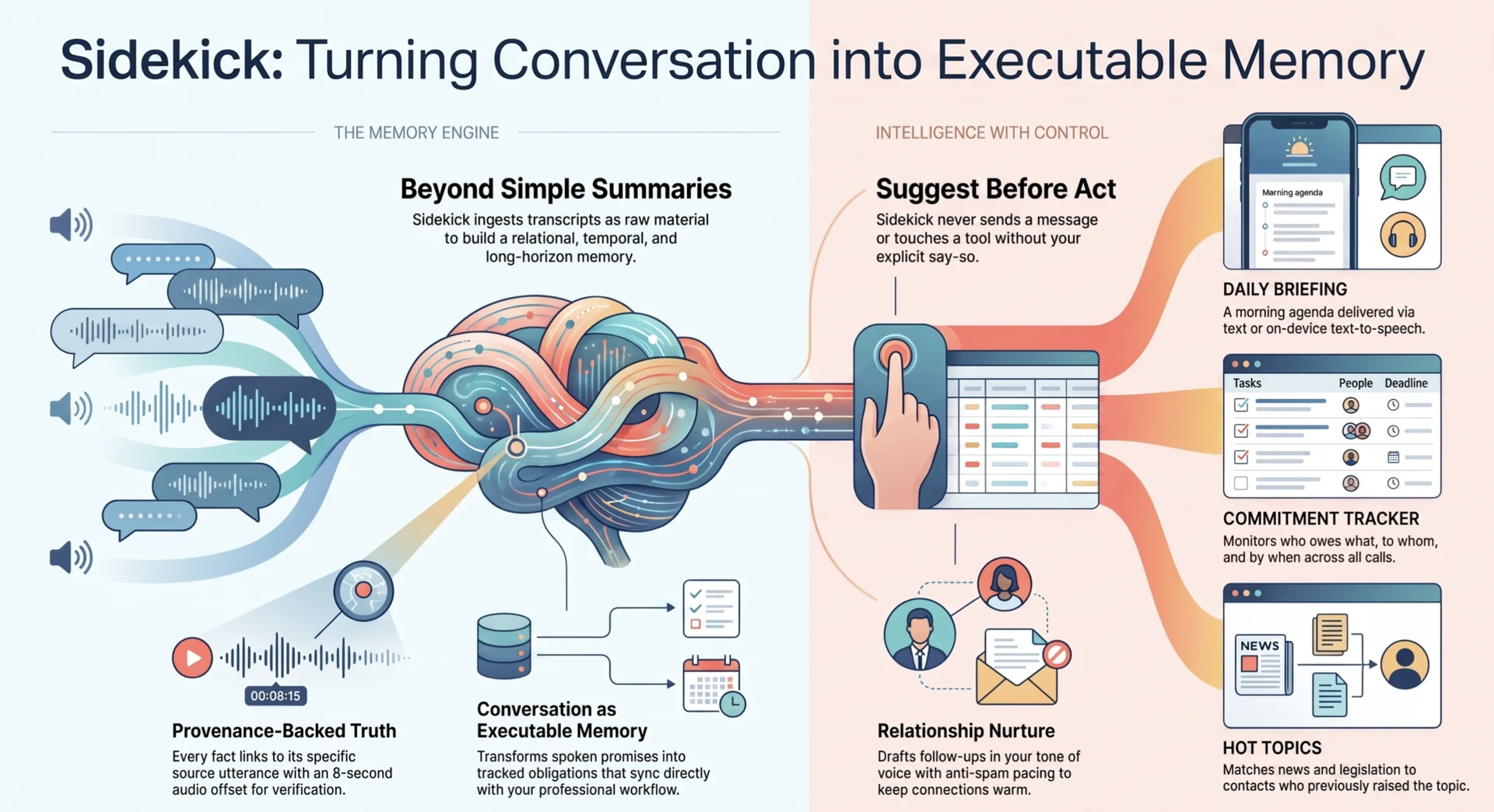
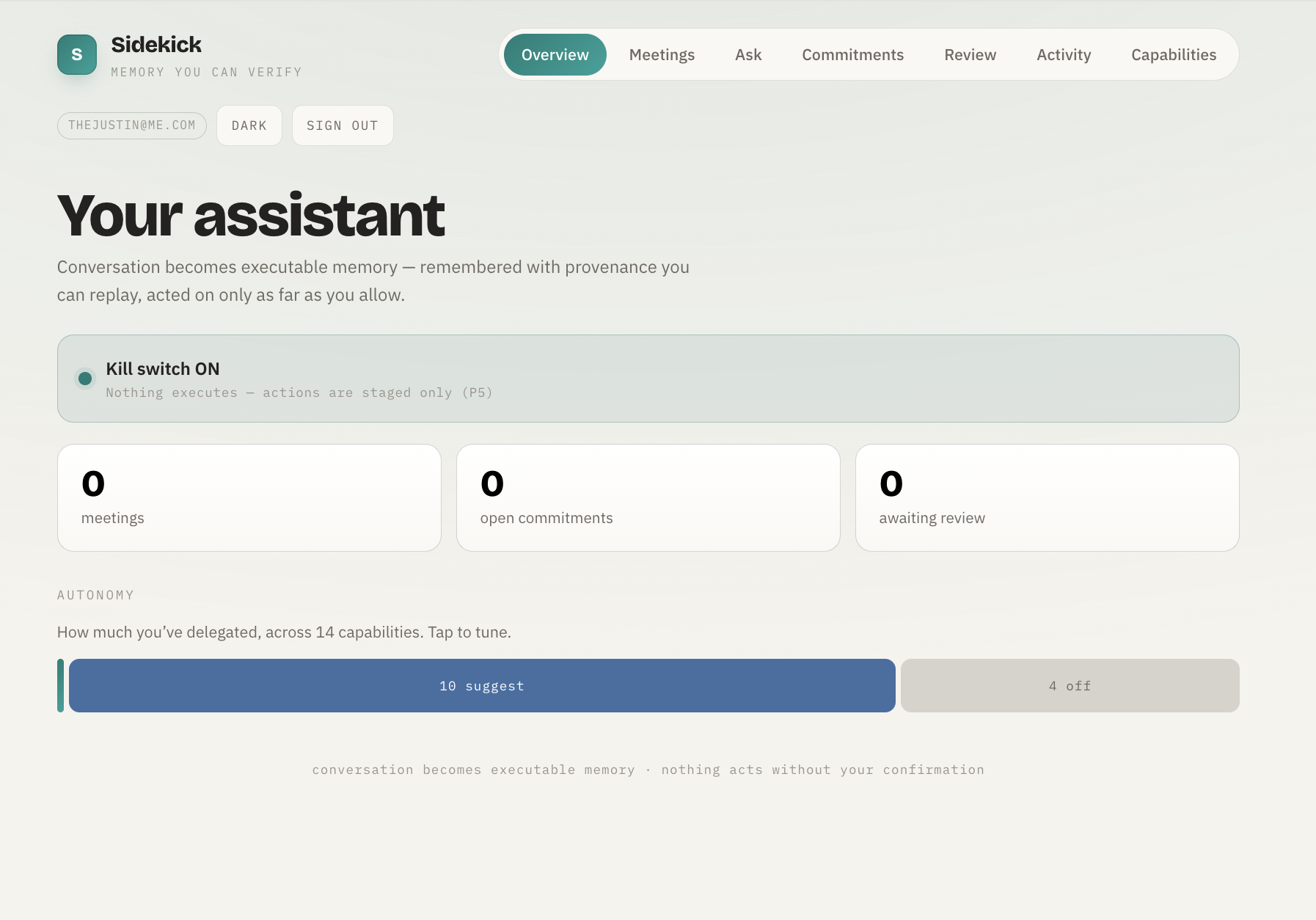
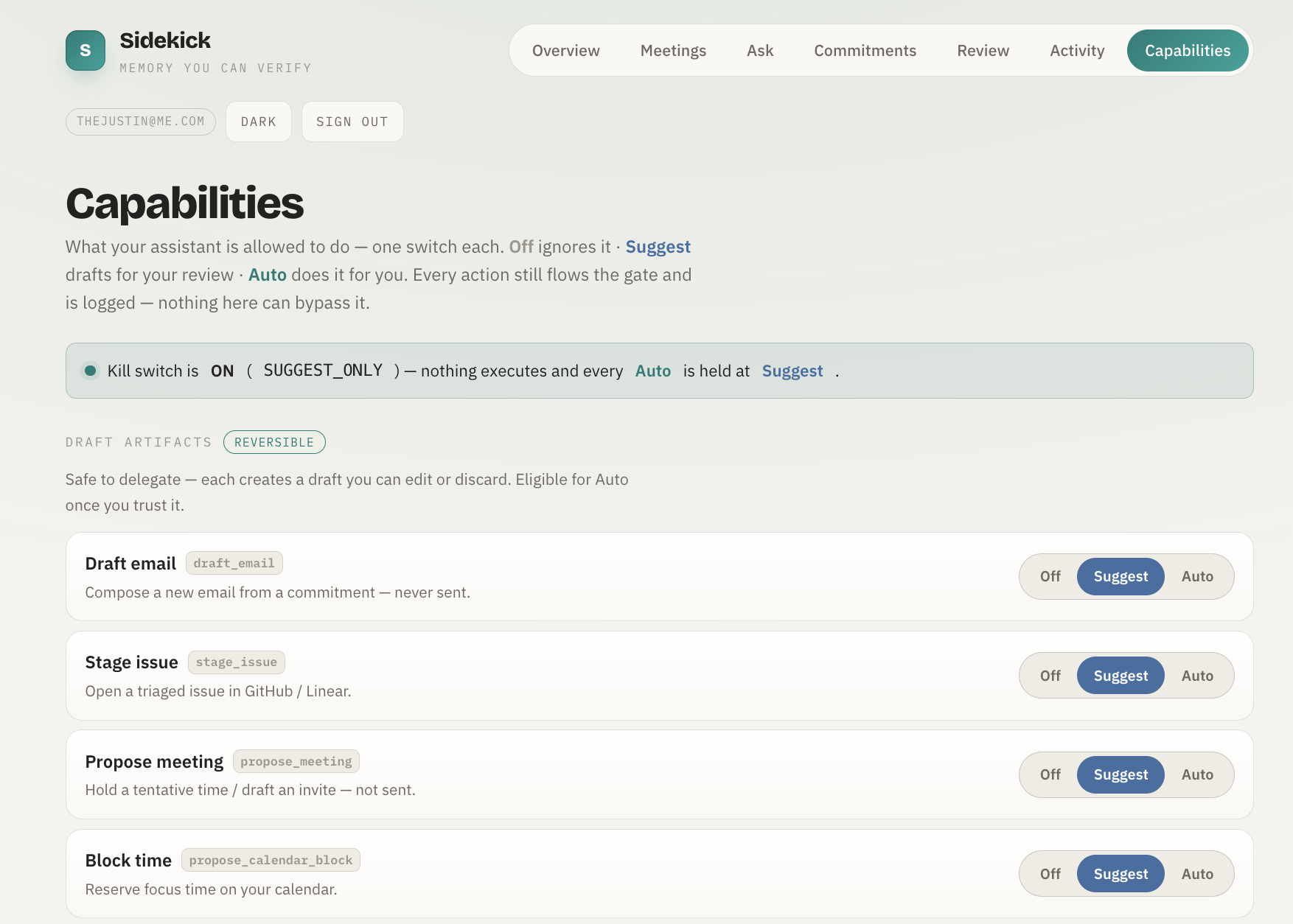
Formerly Sidekick. Saksi captures your professional conversations, turns them into a relational, temporal, provenance-backed memory — every fact one tap from the eight seconds of audio that prove it — and then, only once that memory is trusted, acts across your tools through a confirmation gate you control. A real personal assistant whose defensible core is memory you can verify, not another summariser.
Now called Saksi
Sidekick has been rebranded Saksi. Same product, same architecture, same memory model — a better name.
Two reasons, one of them romantic and one of them entirely practical. The practical one first: Sidekick is a crowded shelf. It is a generic English noun that half the App Store has already reached for, which makes it a naming conversation you don’t want to have with Apple’s reviewers and a losing battle in search — nobody can find you if your name is a word. Saksi is short, distinctive, pronounceable, and unclaimed. Compliance and findability, in one move.
The romantic reason is what the word means. Saksi means witness — in Tagalog, in Indonesian, in Malay and Javanese — descended from the Sanskrit sākṣin, literally one who sees with their own eyes. Which, once you’ve said it out loud, is embarrassingly obviously what this product is. A sidekick tags along. A witness saw it happen and can be called to say so. An assistant that doesn’t merely claim you promised Simon an intro but plays you the eight seconds where you said it isn’t a companion — it is testimony, with the recording attached.
I have been building a provenance chain for a year and calling it a sidekick. The name caught up.
The layers
Observe → Decide → Act → Govern. Saksi listens, remembers, proposes, and — only when you allow it — acts, with every step logged and reversible. The clever part is not any one layer. It is that they are wired together around a memory you can actually trust.
Why I built it
I run several ventures at once, and I made an uncomfortable discovery — the single most expensive piece of infrastructure I owned was my own memory, and it was failing quietly all the time. A promise made on a Tuesday call. A decision that reversed itself between two meetings without anyone quite noticing. A name, a number, a “leave it with me” that evaporated the moment the next conversation began. Human memory is a wonderful thing, but as a system of record it is, to put it charitably, lossy.
Now, the temptation here is to reach for the obvious gadget — record the meeting, generate a tidy summary, offer three suggested actions. It looks marvellous in a demo and it proves absolutely nothing, because every platform on Earth already ships it. Google does it. Apple does it. It is table stakes, and table stakes are not a company.
The genuinely hard, genuinely useful thing — the thing nobody can copy in a weekend and the platforms are structurally disinclined to build — is long-horizon recall you can trust enough to act on. Memory that is relational and temporal, not a warm fuzzy vector guess. Memory that, when it tells you “you promised Simon,” can play you the eight seconds where you said it. Get that right and everything downstream — the drafting, the nudging, the quiet catching of a contradiction three meetings apart — becomes safe. Get it wrong, and a confidently fabricated obligation is the failure that kills the whole idea. So I built the hard layer first and treated the rest as plumbing.
What makes it different
Plenty of tools will happily act on your behalf. The permissive ones — an OpenClaw-style runtime that hands an agent your credentials and hopes for the best — get the autonomy exactly backwards. Autonomy is worthless, and frankly dangerous, without trustworthy memory underneath it. A PA you would let auto-answer an email is only safe because it knows who this is, what was promised, and what the thread already settled — and can show its work.
So Saksi keeps its own loop and its own gate. It owns the boundary between “proposed” and “done”, because that boundary is the entire safety argument — which is precisely why it drops the third-party runtime and keeps only the protocol (MCP). Same connected-assistant shape as the big cloud tools; a defensible, verifiable core they don’t have.
What it plugs into
Saksi is not a lone app. It is the memory layer of a small stack I actually use every day, and the pieces either side of it matter as much as the middle.
ATLAS sits on top — the agentic operating system, and the thing that actually does the running around. Saksi supplies the memory; ATLAS supplies the governed execution, bounding what a run may spend, verifying that it did what it claims, and rolling it back when it didn’t. The division of labour is the whole point: an agent is only ever as safe as what it knows and as affordable as what it is allowed to spend. Plenty of people are building the agent. Rather fewer are building the two layers that make letting it loose a defensible decision.
SpeakEasy feeds it from the other end. SpeakEasy is my free macOS app for Apple Silicon — hold a key, talk like a human, and get clean, punctuated, filler-free text anywhere on the Mac. It is the shortest path from a thought in your head to a system that will still have it in eighteen months. Say it once; Saksi keeps it, with the audio still attached.
Voice in, verified memory in the middle, agent on top — and a gate between the last two, because that is where the trouble lives.
How it is built — and how fast
Here is the part that still makes me grin. Saksi went from architecture to a working, dogfooded assistant in about a week — because I ran the whole build through my own CodeEasy AutoCode. I designed the memory model deeply, handed the spec to the autonomous multi-agent build loop, and let the build streams run overnight. I would sketch the hard decisions by day; the machines would implement, validate and hand back working code by morning. Design deeply, then ship lean — with a night shift that never sleeps.
Where it goes
Today Saksi is my personal tool, and an unreasonably good one. It could become a product — monetised for operators who live the way I do — or run for free inside an organisation I partner with. And for anyone who needs it, it can be completely privately hosted, memory and all, inside enterprise walls — because a second brain you can’t fully trust with your own words was never worth building.
Status
Beta — live, in daily use, and getting sharper every week I feed it.
The mobile front end is currently in beta on TestFlight, and it is being tested the way the product is meant to be deployed: against test client backends that the clients themselves control. Not my servers. Not my keys. Not my copy of anyone’s conversations. If the whole argument is that a second brain is only worth having when you can trust it with your own words, then the beta had better be honest about where those words live — so the client owns the backend from the first day of testing, not as a later enterprise upgrade.
Curious how it fits together? The full architecture & flows — the memory model, the provenance chain and the gate — is published in the open (button up top), still under the Sidekick name while the rebrand works through.
Watch
A short walkthrough — the memory, the provenance chain, and the confirmation gate in action. Filmed while the product was still called Sidekick.
Code teaser
A code teaser — roughly 85% of Saksi was generated by CodeEasy AutoCode, my autonomous multi-agent build loop. Design deeply, then ship lean, with a night shift that never sleeps.
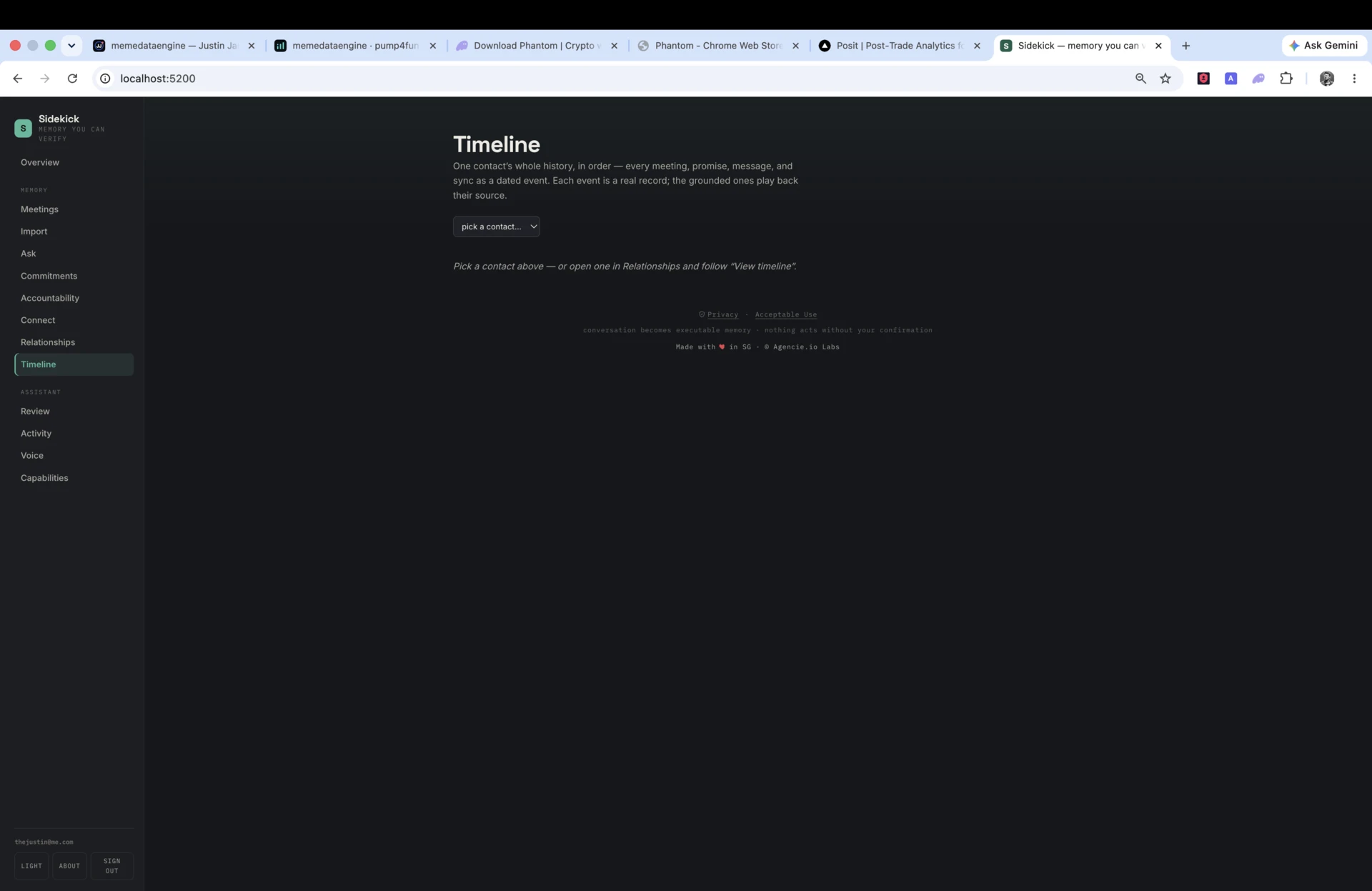
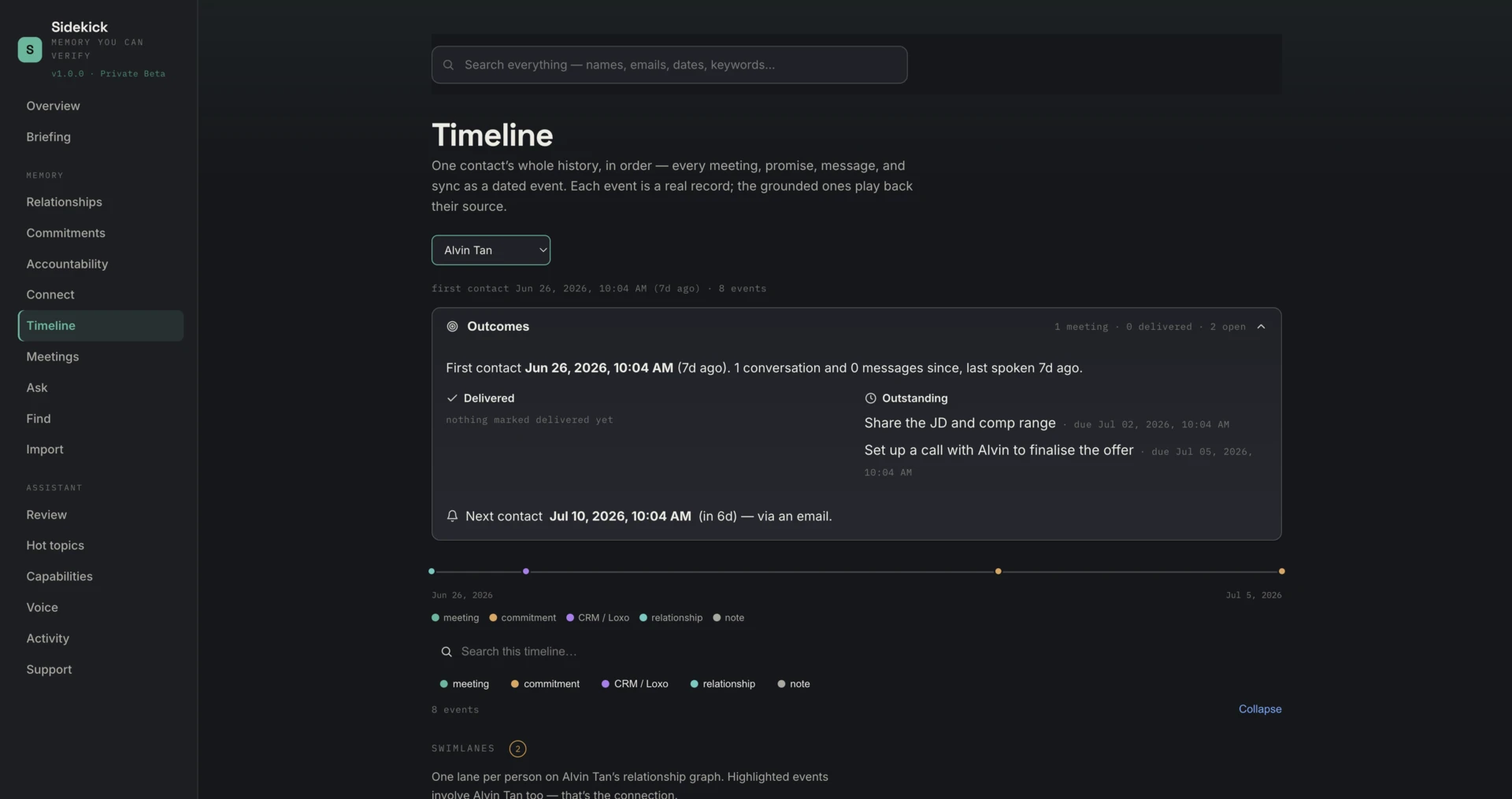
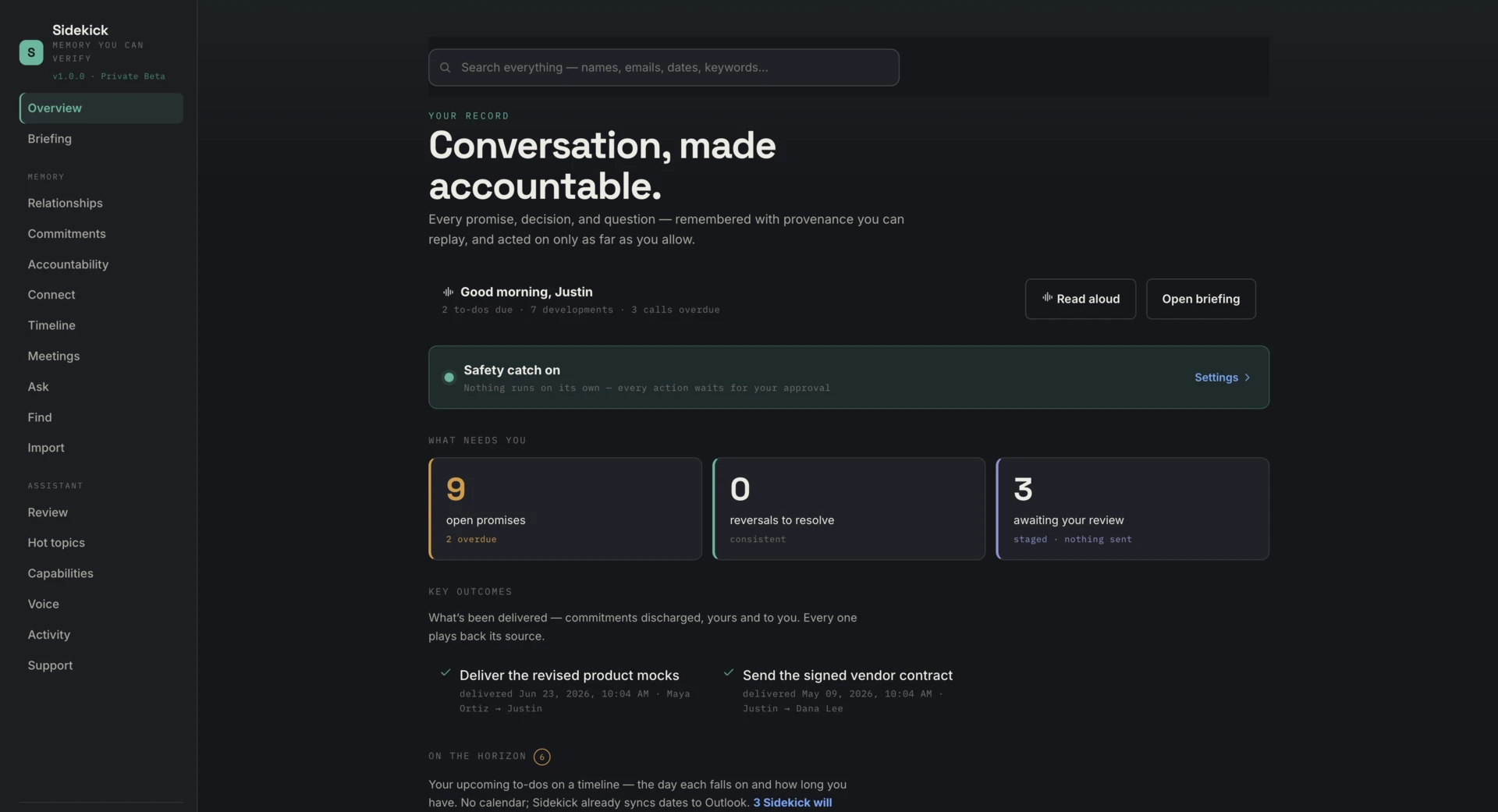
Screenshots