The CTO Is the First Executive Role to Break
What happens when one job quietly becomes six? The CTO role didn't evolve — it fractured. A field account of the five (now six) CTOs hiding inside one title, and why technology leadership is just the canary for a C-suite that's about to break the same way.
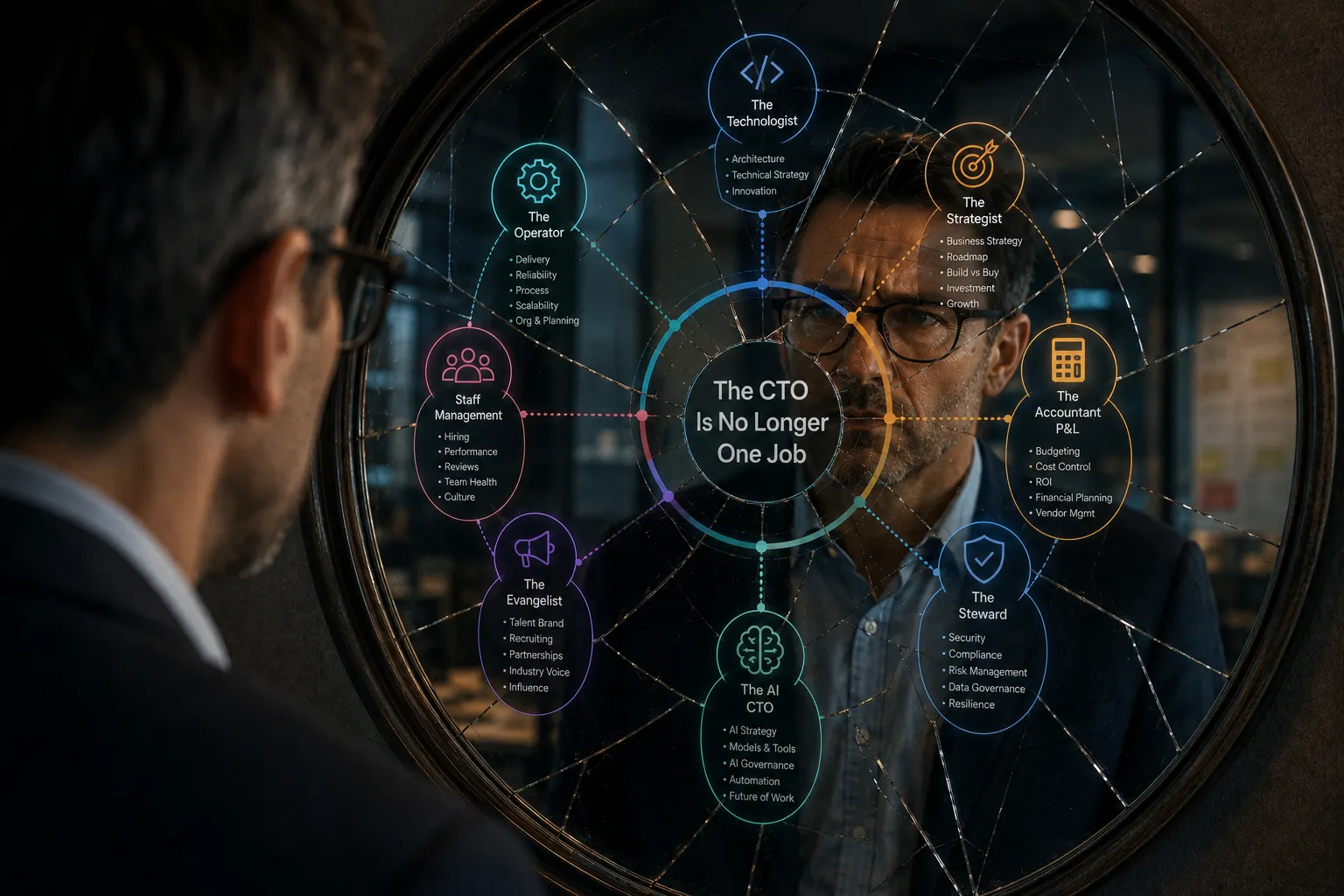
What happens when one job quietly becomes six?
Ask ten companies what a CTO does and you’ll receive ten different answers.
In one organisation, the CTO still manages infrastructure. In another, they’re the chief product strategist. Somewhere else, they’re effectively the CIO. Elsewhere, they’re the public spokesperson for AI. And increasingly, they’re expected to be all of those things simultaneously.
The truth is uncomfortable:
The CTO role has fractured. What used to be one job has quietly become five.
Let me be clear about where this comes from, because it shapes everything that follows.
I’ve spent the better part of three decades moving through most of the seats that surround this role. Enterprise architect. CTO. Product owner. Transformation lead. Founder — and CEO of a startup, though I’ll say plainly that running a startup is a different animal from running a Google, and that deserves its own piece. Along the way I’ve led teams ranging from a handful of engineers to programmes spanning dozens of teams and budgets measured in the millions.
What became obvious across all of it was simple. The job title stayed the same while the job itself kept changing.
The CTO role did not evolve. It fragmented.
And that fragmentation is not really about the CTO. The CTO is just the first place the crack became visible — the canary in the coal mine for something much larger. The executive structure we inherited from the industrial age is buckling under the weight of the AI age. And technology leadership is simply where it broke first.
Why This Happened: Technology Stopped Being a Department
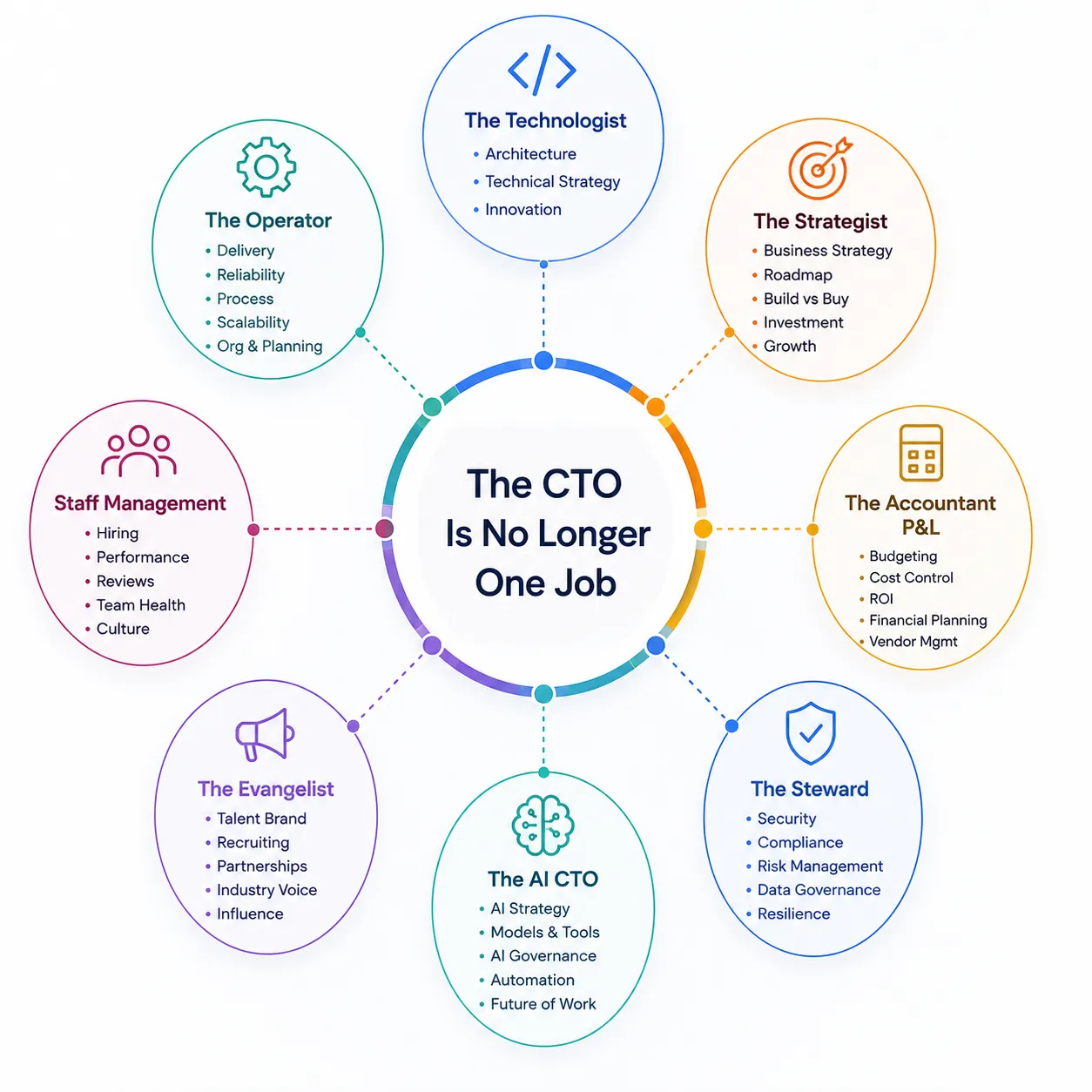
To understand why the CTO role exploded, you have to look at what technology used to be — and what it became.
In the 1990s, the org chart was clean. Functions were boxes, and the boxes had walls.
Finance was Finance. Marketing was Marketing. Operations was Operations. Technology was Technology — a department, a cost centre, a place you sent requests and waited.
That world is gone. Look at what technology is today:
Technology is Marketing. Technology is Sales. Technology is Operations. Technology is Customer Service. Technology is Product. Technology is HR. Technology is Finance.
There is no longer a function that technology sits beside. It sits underneath all of them. Every department now runs on software, ships through software, competes through software, and increasingly thinks through software.
The CTO role exploded because technology escaped the technology department.
Once that happened, the person responsible for technology became — by definition — partly responsible for everything. And a role that touches everything cannot stay a single job. It fractures along the seam of every function it now reaches into.
The five CTOs are not a failure of focus. They are the predictable result of technology becoming the substrate of the entire business.
The Five CTOs
Strip the title back and you find at least five distinct jobs underneath it — each with its own skills, its own time horizon, its own definition of success.
The Technologist. The deep one. Architecture, hard technical calls, the judgement that comes from having actually built things. This is the version most CTOs fell in love with, and the one hardest to keep alive as everything else grows.
The Operator. The one who runs the machine. Hiring, delivery, reliability, the org chart, quarterly planning. Measured in throughput and stability — and in the number of fires that never happened.
The Strategist. The business partner. Board conversations, roadmap against revenue, build-versus-buy, the commercial consequences of technical choices. Measured in decisions, not deliverables, and conducted almost entirely in the language of money.
The Evangelist. The external face. Recruiting, the talent brand, partnerships, the sales call that needs technical credibility in the room, the talk that makes senior engineers want to join. Measured in gravity — who you can attract.
The Steward. The one who owns the risk. Security, compliance, resilience, data governance. Invisible when it works and career-ending when it doesn’t.
Most job descriptions ask for all five. Most compensation packages pay for one. Most humans are genuinely excellent at two, competent at a third, and quietly drowning in the rest.
The Hands-On Paradox
Every CTO I have met over the last decade has said some version of the same sentence:
“I’m leading seventy-five engineers, and they still expect me to be hands-on.”
Watch how the expectation moves as the organisation grows:
At five engineers, you’re expected to code.
At fifteen, you’re expected to review architecture.
At thirty, you’re expected to lead leaders.
At seventy-five, you’re expected to shape systems of work.
Four different jobs. Four different definitions of “technical.” And somehow the modern CTO job description still expects all four at once.
Here is the real problem.
The problem isn’t being hands-on. The problem is that nobody agrees what hands-on means anymore.
At seventy-five people, you are not running a team. You are running an organisation — one with its own communication overhead, its own politics, its own second-order effects that take all your attention just to perceive. Every hour in the diff is an hour not spent on the seventy-five careers, the three struggling teams, the reorganisation, and the board deck due Thursday.
And yet the instinct to stay hands-on is not vanity. It is survival. The moment you stop touching the work, your judgement begins to drift, and you become the executive who is confidently wrong because the constraints changed since the last time you shipped.
So “hands-on” has to change its meaning. It stops meaning in the keyboard and starts meaning in the work — close enough to the real system to keep your taste calibrated, far enough back that you are not the bottleneck on the critical path. You read the code; you do not own the merge. You sit in the hard design review; you do not run it. You keep one genuinely technical thread alive, not because the company needs your commits, but because you need the contact with reality to do the other four jobs honestly.
The CTO who insists on being in the keyboard at seventy-five people is not being technical. They are being a single point of failure with a title.
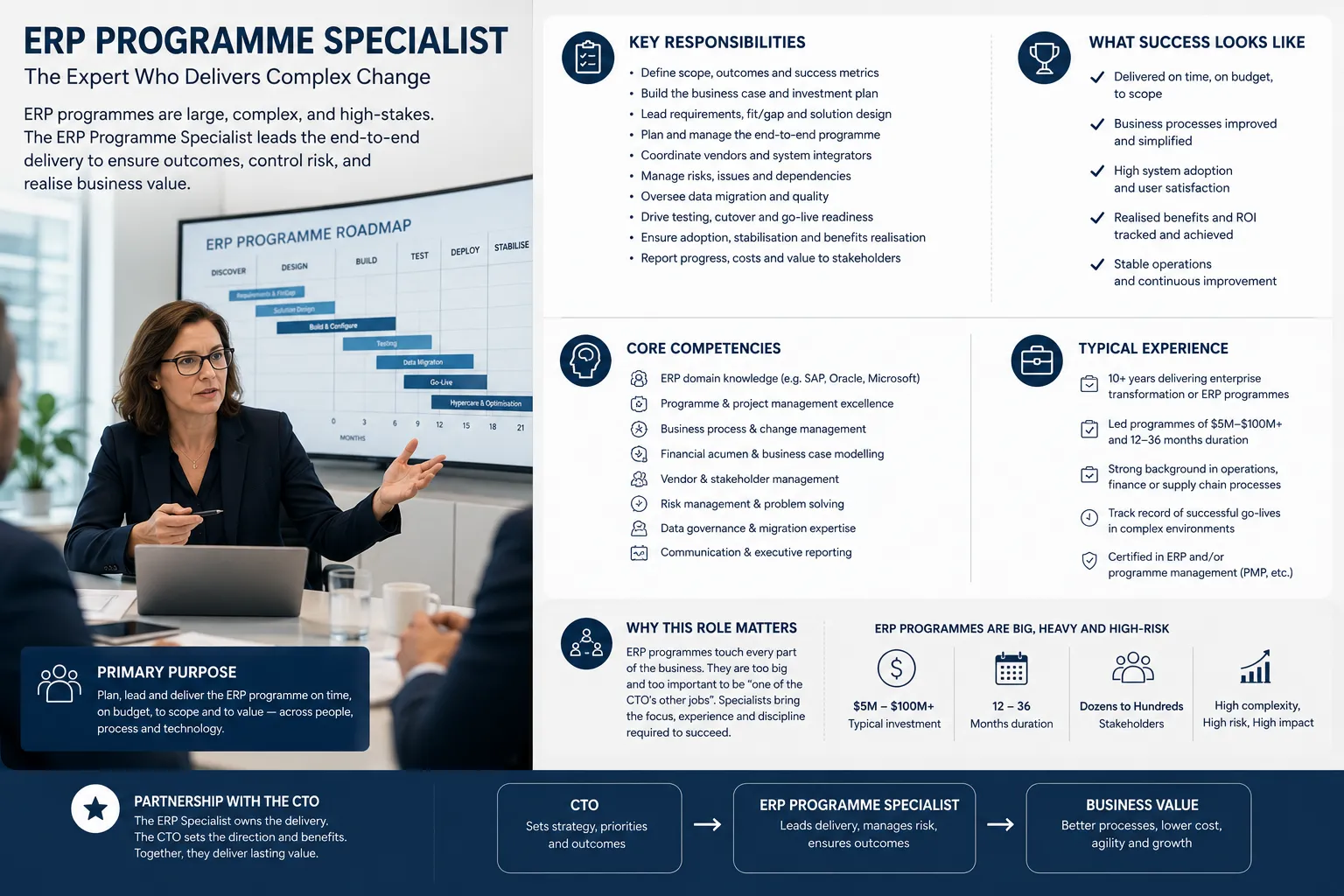
How Many More ERP Programmes Must I Endure?
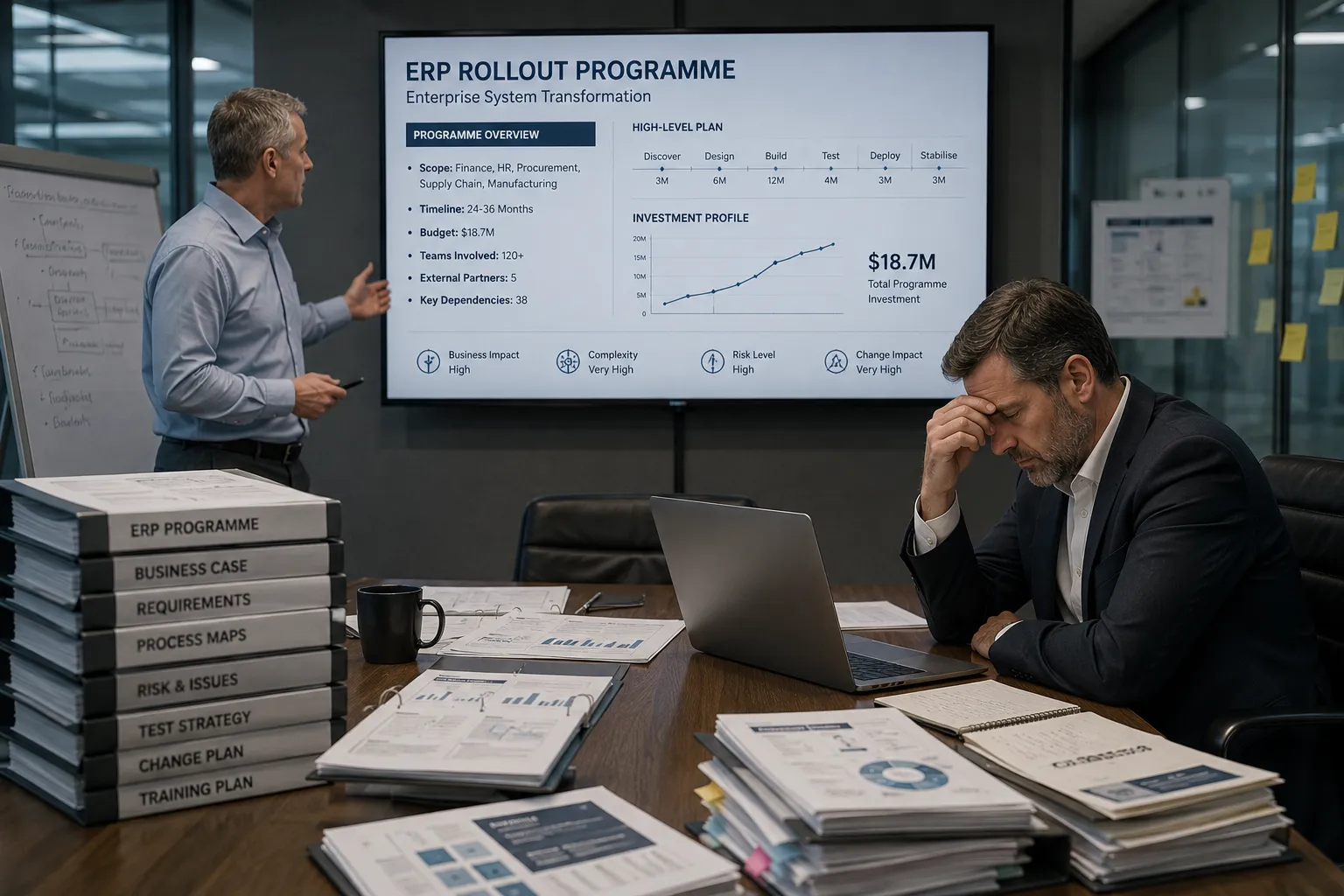
Every experienced technology leader eventually reaches the same moment.
Halfway through another ERP replacement. Another CRM migration. Another operating model redesign. Another steering committee. Another programme board. Another set of traffic-light reports.
And the question appears:
“How many more of these must I endure?”
Not because they are unimportant. But because you begin to realise they are consuming years of your life while creating very little that is genuinely new.
This is the quiet weight of the old world — the enterprise estate that actually runs the business. The systems of record. The vendor contracts measured in years. The migrations you have done four times and could narrate in your sleep: the discovery phase that discovers nothing, the integrator whose certainty is inversely proportional to their accountability, the “minor customisations” that become the whole project, the go-live that slips two quarters.
None of it is optional. The system really is end-of-life. The debt really is compounding. The business really cannot run on what it has.
The trap is not the programme. The trap is letting the old world consume the entire identity of the role — spending so long managing the inevitable that there is nothing left for the possible. The CTO who is only ever the steward of last decade’s platform never gets to build next decade’s.
The skill is not avoiding the old-world work. It is refusing to let it become the whole job.
The CEO Problem
For most of my career, I assumed the CTO role was becoming harder because technology was becoming more complex.
I no longer think that is true.
Technology has certainly become broader. Cloud, data, cyber, AI, platforms, product engineering, developer experience, governance. The surface area is enormous. But complexity is not what breaks most CTOs.
Context does.
The moment I moved from CTO into COO, and later CEO, something became painfully obvious. Most CTOs are trying to optimise technology inside constraints they did not create.
The board wants growth. The CFO wants predictability. The COO wants stability. The CMO wants speed. The investors want efficiency. The customers want innovation. The engineers want autonomy.
The CTO sits at the centre of all of it. Not because they own all of it — but because technology increasingly touches all of it.
The role becomes exhausting when you believe every problem arriving at your desk is a technology problem.
Most of them are not.
They are trade-offs. And trade-offs are leadership problems, not engineering ones.
The breakthrough, for many CTOs, is realising that their value no longer comes from having the best answer. It comes from helping the organisation make better decisions.
That is the moment the role stops looking like chief technologist and starts looking like executive architect.
Not architect of systems. Architect of outcomes.
Which reframes everything that follows. The fragmentation is not really five technical jobs competing for one calendar. It is an executive leadership role that has been mislabelled as a technology role — and is still, in most companies, resourced and measured as if it were the latter.
What To Actually Do About It
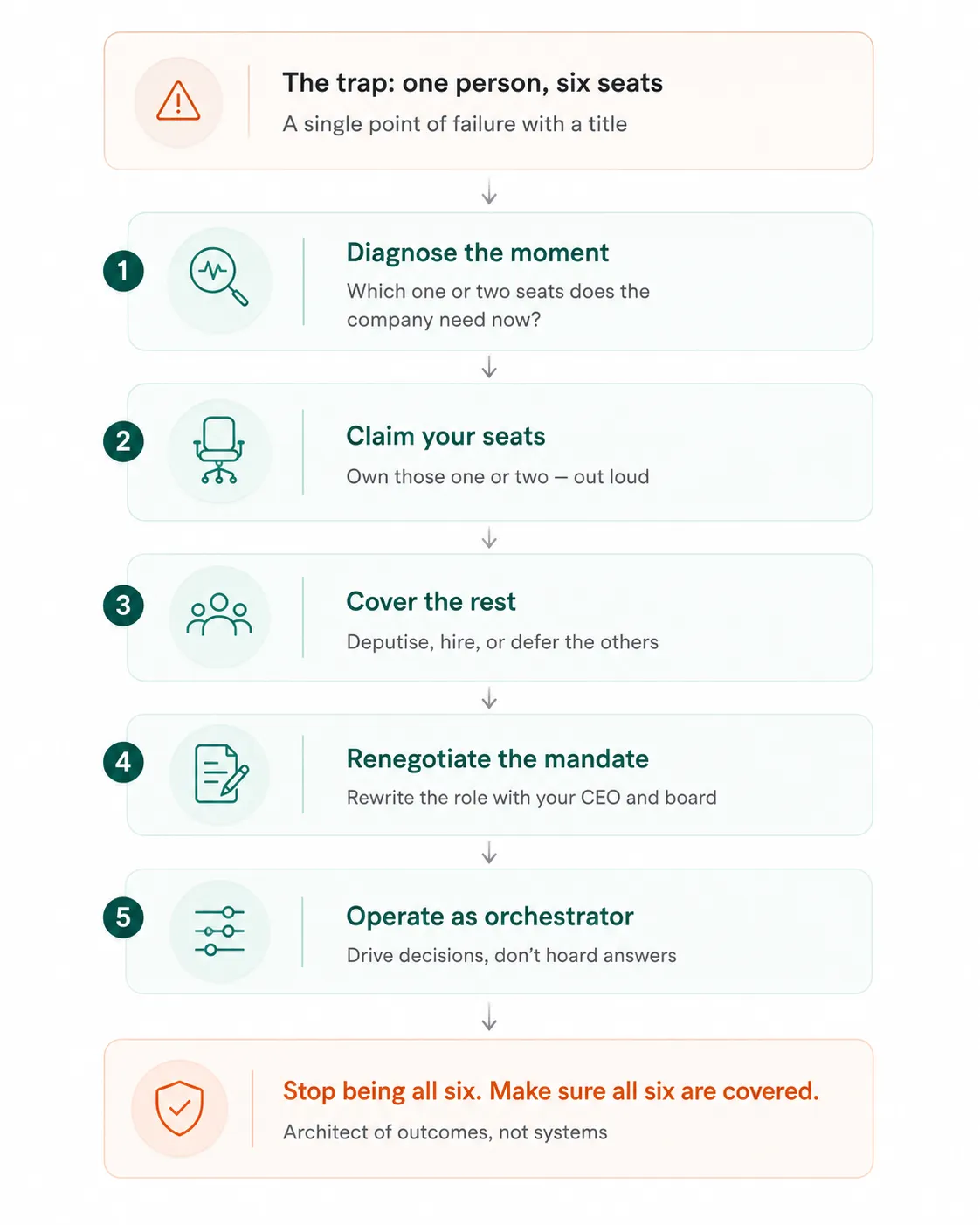
None of this is solved by working harder. The role is not under-resourced; it is incoherent. You cannot grind your way to being five excellent people. You have to make structural choices instead.
Pick which CTO you are — out loud. For this company, at this stage, the role genuinely needs one or two of the five more than the rest. A pre-product startup needs the Technologist and the Evangelist. A scaling company needs the Operator. A regulated enterprise mid-transformation needs the Steward and the Strategist. Choose deliberately — then build a leadership team that covers the others.
Renegotiate the job description with whoever wrote it. The incoherence usually lives in the gap between what your CEO thinks they hired and what the role actually demands this year. Most CTOs never have that conversation. Have it. Name the jobs. Ask which ones the business needs from you versus which can be hired, split, or deferred.
Sequence — do not parallelise. The old-world programme and the new-world push cannot both be priority one. The discipline is admitting which, rather than half-serving both and failing slowly at each. The new world rewards parallelism in systems; it punishes it in human attention.
Apply platform thinking to your own time. You spent years building leverage into systems so the team is not bottlenecked on any one person. Point that instinct at your own role. If everything escalates to you, you have built your own job badly.
A Note for the People Who Hire CTOs
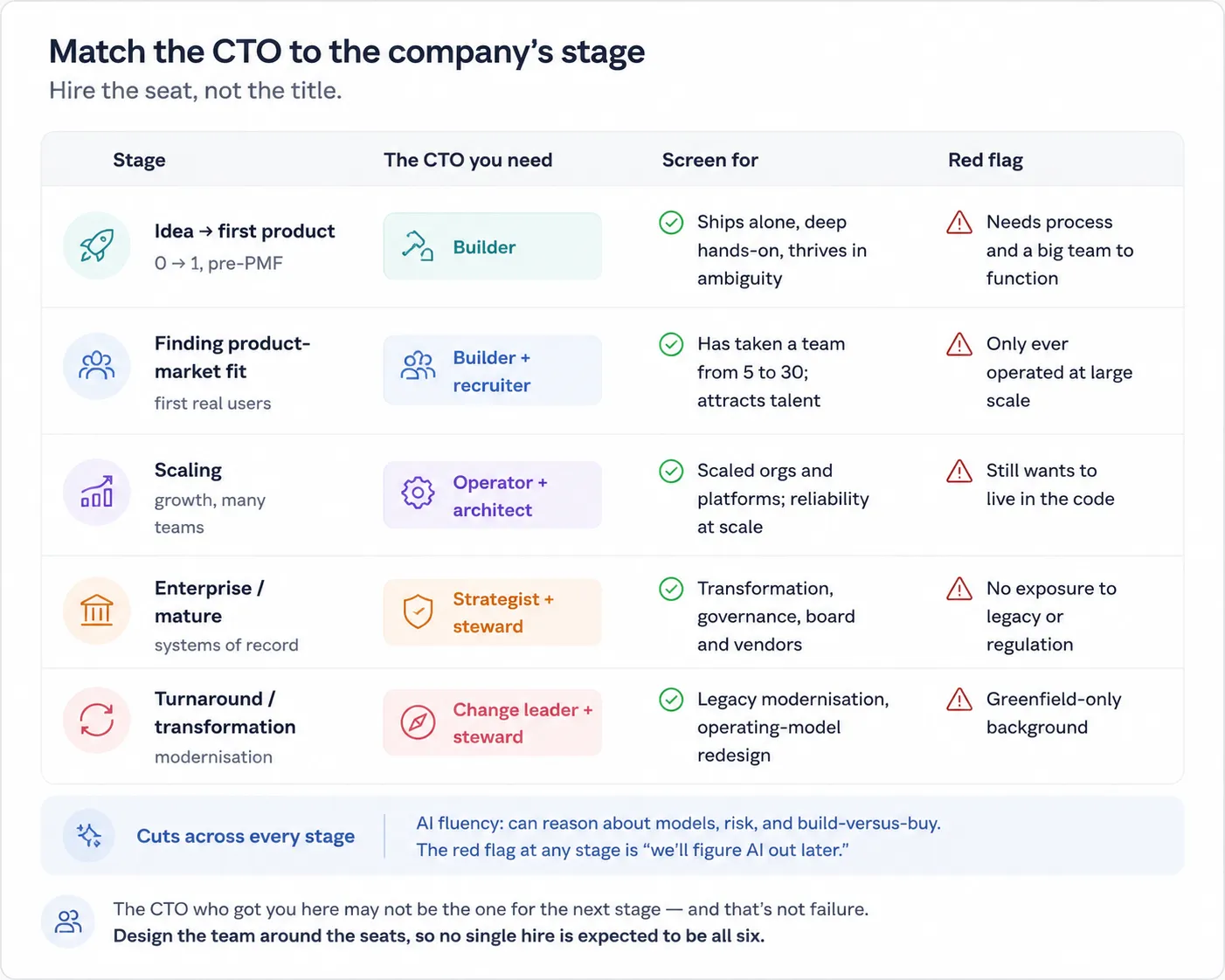
If you recruit for this role — in-house talent, executive search, a founder writing the brief yourself — most of the difficulty you experience is downstream of one mistake. You are hiring a title. You should be hiring a seat.
“CTO” tells you almost nothing. It is a container that holds five or six different jobs, and the only question that matters is which one or two your company actually needs right now. That answer is set almost entirely by where the business is in its maturity — and it changes as the business grows.
A pre-product startup needs a builder who will write the first version themselves and is energised, not paralysed, by ambiguity. Hire a governance-minded enterprise architect into that seat and they will design a beautiful operating model for a product that does not exist yet. Conversely, a regulated enterprise mid-transformation needs a strategist and steward who can carry a board, a vendor estate, and a compliance regime. Drop a brilliant 0-to-1 builder into that seat and they will be miserable inside a quarter, and gone inside a year.
Three things worth holding onto:
Screen for the seat, not the CV. The most common failure is hiring the person who succeeded at the last stage rather than the one your stage needs. A track record of scaling an org from five to fifty engineers is the wrong signal for a company that needs someone to ship a prototype alone — and vice versa. Match the evidence to the seat.
Be suspicious of the job description that asks for everything. When a brief wants deep hands-on coding and board-level strategy and a public AI profile and enterprise governance, that is not an ambitious hire. It is a company that has not decided what it needs, outsourcing that decision to whoever is unlucky enough to accept. The strongest briefs are narrow on purpose.
Define what “hands-on” means before you write it down. It is the single most overloaded word in every CTO brief, and it means something completely different at fifteen engineers than at seventy-five. Decide which one you mean. Putting “hands-on” in a brief for a role that runs an organisation of seventy-five is how you set up both the hire and the company to fail.
And one structural truth that is no one’s fault: the CTO who got you here may not be the CTO for the next stage. That is not a performance problem. It is the role fragmenting underneath a person who was an excellent fit for the seat the company used to need. The kinder, clearer thing is to name the stage shift early — and to design the leadership team around the seats, so that no single hire is quietly expected to be all six.
When stages overlap. Real companies rarely sit in one clean stage. A fast-scaling fintech is also a regulated enterprise. A mature business mid-transformation has to run the old world and rebuild it at the same time. Where two stages overlap, the company needs two seats at once — and that is precisely the situation a single hire cannot satisfy. The overlap is not a brief for a more heroic CTO. It is the signal to split the role: a CTO paired with a strong VP of Engineering, a CISO, or a transformation lead, so that two demanding seats are held by two people who are each genuinely excellent at one, rather than one person who is stretched thin across both.
The Sixth CTO
And then, just as the role was settling uneasily into five jobs, AI added a sixth.
The AI CTO is the executive who must answer questions that did not exist three years ago — and whose answers expire in months:
Which models. Which governance. Which agents. Which risks. Which opportunities. Which jobs change. Which jobs disappear.
The half-life of technical certainty has collapsed. A CTO used to make an architectural bet and live inside it for years. Now the ground shifts every quarter, and the role carries the expectation of being both calm and current — sure enough to commit, humble enough to reverse, fast enough that “we’re evaluating it” stops being acceptable somewhere around the second board meeting.
The CTO role was already five jobs. AI just made it six.
The First To Break Is Not The Last
Here is the part worth sitting with.
The CTO is not breaking because CTOs are weak, or because the job was badly designed. It is breaking because it is the first executive role to absorb the full force of continuous change — the first place where the industrial-age org chart, with its clean functional walls, stopped describing reality.
Those walls are coming down everywhere.
The CFO is discovering that finance is becoming a real-time, instrumented, increasingly automated function — part forecaster, part data-platform owner, part AI-risk underwriter, no longer just the steward of the quarterly close. The number that mattered once a quarter now wants to be live, and the person who owns it is being asked to own the models that produce it.
The CMO is discovering that marketing has quietly become a software and data discipline — part brand storyteller, part growth engineer, part owner of the customer-data and model stack that now decides who sees what, when, and why. The creative seat and the engineering seat are merging into one job, and most marketing org charts have not noticed yet.
The COO is discovering that operations is becoming an algorithmic system — run as much by models and automation as by people and process.
Every seat in the C-suite is heading toward the same fracture the CTO reached first — one title quietly becoming several, one human asked to be all of them at once.
The CTO is simply the canary in the coal mine.
The structures that worked in a world of predictable change are failing in a world of continuous change. The CTO is the first executive role to break under that pressure.
It will not be the last.
Perhaps the real lesson is that the future belongs less to specialists and more to translators.
The leaders who thrive will not be those with the deepest expertise in a single discipline. They will be those who can connect disciplines. Technology to business. AI to operations. Strategy to execution. Innovation to governance.
The CTO is the first executive role to break because it is the first role forced to live at all of those intersections at once.
What we are witnessing is not the evolution of a title. It is the emergence of a new kind of leadership.
And that is the shift worth naming plainly:
The CTO is no longer the person who understands the technology. The CTO is becoming the person who helps the organisation understand what technology makes possible.
A Personal Note

Some readers who know my background will notice the obvious thing, so I’ll say it before they do. The composite figure in this article — technologist, operator, strategist, steward, recruiter, and now the AI seat as well — looks more than a little like a description of my own career. I have sat in most of those seats over the last thirty years, and moved between them more than once.
I don’t write that as a credential. I write it as the confession that keeps the argument honest.
Because the lesson I actually took from all of it is not “be the person who can fill every seat.” It is closer to the opposite. Being capable of sitting in all six is not the same as being able to sit in all six at once — and the years I spent learning that distinction the hard way are most of the reason this article exists. The rare skill was never the range. It was knowing which seat the moment needed, which one was genuinely mine to hold, which ones to hand to people better at them than me, and when to stand up and move to another. Most executives spend a career building expertise. A smaller number become translators — and translation, it turns out, is mostly knowing when to move.
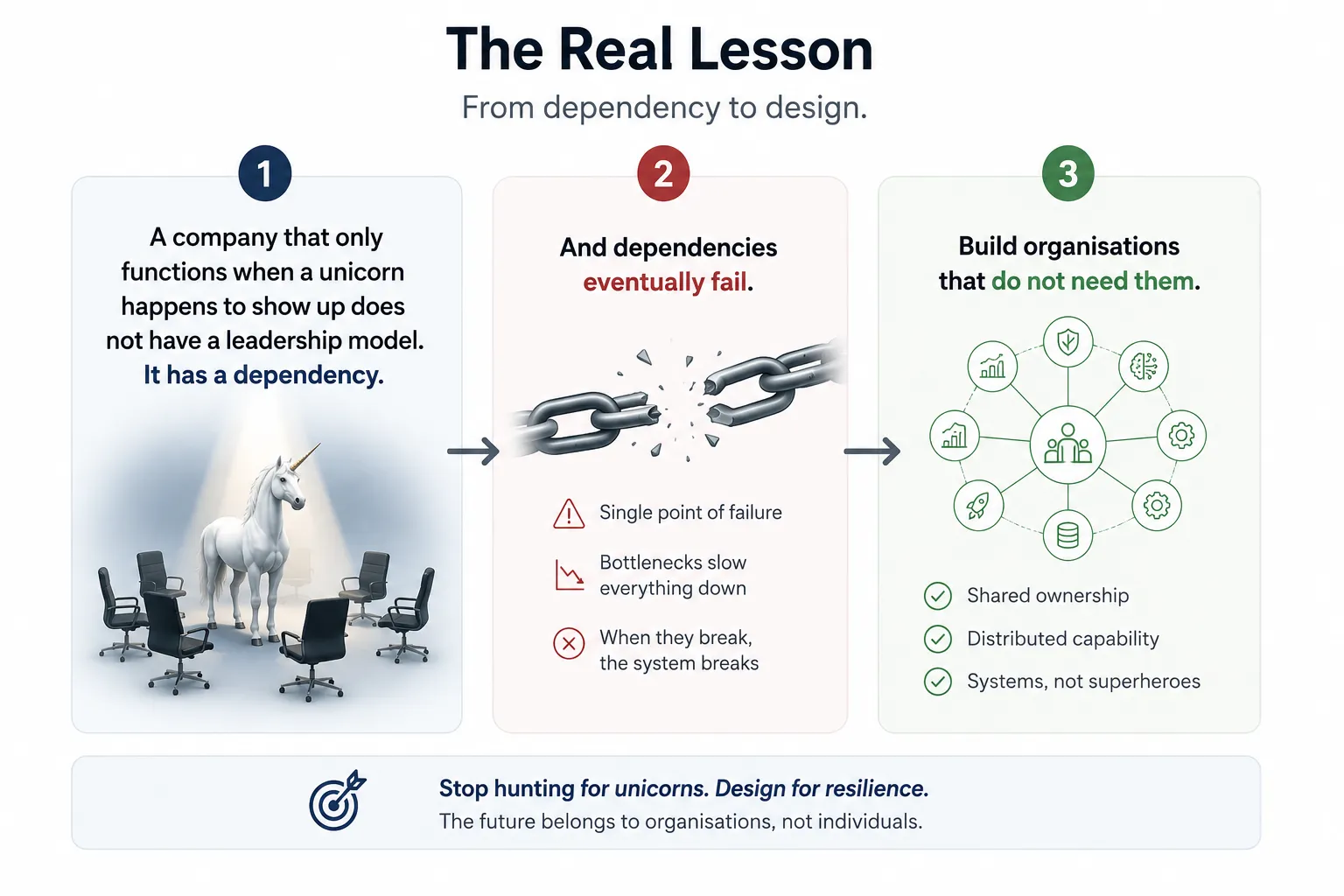
Which leads somewhere slightly uncomfortable, and worth saying out loud. If the only version of this role that works is a person who has spent three decades becoming a generalist, then it does not scale, and it should never be the plan. A company that only functions when a unicorn happens to show up does not have a leadership model. It has a dependency. And dependencies, eventually, fail.
So the real conclusion is not “go and find people like me.”
It is “build organisations that do not need them.”