memedataengine
The full pump.fun firehose — decoded, retained, scored.
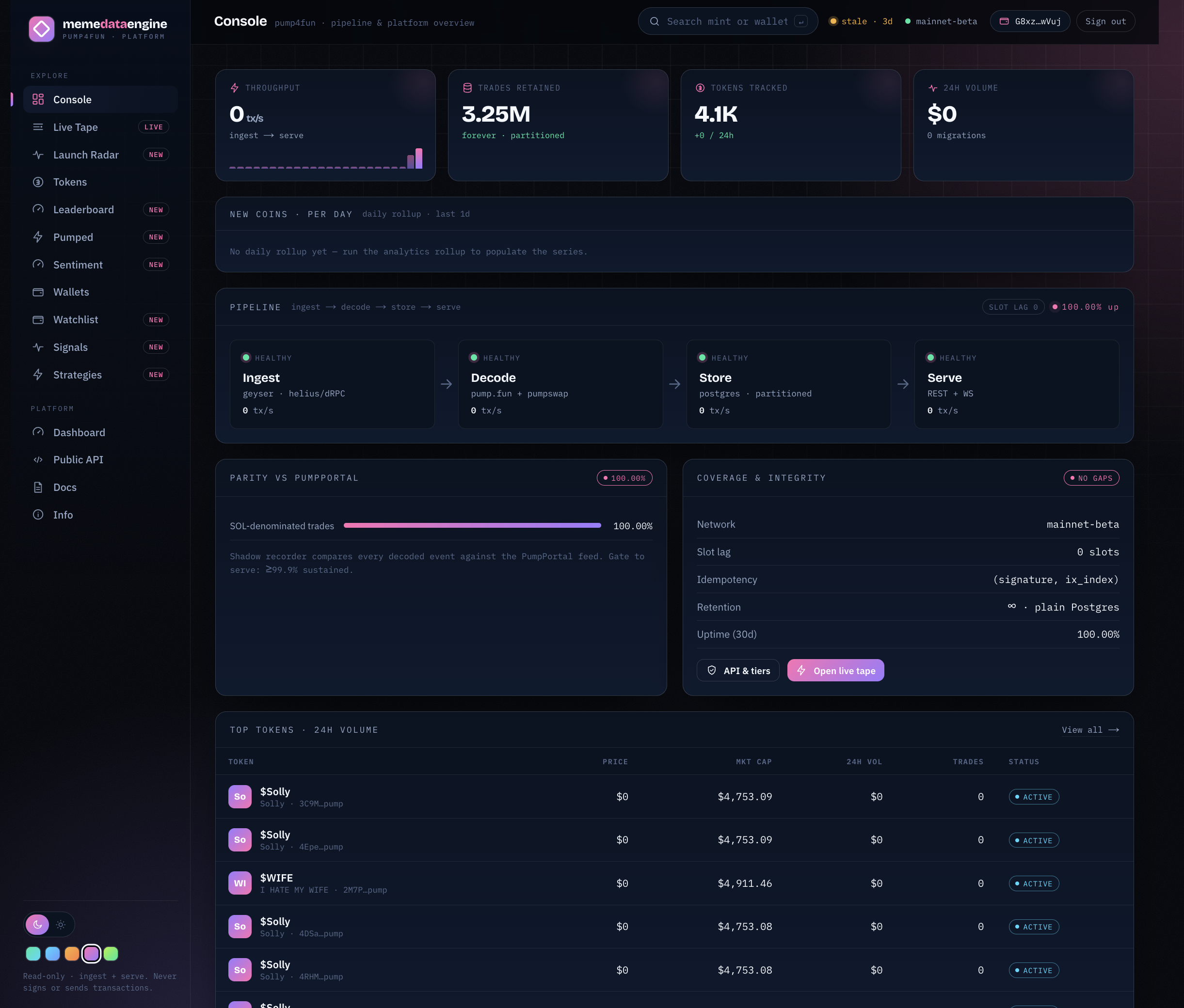
memedataengine ingests the complete pump.fun and PumpSwap trade firehose, decodes every event, retains every trade forever in plain Postgres, and layers wallet scores, token metrics, coordination clusters and signals on top. It is a read-only lab for measuring fraud, sentiment and real informational edge in the memecoin market — the moat is the decoded, retained, labelled dataset, not the access.
The layer
Observe. memedataengine sits at the very bottom of the stack and does one thing with quiet obsession — it watches. It signs nothing, sends nothing, and risks nothing. It simply refuses to forget.
A field guide to the strange world of the degen
A word, before the architecture, on the natives of this ecosystem. Degen — short for degenerate, a term that wandered in from the gambling tables and was adopted, half as insult and half as badge of honour, by the crypto tribes. The degen is a creature of magnificent conviction and questionable judgement, and like any exotic species it has evolved a language all its own:
- Apeing in — buying with great enthusiasm and no research whatsoever.
- Moonboy — one who is serenely certain a coin is bound for the heavens.
- Diamond hands — the refusal to sell through any amount of turbulence.
- Paper hands — selling at the first tremor, to the eternal scorn of the above.
- Jeet — one who dumps a token the instant there is a profit to be taken.
- Pump-and-dump — coordinated euphoria, followed with grim inevitability by the exit.
It is, if you stand far enough back, a genuinely fascinating natural experiment — thousands of people, real money, near-zero information, all colliding at enormous speed. The trouble is that from the inside it is pure noise. Hype dressed as signal. Manufactured euphoria. Wallets that look sharp until, three weeks later, they very much are not.
What it does
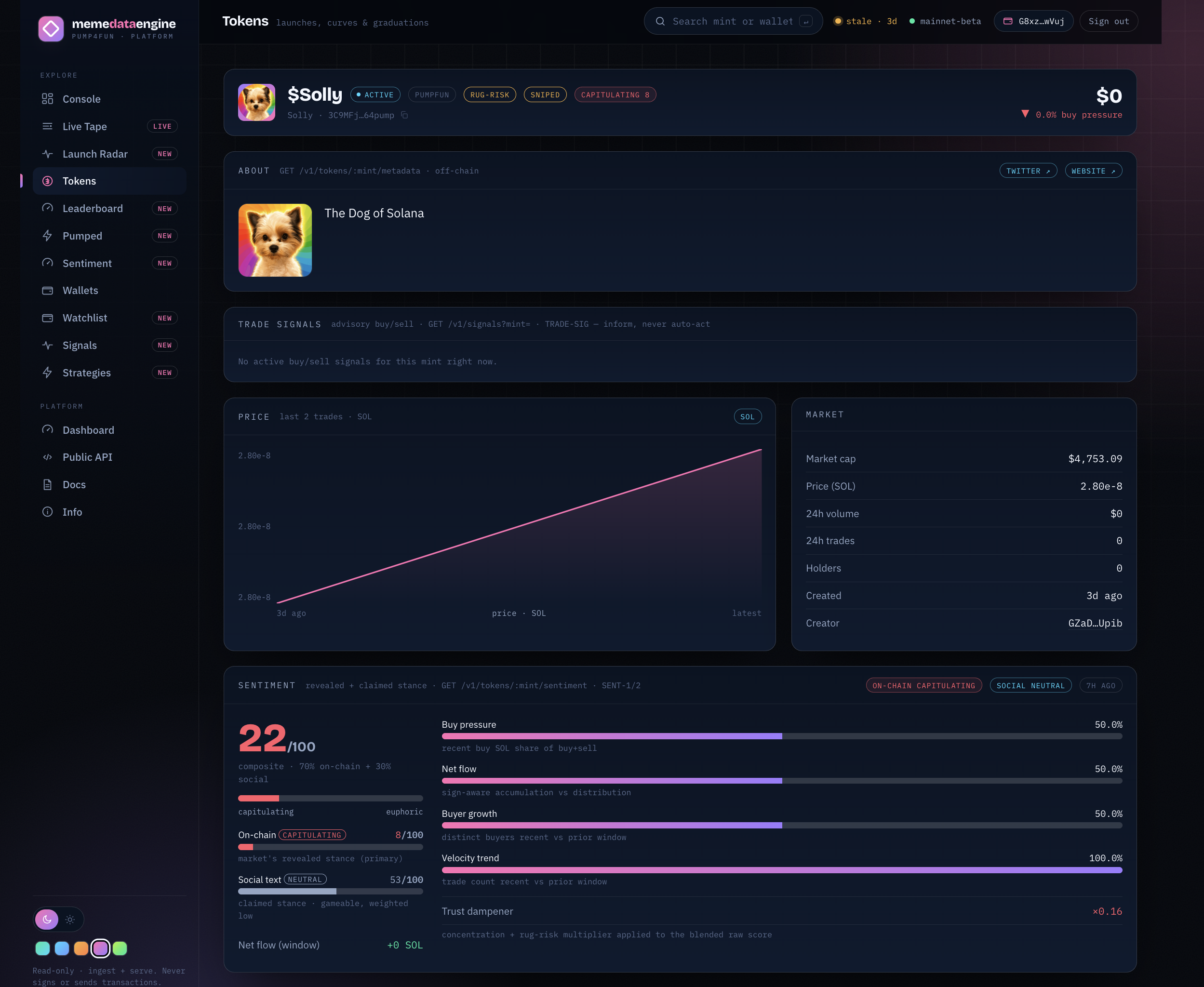
memedataengine is the instrument you point at that chaos. It ingests the entire pump.fun and PumpSwap firehose — every launch, every trade, on a public chain where access was never the hard part. It decodes each event down to the raw Anchor logs, retains all of it forever in plain, partitioned Postgres, and then does the interesting bit — it scores it. Wallet quality. Rug risk. The gap between what a market says about itself and what its on-chain behaviour quietly confesses. Coordination between wallets that would very much prefer not to be seen coordinating.
The result is a read-only intelligence terminal — a place to measure fraud, sentiment and real informational edge, rather than feel your way through it and hope. It watches the moonboys so you can keep your diamond hands for something the data actually justifies.
Why it exists
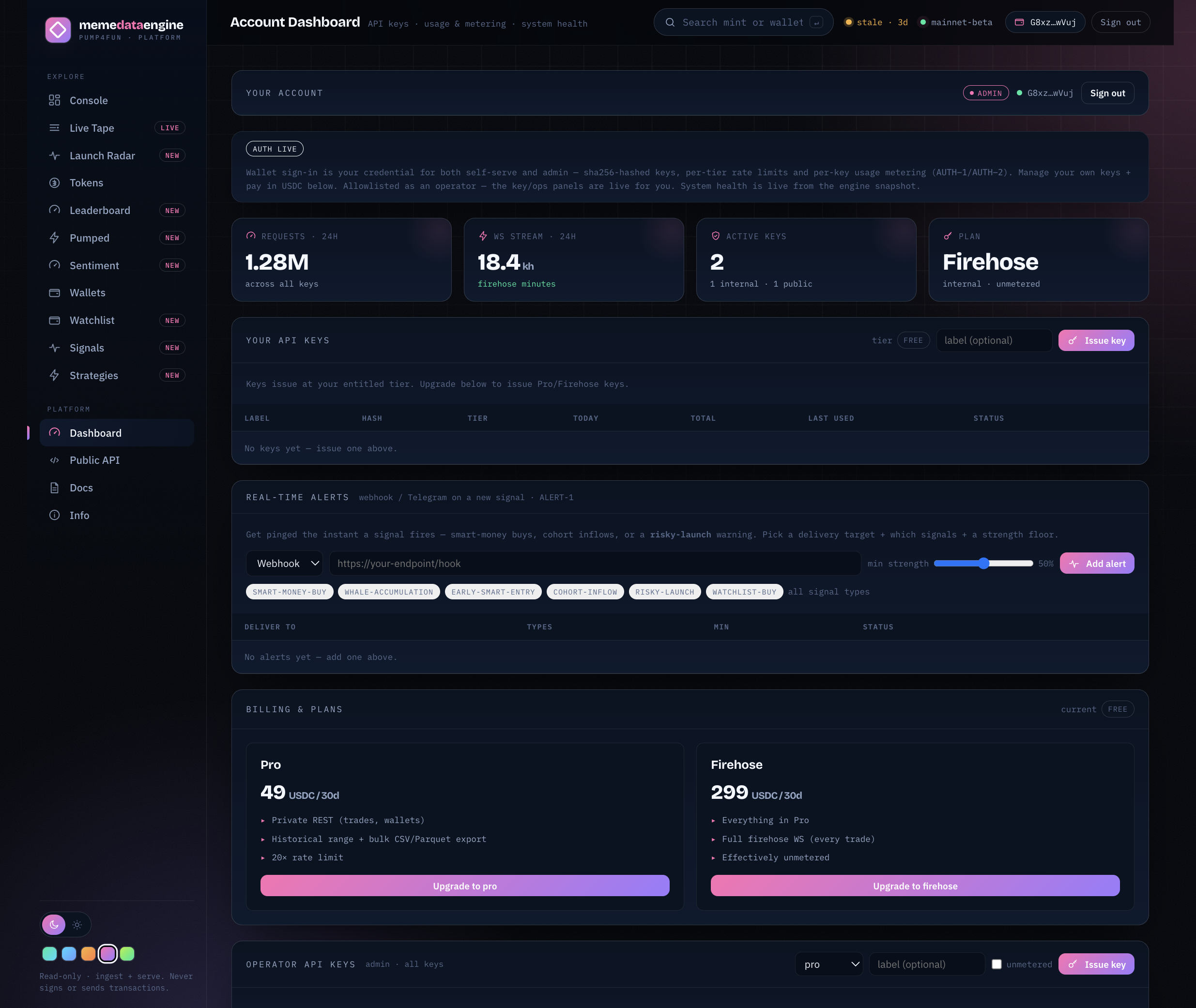
Honestly? It began as an experiment. A friend was building a memecoin trading product, and the more I dug into the problem the clearer it became that the durable asset was never the live feed — it was the decoded, retained, labelled history and the models on top of it. So I built the thing that would fund and feed his: an engine that owns the archive instead of renting a window. It grew, quietly, into a proper platform — API, SDK, USDC-billed tiers, the lot.
Status
Release Ready — commercially ready and running at 100% parity against the rented feed it replaces. What we are deliberately still deciding is what it should become — a public API anyone can build on, or a private in-house engine kept as an edge. Both doors are open on purpose.
Screenshots