BlackBoxAI
One human. One hundred robots. One action at a time.
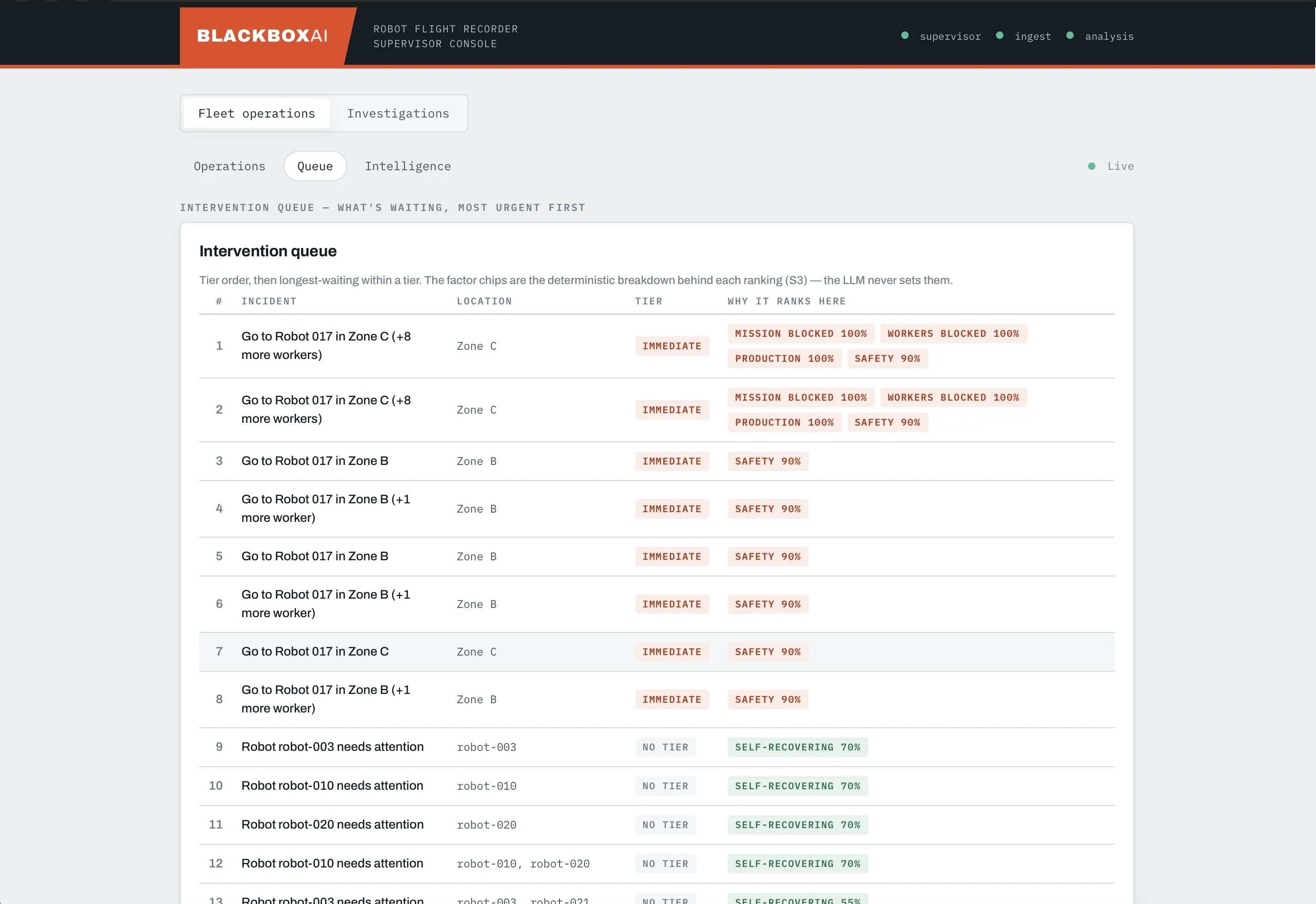
As robot fleets grow, human supervision does not scale — an operator can watch five robots, not a hundred. The hard part was never the number of alerts; it was the judgement. Which alert matters most, which robot recovers on its own, which problems share one root cause, and is it even safe to let the machine continue. BlackBoxAI performs that judgement continuously. It turns twelve thousand telemetry events a minute into one or two useful decisions — maintaining live awareness of every worker, recognising ordinary recovery and suppressing it auditably, prioritising exceptions deterministically, recovering autonomously where policy allows, and escalating precisely — not "navigation failure" but "Robot 17 is stopped near Bay 4 because its rear lidar is obscured; clear the obstruction and press Resume." It is free and open source, and it runs with or without an API key — use the Claude API, or connect Claude over MCP and keep every byte of telemetry on your own machine.
The layer
Observe → Decide → Act → Govern. BlackBoxAI is the operations layer that sits between an autonomous fleet and the human, and does continuously what a Lancashire mill foreman did instinctively among his looms — decide, moment by moment, what is normal, what is abnormal, what will recover on its own, and what genuinely requires a person.
The problem it solves
As robot fleets grow, human supervision does not scale. An operator managing five robots can watch screens and chase alerts. An operator managing a hundred cannot — and the hard part isn’t the number of alerts, it’s the judgement. Which alert matters most? Which robot recovers on its own? Which problem can wait? Which robots share one underlying cause? Is it safe to let the robot continue? Most fleet software still leaves all of that to the human. BlackBoxAI performs it continuously.
Not this — this
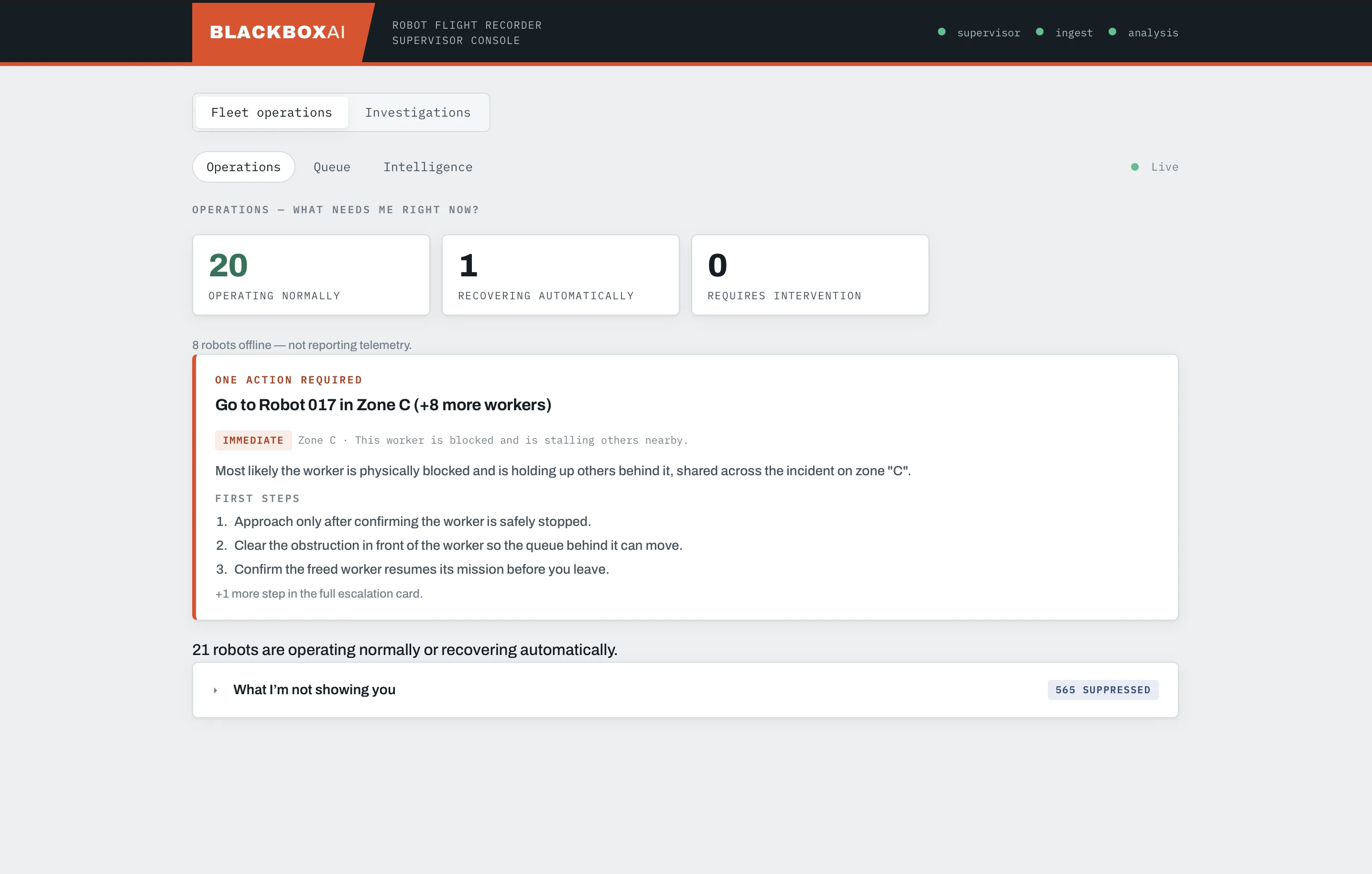
Not a hundred green and red dots:
Robot 1 — Warning · Robot 2 — Warning · Robot 3 — Healthy … Robot 100 — Healthy
But one decision:
Go to Robot 17 in Zone C. It cannot complete its recovery manoeuvre and is blocking the main transport corridor. Likely cause — rear safety scanner obstructed. 1. Check the rear scanner. 2. Clear any obstruction. 3. Press Resume. Estimated resolution — three minutes. The remaining 99 robots are operating normally or recovering automatically.
The metric that sells it
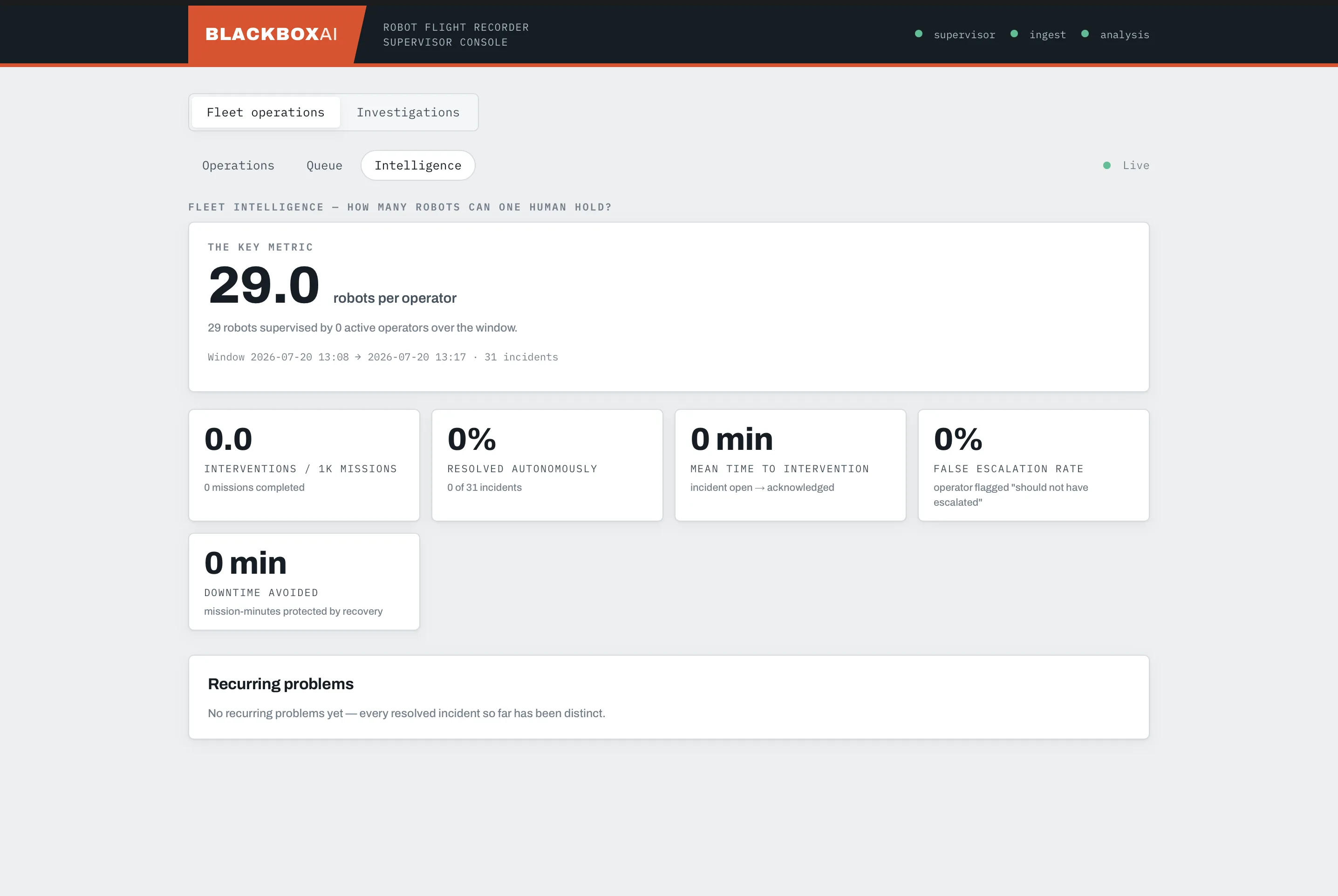
The most important number isn’t uptime. It is: how many robots can one human safely supervise? Before the supervisor, roughly one operator per ten robots; after it, one operator per hundred. That is a direct labour-and-scalability argument — and it is the economic heart of The Supervisory Economy, the essay this product grew out of.
Free and open source
BlackBoxAI is free and open source — the full source lives on GitHub ↗. Self-host the four containers — console, ingest, analysis, supervisor — read every line, and keep your telemetry on your own infrastructure. It runs with or without an API key — use the Claude API and it sends only a windowed, redacted, disclosed prompt; or connect Claude over MCP and no byte of telemetry ever leaves the machine.
The bigger picture
BlackBoxAI is the robotics endpoint of a broader Supervisor Pattern — one intelligent supervisor managing many autonomous workers. The supervisor brain never changes; only the workers do. To it, a robot is just another endpoint, which is why AI-agent fleets ride the exact same contracts. It is the physical-world sibling of The Governor, the operating system for software agents. Read the essay or request a briefing.
Screenshots