The Supervisory Economy
Why the scarcest resource of the machine age will be human judgement. The autonomous workforce is not coming — it is already clocked in, wearing the disguises of warehouse robots, driverless trucks, surgical systems and software agents. Across every one of them the binding constraint is the same, and it is no longer intelligence. It is supervision. A Lancashire foreman could watch eighty looms because better systems let him filter signal from noise; the productivity lived in the ratio, not the machine. The next great gain will not come from making each worker cleverer but from making each human responsible for more of them — and that demands a discipline still without a name — the management of autonomous workforces.
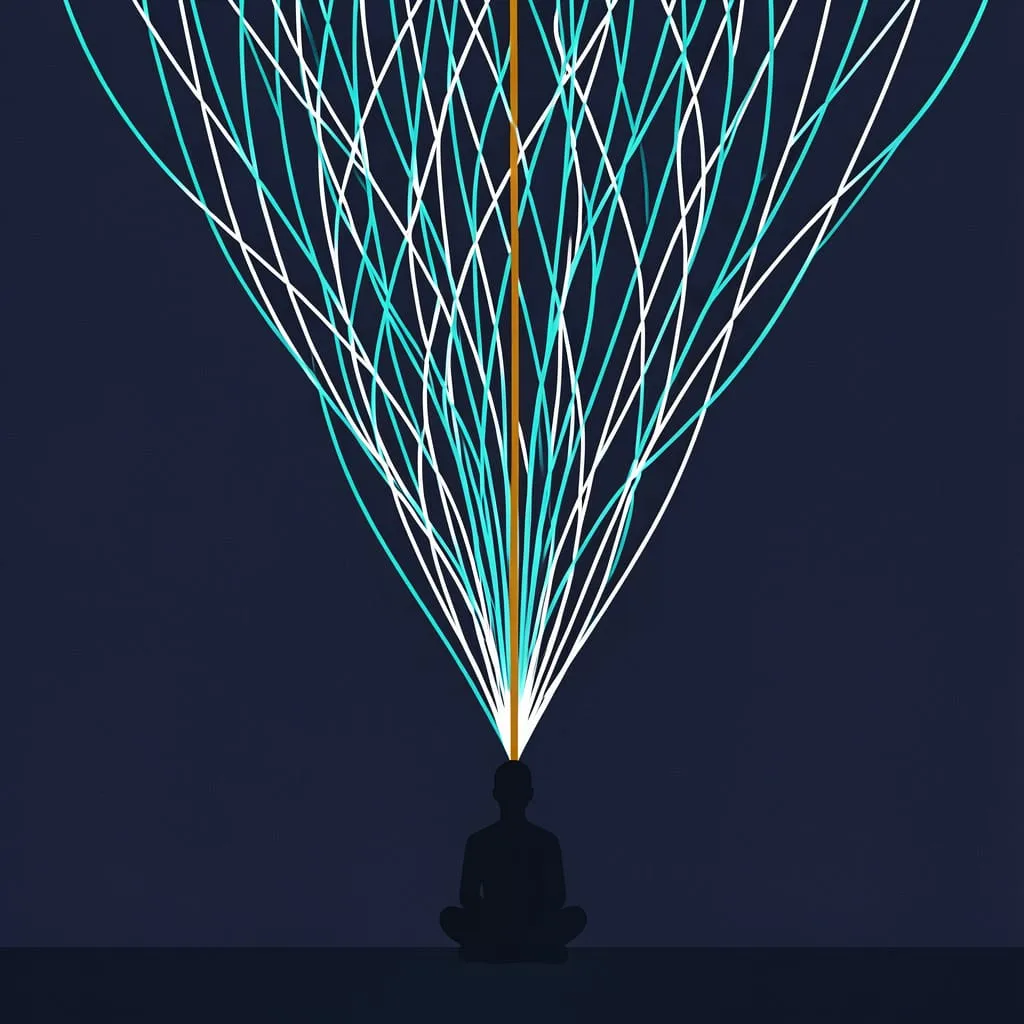
Why the scarcest resource of the machine age will be human judgement.
There are photographs from the Lancashire cotton mills of the early twentieth century in which a single man stands before long rows of automatic looms, clattering away without a human hand on any of them. The man is not weaving. He is watching. When a thread snaps or a shuttle jams, he walks over, fixes it, and returns to his post. He is a foreman, though the more honest job title would be supervisor of machines, and he represents one of the least celebrated but most consequential inventions of the industrial age.
We tend to remember the loom. We rarely remember the man watching it. Yet the productivity miracle of the nineteenth century was never really about any single machine. It was about the discovery that one person, properly equipped and properly positioned, could be made responsible for a great many machines at once. The loom made cloth. The foreman made the loom economical. Everything we now call modern industry followed from that unglamorous arrangement.
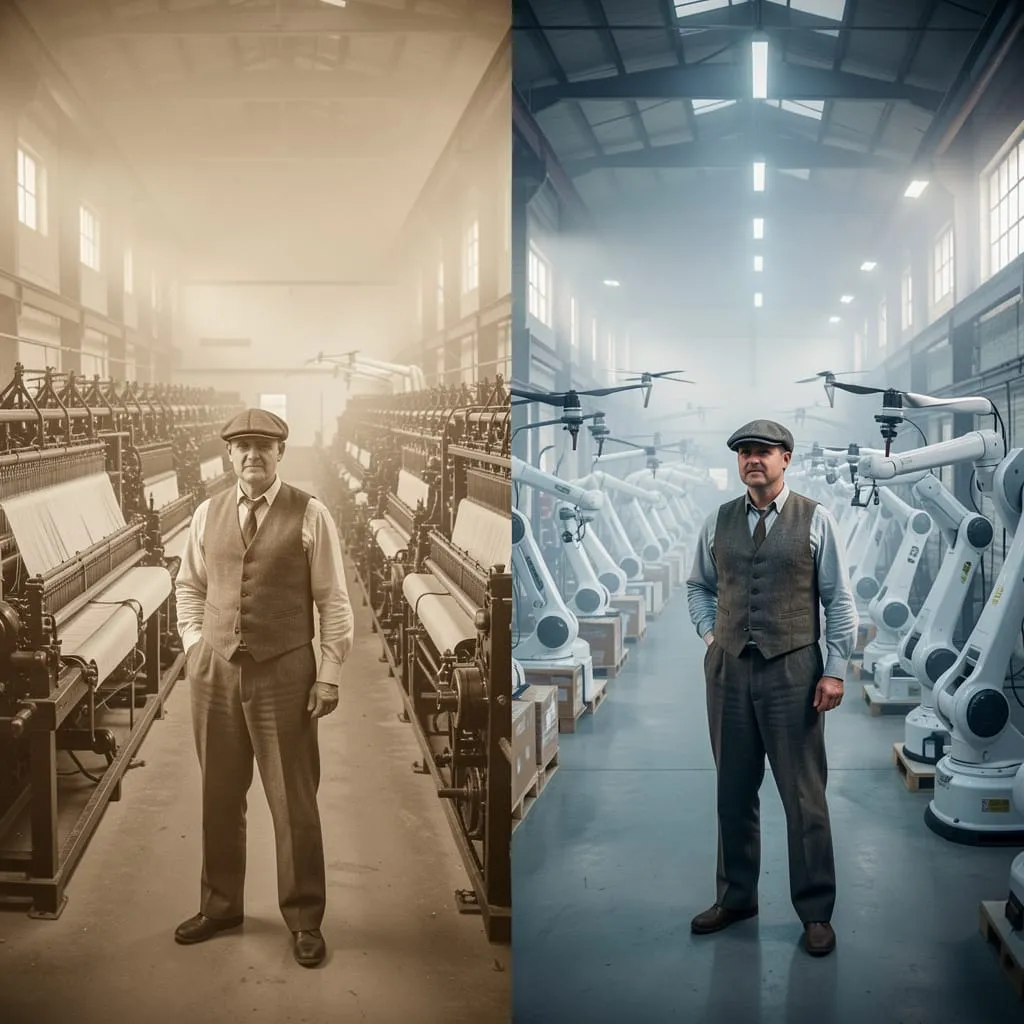
It is worth holding that image in mind, because we are about to reinvent it — only this time the machines will not sit still, and they will not all look alike.
Every revolution is a management revolution in disguise
The comforting story of industrial progress is one of ever-cleverer devices: the steam engine, the dynamo, the transistor, the microchip. It is a story of things. But if you look at what actually changed inside the organisations that adopted these things, you find that the deeper transformation was almost always managerial. New machinery forced new ways of coordinating human effort around it, and the firms that thrived were rarely those with the best machines. They were the ones that worked out how to organise the machines fastest.
The railways did not merely lay track; they invented the modern management hierarchy, because no single person could hold a continental timetable in their head. Henry Ford’s genius is remembered as the assembly line, but the line was only half of it — the other half was a system of supervision that turned a mob of craftsmen into a choreographed flow. The computer did not just calculate; it obliged entire professions to rethink who decided what, and when, and on the strength of which information.
Seen this way, an industrial revolution is not principally an upgrade in what machines can do. It is an upgrade in how many of them a human being can be responsible for at once. The machinery gets the statues in the town square. The management innovation quietly does the heavy lifting.
We are now living through another such moment, and we are making the usual mistake. We are staring at the machines.
We already command fleets — we just don’t call them that
There is a widespread assumption that the age of autonomous workers is something still on the horizon, arriving perhaps when a humanoid robot finally strides out of a laboratory and into our kitchens. This is a failure of imagination, and a rather charming one. The autonomous workforce is not coming. It is already clocked in — and it wears a remarkable variety of disguises.
Walk through a modern fulfilment centre and you will find hundreds of squat orange robots ferrying shelves across the floor, each one navigating, charging and re-routing itself with only the lightest human touch. Look up from an Australian iron-ore mine and you will see driverless trucks the size of houses hauling ore around the clock, overseen from a control room a thousand miles away. Hospitals run surgical systems of extraordinary precision. Farms fly drones that scout, spray and count. Ports move themselves, their cranes swinging containers with nobody in the cab. And in offices far from any warehouse floor, software agents now write code, reconcile accounts and triage tickets through the night — workers with no body at all, yet autonomous in every sense that matters to the person nominally in charge of them. Almost none of these workers looks remotely like a person, and that is precisely why we have failed to notice what they have in common. We filed the robot under logistics, the drone under agriculture, the coding agent under IT, and never joined the dots.
The dots, once joined, form a striking picture. Physical or digital, embodied or not, these are all members of a single emerging category — the autonomous worker — and across every setting where they toil, the same underlying question has quietly become the binding constraint. It is not can we build another one? We can, and cheaply. It is how many can one human safely watch over at once?
The bottleneck is no longer intelligence. It is supervision.
Five years ago, the scarce resource in this story was machine intelligence — the frontier was whether the machine could do the work at all. Five years from now, the scarce resource will not be intelligence. Machine intelligence, it turns out, can be reproduced, deployed and rented by the hour. The thing that cannot scale at anything like the same rate — the thing that remains stubbornly, biologically constrained — is trusted human judgement. Everything else in the system can be multiplied. The supervisor cannot.
Which brings us to the insight that I think matters most, and it is one the cotton mill understood instinctively. The next great gain in productivity will not come from making each worker cleverer. It will come from making each human responsible for more of them.
Consider our Lancashire foreman again. He did not become more valuable because the looms grew stronger or more intelligent. The looms of 1900 were, if anything, rather stupid — they could weave and they could stop, and that was about the extent of their inner life. He became more valuable because better systems of layout, signalling and standardisation allowed him to look after eighty looms instead of eight. The productivity was not stored in the looms. It was stored in the ratio — the number of machines per supervising human — and every improvement in that ratio flowed almost directly to the bottom line.
The same arithmetic is about to reshape the economics of autonomy. A robot that costs a fortune to run because it demands one full-time human babysitter is a curiosity. The same robot becomes an economic revolution when one operator can attend to ten of them, then fifty, then two hundred. Each increase in that ratio changes the economics more profoundly than another incremental improvement in the intelligence of the machine. That ratio — not the intelligence quotient of any individual worker — is where the enormous value hides. We have spent a decade obsessing over how smart we can make each machine. We have spent almost no time on the far more lucrative question of how many one person can be trusted to command.
Economists have spent decades measuring labour productivity as output per worker. The coming decade may demand a new ratio altogether: autonomous workers per human supervisor. It sounds almost absurd written down, yet it captures the economic heart of the age now emerging. A factory in which one person safely supervises ten autonomous workers is a very different business from one in which they supervise a hundred — not ten per cent different, but different in kind, with different margins, different labour requirements and a different answer to the question of where it can profitably operate. The machines may be identical. The economics are transformed.
And “trusted” is the operative word, because this is where the analogy to the cotton mill breaks down in an important and rather thrilling way.
Why the dashboard is a dead end
The instinctive engineering response to “watch two hundred machines” is to build a dashboard. Give the operator a wall of screens, a river of telemetry, a constellation of blinking lights, and let them keep an eye on everything. This is a natural idea, and it is almost entirely wrong, for reasons that have nothing to do with software and everything to do with the stubborn architecture of the human mind.
A person can attend to a small number of things at once. Not a hundred; not a thousand; a handful. This is not a flaw to be trained away — it is a fixed property of our species, as reliable as gravity. Point a single human at a thousand streams of live data and one of two things will happen, both of them bad. Either the operator will be overwhelmed by the sheer torrent and begin, quite sensibly, to ignore it — the state that safety engineers grimly call alarm fatigue, and which has sat at the root of disasters from chemical plants to cockpits. Or the operator will fixate on the few streams they can actually follow and be blind to the ninety-nine they cannot. The wall of screens does not solve the problem of attention. It industrialises it.
A fleet does not fail politely, one machine at a time, in an order convenient for a human observer. It fails in bursts and cascades, at three in the morning, in ways no roster of screens can triage. The uncomfortable truth is that the thing standing between us and enormous fleets of autonomous workers is not a hardware problem or even really an artificial-intelligence problem in the usual sense. It is an attention problem. And you cannot fix an attention problem by adding more things to attend to.
What the foreman actually did
So let us return, one last time, to the man in the mill, and ask what he was really doing as he stood among his looms. He was not, in truth, watching all of them. He was doing something far more sophisticated, so instinctive that he could not have described it. He was continuously judging what was normal. He let the ordinary clatter of a healthy loom wash over him unremarked. He allowed small hiccups that he knew would sort themselves out. He noticed the one sound among a hundred that meant a thread was about to break, and he moved toward it before it did. And he reserved his hands — his scarce, irreplaceable, physically-present human hands — for the few problems that genuinely required them.
This is a pattern, and it is a very old one. The supervisor’s true function is not to observe everything. It is to filter — to separate the signal that needs a human from the vast, roaring noise that does not. Normal is ignored. Self-correcting trouble is left to correct itself. Genuine exceptions are ranked by urgency. And only the residue, the small hard core of situations that demand real judgement or a physical intervention, is ever allowed to reach the person. The foreman was, in effect, a living algorithm for the allocation of scarce human attention.
The trouble is that a living foreman does not scale much past a hundred looms in one room. He cannot be in two mills at once, and he certainly cannot supervise a drone in Nevada, a forklift in Rotterdam and a delivery robot in Seoul at the same instant. The human capacity for judgement is precious precisely because it is limited, and no amount of goodwill or caffeine expands it. If we want the ratio to climb — one operator to ten machines, to fifty, to two hundred, scattered across space and even across categories — then the filtering itself must be done by something that does not tire, does not blink, and does not have to walk across the floor.
A new discipline without a name
Which brings us, at last, to the shape of the thing the coming decade seems to require, and to a discipline that does not yet quite have a name.
As autonomous systems multiply — and they will multiply across every genre and disguise, the humanoid alongside the drone alongside the software agent alongside the autonomous truck — every serious organisation is going to need an operational layer whose entire job is to manage them. Not to build them; we are already rather good at that. Not to control each one by hand; that way lies the wall of screens and the exhausted operator. But to sit between the fleet and the human, and do continuously what the foreman did instinctively: to decide, moment by moment, what is normal, what is abnormal, what can recover on its own, and what genuinely requires a person.
Notice that this is not really a robotics problem at all. It is a management problem, and it simply becomes easiest to see in robotics, because physical fleets make the supervisory problem impossible to ignore. The very same layer will, within a decade, be asked to supervise software agents that never touch the physical world, drone swarms that fill the sky, logistics networks that drive themselves, and humanoids that do all of it at once — managed not as separate industries with separate control rooms but as a single, mixed workforce of digital and physical workers. We spent the better part of a century teaching machines how to work. The task of the next decade is to teach organisations how to manage them — and that is a genuinely new discipline, the management of autonomous workforces, still waiting for its textbooks and its town-square statues.
If that future arrives as it appears to be arriving, then perhaps every organisation will eventually need a supervisor. Not a human supervisor, worn thin by a wall of alarms, but a software one — a layer that watches the machines so that the humans no longer have to. It would filter the operational noise, shepherd the routine recoveries, rank the exceptions by genuine urgency, and send the operator to just those few places where human judgement, or a human hand, is truly required. One human. One hundred robots. One action at a time.
I have since gone and built exactly this. It is called BlackBoxAI, and it is free and open source — a software supervisor that turns a fleet’s telemetry into a single prioritised human intervention queue, recognises ordinary recovery and suppresses it auditably, and sends the operator to the one robot that genuinely needs them. It is the robotics endpoint of the same Supervisor Pattern; to it, a robot is just another endpoint, which is why software-agent fleets ride the identical contracts.
Every industrial age has celebrated its machines. Steam engines fill museums. Aircraft hang from ceilings. Rockets stand in city squares. Yet history suggests that the greatest inventions are often invisible — not the machines themselves, but the systems that allow ordinary people to command extraordinary numbers of them. The coming century may remember the robot. It may even remember the model that gave the robot its intelligence. But the quieter invention — the one that allows a single human judgement to coordinate thousands of autonomous workers — may prove to be the one that changed civilisation. The loom, after all, got the statue. The foreman got the future.