Vibe Science: What Happens When You Take a Joke Seriously
An internet meme — a cosmic egg in the lineage of a declassified 1983 CIA paper on consciousness — got taken out of the drawer of disreputable ideas and put through modern mathematical physics. Exact modular Hamiltonians, relative entropy in a de Sitter causal diamond, the Bianchi identity. The black-hole conduit died by seventeen orders of magnitude. The hologram survived, transformed. The final verdict is a boxed zero — and the zero is worth more than the drawing that started it. On provenance being irrelevant and discipline being everything, on the strange new habitable middle ground between the trained professional who cannot afford to look silly and the dreamer who has no way of being wrong — on an aluminium ion in Colorado now precise enough to ask whether the constants hold still at all, which is the same impertinent question from the other end — and on the dark science, the ninety-five per cent of the universe still filed under a synonym for we don't know, which is exactly where the next overturning is hiding.
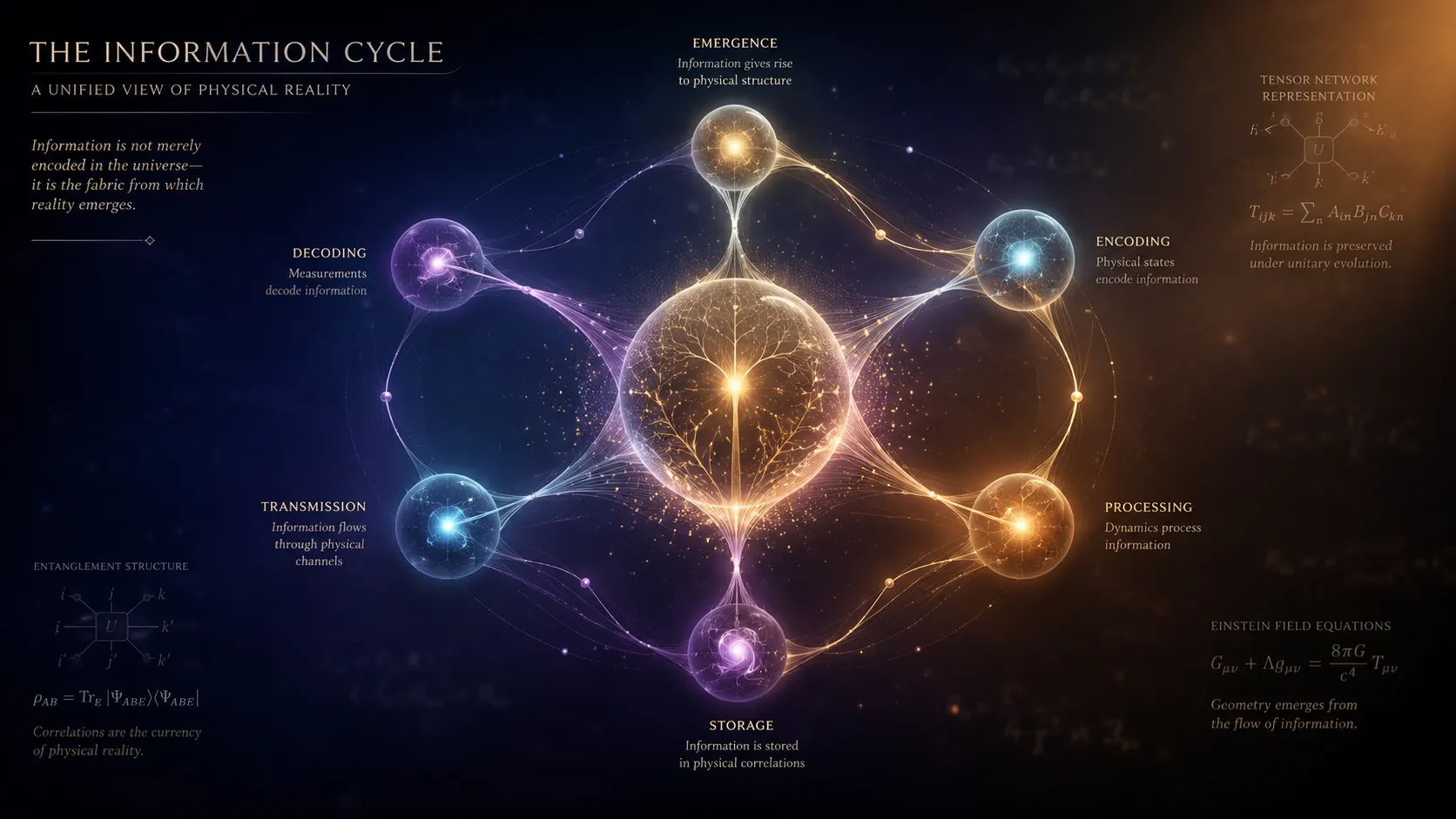
On internet memes, de Sitter space, and the strange new art of thinking out loud with a machine.
I should say at the outset why this exists at all: because I find it genuinely fun to explore ideas, however wacky. It is the curiosity of the human mind that brings innovation — not the tidiness of it. And being able to pressure-test those ideas with tools like this one makes the journey, the thought experiment, so much more delightful than it used to be. What follows is one such experiment, taken further than it had any right to go.
The drawer
Every physicist — indeed, every curious person — keeps a drawer. You know the one. It’s where ideas go when they’re too disreputable to mention at dinner parties and far too interesting to throw away. A half-formed hunch. A pattern that’s probably a coincidence. A diagram you saw somewhere ridiculous that has, annoyingly, refused to leave your head.
This is the story of what happened when one of those drawer-dwellers was taken out, dusted off, and — rather than being either believed or mocked — was audited.
The specimen in question is a genuine oddity: a “cosmic egg” diagram in the lineage of a declassified 1983 CIA analysis of consciousness (the Gateway Process, for connoisseurs of the weird), which has circulated the internet for years as a curiosity. A toroidal universe. A black-hole/white-hole nucleus. A holographic substrate. Time-space “evolving” around a closed loop. It is, let’s be perfectly honest, a meme. Nobody sensible cites it. It contains no mathematics, no mechanism, no predictions. It is the sort of thing that makes a proper academic reach quietly for the door.
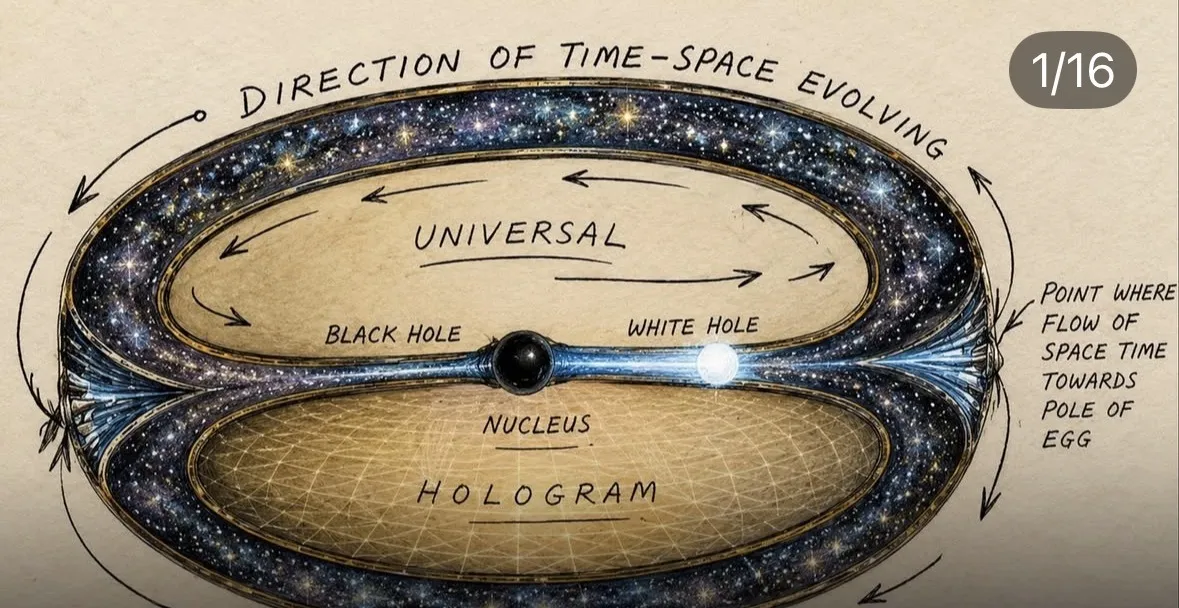
The origin artifact. No mathematics, no mechanism, no predictions — treated here not as a claim but as a hypothesis generator, and nothing more.
And yet. Here’s the itch that started everything: nearly every intuition in that daft drawing rhymes with something real. The hologram rhymes with actual holography — one of the most productive ideas in modern theoretical physics. The loop rhymes with cyclic cosmologies that serious people genuinely work on. The nucleus rhymes with bounce proposals. Even the torus rhymes with CMB topology searches that have actually been carried out, by actual scientists, with actual telescopes.
So a question suggested itself, half in jest: what if there’s more than a grain of truth in the old meme? What is the largest fragment of this picture that can be forced through modern mathematical physics — exact modular Hamiltonians, relative entropy, the Bianchi identity — and survive the trip?
That question, dear reader, is what I’ve started calling vibe science. And before you wince, let me explain why I think it might matter.
Provenance is irrelevant; discipline is everything
There’s a marvellous precedent for all this. Kekulé claimed the benzene ring came to him as a snake biting its own tail — a dream, an ouroboros, about as scientifically respectable as a horoscope. Organic chemistry survived the embarrassment, because what mattered wasn’t where the idea came from. It was what happened next: the ruthless testing, the derivations, the willingness to let the molecule disagree.
That’s the engine at the heart of vibe science. The vibes get you started — the curiosity, the playfulness, the willingness to entertain something your colleagues would file under “crackpot.” But then discipline takes the wheel, and discipline is utterly without sentiment. Every intuition in the cosmic egg was priced. The black-hole conduit? Retired by seventeen orders of magnitude — killed quickly, and by a large margin, which is exactly how bad ideas ought to die. The hologram? It survives, transformed, as relative entropy on horizons. The loop? It survives too, sharpened into something the original doodler would barely recognise: a precise cycle running from matter to horizon information to modular dynamics and back again.
The meme was never treated as a claim. It was treated as a hypothesis generator — and each hypothesis it generated was derived where possible, priced where derivable, and retired where the arithmetic demanded.
Seven stages, five executions
The thing I find most satisfying about the exercise is not what survived. It’s the kill list. Between the first poster and the final paper, five load-bearing ideas were executed — and none of them because they stopped being attractive. Each was removed by something specific: a missing observable, a missing invariant definition, a rejected free parameter, a first-order decoupling, a factor of ten to the eighteen.
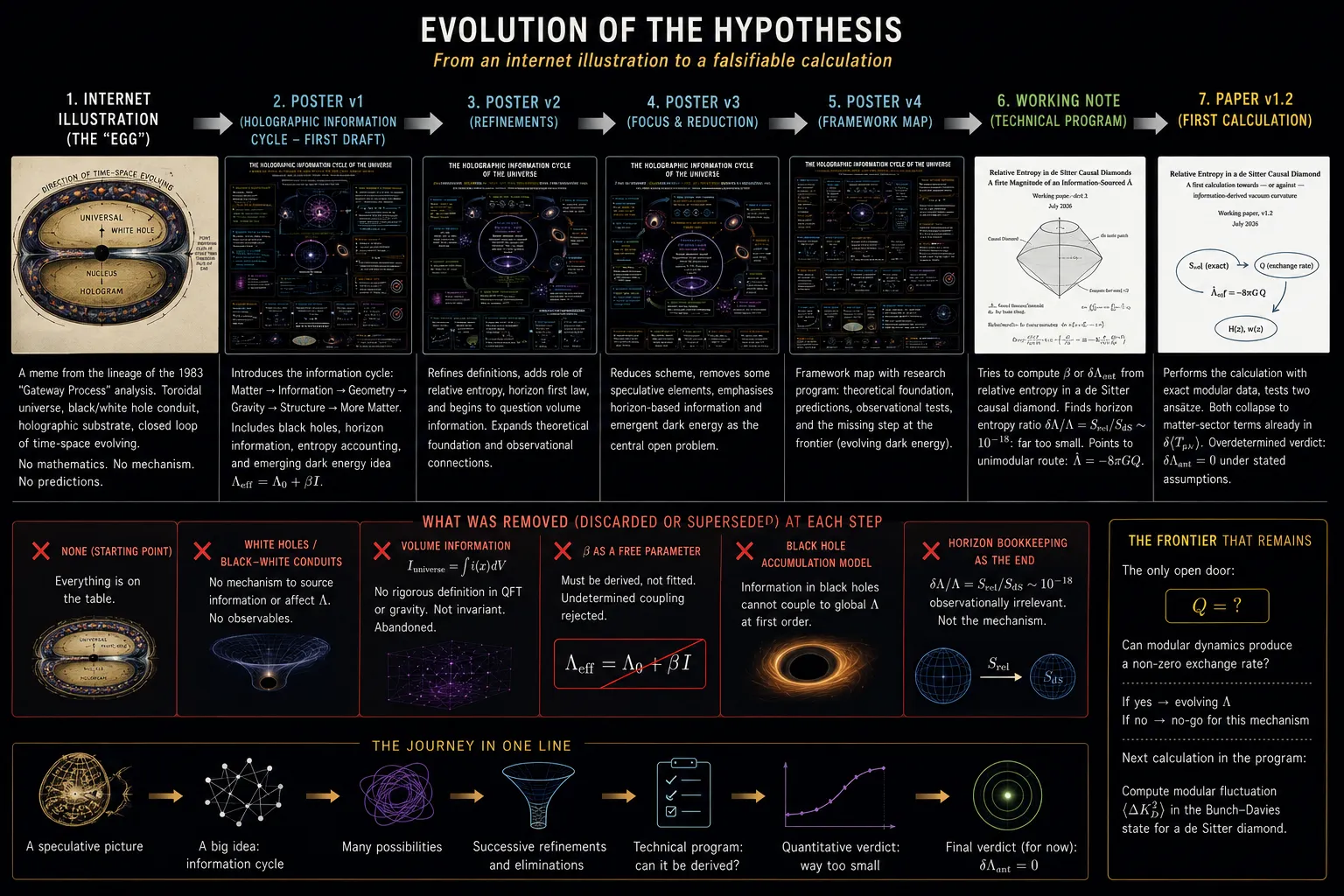
Seven stages from meme to calculation, with the removal track underneath. White holes, volume-integrated information, a fitted coupling, black-hole accumulation, horizon bookkeeping as the mechanism — each executed by something specific, none abandoned merely for going out of fashion.
Papers report what survived. They rarely report the survivorship pressure — and in speculative territory the pressure is the result. What remains at the end is far smaller than what began, and considerably more valuable for it.
The audacity of the actual question
Now, here is where I must correct an impression you might be forming — that this is merely a charming exercise in debunking. It is not. The question being asked is one of the biggest in physics.
The framework under test conjectures that the cosmological “constant” — the mysterious Λ that drives the accelerating expansion of the universe, the thing we politely call dark energy because we haven’t the faintest idea what it is — might not be a constant at all. It might be emergent: derived from the entanglement dynamics of quantum information on cosmic horizons. Λ_eff = Λ₀ + βI, with the crucial rule that β must be derived, never fitted.
Stop and consider what it would mean if that were true. It would explain where the cosmological constant comes from — one of the deepest unsolved problems in all of science, the question on which quantum mechanics and general relativity most spectacularly fail to agree. It would extend the “geometry from entanglement” programme — genuinely one of the most exciting research directions of the past two decades — from toy universes to our universe. It would be, not to put too fine a point on it, the sort of result careers and prizes are made of.
That is not a modest question smuggled in behind a joke. That is the joke being used as a ladder to reach one of the highest shelves in physics.
What the mathematics actually said
The first rigorous calculation — relative entropy in a de Sitter causal diamond, using only exact, established results — returned its verdict: at first order, under clean assumptions, the entanglement mechanism generates no shift in the vacuum curvature. δΛ_ent = 0. Not once, but overdetermined: three independent structural facts each force the answer.
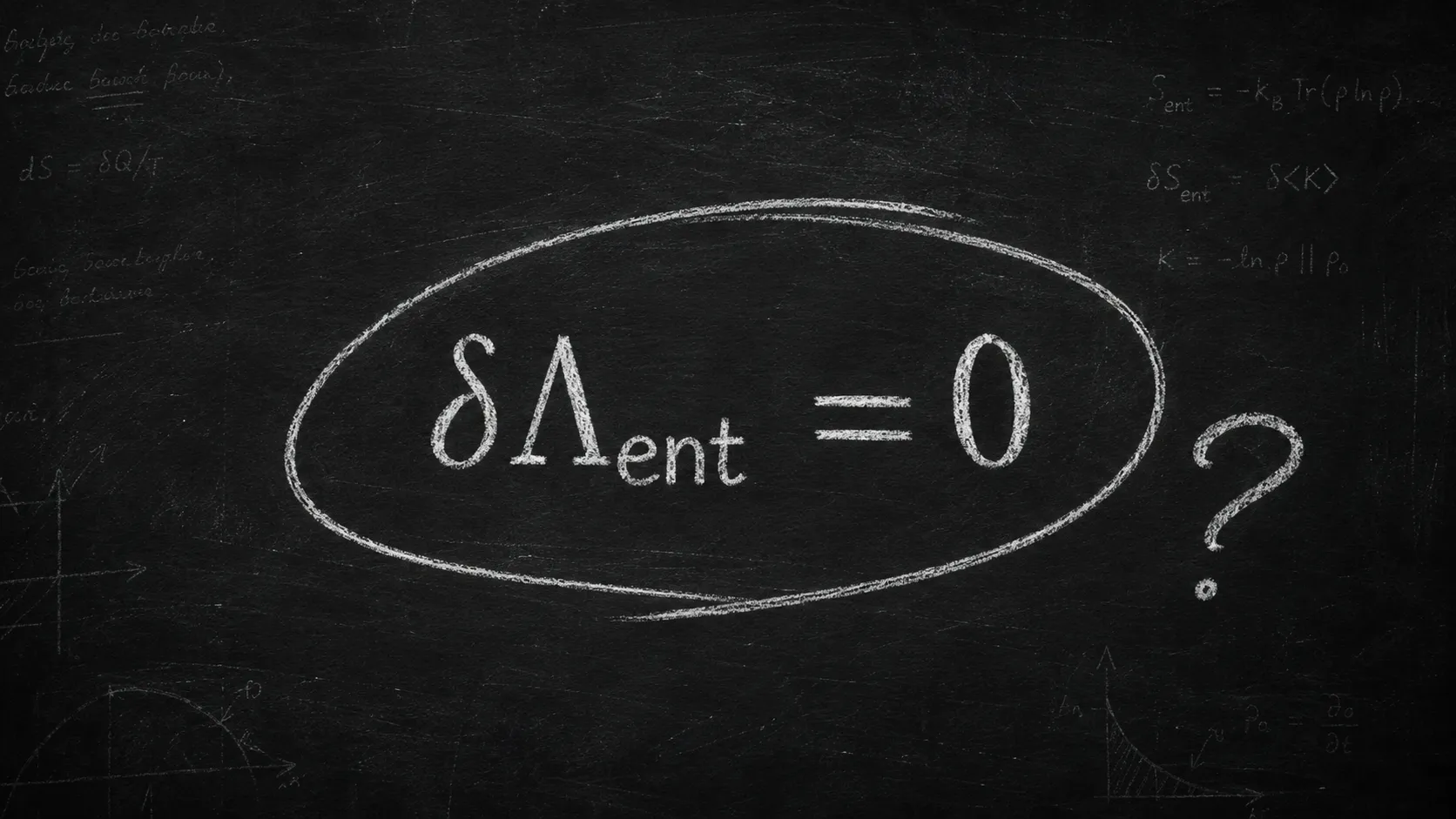
The whole programme, compressed into one boxed zero: δΛ_ent = 0, under the stated assumptions — conformally coupled scalar, Bunch–Davies vacuum, coherent perturbation, finite diamond, first order in backreaction. Four posters became this. The question mark is the honest part.
Is that a defeat? Only if you think science is about being right on the first swing. The null result is load-bearing. It says precisely where the treasure isn’t, which is how every real treasure hunt proceeds. Better still, the calculation came back with a ranked list of exactly five doors that remain open — non-conformal matter, second-order Fisher information, state-dependent modular flow, type-II quantum corrections, and a posited unimodular flux — the first being the most tractable, and the last the only one structurally capable of producing a genuinely time-dependent Λ. The programme is designed so that it cannot end in ambiguity: it terminates either in a no-go theorem (a real contribution to quantum gravity) or in an entanglement-derived exchange law (a far bigger one).
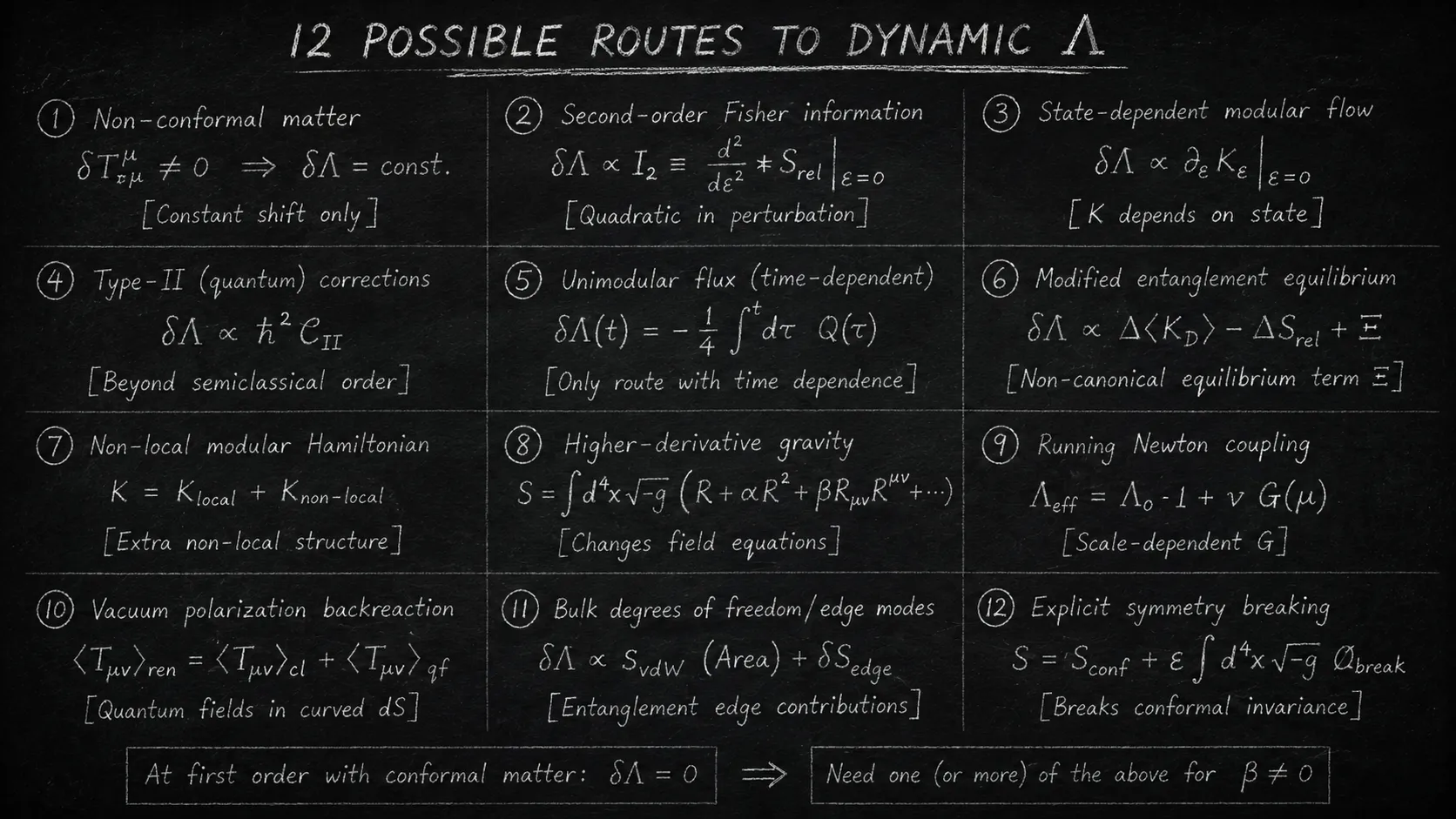
The map of what is left. The paper’s ranked five are numbers 1–5 here; the remaining seven widen the search rather than replace it. Note the bracket under number 5 — of all twelve, unimodular flux is the only route that carries time dependence at all, which is why an evolving dark energy has to come through that door or not at all.
That grid is the honest state of play, and I rather like that it fits on a blackboard. Every one of those twelve is a specific, checkable structure. Nothing there is hand-waving; each is either derivable or it isn’t, and finding out is just work. A meme with no mathematics in it produced, eventually, a to-do list.
And lurking in the background, tantalisingly: the DESI survey’s data currently prefers evolving dark energy over the standard model at around three sigma. Motivation, not proof — the paper is scrupulously careful to say so. But the universe has not yet ruled the idea out. If the mathematics eventually proves the thesis right, this stops being a story about method and becomes a story about discovery. If it proves it wrong, we get a clean theorem. Either outcome is a win. That’s not spin; that’s how the programme was deliberately built.
The machine in the room
There’s one more ingredient, and it’s the one I suspect will age most interestingly. This entire exercise was conducted in conversation with a large language model — not as an oracle, but as a tireless, well-read, occasionally brutal interlocutor. The AI’s running commentary is included in the paper itself, and it is not flattery: its first assessment called the framework “a beautifully assembled collage of real physics ideas, not yet a theory.”
Let me be clear about what I am not claiming. I am not claiming to have discovered anything new — that is almost certainly not the case, and the boxed zero at the end of the working paper says as much in the most unambiguous language mathematics offers. I am not an academic. I have no institutional standing to defend, no reviewers to appease, no career to bet. What I have is curiosity, a meme, and a machine that has read essentially the entire physics literature and will happily spend all night telling me why I’m wrong.
But here is the hypothesis I am willing to float — offered with exactly the tentativeness the method demands. What if some of the next areas of human discovery come from the armchair warrior, using tools like this one to stumble across hypotheses at heights they were never supposed to reach?
Think of it as a question of terrain. On one side stands the classical scientist: rigorous, trained, and necessarily constrained — by the priors of their field, by what is fundable, by what is publishable, by the entirely sensible professional instinct not to be seen entertaining nonsense. On the other side sits the idea-shower merchant: unconstrained, exuberant, and usually baseless — all vibes, no audit, the cosmic egg believed rather than tested. Both sides wear a fabric of constraints, just cut from different cloth. The scientist’s guardrails keep them on the road but also on the map. The dreamer has no map, no road, and consequently no way of knowing whether they’ve arrived anywhere at all.
Somewhere between the two, I suspect, there is a middle ground that has never really been habitable before — because occupying it used to require both a professional’s command of the literature and an amateur’s freedom from it, and no single human could hold both at once. Now the literature can sit on the other side of the conversation. The armchair explorer supplies the unguarded curiosity; the machine supplies the guardrails on demand — the derivations, the counterexamples, the seventeen-orders-of-magnitude corrections — without ever once worrying about tenure. Neither party in that partnership carries the full fabric of constraints, and so together they can push into ideations that neither the academy nor the dreamer would reach alone. The professional’s discipline is a superpower, but every filter discards signal along with noise. The amateur’s filter is set differently. Occasionally — rarely, but occasionally — differently is better.
A confession from the cheap seats
I should also come clean about where all this curiosity actually comes from. I am an avid consumer of podcasts across a healthy range of genres — and science is firmly one of them, physics most of all, because physics really is a way of understanding what is actually around us. What makes everything tick. Do I understand it all? Certainly not. Great swathes of it sail past me at altitude. But I find it endlessly interesting, and interest, it turns out, is a renewable resource: it’s precisely why a silly meme of a cosmic egg could snag on something in my head and refuse to let go. Because what if there were a whiff of exploratory truth somewhere in that drawer of dismissed ideas? And if I’m honest, I mostly wanted to prove the meme wrong — that is what actually took me down the rabbit hole. I’ll afford myself a few hours of fun, I thought, and that in itself will enrich my learning and understanding at least a little. (A good deal of that time went nowhere near the frontier. It went on breaking the underlying theories down into something an armchair consumer could actually follow.)
Only recently, one of them told the story of a single aluminium ion in a Colorado laboratory — held motionless, cooled to a whisper above absolute zero, ticking so regularly that a clock built around it wouldn’t slip a second across the lifetime of the universe. And the first thing that clock turned out to be precise enough to check was whether the fixed numbers underneath all of physics are actually fixed. Sit with that for a moment. The fine structure constant, the gravitational constant — none of them derived from anything deeper, all of them written into the equations by hand because that’s what the experiments say. And a measured quantity, unlike a mathematical necessity, has no obligation whatsoever to hold still. Which is, you may notice, the very same impertinent question this whole exercise has been asking of the cosmological constant: what if the universe’s most famous fixed number has a history? When the armchair and the world’s most precise instrument find themselves wondering the same thing, the armchair is entitled to feel a little less silly.
The clock and the constant
In fact, the connection runs deeper than a pleasing rhyme, and it’s worth laying out honestly — in three layers, each less solid than the one beneath it, clearly labelled as such.
The first layer is established physics, and it was never in question. Time really does run at different rates depending on where you stand and how you move — measured in a Harvard stairwell in 1959, confirmed with atomic clocks flown around the world in passenger seats, now detectable across a single millimetre of height. None of that threatens anything in this programme; it is the general relativity the whole framework is built upon. Your head ageing faster than your feet is the floor we’re standing on, not a crack in it.
The second layer is where it gets properly interesting. In the theory literature, varying constants and evolving dark energy are frequently two faces of the same mechanism: a slowly rolling scalar field can make the fine structure constant drift and make the vacuum energy evolve. If a clock ever catches a real drift, it would demonstrate that “constants” can be dynamical — and a time-dependent Λ would instantly stop being heresy and become a member of a family. Better still, this walks in through precisely the doors the working paper left open. The null result was forced by, among other things, the assumption of conformal matter — and a constants-drifting scalar field is exactly non-conformal matter, the first-ranked escape route. The only structure the calculation found capable of a genuinely evolving Λ was an exchange flux between matter and vacuum — exactly the sort of thing a rolling field supplies. Drifting constants wouldn’t contradict the boxed zero; they’d stroll in through the very exits it signposted.
The third layer is the speculative and delicious one. The question the clock forces — if the constants are drifting, what are they drifting through? — brushes against a serious proposal called the thermal time hypothesis: that time itself is nothing but modular flow, emerging from entanglement structure. And modular flow is, quite literally, the mathematical engine of the working paper. On that view, “where does dark energy come from?” and “what is time?” aren’t neighbouring questions. They’re the same building, different floors.
One caveat, stated with the care the method demands: no drift has actually been detected. The clocks so far have delivered exquisitely tight bounds — the constants are holding still to an absurd number of decimal places, as far as anyone can tell. The Boulder instrument makes the question checkable; it has not yet answered it. So the honest framing is not “time is slipping and our variables are wrong.” It is that the world’s most precise instrument and one amateur’s armchair are now, remarkably, interrogating the same suspect.
And listening from the cheap seats gives you a useful perspective on something the experts sometimes seem too polite to mention: an awful lot of the grandest ideas in physics are, formally speaking, still hypotheses. String theory is a theory. A holographic, information-driven universe is a theory. The multiverse is a theory. Time travel is a theory. We don’t yet know — none of us, not the podcast listener and not the professor. And if you rewind far enough, everything we now call settled science began life as somebody’s science fiction: an idea, a hypothesis, a thought experiment about riding alongside a beam of light. Einstein chasing that light beam. Dirac trusting a beautiful equation over common sense and predicting antimatter. Wegener being laughed out of the room for suggesting the continents drift. The pattern is always the same — someone builds a hypothesis strange enough to be interesting, and then people probe it, push it, test it, and out of that scrum comes the new thing.
I am emphatically not saying this paper is that. But ideations like this — the daft ones, the meme-born ones, the ones assembled in armchairs with a tireless machine for company — may well be the micro tipping points from which something new is one day discovered. One of them, eventually, will be.
Anyway. Over to you, scientific boffins.
The point of the whole exercise
Whether this particular thesis lands is, in the loveliest way, beside the point. If it’s proven right: wonderful. If it’s proven wrong: also wonderful — the wall it hits will be a real wall, precisely mapped. The drawer of disreputable ideas has been opened, one specimen has been put through the machinery, and the machinery worked.
And I enjoyed every minute of it. That is not a trivial detail — it is most of the argument. Curiosity is the raw material of every discovery anyone has ever made, and until very recently it was expensive to indulge: to test a wild idea properly you needed a field, a training, a library and a decade. Now the audit is available on demand, and the delight of the thought experiment survives contact with the mathematics instead of dying at the first hard question. More people should open their drawers.
The egg did not know any of this, of course. The egg was just a drawing.
The calculation, on the other hand, knew exactly what it was doing.
The dark science
There is a larger reason to bother with any of this, and it is not really about dark energy at all. It is that the unknown is the engine. It is the very nature of how much remains unknown in science — and our peculiar, stubborn fascination with wanting to understand it anyway — that drives us forward as a species. Not the answers. The gap where the answers should be.
It is worth remembering how recently the settled view was wrong, and how confidently it was held. What was flat, once? The Earth was — not as a punchline, but as the reasonable position, the thing sensible people knew. The sun went round us. The continents stood still. Space and time were the fixed stage on which events happened, rather than participants in them. Every one of those was overturned, not by consensus, but by somebody sufficiently fascinated to keep asking after everyone else had stopped.
And the universe, as it happens, was an egg. Not only in the meme, and not only in the old cosmogonies that put a world-egg at the beginning — but in the twentieth century, in the mouth of the priest-physicist Georges Lemaître, who proposed that everything began in a single primeval atom and is often quoted describing it as a cosmic egg. He was ridiculed for it in his time; Einstein told him his mathematics was correct but his physics abominable. We now call the idea the Big Bang. The picture the internet passes around as a joke is, in its bones, a distorted memory of an idea that turned out to be one of the great ones.
Which ought to induce a certain humility about what we currently find silly.
And the frontier is not small. Something like ninety-five per cent of the universe is made of things we cannot see, cannot name, and cannot yet explain — dark matter and dark energy. Note the word we reached for. Dark is not an explanation; it is an admission, a placeholder we agreed to write in the ledger until someone works out what actually goes there. Almost all of reality is currently filed under a synonym for “we don’t know.”
That is where the interesting things are. The dark science — the science we have not done yet, the part still sitting in everyone’s drawer — is exactly where the next overturning is hiding, precisely because it is the part we cannot see clearly enough to have got wrong on paper yet. And a world in which we had finished, in which every drawer was empty and every question closed, would be an achievement of a sort. It would also, I suspect, be rather dull.
So: open the drawer. Take the daft thing out. Make it prove itself, and let it fail if it must — but ask.
Thank you for reading.
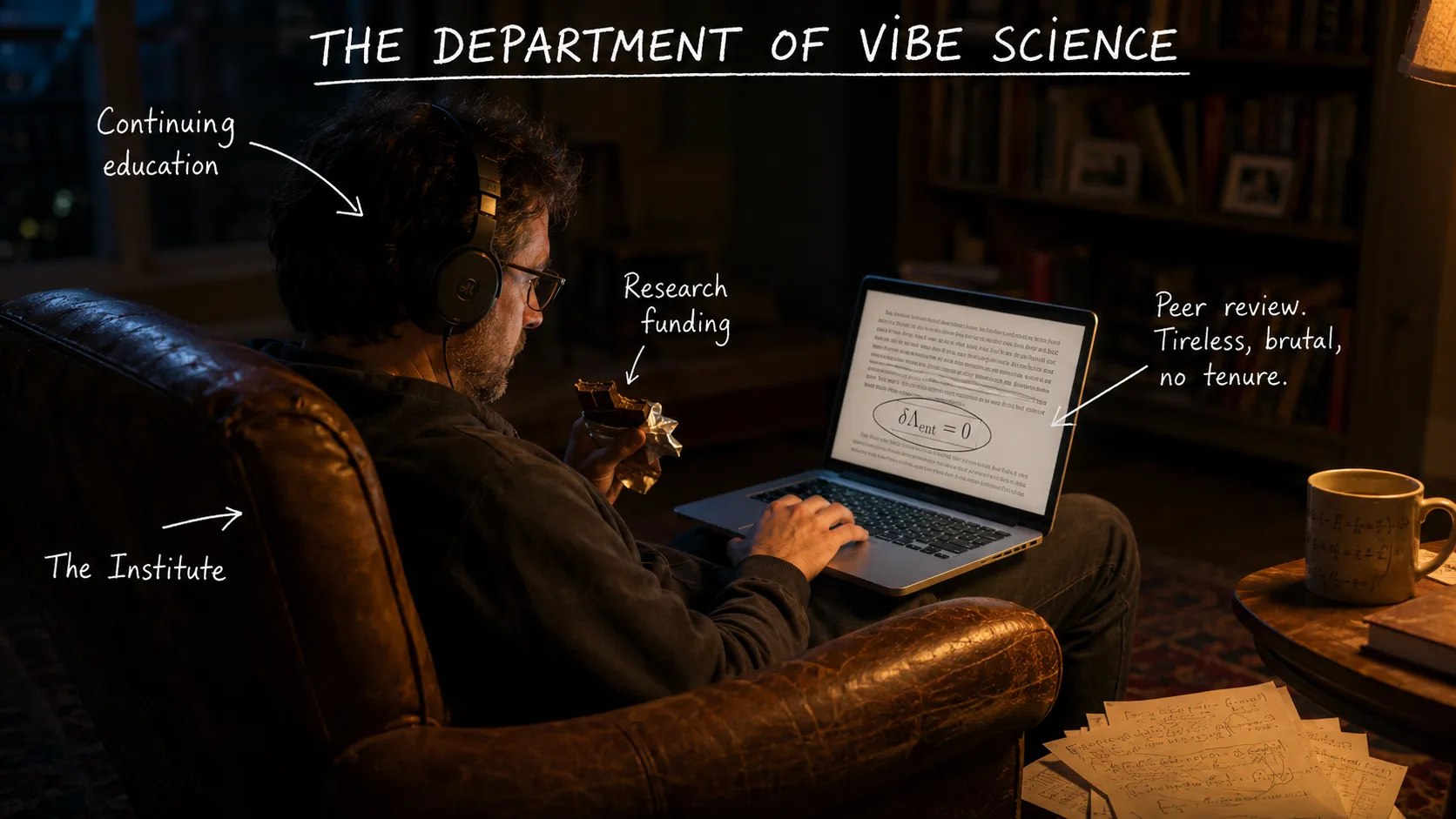
The Department of Vibe Science, in session. Research funding pictured. The Institute seats one, has no committee, and there is no waiting list.
Check the working
Both research documents are here in full — the working paper with the derivations and the boxed verdict, and the companion that preserves the dead ends, the diagrams, and the order in which attractive ideas were eliminated. Checking the working is, after all, rather the point.