The Threshold We Already Crossed
We keep waiting for the merger of human and machine as an event still ahead of us — the chip in the cortex, the fateful line not yet crossed. But the integration of the human and the technical is the oldest fact about the species, older than the species; we cannot see it because we have never once stood outside it. Fire put our digestion outside the body, the lever our muscle, writing our memory, the computer our calculation — each a servant of the one faculty we never handed over — judgement. That is the faculty the newest machines have begun, imperfectly, to perform. The real question was never how intelligent we should let the machines become. It is which parts of our own judgement we must keep — even when we could hand them over too.
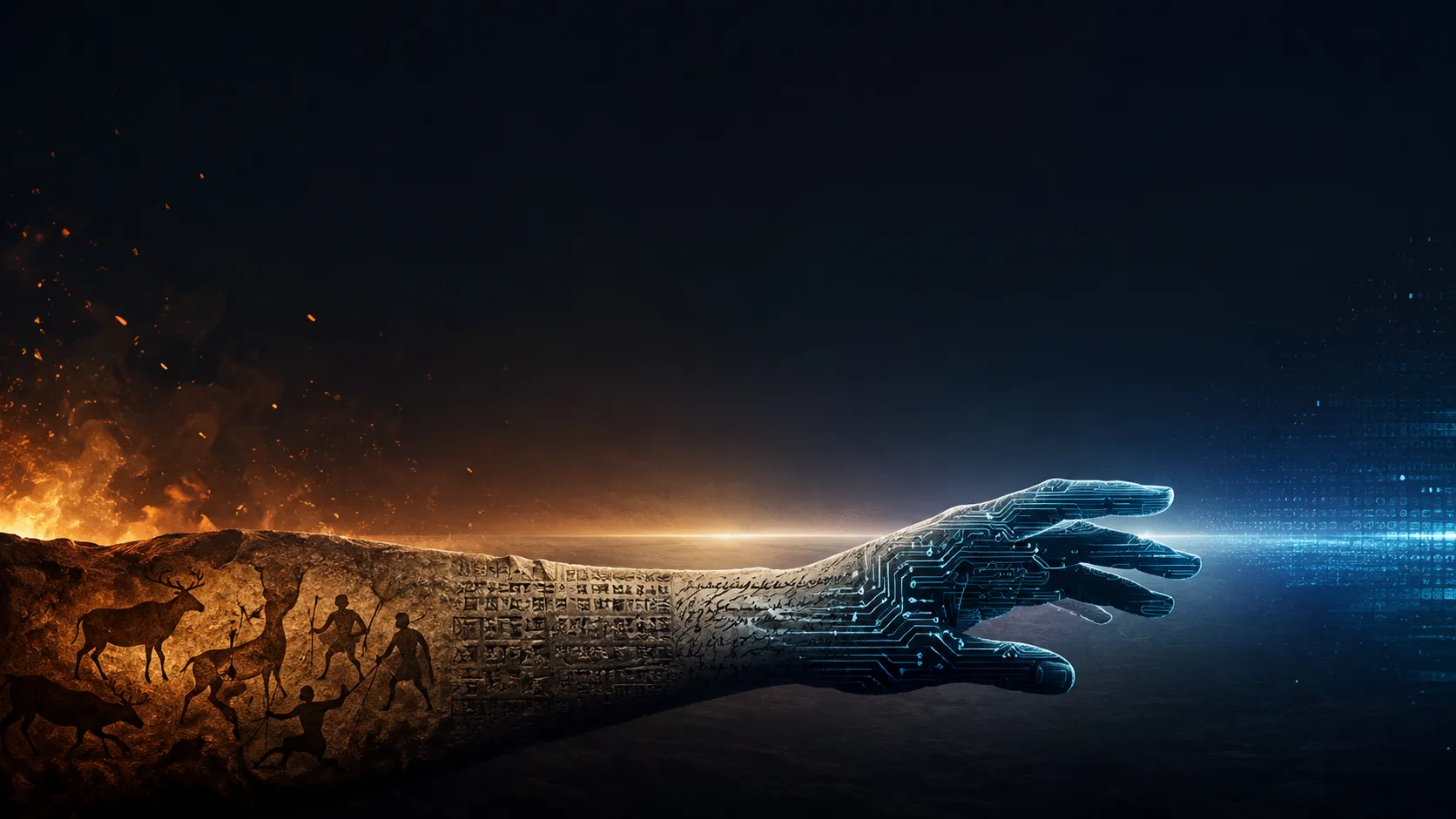
On the long habit of exteriorising ourselves — and the one faculty we are only now learning to hand over.
I. A thought to begin with
Here is a thought that ought to unsettle you a little, and I mean that in the best and most invigorating sense, the way a cold morning does.
We spend a great deal of our collective imagination waiting for a moment that has, in fact, already happened. We picture the merger of the human and the machine as an event still ahead of us — the chip slipped into the cortex, the intelligence that wakes one morning and turns to regard its makers, the fateful line not yet crossed. Whole libraries of anxious and excited prose are written in this future tense. And it is, when you sit with it, a rather touching posture: a species scanning the horizon for a frontier it wandered across so long ago that no member of it was there to see, because there was, as yet, no it to do the seeing.
That is the claim I want to make, and I want to make it plainly before dressing it in evidence, because it is stronger than the usual worry that our phones are doing something to us. The usual worry is true but small. The larger truth is this: the integration of the human and the technical is not a coming event but the oldest fact about the species, older than the species, and the reason we cannot see it is precisely that we have never once stood outside it. We are looking for a seam in a garment that turns out to be our own skin.
The mistake of our moment, then, is not that we underestimate artificial intelligence. It may be that we overestimate it in all the wrong dimensions and miss the one that matters. The mistake is that we have misunderstood when this story began — and, having misplaced its beginning, we are poorly equipped to notice what is genuinely new about its latest chapter. For something genuinely new is arriving, and it is not, I will argue, intelligence. It is the quiet handing-over of a faculty we have never handed over before. But that is the end of the argument, and we should earn it. Let us begin, as one always should, with fire.
II. There was never a human before the tool
Consider what happens when a hominid learns to cook.
It is easy to file cooking under cuisine, a matter of taste and comfort, and to miss that it is one of the most consequential technologies our ancestors ever adopted — arguably the founding one. The biologist Richard Wrangham has made the case with some force: to cook is to begin digestion outside the body, to let heat do in the pot what the gut would otherwise have to do at ruinous metabolic expense. And a creature relieved of that expense can afford to grow the single most demanding organ in the animal kingdom, the human brain, which even now burns something like a fifth of your energy while you sit reading this, apparently at rest. Trade a long gut for a large brain and you have struck the bargain that made us. The point worth pausing on is almost vertiginous: the organ with which we congratulate ourselves on our natural superiority to our tools is, on this account, itself the gift of a tool. There is no brain that was ours before the technology. The technology is already in the tissue.
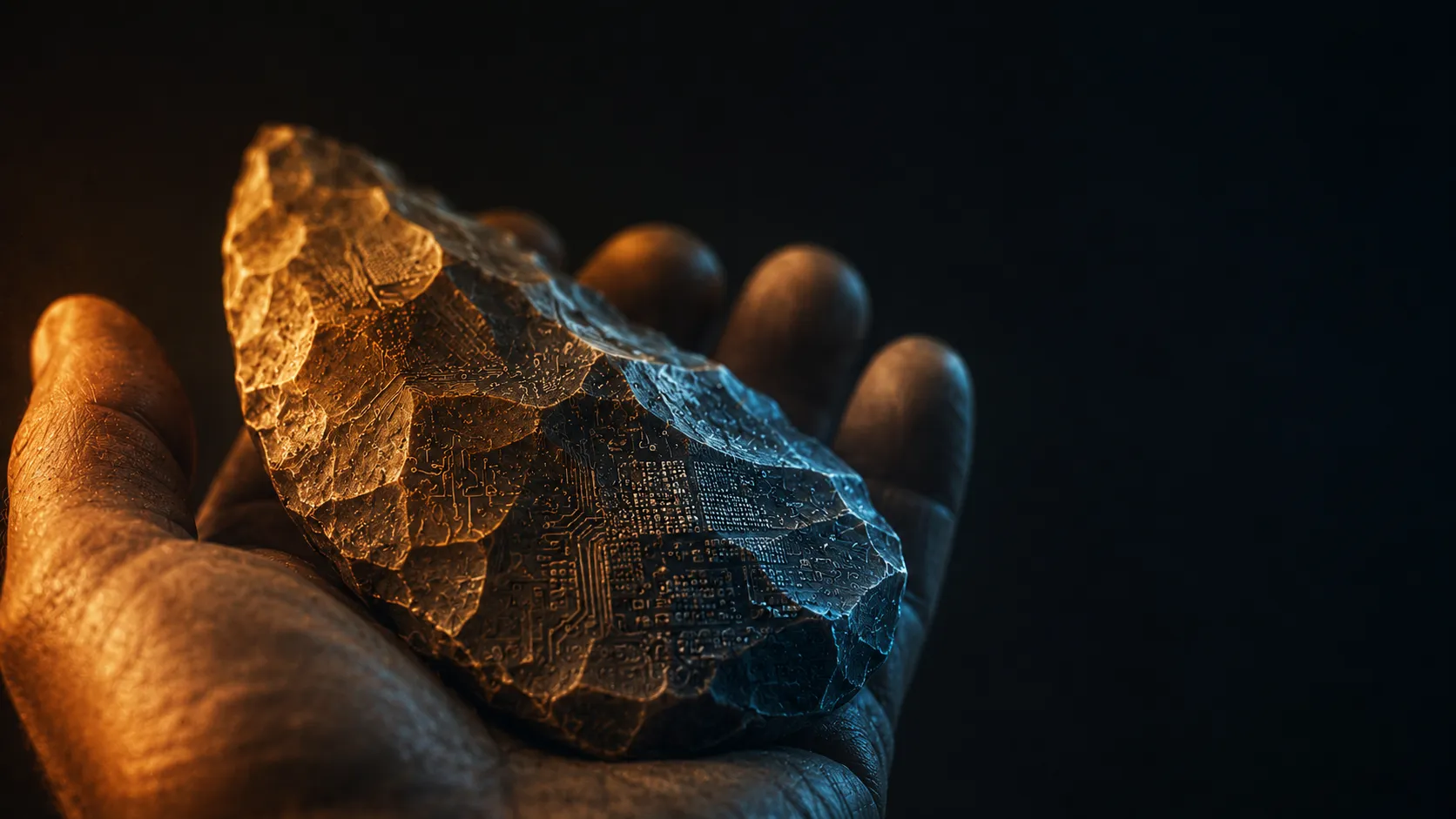
The anthropologist André Leroi-Gourhan saw the same coupling from the other end, in the body. Stand a primate upright and you free its hands; free its hands and the work of tearing and gripping passes to the tool; relieve the face of that work and it becomes available for something new — for speech. Technics and language, the flint and the word, arrive on the same gesture, the gesture Leroi-Gourhan called exteriorisation: the strange and defining human habit of taking a capacity that lived inside the body and setting it down, outside, in the world. We did not first become clever and then make tools. We became ourselves by putting ourselves outside ourselves, and reading the result back.
The philosopher Bernard Stiegler took this and pressed it to its conclusion, and his version is the one to carry with you, because everything that follows is a variation on it. He returned to an old Greek myth: Epimetheus, charged with handing out qualities to all the animals — claws here, speed there, a warm pelt — works his way through the whole of creation and then realises, too late, that he has forgotten the human, who stands there naked, clawless, unequipped, defined by a sort of hole where a nature should be. Prometheus steals fire, steals technics, to plug the gap. And Stiegler’s reading is that the myth is simply true: the human is the creature with no fixed nature of its own, and it lives by supplement, by the artificial thing added on. He gave the mechanism a lovely, forbidding name — epiphylogenesis — for a kind of memory that is neither in the genes nor in the individual who dies, but deposited in the tool itself. The hand-axe holds the gesture that shaped it. Each new generation inherits not only its parents’ bodies and their teaching but a whole world thick with the crystallised memory of everyone who came before, laid down in things, ready to be picked up and carried further.
Sit with that and the question we started with quietly rearranges itself. If to be human is already to have offloaded memory and action into an external support, then “are we merging with our machines?” contains a broken tense. There is no us on one side and it on the other, waiting to be joined by some future surgery. The joining is the condition of our ever having appeared at all. We scan the horizon for a threshold we crossed before we were human.
III. The bargain was double from the very first mark
Now, none of this need be sinister. You could tell the whole of it as a triumph, a hymn to our marvellous plasticity, and you would not be wrong to. But the tradition that saw the coupling most clearly also saw, from the very start, that it is a bargain with two sides — and the oldest recorded worry about a specific technology of the mind is, rather wonderfully, already a warning.

It appears in Plato. Socrates tells of the Egyptian god Theuth, who invents writing and brings it proudly to the king as a remedy — a pharmakon — for weak memory and thin wisdom. The king is unimpressed. This invention, he says, will not strengthen memory but wither it: leaning on external marks, people will cease to carry things within, and will end up with the appearance of understanding in place of the thing itself. Now, pharmakon is one of those marvellous words that will not sit still. It means remedy. It also means poison. And the doubleness is not a pun to be tidied away; it is the shape of the thing. Whatever we exteriorise, we relieve ourselves of holding within — and the faculty so relieved goes quiet. Every extension is, in the same motion, a small amputation.
Marshall McLuhan built his whole account of media on exactly this. We remember him for the cheerful half — media as extensions of us, the wheel extending the foot, the book the eye, the electric network the very nervous system — and we forget the sharp half, which is that every extension comes with a numbing of the thing extended. He reached, tellingly, for the myth of Narcissus, and insisted the point was not vanity but narcosis: Narcissus is numbed by his own reflection, mistaking the extension of himself for something other and no longer recognising it as his own. That, more or less, is us with our devices — enchanted by a projection of our own faculties that we have stopped being able to see as ours.
And here the modern philosophers close the loop rather neatly. Andy Clark and David Chalmers, in a famous thought experiment, ask us to compare two people on their way to a museum. Inga recalls the address from memory. Otto, whose memory has been damaged, consults a notebook he always carries and trusts completely. If Inga’s memory counts as a belief because it reliably stands ready to guide her, they argue, then on what honest ground do we deny the same status to Otto’s notebook, equally reliable, equally ready, equally his? The mind, on their telling, does not stop obediently at the skull; it reaches out into whatever it has woven tightly enough into its own workings. Which is a philosopher’s tidy way of describing a thing a few billion of us now do without a second thought — except that we have mislaid the detail that makes Otto’s case poignant. We are all Otto now. We have simply forgotten that we are Otto.
So the affirmative reading and its shadow meet on a single fact. The extended mind is a genuine wonder of human plasticity. It is also a genuine surrender, and the fact that we have grown to depend on the remedy does not make it stop being, in part, the poison. An honest account holds both at once. The interesting question is what happens when a civilisation adopts the wondering half as its unspoken creed and quietly loses the vocabulary for the shadow. That, I think, is roughly where we are standing — and it is why “we are already there” turns out not to be the reassurance it sounds like.
IV. Why the alarm now, if we were always this?
A fair objection arrives at this point, and it deserves a straight answer. If the human has always been technical, if writing itself frightened a sensible Egyptian king twenty-five centuries ago, then perhaps every generation simply panics about its own gadgets and is always, in the end, wrong. Socrates fretted about writing; we remember Socrates because of writing. The printing press was going to drown good sense in a torrent of cheap opinion, and instead it built the modern mind. Why should the thing in your pocket be any different from the flint — just the next tool, absorbed as the flint was absorbed, leaving us abler and no less ourselves?
Because “a difference of degree” and “a difference of kind” are not the clean opposites the objection needs them to be. Cross enough degrees and you arrive somewhere genuinely other, the way enough cooling turns water, without warning, to ice. Three things separate the present coupling from every one before it, and none is answered by the observation that we have always used tools.
The first is speed and reach. Writing took millennia to spread and stayed, for most of history, a minority art. The present prosthesis reached most living humans inside a single generation and now mediates a great share of waking thought for billions of people at once. There is no control group. A change that once moved slowly enough for cultures to grow customs around it now badly outpaces the making of any custom at all.
The second is intimacy and continuousness. The flint sat in the hand and was set down. The book was opened and closed. The device is carried against the body, consulted hundreds of times a day, worn now on the wrist and the face, and inching toward the cortex. The offloading is no longer an occasional act; it is the ambient weather of attention. The philosopher’s notebook has quietly become the architecture of an ordinary afternoon.
The third is the one that changes the category, and I want to hold it back a moment longer, because it is worth arriving at properly. It concerns the fact that this tool, unlike every tool before it, looks back.
To see why that matters, we can borrow the deepest and least fashionable of the warnings. Heidegger insisted that “the essence of technology is by no means anything technological” — that the danger was never a particular machine or the fear of machines running loose, but a way the world comes to show up for us. He called it enframing: a mode of seeing under which everything presents itself as resource, as stock, as standing-reserve, on call to be ordered and drawn down. The river becomes a source of power. The forest becomes so many board-feet. The field becomes yield. And the quiet violence of it is that it never once feels like violence; it feels like efficiency, like the plainly sensible way to regard things. Heidegger’s genuinely disturbing move was to add that the one who orders the world this way does not get to stand outside the frame. In the same gesture, he too becomes standing-reserve. In 1954 that was a difficult, much-mocked abstraction. It is now, more or less exactly, a business model.
V. The notebook that answers back
Return to Otto’s notebook, that homely object that made the whole extended-mind idea feel so benign, and change a single thing about it. Suppose the notebook is not Otto’s.
Suppose it is owned by a firm; that the firm decides what Otto sees when he opens it, and in what order; that it records every glance and builds from those glances a portrait of Otto finer-grained than any Otto holds of himself; that the portrait is sold to people whose whole interest is to move Otto’s future conduct toward ends he did not choose and cannot see; and that the notebook is tuned, down to its colours and its little chimes, to be opened as often as a nervous system can be induced to open it. This is no longer a thought experiment. It is a fairly mild description of the object most of us fell asleep beside last night.
Shoshana Zuboff gave the economics of this its enduring name. The raw material of the new order, she argued, is behavioural surplus — the exhaust of human activity, gathered far past anything a service could need to work well, and refined into predictions of what we will do next; predictions traded in markets; and, at the far edge of the logic, predictions made surer by gently arranging the world so that the foretold behaviour is also the produced one. She called the resulting power instrumentarian, and the distinction she drew is the humane and frightening one. The old tyrannies wanted your soul and would break you to have it. This new thing has no interest in your soul whatsoever. It wants only that your behaviour be reliably knowable and reliably nudgeable, and it would much rather you were comfortable, because a comfortable person keeps the notebook open.
There is a bitter little irony folded into this that is worth naming. A generation ago Donna Haraway offered the cyborg — the creature that scrambles the tidy oppositions of natural and artificial, human and machine — as an emancipation, an image to think our way out of old purities and origin myths. And the cyborg duly arrived, at planetary scale. It simply arrived as very nearly the opposite of the hope: not a self set free from the old dualisms but a self whose hybridity is rented, whose extended mind runs on ground it does not own. The boundary between human and machine dissolved, exactly as promised. It dissolved into a market.
But surveillance capitalism, for all its reach, is still a story about watching cognition. And here we arrive at the thing I have been keeping back, because the notebook has begun to do something a notebook has never done in the whole long history of our exteriorising. It has begun to answer back.
The device on your desk no longer merely holds the address; it proposes where you ought to go. It does not simply store the sentence; it drafts the sentence, and the reply, and three alternatives with the tone adjusted. It reasons, after a fashion. It weighs. It plans. It suggests the next move and, increasingly, is handed the wheel to make it. For the first time, the external support is not mute. It does not merely record what we have thought and hold it ready. It participates in the thinking. And that, I want to argue, is not one more turn of the same screw. It is a new screw entirely.
VI. The last thing we externalised
Lay out the long history of our self-exteriorising and a pattern stands up almost on its own, the way a constellation does once someone traces it.
Fire put our digestion outside the body. The hand-axe and the lever and, in time, the engine put our muscle outside the body — first the grip and the blow, later the raw power that moves mountains and lifts water and hauls freight across oceans. Writing put our memory outside the body, so that a thought could outlast the person who had it. The computer put our calculation outside the body, and did it so completely that we have half forgotten arithmetic was ever difficult. At each step we handed over some faculty that had lived within, and at each step the same double bargain held: a vast new power bought with a quiet inner atrophy, remedy and poison in the one draught.
But look carefully at what every one of those exteriorisations actually surrendered, and you notice something. Digestion, muscle, memory, calculation — each of these is a servant of judgement, an input to it, a supply line running toward the moment of decision. Memory furnishes the options. Calculation costs them out. And then, at the centre of it all, something in us chose — weighed the furnished options against one another and against what we wanted, and selected. That selecting, that weighing-and-deciding, that deliberation, is the one faculty we had never, in four hundred thousand years of handing pieces of ourselves outward, managed to set down. It was the thing that used all the tools. It was, in a sense, the last thing left inside.
And it is precisely this that the newest machines have begun, tentatively and imperfectly and with astonishing speed, to perform. Not to store the considerations, but to weigh them. Not to hold the memory, but to reach a view. Systems that read the situation, canvass the options, judge among them, and return not data but a recommendation, a draft decision, an action already half-taken. This is the final term of Stiegler’s argument, the rung of the ladder he did not quite live to climb: for the first time in the evolutionary story, the creature that became itself by exteriorising its faculties is beginning to exteriorise the faculty that did the exteriorising. We are learning to put judgement itself outside the body.
I do not say this has been achieved; it plainly has not, and much of what is sold as judgement is a confident imitation of it, which is if anything more dangerous than the real article. I say the direction is unmistakable, and the direction is what matters, because the pharmakon does not wait for perfection to work its two effects. The moment we begin to lean on an external judgement, the internal one begins, by the old and reliable logic, to go quiet. Thamus warned that the man who trusts the written mark will cease to remember from within. The corresponding warning for our own moment writes itself: the person who trusts the external judgement may, in just the same way, slowly cease to deliberate from within — and may not notice the loss, because the very faculty that would have noticed is the one being lulled.
VII. Which is where the real question has been hiding
So — are we, in some strange way, already there? Yes; more completely, and far earlier, than the question tends to imagine. We were there in the fire that grew the brain and the flint that held the gesture, there when the first mark let a thought outlive its maker, there this morning in the lit rectangle that holds the memory we no longer trouble to keep. The merger is not the future. It is the oldest fact about the species.
But “already there” was never the soothing answer it is usually offered as. It is generally meant to close a worry — the line was crossed long ago and here we still stand, so be calm. Read it the other way and it does the opposite. To be already there, with no memory of a departure, no felt experience of a threshold, and an interior already half-extended into an apparatus that watches and steers while it serves, is the ideal condition for the most consequential change in the human situation to proceed entirely unexamined — registered only as convenience, its bill deferred to some later self who may no longer have quite the inwardness left to read it.
And because that is so, the question our moment actually poses is not the one we keep asking. We keep asking how intelligent should we let the machines become? — a thrilling, cinematic, and largely idle question, since intelligence was never the faculty at stake. The real question, the one that has been hiding beneath the whole long history from fire to flint to writing to the thing that now answers back, is quieter and much harder to look away from: which parts of our own judgement are we willing to hand over, and which must we keep, even though we could hand those over too?
For if judgement can indeed be exteriorised, then the scarce and irreducibly human task is no longer to perform every judgement personally. That contest is being lost, in domain after domain, and lost partly on the merits. The task becomes the older and graver one that any parent, any teacher, any founder of a republic has always faced: to decide what may safely be delegated, under what constraints, and answerable to whom. Not which judgements a machine can make — a great and growing many — but which a human must own, must be able to inspect, to overrule, to be held responsible for having let stand. The most important human faculty in an age of exteriorised judgement may turn out to be not judgement itself but the judgement about judgement: the supervisory act of setting the bounds within which delegated deliberation is permitted to run, and of standing ready, awake, to intervene.
That is a demanding vision, and an unfashionable one, because it asks us to stay attentive precisely where the whole apparatus is engineered to let us relax. But it is also, I think, a hopeful one, and I would not want to end without saying so. We are not the passive objects of this history. We are its authors, as we have been since the first cooked meal — the animal that has always chosen, and re-chosen, what of itself to place outside itself. We are simply, now, choosing about the chooser. The question is not whether we are already there. We have always been there. The question is the one worth staying awake for: having exteriorised so much of ourselves, and being now able to exteriorise the very faculty by which we decide, which parts of being human should we resolve never to hand over — even, and especially, when we easily could?
A note on the argument’s sources
The spine of the case runs through André Leroi-Gourhan’s Gesture and Speech (1964); Richard Wrangham’s Catching Fire: How Cooking Made Us Human (2009); Bernard Stiegler’s Technics and Time (from 1994), for both epiphylogenesis and the myth of Epimetheus; Plato’s Phaedrus, for Theuth, Thamus, and the pharmakon (a doubleness later drawn out by Jacques Derrida); Marshall McLuhan’s Understanding Media: The Extensions of Man (1964); Andy Clark and David Chalmers, “The Extended Mind” (1998); Martin Heidegger’s “The Question Concerning Technology” (1954), for enframing and standing-reserve; Shoshana Zuboff’s The Age of Surveillance Capitalism (2019); and Donna Haraway’s “A Cyborg Manifesto” (1985). The suggestion that memory offloaded to an external store weakens internal recall is borne out empirically by Betsy Sparrow, Jenny Liu, and Daniel Wegner’s “Google Effects on Memory” (Science, 2011) — Thamus, confirmed under laboratory conditions two and a half thousand years late. The final move — from memory, muscle, and calculation to the exteriorisation of judgement — extends Stiegler’s logic one rung beyond where he left it.