The Pollen and the Ledger
A confession first — I am no mathematician and no physicist. It is a hobby, and I rather wish I were that clever. But you do not have to have composed the symphony to be undone by it, and the thing that undoes me most is this — the market, that grubby and entirely human institution, appears to obey the same mathematics as a speck of pollen jittering in a glass of water. This is a hobbyist's wonder at the physics hiding inside autonomous trading — SignalFabric, the memedataengine, the whole Predict layer — and the same borrowed trick I pull, badly and happily, for marketing.
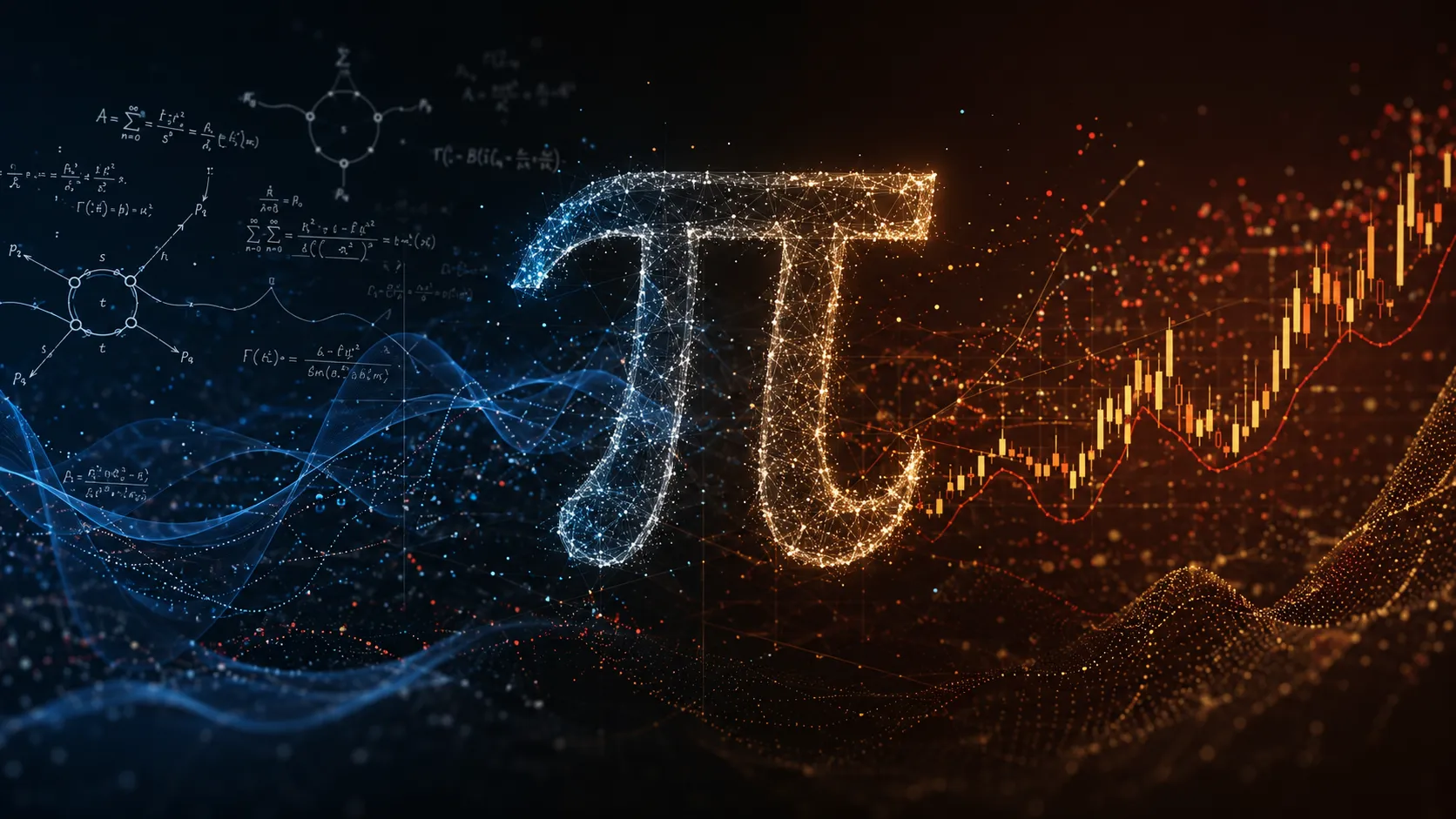
A hobbyist’s wonder at the physics hiding inside autonomous trading — and the same borrowed trick I pull for marketing.
Let me get the confession out of the way first, because everything else depends on it being true.
I am not a mathematician. I am not a physicist. I am, at very best, an enthusiastic amateur — the sort of person who reads popular science on aeroplanes and feels the top of his head lift gently off, and who then, if you handed him a pen and asked him to reproduce a single line of the derivation, would develop a sudden and pressing need to fetch you a coffee. I wish I were that clever. I am genuinely, unsportingly envious of the people who are. But I have made a certain peace with it, and the peace is this: you do not have to have composed the symphony to be reduced to tears by it. You just have to be in the room, and be paying attention.
And the thing I have been paying attention to — the thing that undoes me most reliably, that I return to like a tongue to a loose tooth — is a fact so quietly outrageous that I still don’t think we have properly recovered from it as a species. The market. That grubby, greedy, thoroughly human institution, all fear and adrenaline and men shouting into telephones. It appears to obey the same mathematics as a speck of pollen drifting in a glass of water.
Not similar mathematics. The same.
I want to spend a little time on why that is so wonderful, because it turns out to be the whole of my day job in disguise — and, if you’ll indulge me, the honest reason I do the work I do at all.
A speck of pollen in a glass of water
In 1827 a Scottish botanist named Robert Brown put some pollen grains under a microscope, suspended in water, and watched them jitter. Not drift — jitter, twitching about in a restless, directionless dance, as though each grain were slightly, privately alive. Brown was a careful man, so he tested the obvious explanation and killed it: he ground up things that had never been alive — dust, soot, a fragment of the Sphinx, apparently — and they jittered too. Whatever was pushing the pollen around, it wasn’t life. It was something underneath.
He could not say what. He simply, honestly, wrote down what he saw and left it hanging there, unexplained, for the better part of a century — which is, I think, one of the more admirable things a person can do.
It took Einstein to close the loop, in 1905, in the middle of the most absurd year any human mind has ever had. The jitter, he showed, was the pollen being shoved about by water molecules — millions of invisible collisions a second, never quite cancelling out, the grain forever staggering home like the last one to leave the party. It was, and I do not think this is over-egged, one of the first hard proofs that atoms are actually there — that the world is grainy at the bottom, made of tiny insistent things you cannot see. A speck of pollen, twitching in a doctor’s microscope, turned out to be a window onto the fundamental architecture of reality.
Now here is the part that gets me every time.
Five years before Einstein, in 1900, a French doctoral student named Louis Bachelier wrote a thesis on how prices move on the Paris Bourse. And to describe the wandering of a share price — up a bit, down a bit, no memory of where it had been, no idea where it was going — he reached for exactly the same mathematics that Einstein would later use for the pollen. The random walk. The drunkard’s stagger. He got there first, applied it to money rather than molecules, and was rewarded for his originality in the traditional French manner: a lukewarm grade and a career spent in relative obscurity. History has a cruel sense of comedy about who it chooses to applaud, and when.
But sit with the shape of it. A pollen grain shoved by water it cannot perceive. A share price shoved by news, and fear, and a thousand strangers it will never meet. Two systems that could not possibly be more different — one mindless, one made of nothing but minds — and underneath them both, the same quiet equation, humming away, indifferent to which one it happens to be describing.
The universe is stubbornly, almost rudely self-similar. It keeps using the same few good ideas over and over, in places that have no business rhyming. And once you have seen it do that — really seen it — you cannot unsee it, and you start looking for it everywhere, like a man who has just learned a word and now hears it in every conversation.
The physics we quietly borrowed
Bachelier’s little random walk did not stay little. It grew up, went to America, and became the engine underneath modern finance. The Black–Scholes equation — the thing that lets you put a price on an option, a bet on a bet — is, if you squint at it in the right light, the heat equation. The very same piece of mathematics that describes warmth spreading through a metal bar, smoothing itself out, seeking the boring democracy of equilibrium. Someone realised that money diffusing through a market and heat diffusing through iron were, mathematically, the same event wearing different clothes. They won a Nobel Prize for the observation, which seems fair.
And then it kept going, because physicists are incorrigible and cannot leave a good market alone.
Benoît Mandelbrot looked at cotton prices and noticed the neat bell curve everyone was using was a comforting lie. Real markets have fat tails — the catastrophic day, the once-in-a-thousand-years crash, turns out to happen roughly every other Tuesday. The wildness isn’t an aberration to be smoothed away; it’s the texture of the thing itself. Markets are fractal, jagged at every scale, self-similar all the way down — a coastline made of panic.
Others borrowed the physics of phase transitions — the moment water becomes ice, or a hot magnet, at precisely the Curie temperature, suddenly loses its magnetism as all its little atomic compasses stop agreeing. A market crash, it turns out, looks uncannily like that: a slow build of correlation, everyone’s opinion quietly aligning with their neighbour’s, until the system tips all at once from liquid to solid, from calm to stampede. Herding — the oldest, most human thing in the world — has a name in physics. It’s called the Ising model, and it was invented to explain magnets.
Even information itself got a physics. Claude Shannon worked out that information is, in a real and measurable sense, the opposite of entropy — that a signal is a small, hard-won pocket of order carved out of an ocean of noise. Which means a genuine market forecast is not a prophecy. It is a tiny, effortful reduction in disorder. A little order, bought dearly, in a universe whose entire long-term project is disorder.
I will be honest with you, as promised: I do not fully understand these things. I can follow the wonder but not always the working. I can tell you that the Black–Scholes equation is the heat equation; I could not, at gunpoint, walk you through the derivation. And here is the humbling coda that the physicists themselves insist on, the one that keeps the whole enterprise honest — none of this makes prediction easy. Quite the opposite. Three bodies pulling on each other under plain old gravity is already, formally, chaos — no neat solution, just sensitive dependence, the flap of Lorenz’s butterfly. A market has not three bodies but billions, each one watching the others, each one lying. The mathematics does not hand you certainty. It hands you something better and much harder to sell: honestly-priced uncertainty. The good forecaster is not the one who claims to know. It is the one who can tell you, precisely, how little they know, and calibrate the bet accordingly.
That distinction — between the confident fool and the calibrated one — turns out to be the entire game.
I promised I couldn't derive these, and that remains embarrassingly true. But here are the five the essay leans on, for readers cleverer than me who would quite reasonably like to confirm I'm not simply making it up. Each is a real, load-bearing equation; the gloss underneath is the only part I can be trusted to write.
The machines that trade while we sleep
This is the point where the essay was supposed to stay a pleasant lecture, and instead becomes a thing I actually build, because I could not help myself.
If markets run on borrowed physics, then a sufficiently patient machine ought to be able to listen to that physics directly — to sit inside the noise, hour after sleepless hour, and pull the faint signal out. That machine exists, and building a version of it is one of the more quietly thrilling things I have done. We call it SignalFabric, and its ambition is almost embarrassingly earnest: to take the kind of quantitative machinery that used to live behind the frosted glass of institutions and hand it, explainably, to a normal human being.
Underneath, it fuses something like five hundred distinct signal primitives across sixteen quant categories and dozens of integrations — markets, macro, sentiment, prediction markets, and yes, physics-informed models of exactly the sort I’ve been rhapsodising about — into forecasts that are calibrated and, crucially, explainable, with a trust layer sitting on top that scores how much of the apparent signal is really just someone trying to manipulate you. And then, because a forecast that only forecasts is a coward, it acts: you describe a strategy in plain English, and it will backtest it, and then trade it live — but never off the leash. There is an AI risk critic arguing the other side of every position, and there is a kill switch. Always a kill switch.
At the far, feral edge of all this sits the strangest instrument I’ve had a hand in, the memedataengine — an intelligence terminal pointed directly at the most deranged corner of the markets, the memecoin firehose, where there are no fundamentals whatsoever, no earnings, no product, nothing but pure herd. If Brownian motion is the physics of the calm — the gentle jitter of a system at rest — then the memecoin is the physics of the stampede, the Ising model with the temperature cranked past the Curie point, greed and fear flipping in lockstep in real time. The engine decodes the whole chaotic torrent, keeps it forever, and scores it for fraud, for sentiment, for the fingerprints of smart money moving early. It watches the madness so that you don’t have to mistake it for a plan.
And running underneath both of them is the shape Agencio organises everything around — Observe, Predict, Decide, Act, and, never optional, Govern. Observe the signals. Predict, with calibrated humility. Decide within limits you set while calm. Act autonomously. And govern the whole thing so it can never quietly go feral while your back is turned. The genuinely interesting advancement in autonomous trading, the one worth staying up for, was never that a machine can trade. Machines have been able to trade for years. It is that a machine can now trade and stay honest — explainable about its reasoning, calibrated about its confidence, scored against manipulation, and, at all times, stoppable by a human who has changed their mind. Anyone can build a machine that gambles. The whole art is building one you can trust with the keys, which is, as it happens, the only thing I have ever really been interested in building.
The confession, and the one trick I actually have
So here is the real confession, the one underneath the modest one I opened with.
I do not fully understand the inner workings of these models. I’ve said it and I mean it. I can read the paper and nod gravely at the Hamiltonian and feel, genuinely, the lift-off at the top of my skull — but the deep machinery lives a little beyond my reach, and I have stopped pretending otherwise. And I understand the human brain no better. I am not a neuroscientist. I could not tell you, at the level of a synapse, why one arrangement of seven words makes a stranger’s chest tighten and another, almost identical, slides off them like water off glass. The wet electrical miracle inside the skull is as much a locked room to me as the market’s deepest maths.
And yet. There is exactly one clever thing I can do, and it is the only genuinely useful idea in this entire essay, so I’ll say it plainly.
I can take a science I did not invent and do not fully grasp, and adapt its shape into behaviour.
That is the whole job. In quant, you borrow the physics and apply it to the behaviour of markets. In marketing — which is the subject I spent four years and a whole other essay, The Magic and the Ledger, trying to be honest about — you borrow the behavioural science, the psychology, the cognitive biases with their tidy names, and you apply them to the behaviour of people. It is the identical manoeuvre. Borrow the deep thing. Adapt it into how the herd will move. Different medium, same trick.
I’m aware this is a simplification bordering on the impudent. The real versions are far messier, and there are details inside each box that I have, in good faith, not fully understood — I’ve drawn a clean arrow where the truth is a tangle. But the shape is honest, and the shape is the point. A physicist would wince at my diagram. A neuroscientist would wince at my model of the mind. They would both be right to. And I would still, cheerfully, use both, because the person who carries an idea across a border does not need to have built the country it came from. They need to know which idea is worth carrying, and how not to drop it on the way.
That, it turns out, is a real and useful role — the translator, the adapter, the bridge between the deep thing and the practical one. It does not require you to be the cleverest person in the room. On a good day it requires only that you be the most curious one, and the most honest about the edges of what you know.
Wonder is the whole point
I want to end where the wonder started, because I think the wonder is not a decoration on this argument. It is the argument.
The market is the largest, rudest, most relentlessly honest ledger our species has ever kept — a real-time referendum on what we collectively fear and want, updated every millisecond, impossible to lie to for very long. And underneath all that heat and greed and human noise runs the same cool mathematics as a grain of pollen staggering across a microscope slide, a bar of iron losing its warmth, a magnet forgetting how to be a magnet at precisely the wrong temperature. That should probably be unsettling. Instead I find it almost unbearably reassuring — the idea that the same few elegant rules are holding up the pollen and the price and, for all I know, the pattern of our stampedes and our sudden collective changes of heart.
The advancements are real and they are arriving quickly. Machines that observe more than we can, predict with more calibration than we can bear to, and act while we sleep. The ones worth building are not the cleverest. They are the ones that keep the wonder and fit the kill switch — that stay explainable, stay humble about their own confidence, and never, ever forget that there is a person on the other end who is allowed to change their mind.
I remain a hobbyist. I will never be that smart, and I’ve stopped losing sleep over it. But I get to stand at the window with my nose against the glass, watching people far cleverer than me do the real work — and then, every so often, on a very good day, reach in through the borrowed light and build something honest with it. For a pollen grain of a man in the great jittering ledger of everything, that feels like a fair bit more than enough.
Further reading
- The marketing half of this argument — how the same borrowed-behaviour trick plays out in the boardroom, in The Magic and the Ledger.
- The quant machine itself — SignalFabric, institutional quant made explainable and retail-accessible.
- The feral frontier — the memedataengine, watching the memecoin stampede so you don’t have to.