The Feed Got Crowded. The Trust Ran Out.
For twenty years social platforms ran on one equation — maximise reach, harvest attention, sell it. That equation is ageing out, regulated on one side and abandoned on the other. As it goes, what we consume inverts: from reach to trust, from feed to circle, from attention to permission.

For twenty years social platforms ran on one equation: maximise reach, harvest attention, sell it. That equation is ageing out — regulated on one side, abandoned on the other. And as it goes, what we consume, and how, inverts: from reach to trust, from feed to circle, from attention to permission.
Every social network ever built started from the same promise, and it was a genuinely beautiful one. Connect everyone. Collapse the distance between you and anyone you might ever want to reach. Build a town square the size of the species, and let anyone stand up in it and be heard.
It worked, and the business model that funded it was elegant in its ruthlessness. Reach was the product. The more people you could connect, the more attention you could gather; the more attention you gathered, the more you could measure, predict, and sell. So everything was tuned downward from reach — more followers, more strangers, more time-on-site, more signals harvested, more precisely targeted ads. The platform was built from the top of the pyramid down: everyone on Earth at the wide end, and you, somewhere near the bottom, as the thing being sold. It was the most successful attention machine ever constructed, and for two decades it only ever got bigger.
It is not getting bigger any more. And the interesting part is not that it is shrinking — it is how. The reach equation is being dismantled from two directions at once, and most of the conversation only ever notices one of them.
From below, people are leaving. Not in a dramatic exodus — in a quiet, steady retreat. Global social media time has fallen roughly ten percent from its 2022 peak. Teen use of X has dropped from a third of teenagers in the mid-2010s to one in six; Facebook, which once held seven in ten teens, now holds about three. Nearly a third of Gen Z deleted a social app in the past year. And tellingly, when researchers ask teenagers whether social media is good or bad for people their age, the share saying bad has climbed from a third to nearly half in three years. The town square did not get banned. People just stopped wanting to stand in it.
From above, the law is arriving. In December 2025 Australia made it illegal for under-16s to hold accounts on the major platforms, with penalties approaching fifty million dollars. The European Parliament has proposed a minimum age of sixteen with mandatory, privacy-preserving age verification, and the Digital Services Act already forbids profiling-based advertising to minors outright. Nineteen US states and counting have passed age-check or parental-consent laws. The permissionless model — sign up, harvest, target, no questions asked — is being legislated into a model that must ask first.
So here is the situation, stated plainly. The reach era is ending, and a platform now faces exactly two ways to age. It can grow up — re-found itself on consent, permission, and trust, because the law and the users are both demanding it. Or it can slowly fail — keep optimising for a reach that fewer and fewer real humans are present to supply. This piece is about that fork, and about the thing it changes that nobody is pricing yet: not the platforms, but the consumption itself.
The Slow Failing: A Feed That Empties and Fills at Once
The most quietly devastating thing happening to the public feed is that it is emptying of people and filling with machines at the same moment.
The emptying is the retreat to private. The valuable interactions — the ones people actually want — have moved off the public timeline and into closed spaces: direct messages, group chats, close-friends lists, micro-communities. Instagram has admitted the hierarchy out loud: teens now spend more time in DMs than in Stories, and more in Stories than in the feed. The feed, the thing the entire business was built around, has become the least used surface on the platform. Roughly seven in ten Gen Z users are messaging rather than posting. The performance moved backstage, where there are no ads to sell against it and no reach to measure.
The filling is stranger and worse. As the humans move out, the synthetic moves in. By 2026, bot traffic accounted for more than half of all activity on the web — fifty-one percent by one major measure, nearer sixty by another. Three-quarters of newly published web pages now carry AI-generated content, and Europol projects that by the end of 2026 as much as ninety percent of online content could be synthetically generated or manipulated. Human web traffic has quietly become the statistical minority.
Put those two facts together and you get the real condition of the public feed in the mid-2020s. It is a town square you can no longer trust — where you cannot easily tell who is real, where half the noise is machines talking to machines, and where, in any case, none of the people you actually love are standing any more. The engagement recession is not a glitch in the model. It is the model working exactly as designed, optimising relentlessly for reach right up to the moment that reach stopped meaning attention from a human being.
The reach machine did not break. It kept maximising reach long after reach stopped containing people.
That is what slow failing looks like. Not a crash — a hollowing. A platform can post record reach numbers while the thing those numbers used to represent quietly drains away beneath them.
The Growing Up: Permission Arrives by Law
The other branch of the fork is being forced, and it is worth being honest that it is being forced rather than chosen.
For its entire history, the reach model was permissionless by design. You did not ask to be profiled; you were profiled. You did not consent to the algorithm deciding what your thirteen-year-old saw; the algorithm decided. Permission was friction, and friction was the enemy of reach, so permission was engineered out. That is now reversing, and not because the platforms had a change of heart. It is reversing because regulators across three continents have decided, more or less simultaneously, that a model built downward from reach cannot be trusted with the people at the bottom of it — and children least of all.
Australia’s under-16 ban, the EU’s proposed age-16 floor and its prohibition on profiling-based ads to minors, France’s age-verification regime, the wave of US state laws demanding parental consent and age checks: read individually they look like a patchwork. Read together they are a single instruction to the industry. Ask first. Prove the person is who and how old they say they are. Get a guardian’s permission before you touch a child. Stop building a profile nobody agreed to. Permission, consent, and guardianship — the exact things the reach model deleted — are being legislated back in as conditions of operating at all.
And here is the trap inside the growing-up branch, because it is not as clean as it sounds. The most common way to comply with “verify everyone’s age” is to collect more data about everyone — to meet a privacy problem with a surveillance solution. Civil-liberties groups spent 2025 warning, correctly, that a badly built age-verification regime makes every user prove their identity as a condition of speaking, which is its own harm. So growing up is not automatic, and it is not the same as bolting an age-gate onto the old machine. A platform that adds verification on top of a surveillance foundation has not grown up. It has just put a lock on the front of a building whose whole architecture still assumes you are the product.
Real growing up is structural. It means the platform’s foundations — not its settings — start from consent. And that is a far harder thing to retrofit than to build, which is the whole reason the next part matters.
What Actually Changes Is Consumption
Step back from the platforms, because they are not the most important thing changing. The most important thing changing is us — what we consume, and on what terms.
For twenty years the unit of value was attention, and the metric was the impression: how many eyeballs, how many seconds, how many times something was served. Reach was the asset because attention was the asset, and attention was assumed to be roughly infinite, harvestable, and for sale. Everything downstream — the algorithm, the ad auction, the engagement loop tuned to outrage because outrage holds attention longest — followed from that one assumption.
The fork breaks the assumption. When people retreat into trust circles and the public feed fills with synthetic noise, attention stops being the scarce, valuable thing. Trust becomes the scarce, valuable thing — and trust does not behave like attention at all. Attention scales up; trust scales down. Attention is taken; trust is granted, and can be withdrawn. Attention is indifferent to who is speaking; trust is entirely about who is speaking. You cannot harvest trust the way you harvested attention, and you cannot sell it without spending it.
So consumption inverts along three axes at once. It moves from broadcast to circle — from speaking to everyone to speaking to the few who matter. It moves from algorithmic to permissioned — from a feed that decides what you see to a person, or a rule you set, that decides. And it moves from impression to intent — from how many people something reached to how many people actually asked for it. The new measure of an advertisement is not how many saw it. It is how many wanted it. That single shift — from reach you take to permission you are granted — is the entire future of the category, and it is why the platforms tuned for the first will struggle so badly to follow people into the second.
Attention was infinite and for sale. Trust is finite and earned. A platform optimised for the first cannot simply pivot to the second, because the second is not a feature. It is a foundation.
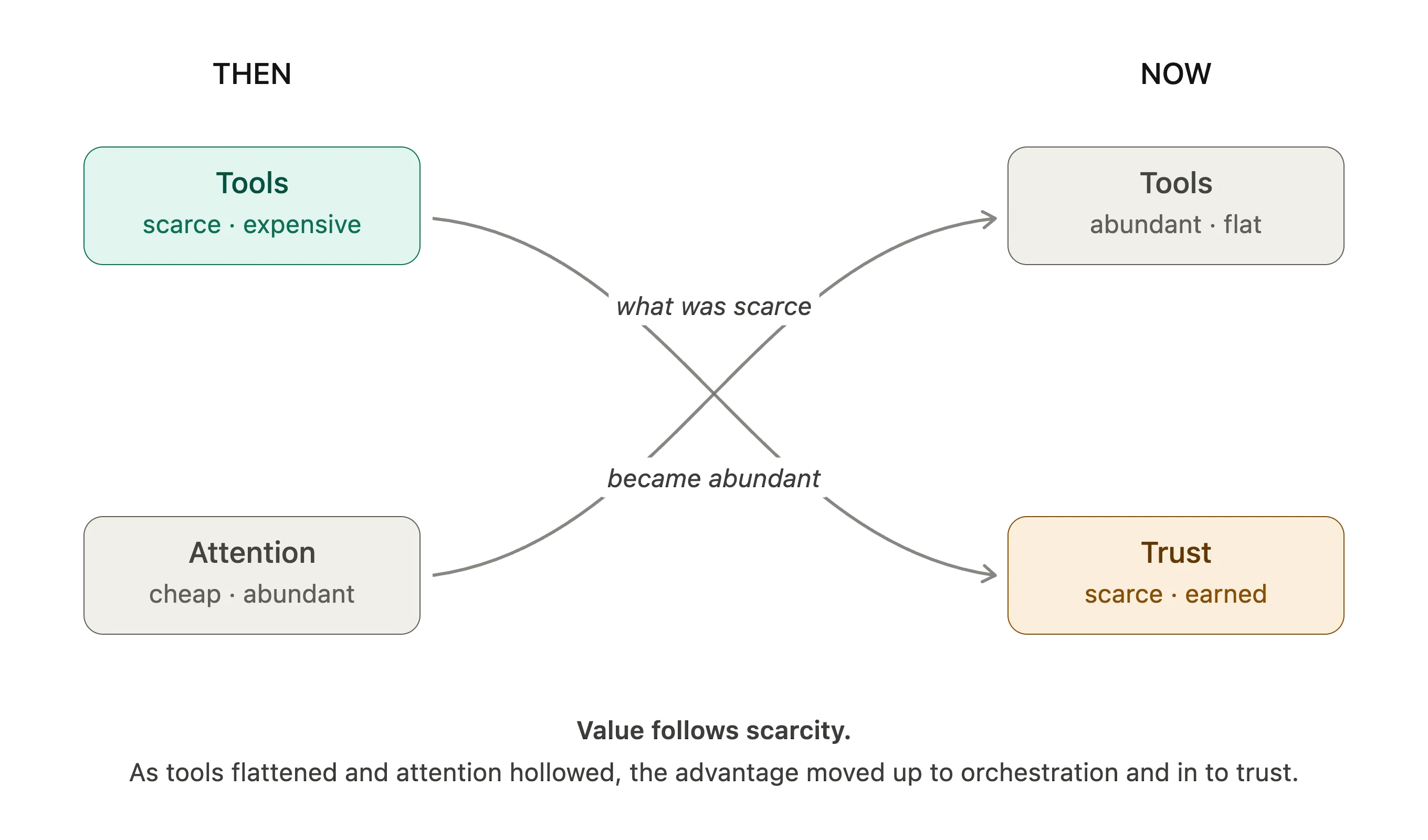
This is the same law this series keeps arriving at from different directions. The artefact is never the asset; the ability to keep it alive and trusted is. A feed that cannot be corrected by the people inside it — that optimises for outrage because outrage performs, and removes every mechanism by which a human could say no, not this — is a system that has engineered away its own correction. And systems that cannot be corrected do not endure. They hollow, and then they fail.
The Upside-Down Network

I should say where I am standing, because I have been building on the other side of this fork. The platform is called MiFamilias, and the simplest way to describe it is that it is built upside down.
A normal social network is built downward from reach: everyone on Earth at the top, strangers and followers below them, and you near the bottom as the thing being sold. MiFamilias inverts the pyramid. The smallest circle — the family you actually trust — sits at the top, and everything else has to earn its way in. There are no followers and no public profiles to harvest. You do not join a family with a friend request; you are vouched in by people already inside it, weighted by how long they have been trusted themselves, and you can be removed only by their consensus — no single person can throw you out, and no algorithm can let you in. A guardian, not a recommendation engine, governs what a child sees, and the platform enforces that on the server where no clever workaround can override it. Trust is granted together and revoked together, which is simply how trust has always worked everywhere except online.
The part that matters most for the future-of-consumption argument is the advertising, because it is the reach model turned exactly inside out. There is no surveillance engine. When the platform notices a probable interest — you have been posting a lot about your dog — it does not build a profile. It asks one transparent question, you tick the categories you actually want, and you set a timer after which it switches itself off. Say no and nothing is stored, nothing is inferred, no profile quietly accumulates. The metric is not impressions. It is Intent Quality — not how many people were shown an ad, but how many asked to see one. That is permission-based consumption rendered as a product, and it only works because the foundation underneath it was built for consent rather than retrofitted with it.
I want to be honest about what this is and is not, because the honest framing is the more useful one. MiFamilias is one early, specific attempt at the grown-up model — a worked example of what “built upward from trust” can mean, not a finished answer to it. Its Communities feature, the safe alternative to the unmoderated group chat, is still in beta, hand-verified, deliberately tuned with real families before the doors open wider. The whole posture is trust first, scale second — which is the right posture and also, candidly, the slow one. It is a proof that the inverted foundation is buildable and that people want it. It is a stepping-stone toward a category that barely exists yet, not the destination.
The Counter-Case, Honestly
It would be too neat to declare the trust model the obvious winner and walk away, so let me make the case against my own argument.
The grown-up model is, by construction, smaller. Reach was extraordinary precisely because it was unlimited and frictionless; trust circles are limited and full of friction by design. A business built on permission you must be granted will almost certainly be a smaller, slower, less explosively profitable business than one built on attention you could simply take. The economics that funded the entire free internet — your data in exchange for the service — do not obviously survive the inversion. Nobody has yet proven at scale that a platform built upward from trust can pay for itself the way the attention machine did. That is a real, open question, and anyone who tells you it is settled is selling something.
There is a second honest difficulty: the incumbents are not stupid, and they will try to follow. They will add private spaces, close-friends features, age gates, consent prompts. Some of it will be genuine. But there is a deep version of the innovator’s dilemma here — a company whose entire revenue, infrastructure, and culture are built downward from reach cannot easily rebuild itself upward from trust, because the foundation is the thing that would have to change, and the foundation is what is paying the bills. Bolting trust features onto a surveillance base produces exactly the half-measure regulators and users will see through. Which edge any given platform ends up on is not a property of the press release. It is a property of the foundation, and foundations are the one thing you cannot patch.
And the third, which I have already flagged: growing up can be done badly. A regime that delivers “trust” through mandatory mass identity-verification has met a privacy problem with a surveillance answer, and made things worse. The grown-up model is only actually grown up if it is built on consent that the user genuinely holds and can withdraw — not on a new and more invasive way of watching them. The technology is double-edged. Which edge you get is determined almost entirely by the discipline of the foundation, not the sophistication of the feature.
Reach Was Never the Asset
So here is where it lands, for anyone building a platform, advertising on one, or simply trying to understand where their own attention has been going.
For twenty years we mistook reach for the asset. We built the largest attention machine in history on the assumption that connecting everyone, harvesting everyone, and selling everyone was both infinitely scalable and permanently fundable. It was neither. The feed got crowded — first with everyone, then with machines — and somewhere in the crowding the trust ran out. The people drifted into smaller rooms, the regulators arrived to insist on permission, and the synthetic tide came in to fill the empty square.
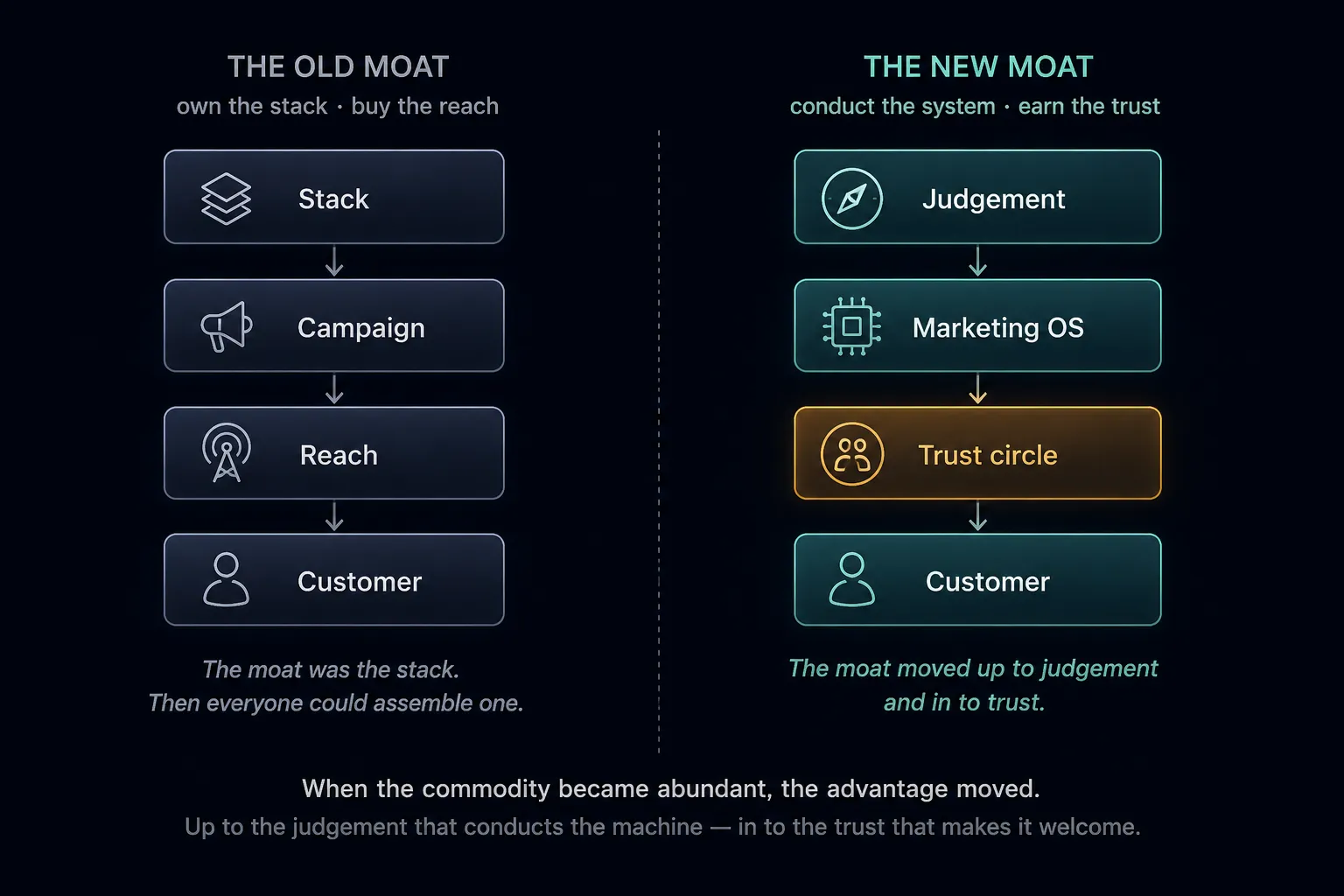
What survives that is not the platform with the most reach. It is the platform built to be trusted — on a foundation that can actually hold consent, governed by people who can still say no, measured by how much it is wanted rather than how far it travels. Consumption is following trust into the smaller rooms, and it is not coming back out into the square. The whole game is moving from attention you take to permission you are granted.
Reach was never the asset.
Trust was. It always was.
We just built the entire thing upside down — and now, slowly, painfully, by law and by exodus both, it is being turned the right way up.