The Upside-Down Idea: Why I Built MiFamilias
It started in 2022 with a simple, uncomfortable question about my own family and the platforms we lived on. This is the story of the idea, the principles behind it, and how a €250,000 quote became one coder and six months.
2022: the question that wouldn’t leave
It started, as these things do, with something small. In 2022 I watched a feed decide what my family should see — what mattered, what didn’t, who was worth our attention that day. And I asked myself a question I couldn’t put down: why does a platform I’ve never met know more about my children than I do?
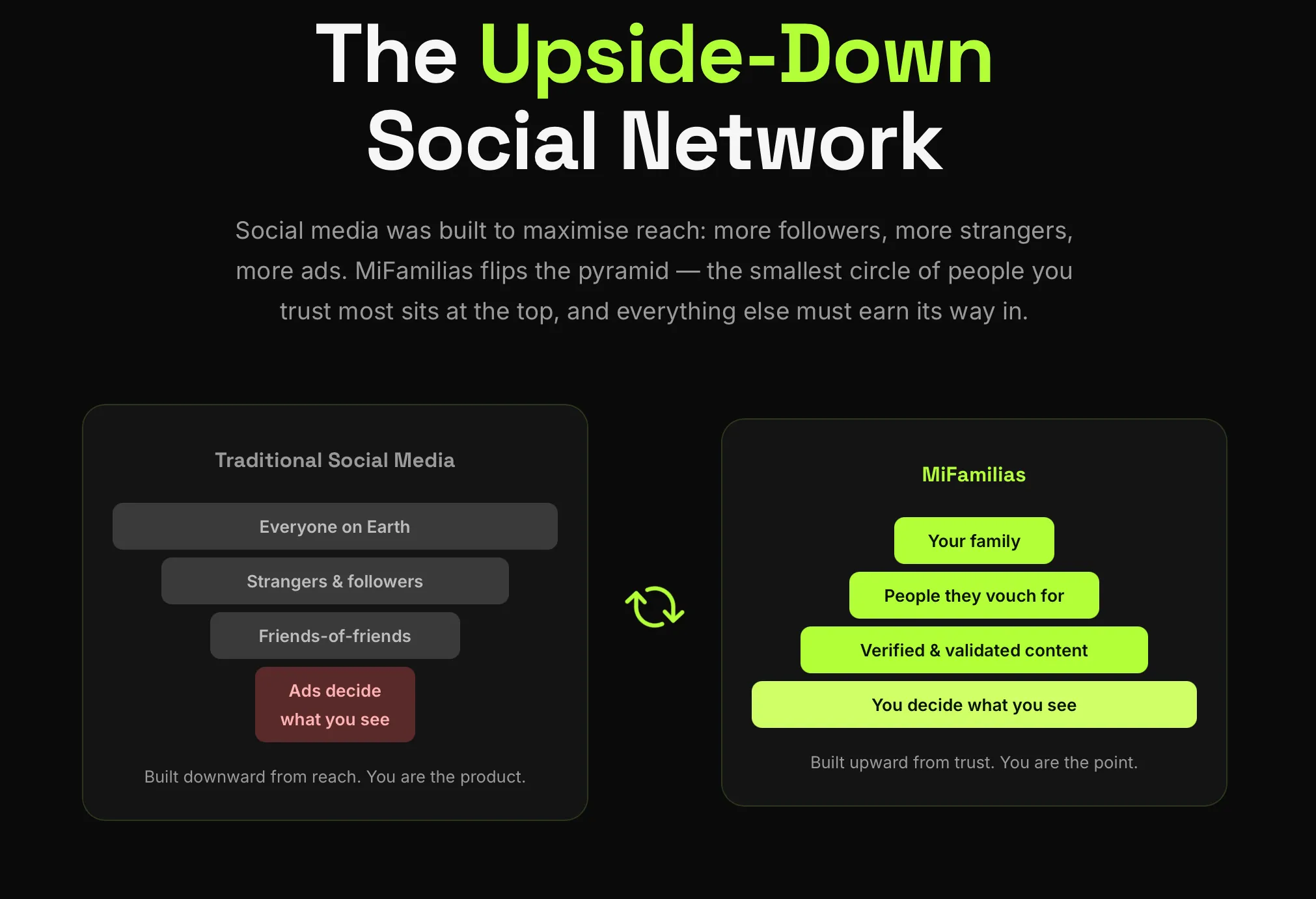
Every social network I’d ever used was built the same way round. It starts with everyone — the whole world — and tries to work inward toward the people you actually love, monetising every step of the journey. Reach first. Family last, if at all.
I wanted to turn the whole thing upside down.
The inversion
The idea was almost embarrassingly simple. What if a network started with the people you trust most — your family — and only then built outward to friends, communities, and finally the wider world? Not reach first, but trust first. No followers. No surveillance. No algorithm deciding what your family should see.
Facebook starts with everyone and works inward. MiFamilias starts with family and builds outward.
That single inversion changes everything downstream — privacy, safety, advertising, even how you measure success. It stopped being an app in my head and became a thesis: what if a social network were designed around trust instead of engagement?
The principles I refused to compromise
By the time I started building, the principles were already non-negotiable — the spine the whole thing hangs from:
- Trust Bubbles. Closed, invited circles. New members join as pending and become full members only when existing family vouch for them. No public profiles. No algorithmic feed.
- Guardianship. Parents control what minors see through server-side enforcement that an app setting can’t bypass. My answer to that 2022 question — it doesn’t know more than you do, because it can’t.
- Intent Quality, not impressions. The platform asks before it shows you anything. Advertising is opt-in, time-limited, and user-controlled. The new measure isn’t how many eyeballs — it’s whether the person actually wanted it.
- Foundations built to last. Time capsules that open decades from now, and a trust-fund model that funds the storage to make “fifty years” a promise we can actually keep, not a slogan.
If those four survived contact with reality, I’d have something worth shipping.
€250,000, or one coder and six months
Here’s the part people find hard to believe. When I took the design out to be built, the quote came back at around €250,000 and the better part of a year.
But I’d already done the expensive part. The architecture was mapped. The data model, the trust logic, the server-side guardianship, the media pipeline, the time-capsule encryption — all of it was designed before a single quote landed. I didn’t need a team to figure it out. I needed to build it.
So I did. One coder — me — with AI as a relentless pair-programmer, and an architecture that already knew where it was going. Six months, not a year. A fraction of the budget, none of the dilution, and a codebase I understood to the last line. It’s the same operating model behind everything I’ve built since: design deeply, then ship lean.
Thank you
No founder does this alone, and I didn’t. To the small circle who believed in the idea before there was anything to believe in — the family and friends who tested the earliest, ugliest builds, who let me film time capsules to prove the concept, who funded the first servers and forgave the first crashes, and who kept asking “when can we actually use it?” until I had no honest answer but to finish it — thank you. You were the first trust bubble. MiFamilias exists because you were patient with me while it didn’t yet.
Now
MiFamilias is the one bet in my portfolio that isn’t solving a workflow problem — it’s attempting a societal one. If it works, it could outlast everything else I’ve made. Either way, the principles hold, and the question that started it in 2022 finally has a product-shaped answer.