The Day the Mountain Moved
At 8.37 on the morning of 26 August, seismometers across Asia recorded an earthquake on the Nepal–Tibet border. There was no earthquake. A short piece to run ahead of the longer one.
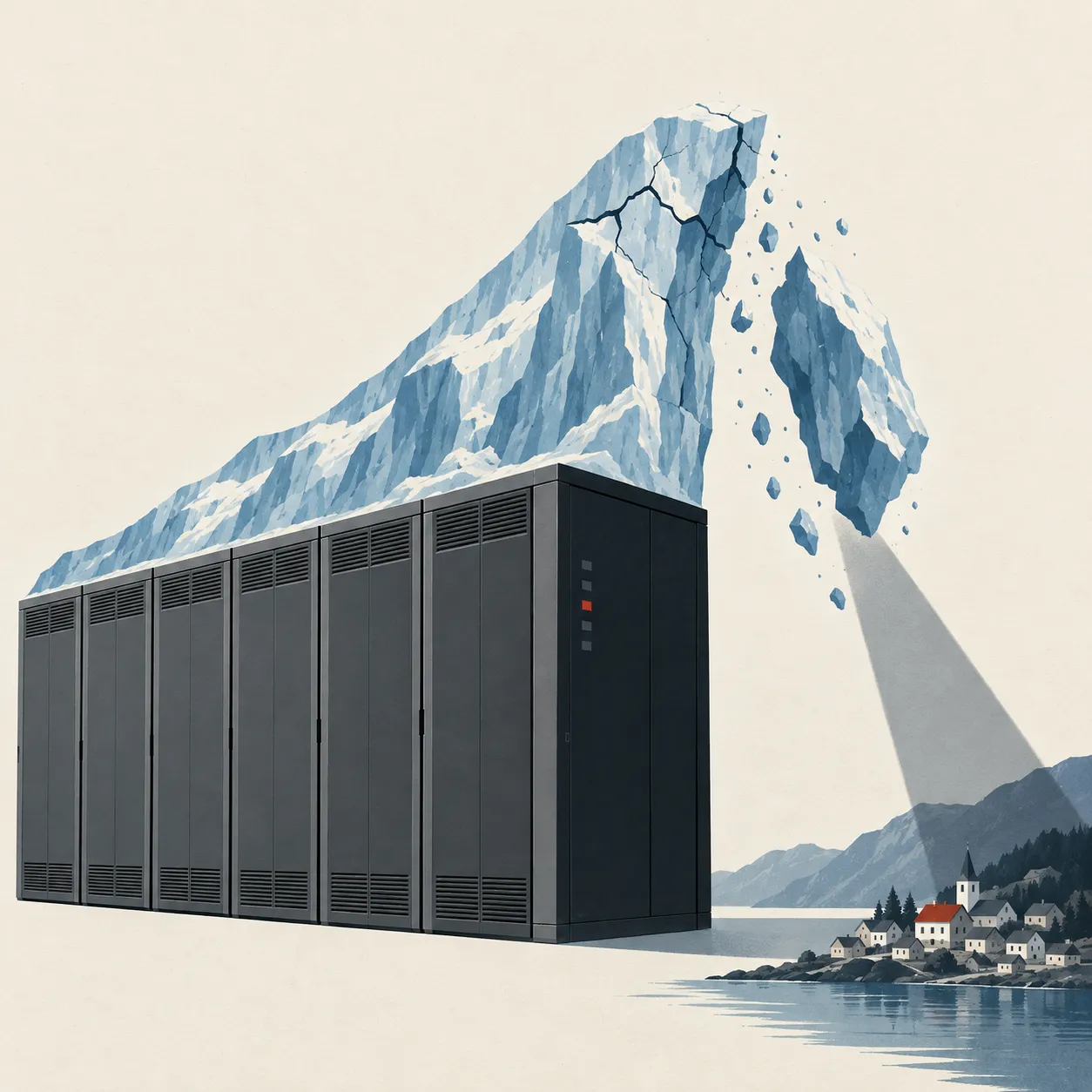
A short piece to run ahead of “My Godfather Ran the Met Office. He Warned Me About This 30 Years Ago.”
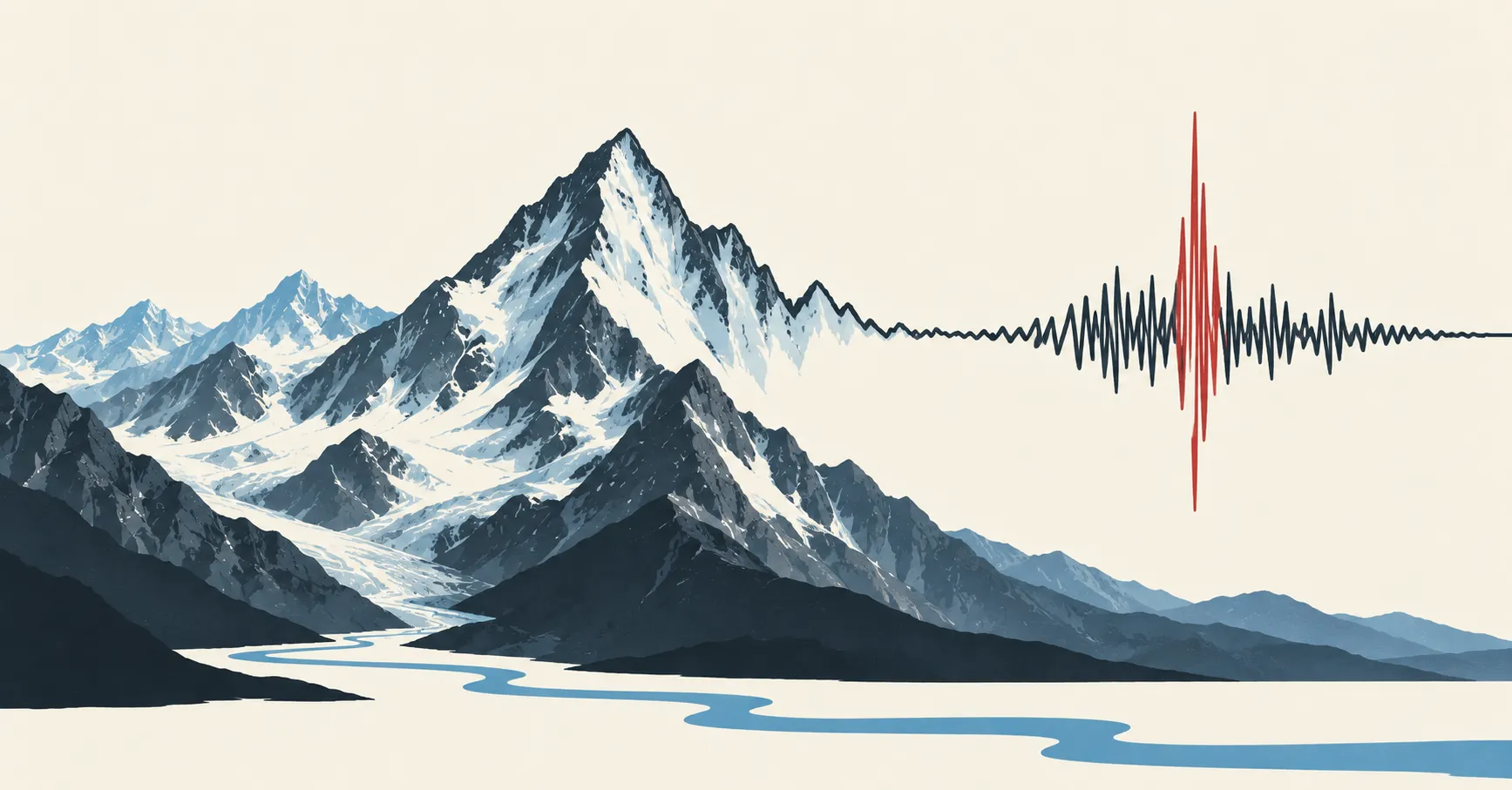
At 8.37 on the morning of 26 August, seismometers across Asia recorded an earthquake on the Nepal–Tibet border.
There was no earthquake.
What the instruments had felt was a mountain letting go. High in the Himalayas, a section of glacier and the rock beneath it detached and fell around 1,200 metres into the valley below, and what reached the bottom was no longer ice. It was a moving wall of rock, water and sediment that went down the river system in about half an hour, lifting the water nine metres as it went.[2] At least 359 people are confirmed dead. More than 1,000 are missing.[1]
And before the mud had settled, the question arrived on cue:
Was this climate change?
I want to give that question a proper answer, and a proper answer will not fit in a headline. So I have written something longer. But let me tell you, briefly, why I am the one writing it.
My godfather was Peter Ewins. He ran the UK Met Office from 1997 to 2004, and before that he was Chief Scientist at the Ministry of Defence.[4] In the 1990s, when climate change was still a subject for the back pages, he sat me down and warned me — not about warmer summers, but about something he called destabilisation. Change the temperature of a planet, he said, and you have not turned one dial. You have nudged all of them. Ice, water, rainfall, oceans, soil, the frozen ground that holds mountains together. Eventually, things we have always assumed were stable stop behaving as though they are.
I had just come back from the Antarctic, where I had served aboard HMS Endurance. I had stood on the ice. It still sounded impossibly distant.
Peter did not keep that warning private. In December 1999, as head of the Met Office, he signed a public letter with the head of America’s NOAA. It said the warming could not be explained without human greenhouse gases, and it ended with a line that has aged rather better than most of what was written that year: ignoring climate change would be the most costly of all possible choices, for us and our children.[5]
That was twenty-seven years ago. The computers he was relying on could perform about a billion calculations a second. The Met Office’s current system manages sixty quadrillion.[8] We have since gone back and marked the old models’ homework, and the awkward truth for the sceptics is that they largely passed: the warming arrived roughly where the physics said it would.[10]
Nobody, then or now, was predicting that a particular glacier above a particular valley would fall on a particular morning. Peter’s generation was predicting something more important than a headline. They were predicting the system in which the headline would eventually be written — a world of retreating ice, thawing permafrost, new lakes, new weight, new water finding new paths. And gravity, which does not read the newspapers, waiting patiently underneath.
We trust this kind of computation to run the stock markets, to fight our wars and to read our medical scans. Only in climate do we treat the output as an opinion. It is worth asking who benefits from that, and worth remembering who pays. The bill does not go to the boardroom. It goes to the future — and the future is you and me.
The longer piece goes through all of it: the ships that gathered the data, the machines that ran it, the test the old models passed, what actually happens inside a warming mountain, and why the next thirty years of climate projections are also thirty years of economic ones — for your house, your pension and the snow on the hills.
But it starts where this one does. With a mountain that moved, and a man who told me, thirty years ago, that one day it would.
→ Read the full article: My Godfather Ran the Met Office. He Warned Me About This 30 Years Ago.
Sources
Numbering matches the full reference list in the main article.
- [1] Reuters. “Hundreds killed, more than 1,000 missing in Nepal and China after Himalayan flood.” 27 August 2026.
- [2] Reuters. “What triggered the catastrophic flood on the Nepal-Tibet border?” 26 August 2026.
- [4] Royal Meteorological Society. “Remembering James Milford and Peter Ewins.” 24 January 2025.
- [5] Ewins, Peter D., and D. James Baker. “Letter — global warming.” The Independent, December 1999.
- [8] Met Office. “History of numerical weather prediction.”
- [10] Hausfather, Z., Drake, H. F., Abbott, T., and Schmidt, G. A. “Evaluating the Performance of Past Climate Model Projections.” Geophysical Research Letters, 47, 2020. DOI: 10.1029/2019GL085378.