Only Continue Reading If You Are Slightly Clinically Insane
It is half past eight, the house is quiet, and I have spent three hours this morning and rather too much of last night on a concept that sits between a territorial strategy game, a collectible archive and a crypto experiment. Impossible objects with memories, a map worth fighting over, and coin communities as the armies fighting for it — where your coin buys you a flag and nothing else, which is the exact opposite of the token I wrote about yesterday.
On impossible objects, a map worth fighting over, whose coin holds which ground, and the difference between a collectible and a financial instrument wearing a small decorative hat.
Updated 11 September 2026. The coin communities have moved from a footnote to the centre of the thing, the product is digital only, and the discussion paper has been rewritten to match. What a coin buys you has not changed, and was never going to: a flag, and nothing else.
There. That title should have removed the sensible people.
If you have no interest in games, trading currencies, strange speculative punts, weird collectibles, virtual influencers, YouTube celebrities or the exhilarating possibility of losing money with surprising efficiency, please stop reading now.
I mean that sincerely. You are wasting your time, and time is the most precious thing you possess. Money comes and goes. Reputation can be repaired. Hard drives can occasionally be recovered from a bath. But the minute you have just spent reading this paragraph has vanished into the expanding universe and will never return.
Still here?
Excellent. You may be exactly the sort of person I am looking for.
It is half past eight in the morning, the house is quiet for the first time this week, and I have spent three hours today and rather too much of last night on something that has entrained me completely. I am going to write it down while it is still warm, partly because that is the only reliable way to find out whether an idea survives contact with sentences.
A completely unreasonable idea
Somewhere between a territorial strategy game, a collectible archive and a crypto experiment, there is a gap. I have been standing in it since about eleven o’clock last night.
Imagine Risk meeting the roaming territorial mischief of Grand Theft Auto. Now remove the cars, the guns and the requirement to spend three years building a video game. Replace them with a persistent map, rival factions, and collectible evidence of things that officially never existed.
The objects might include:
- a glass telephone that rings without a line;
- a railway platform where trains arrive but never depart;
- a memorandum containing instructions nobody remembers issuing;
- a compass that points towards somewhere absent from every known map.
These are not monsters or conventional fantasy characters. They are machines, places and documents from an impossible institution — an archive of the things a bureaucracy would have had to invent in order to explain itself.
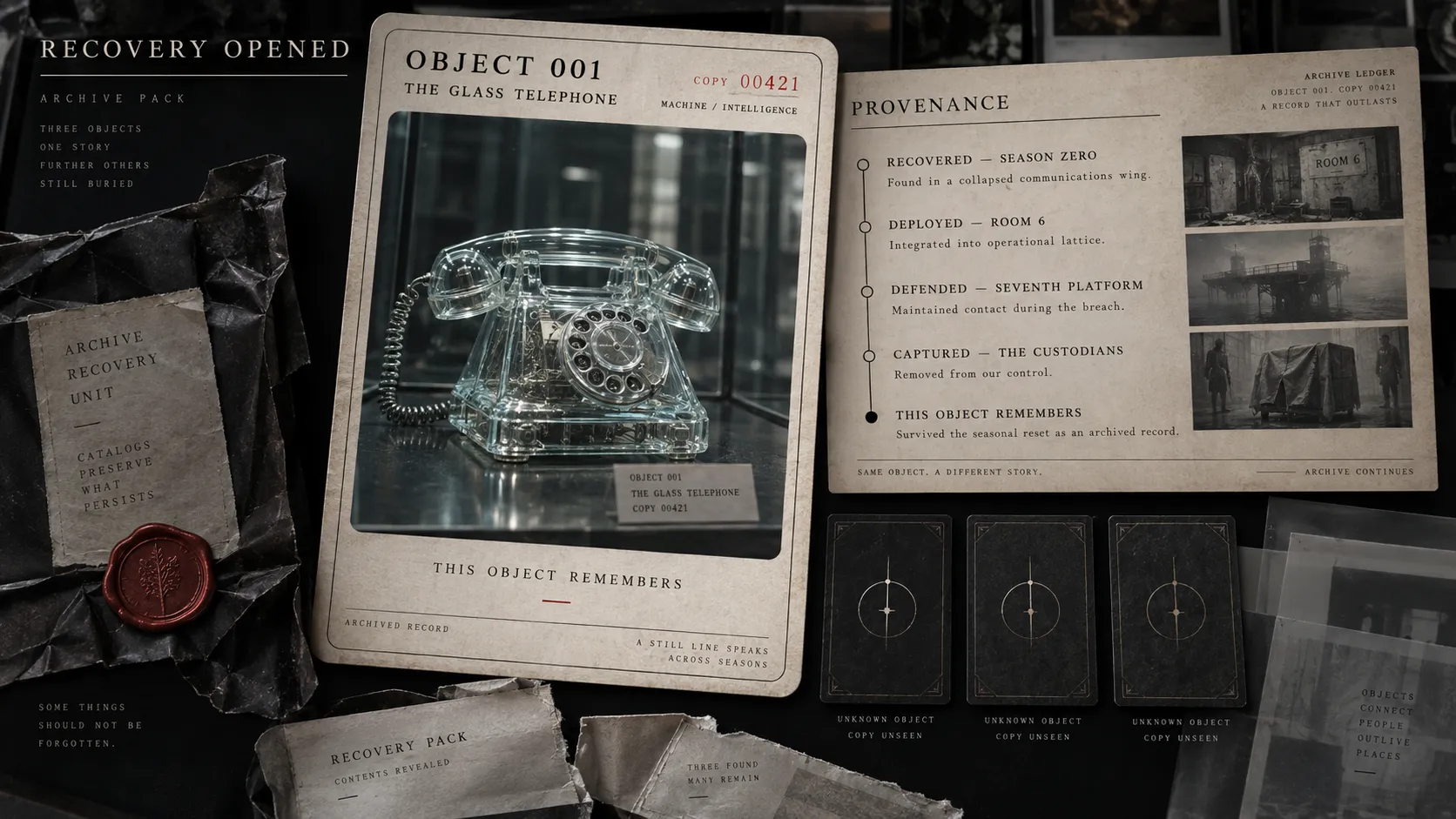
Each object can be collected. Each can alter what happens on the map. And each acquires a history of where it was recovered, deployed, defended, lost and captured.
Look at the ledger in the picture at the top of this page. Object 001, the Glass Telephone, copy 00421. Recovered in Season Zero from a collapsed communications wing. Deployed to Room 6. Defended at the Seventh Platform during the breach. Captured by the Custodians and removed from our control. Survived the seasonal reset as an archived record.
That is not decoration. That is the product.
The same object, in different hands, becomes a different artefact. Two copies of the Glass Telephone can be identical in every respect a smart contract can see, and be worth entirely different things to entirely different people, because one of them was at the Seventh Platform and the other spent the season in a drawer.
Which brings me, awkwardly, to yesterday
Yesterday I published a forensic breakdown of a token called LAPTOP, which went from $3 to $317 and back to $3 in forty-two minutes. Eighty-eight per cent of its supply sat in seven wallets before trading opened. No token entered any pool before the first trade. The whole event lasted about as long as a school assembly, and cost me and four colleagues seventy-five dollars each to observe from the inside.
That token had exactly one property. A price.
It had no object, no history, no reason for anybody to want it once the arithmetic stopped being exciting. And when a thing’s only interesting feature is its price, the price is the only thing anyone can talk about, which is why the conversation ends the moment the price does.
So this is the same question from the other end.
LAPTOP asked: how fast can a price come to exist with nothing underneath it? Forty-two minutes, since you ask.
This asks the opposite. Can you build the underneath first — the object, the history, the reason to care — and find out whether anybody wants it before they know what it costs?
I am not claiming that is a business model. It is barely a hypothesis. But it is at least the right way round, and after the week I have had I find that unreasonably appealing.
The simple version
The architecture is deliberately easy to explain, which is the only architectural virtue I still fully trust:
Your coin determines whose flag you fight under. Our token determines what you can do. Objects determine how you do it. The map is what everyone is fighting over.
The first line is the one that has changed, and it is now the whole idea rather than a footnote to it. The sides on the map are not invented institutions. They are the communities that already exist around individual coins — a dog coin, a political meme coin, a coin attached to a public figure, a coin attached to a joke about a laptop. A season opens, the qualifying communities are announced, and seven territories are fought over by people who turn up already knowing who they are and who they are against.
That solves the only problem that actually kills projects like this, which is that nobody sees the first object. A coin community arrives as a bloc. It has a chat, an identity, an appetite for a scrap and an existing rival, and none of that had to be assembled by me at eight in the morning.
Now the important part, because this is where the whole thing either holds together or becomes the exact thing I spent yesterday taking apart.
A coin buys you a side. It buys nothing else. Not strength. Not packs. Not better odds. Not a better price. A holder of ten thousand stands in the line beside a holder of ten as precisely the same soldier under precisely the same flag. Territories are taken by how many people turn up and what they do with their objects, which means the map can never become an argument about whose treasury is larger.
And eligibility is measured from a window that closed before the season was announced — a balance held over a historical period, published retrospectively. Nobody can buy in, because the qualifying moment has already passed and the next one is not known.
Those two properties are doing all the work. Identity should record that you were already there. It should not create a fresh reason to buy your way across an eligibility threshold — which is, if you would like the short version of yesterday’s essay, roughly the whole of what went wrong.
The project’s own activity token would pay for chosen actions: opening recovery packs, attacking territory, entering campaigns, crafting or restoring objects. Defence would remain free, because charging somebody to avoid losing feels less like an economy and more like being mugged by the game.
The map would resolve at a fixed daily interval, and players could queue a defence in advance. Nobody should lose a territory because an opponent happens to maintain a highly caffeinated tactical unit in another time zone.
Why anyone might care
Most speculative projects begin with an economy and then go hunting for a reason to exist.
This one begins with a question:
Would anybody want these impossible objects even if they did not know what the objects were worth?
That is the real test, and it is a brutal one, because it cannot be passed by arithmetic.
The artwork has to make somebody stop and ask what on Earth is that. The fiction has to make them want to see the next object. The game has to make ownership matter after the first moment of discovery has worn off.
If the only interesting fact about a card is its price, then we have created a financial instrument wearing a small decorative hat.
But if people remember the Glass Telephone, argue about who really held the Seventh Platform and care who controls Room 6, then the thing may have something considerably rarer than artificial scarcity. It may have genuine curiosity — which, unlike a floor price, does not evaporate when the buying pauses.
The map must earn its existence
The first prototype has two players, seven territories, ten cards and roughly twenty minutes in which to answer one question:
Does taking a room that contains an object feel more interesting than comparing two cards?
If the answer is yes, the map may be the product.
If the answer is no, the map is administration with a story stapled to it, and the collectible world should stand on its own.
Both answers are useful. Discovering that an idea does not work after twenty minutes is one of the highest-return investments available to humanity, and I say that as somebody who spent rather longer than twenty minutes discovering the same thing about a memecoin.
The whole first experiment — cards, board, two players, an afternoon — costs under £400. If it fails, that is the cheapest no I will ever be given.
Only once the base game proves interesting would the project test routes, visible travel time and queued defence. Only after that would the coin factions, seasons and a larger economy enter the design — and that stage is gated twice over, on a legal opinion and on two communities actually saying yes.
Nothing gets complexity merely because complexity is available. The governing question is:
Does this proposal add a rule, or does it add a card?
Cards are content. Rules are permanent weight. You can print a thousand of the first and survive; a dozen of the second will bury you.
Yes, there is a business hiding in here
There is a pitch deck, a technology architecture and a staged route to launch. I did say three hours.
Most of it you can simply read. There is a twenty-page discussion paper — the coin war, the four roles that must not merge, the three tiers and their technical footprint, the costs, and a genuinely unkind section on the case against — and it arrives with the PDF of this essay at the foot of the page, for the price of an email address. It is a good deal franker than this piece, particularly about the one question the whole design rests on: whether qualifying a faction from a historical holding window is enough to stop the thing being a financial promotion of somebody else’s coin. I think it is. I am not a solicitor, the paper says so in the section listing what has not been verified, and that conversation now happens before any artwork is commissioned rather than after.
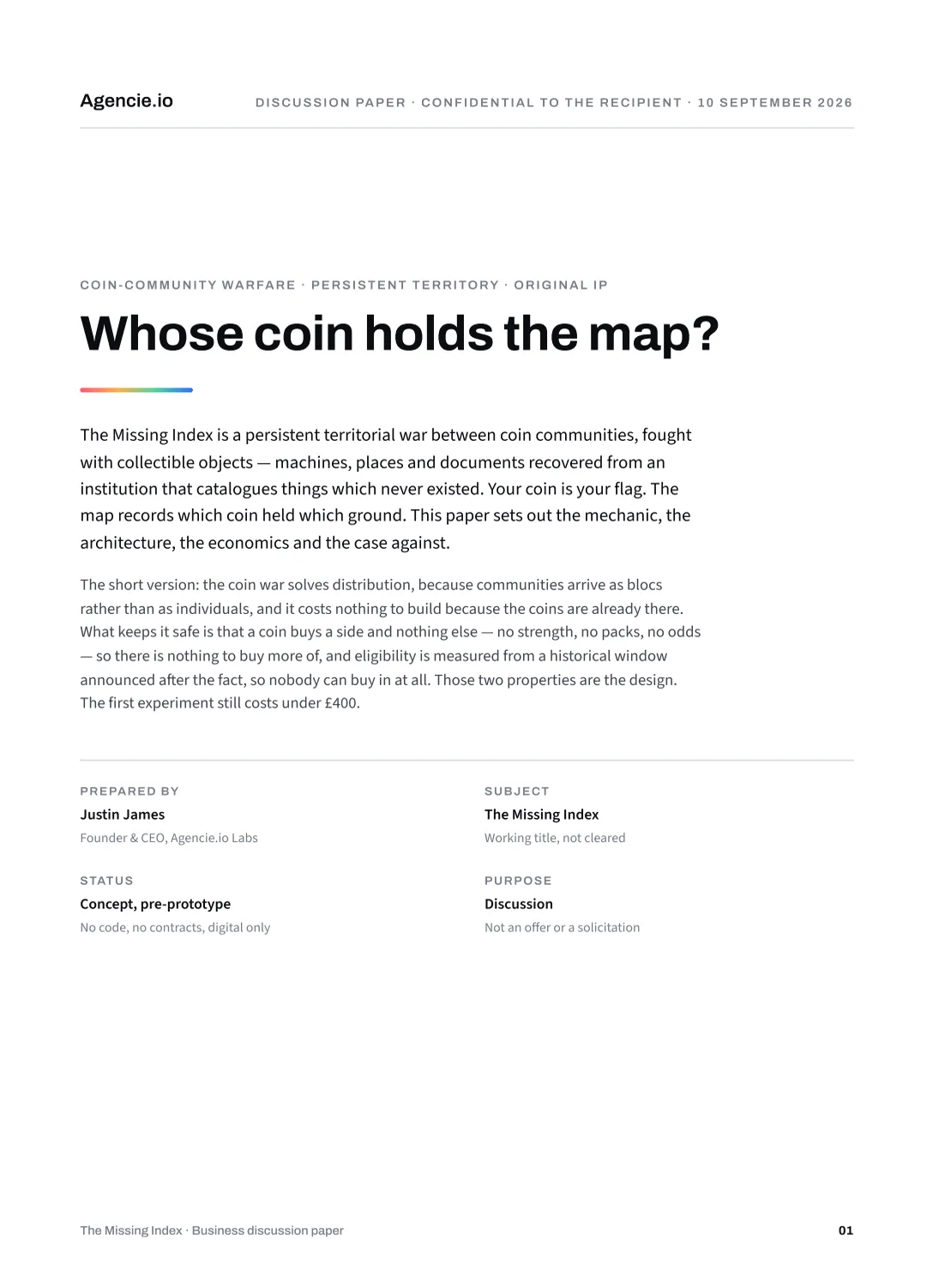
The cover, so you know what you are asking for. Note the status line: concept, pre-prototype, no code, no contracts, digital only. And note that the second paragraph gives away the argument before you have turned a single page, which is either admirable or a marketing error, and I have genuinely not decided which.
The deck goes to anybody who asks for it. That is not coyness. A deck with no conversation attached is thirteen pages of assertions with a handsome cover, and I would rather send it to someone who is going to argue with slide seven. Ask me if you would like it.
Because I can build the software myself, the first serious expense is not an army of developers. It is the work that cannot responsibly be wished away:
- original art and object production;
- legal and policy review, which has moved to the front of the queue;
- smart-contract testing and independent security review;
- eligibility snapshots and the machinery behind them;
- hosting, launch activity and community operations.
Nothing physical. The product is digital only, which removes the printing, the postage, the per-item fulfilment cost and the open-ended liability of having promised to send somebody a card at some point in the future. I would like a printed set very much. That is not a reason.
The paper puts the build at roughly £15,000 to £20,000, digital only, with operations running on beyond that across the first twelve months, split into two funding stages that begin with a small validation phase before anything is committed to a public release. Of that, something between £2,500 and £9,000 is legal advice taken before the artwork rather than after it. Holding coins to allegiance only is what keeps that figure modest. Had I let holdings buy power, it would not have been.
A transferable project token would be a separate and considerably more expensive undertaking, and it should happen only if the collectible and the game demonstrate repeat participation. Creating a token before proving that anybody cares about the world would be impressively efficient, in the same sense that firing oneself from a cannon is an efficient way to leave a room.
Does it have legs?
Possibly.
That is not false modesty. Nobody knows, and anyone who tells you otherwise is selling something.
Perfectly sensible products fail every day. Absurd ideas occasionally become industries. Some of the most carefully planned things vanish without disturbing the air, while projects assembled from curiosity, obsession and an alarming tolerance for uncertainty somehow acquire millions of users.
The universe provides no committee to assess ideas in advance. There is no celestial investment panel issuing neat scores for originality, timing and market fit. There is only the test.
So this needs testing. Not endlessly discussed. Not inflated into a mythology of guaranteed success. Put in front of people. Played. Questioned. Broken. Improved or abandoned according to what actually happens.
Which is, more or less, what I did to my own trading platform on Wednesday, and it cost me seventy-five dollars and taught me four things I could not have learnt any other way. I have become rather attached to the method.
A temperature check
This is absolutely a pitch. I am not going to pretend otherwise at this hour.
It is a pitch to crypto enthusiasts, obsessive gamers, collectors of strange things, artists, creators, online communities, and anybody fascinated by the point where fiction, ownership and group behaviour collide.
It is also a quiet question to potential sponsors and collaborators. Would you help put the first version to the test?
That might mean sponsoring the first run of artwork; bringing a coin community in as one of the founding factions; helping test the seven-territory prototype; contributing legal, game-design or security expertise; introducing me to an artist, creator or community capable of making it stranger; or funding the next stage, with a clear understanding that experiments are permitted to fail.
On that fourth point, one rule I have written down and intend to keep: no community gets gated into a season without a conversation with it first. Using somebody’s flag without asking them is how you acquire an organised enemy in a single afternoon.
No promise of effortless profit is being made here. There are faster ways to become disappointed and considerably slower ways to become poor.
What exists is a curious proposition:
Risk meets Grand Theft Auto, inside the strange art world of impossible objects offered at impossible prices.
Add weird collectibles, virtual influencers, YouTube celebrities and competing online cohorts. Give every object a memory. Give every community a territory. Let the resulting history become part of the thing people own.
Wild? Certainly.
Wacky? Almost offensively so.
Worth twenty minutes around a table to find out whether it has a pulse?
I think so. Do get in touch if you would like to be one of the two players.
The box below sends you this essay as a PDF and the discussion paper alongside it, in the same email. The deck is one reply away.
The companion piece
A Brief History of $317 Billion →
The sober counterpart, published the day before. A forensic account of the LAPTOP listing read straight off the Base ledger: eighty-eight per cent of the supply in seven wallets before trading opened, not one token in any pool before the first trade, and $19.6m of buying met by a sell ladder dressed as liquidity. What happens when a thing is built price first and world never — and what it cost me to watch it from the inside.
It is now a quarter past nine and the house is no longer quiet. If you read this far despite the warning in the title, you are already the target demographic, and I would very much like to hear from you. If you would like the sober counterpart to all of this, Wednesday’s essay is a forensic account of what happens when a thing is built the other way round — price first, world never.