A Brief History of $317 Billion
On 9 September a token called LAPTOP went from $3 to $317 and back again in forty-two minutes, and our new launch module traded it twice with real money. We lost $386.18 and found four defects, two of which live everywhere in the platform. This is the anatomy of a pump and dump read straight off the public ledger — and the account of what a very small, very expensive morning taught us.
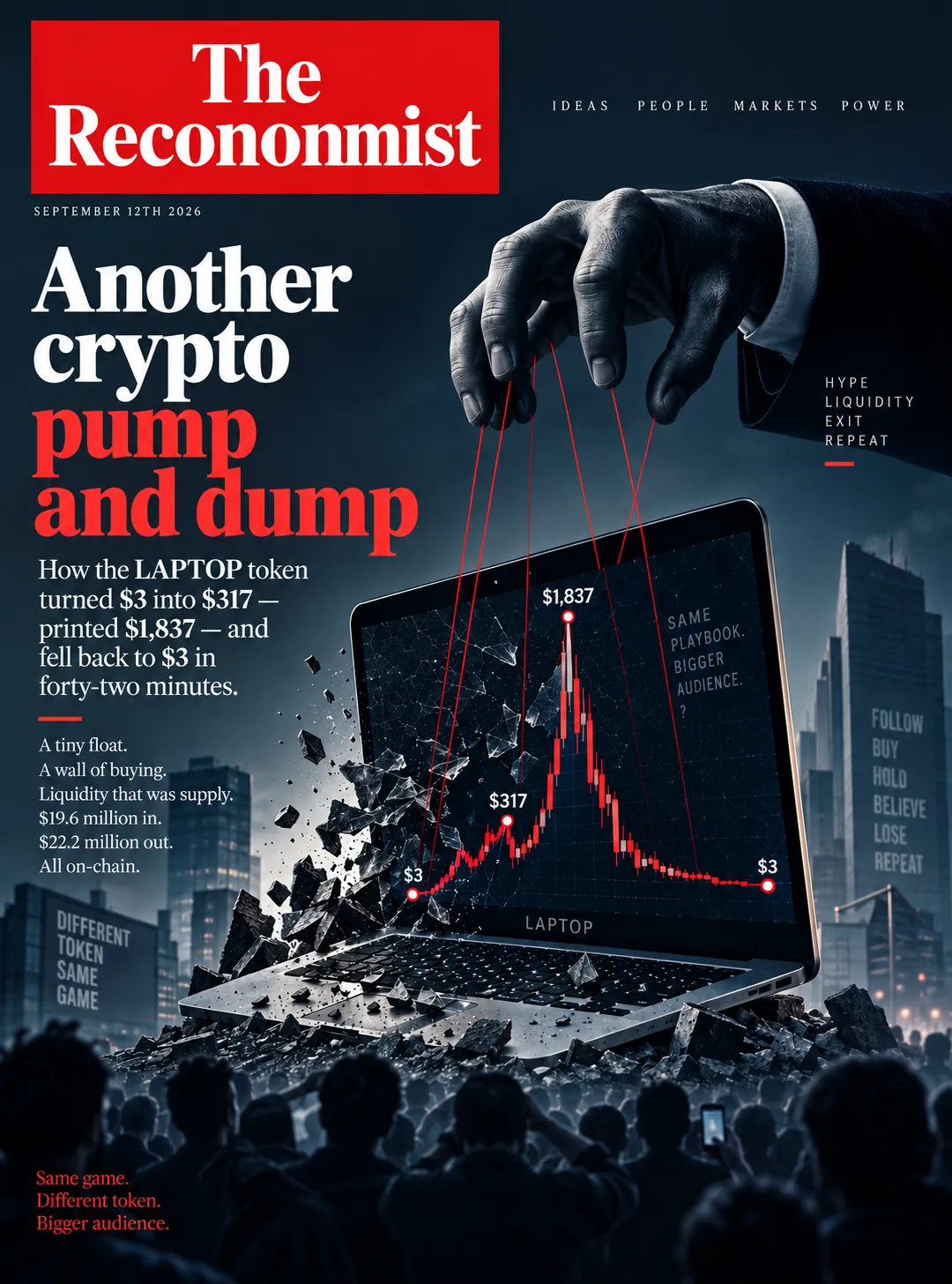
On a token that was briefly, and entirely on paper, worth three hundred and seventeen billion dollars, the difference between depth and inventory, and the four bugs we bought for three hundred and eighty-six dollars.
There is a moment, somewhere around the third cup of coffee, when a perfectly sensible engineering conversation acquires a small and dangerous word. The word is actually. As in: “we could actually just point it at a live launch.”
That is roughly how this began. A friend of mine in the UK and I have been building a module over the last few days — properly in the gaps, between client work, which is the thing that actually pays for the electricity and will always outrank a curiosity. The module is a launch radar: it watches a pinned contract across every venue it can see, judges what it finds against limits set in advance, and takes a position in two legs if and only if the guards pass. It is not a bot in the folklore sense. It is a very fast, very literal-minded risk officer that happens to be able to press the button.
On the morning of 9 September we let it press the button. Twice. With real money.
We put in $550. We got back $163.82. And in exchange for the missing $386.18 — plus $3.15 of gas, which I mention because the receipts are the whole point of this essay — we got four code defects, a set of lessons that reach a long way past crypto, and a front-row seat at one of the cleanest pump and dumps I have ever had the misfortune to be inside.
I want to write about the second thing, because it is the more interesting one, and because it is written in a form almost nobody bothers to read.
What we were actually testing
Some context on the platform, since it is no longer something you can go and look at. Agencio Predict was public once. It isn’t now: it is a closed internal tool, and a small closed cohort trades it with our own money, in anger, on live venues. That was a deliberate decision. It is very easy to publish a backtest and call it a system. It is considerably harder to wire your own bank account to your own architecture and then read the ledger the following morning. If I am going to tell people that autonomous systems need guards, evidence and a kill switch, I would rather be the one who finds out first — with my own funds — what happens when a guard is wrong.
So the launch radar was not being tested to make money. Five hundred and fifty dollars is not a trade, it is a tuition fee. It was being tested to find out which of our assumptions were made of glass.
All of them, as it turns out, were labelled clearly. We just hadn’t read the labels.
Eight o’clock, Eastern
The token was called LAPTOP. I am not going to pretend that isn’t funny. A billion of them, on Base, listing at 8:00 AM Eastern with an airdrop claim opening at the same moment.
Our morning started badly and got worse in an educational direction.
At 11:29 UTC the unattended loop quietly stopped ticking. The object store had been left paused overnight; the health endpoint hung politely waiting for it to answer; and the trading loop, which is nothing if not obedient, held every job for six minutes at the single worst moment of the week. At 11:32 we discovered that the listing time we had been working to was wrong — the brief said 8pm, the project’s own post said 8am — which is a lesson in first-party sources so basic it is almost embarrassing to write down. At 11:55, four minutes before the listing, we found the window had reset itself to Thursday, because someone had saved the settings page with a stale value still sitting in its form.
If you have ever wondered what “operational readiness” means, it means none of that.
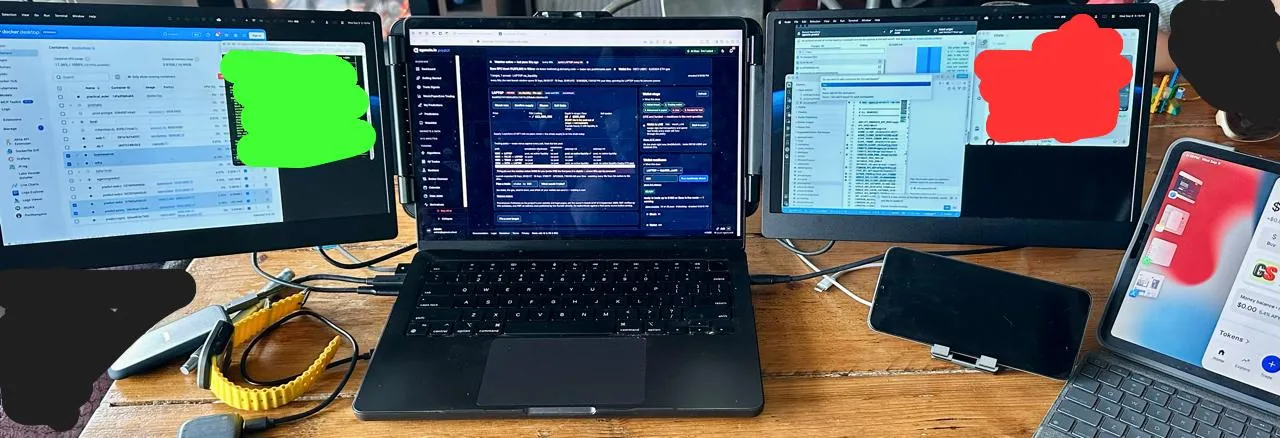
Mission control, shortly before the off. I had been decamped to the dining-room table, my desk having been annexed by my wife’s conference call, which had overrun in the way conference calls do, while my son beavered away in the corner building Lego and then colouring it in. The green and red panels are painted over because not everything on a trading screen is mine to publish. This is the setting for every number in this essay, and I think that is rather the point — none of it needs a trading floor any more, which is precisely why the rest of the story is possible.
At 12:00 the listing happened. Pools existed. Not one of them had liquidity in range. A $20 test buy reverted on every venue, which was the correct answer to the question “is there a market here” — the answer being no, not yet.
At 12:23 there was very much a market. The token was trading at $86 to $98. On a billion-token supply that is a fully diluted value of roughly $95 billion, against a ceiling we had set at $12 million.
The guards refused. Emphatically. FDV eight thousand times the limit, depth well under the floor. The system did exactly what it had been told to do, which was: this is not the market you priced, do not buy it.
And then the owner overrode the guards.
The owner was me.
Our own morning, in numbers
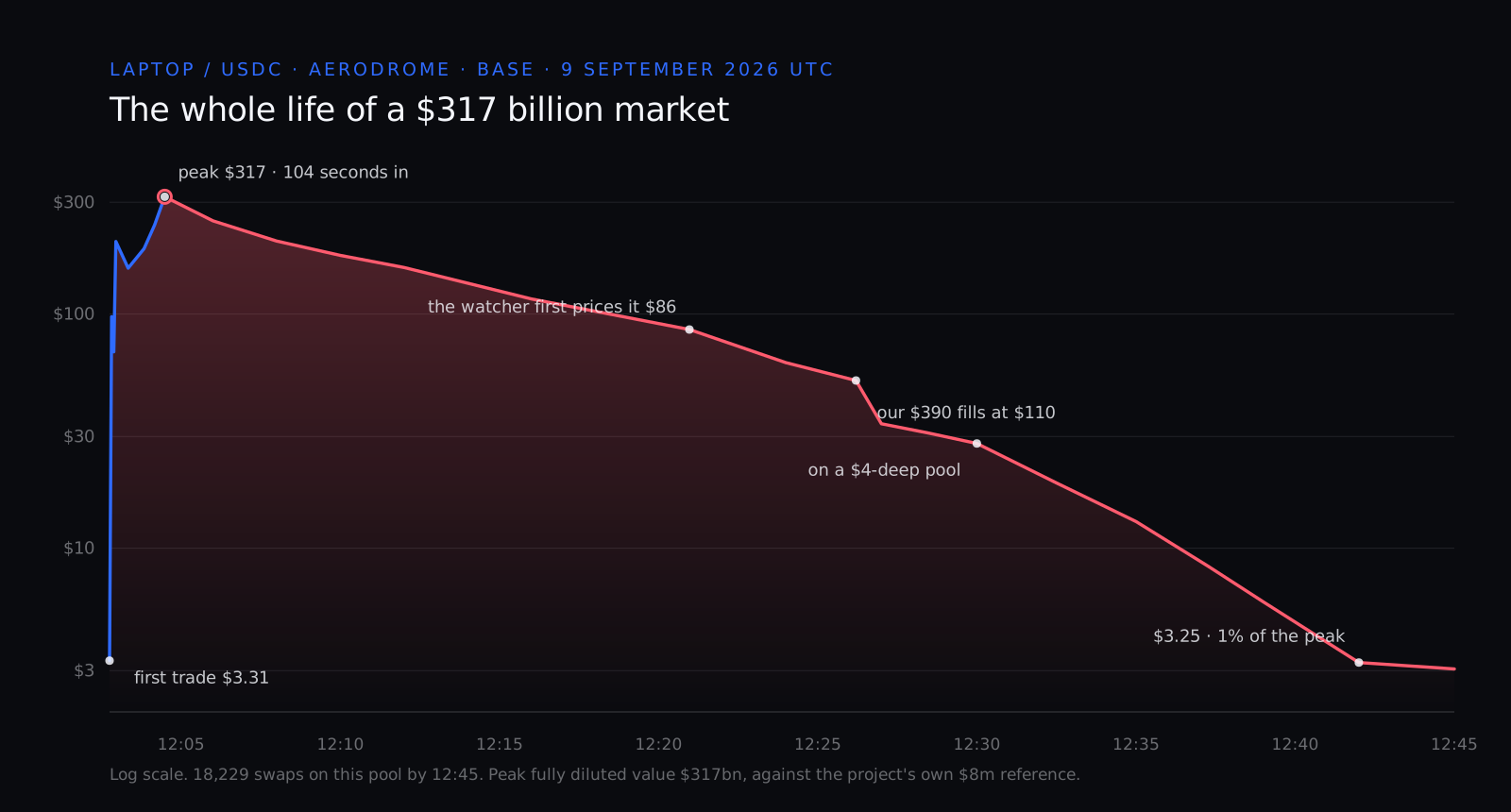
The whole market, on the pool that had the money in it. Our fills are the two marks on the descent. Note the left-hand edge: from $3 to $317 took a hundred and four seconds.
I am going to put this here, near the top, rather than hide it at the end, because a post-mortem that buries its own numbers is a press release.
| Time (UTC) | Leg | Notional | Fill price | Outcome |
|---|---|---|---|---|
| 12:26:02 | buy, probe | $10.00 | $49.85 | filled |
| 12:26:12 | buy, remainder | $390.00 | $110.48 | filled; the pool doubled between the two legs |
| 12:26:21 | sell, all | $114.66 received | $30.73 | a stop that was switched off fired |
| 12:31:31 | buy, probe | $20.00 | — | reverted on the slippage floor; nothing spent |
| 12:32:08 | buy, probe | $20.00 | $26.33 | filled |
| 12:32:16 | buy, remainder | $130.00 | $34.35 | filled |
| 12:35:15 | sell, all | $42.49 quoted | — | reverted on-chain while the price halved |
| 12:37:15 | sell, all | $49.16 received | $10.42 | filled at a widened floor |
| Totals | $550.00 in | $163.82 out | Won: nothing. |
Two stakes. Six fills. Two reverts. No winning leg. Nineteen seconds of exposure on the first one, five minutes on the second. Every fill on the way down.
There is no version of that table where I come out looking clever. There is a version where I come out looking like someone who found four bugs in an hour for less than the cost of a decent dinner, and that version is also true, but I would ask you to hold both.
One clarification, because the headline number does the exercise a disservice. The $386.18 was not one person’s bad afternoon. It was the cohort’s, split between us — about seventy-five dollars each — and it bought four probes and six real transactions on a live launch, every one of them on-chain, every fill and revert and refusal recorded as it happened.
I am not going to dress that up. Nearly is never a win. The platform failed: it went into a market it should never have been allowed into, and two of its own defects made the fills and the exits worse than the market already was. That is a failure and it is written down as one.
But an event like this is rare, and you cannot buy a seat at one. A launch that goes from $3 to $317 and back inside the hour, with your own instrumentation running through the whole of it, is a dataset nobody sells. Every guard that fired, every guard that should have fired and didn’t, every figure the screen got wrong under load, the whole lag between what the watcher saw and what the wallet got — captured live, against real money, for seventy-five dollars a head. No simulator produces that. No backtest would have found those four defects either, because all four live in the gap between what a market actually is and what the code believes it to be, and a backtest is built out of the code’s beliefs.
Seventy-five dollars each for a real one. I would take that trade again, and I suspect I will.
The chain, read backwards
That afternoon I sat down and read the ledger. Not an explorer, not an analytics dashboard — the actual logs, from a standard node, block by block. It took an afternoon. What comes back is one of the most complete forensic records available for any market anywhere, and it is free, and almost nobody looks at it.
Here is what it says.
The supply was already gone. In the forty-eight hours before the open, a single wallet moved 800 million of the billion tokens — eighty per cent — to six addresses, in round numbers. Eighty-eight per cent of the entire supply sat in seven wallets when trading began. One of the six was the airdrop distributor, which spent the hour dutifully sending 4,276.66 tokens to each of 195 claimants, a number I include mainly to establish the scale: the retail claimants were, collectively, a rounding error.
The pools contained no tokens. Four pools were built on 7 and 9 September, the earliest of them forty-five hours before the listing. Every single position placed in them beforehand was one-sided: dollars and ether, waiting to buy at seven-tenths of a cent to a dollar. The quantity of LAPTOP that entered any pool before the first trade was zero. Not “very little”. Zero.
That deserves a moment. On the morning of the listing, several price feeds — and, to be fair, our own readiness check — looked at those pools and reported liquidity. What they were reporting was a row of bids at prices the token would not reach until the collapse was nearly over. The market had depth in exactly the way an empty restaurant with a well-stocked cellar has customers.
The first seller was funded three and a half hours early. Nine million tokens reached a contract at 08:26 UTC, via two hops, from the same distribution chain as the six holding wallets. At 12:02:45 — the very first block containing a trade — that contract sold 29,885 of them.
Not the first minute. The first block. Two seconds.
And then the ladder began.
The ladder
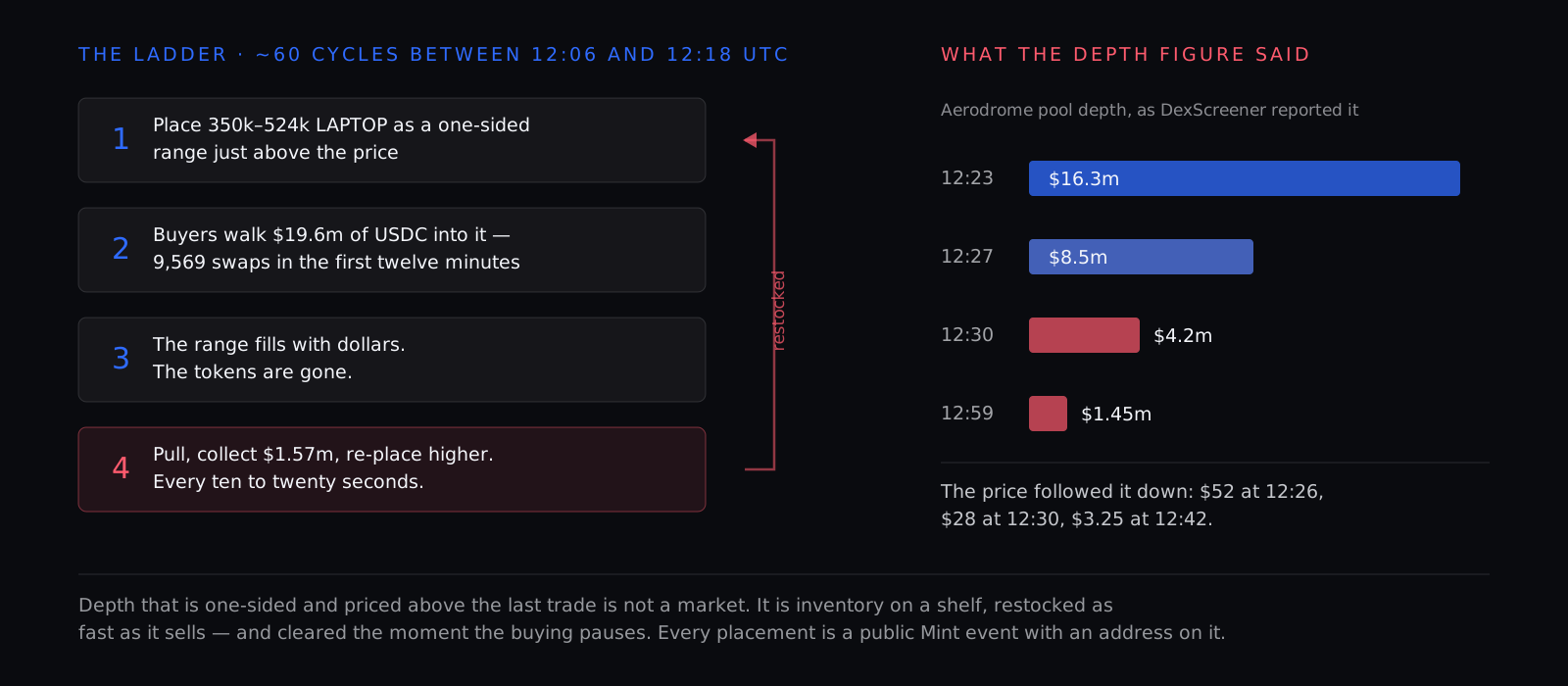
Between 12:06 and 12:18 the same wallet placed and re-placed liquidity positions on the deepest pool roughly sixty times. Three hundred and fifty thousand to five hundred and twenty-four thousand tokens at a go, one-sided, sitting just above the last trade, replaced every ten to twenty seconds as each rung filled. Thirty-eight point seven million tokens cycled out; thirty-eight point eight five million cycled back in. One and a half million dollars came back to the contract.
Now, the mechanism. A one-sided concentrated-liquidity position placed above the market is, in plain economic terms, a limit sell order that also collects the pool’s trading fee. Place a stack of them and re-place each one as it fills, and you have built yourself an order book that only you can write to.
And here is the part that makes it beautiful, in the way a well-designed trap is beautiful: to everything looking in from outside, it reads as depth. At 12:23 the pair showed $16.3 million of liquidity. To a buyer, that is a market. To a price feed, that is a market. To the seller, it was inventory on a shelf, priced above the last trade, restocked as fast as it sold.
Then the buying paused. $16.3 million at 12:23. $8.5 million at 12:27. $4.2 million at 12:30. One and a half by the top of the hour. The shelf was cleared, and the price went with it.
None of this is hidden, which is the thing I keep coming back to. Every placement is a public Mint event with an address attached. Every collection is a Burn. You can read the whole choreography back at your kitchen table. It is also, on every venue that hosts it, entirely legal.
A price is a property of the pool it prints on
I want to dwell on this bit, because it is the closest thing in the whole affair to actual physics, and because it explains why so many people that morning were quoting a number that never existed.
In the lab you learn, fairly early, that a measurement is not a property of the thing being measured. It is a property of the interaction between the thing and the apparatus. Ask a different instrument and you get a different answer, and the interesting question is never “which one is the price” but “what did each one actually touch”.
Crypto price feeds are the purest demonstration of that principle I have ever encountered outside a physics department.
On Aerodrome — the pool with the actual money in it — LAPTOP peaked at $316.75. On a threadbare Uniswap v3 pool with about four dollars of effective depth, the same token inside the same minute printed $1,433, then $1,475, then $1,676, and at 12:07:17, $1,837 — and at one point, sailing through a stretch of empty ticks like a dropped hammer through wet paper, $833,000.
Our own platform’s history recorded $1,351. It wasn’t lying. It was reading an instrument, and the instrument was a pool with four dollars in it.
So when someone tells you a token “hit $1,800”, the honest follow-up is: on what, and how much of it changed hands? A price is not a fact about a token. It is a fact about a pool, a size and a moment, and if you leave any of the three out you are not quoting a price, you are quoting a rumour with decimal places.
At the peak, the deepest pool implied a fully diluted value of $317 billion. Briefly, and entirely on paper, a token named after a laptop carried a valuation with twelve digits in it. The project’s own published reference valuation was $8 million — so the peak was roughly forty thousand times what the people who made the thing said it was worth, and the entire apparatus for noticing this — the depth figure, the price feed, the chart — was reporting, in good faith, that everything was fine.
In one hour, $19.6 million of dollars went into those three pools and $22.2 million came out. The net is minus $2.7 million. Whatever else that hour was, it was not liquidity being built. It was liquidity leaving, at speed, with the lights still on.
The four defects, and the two that live everywhere
Now the engineering, which is the part I can actually do something about.
One: a stop that was switched off, wasn’t. Our hard stop was cleared. The interface said “off”. The command line said “off”. The database said NULL. And the code that acts on it, with the cheerful literalism of all code, read NULL as “nothing specified, better use the sensible default” and applied a −30% stop. Eight seconds after the buy filled, it sold the entire position into the pool that the buy had just doubled. It was, technically, the most decisive thing that happened all morning.
The lesson is one line long and I have written it on the inside of my skull: a setting the interface displays as “off” must mean off in the code that acts on it. Defaults belong where a record is created, never where it is read. If they live in both places, one of them is lying to you.
Two: a pool’s balance was reported as its depth. This one cost most of the $386. For three of the four venue types, our depth figure was simply the pool’s dollar balance. The readiness check looked at a pool “holding $164,000” and concluded, reasonably, that it would absorb a $600 order at about four hundredths of a per cent of impact.
The actual figure was four dollars. Four. The tick at the current price would absorb four dollars before the price moved ten per cent. You could have moved that market with a round of drinks.
A $390 order went in and doubled the price on the way. The exit sold at a third of the market. The size rule that exists precisely to prevent this — the traded pool must be ten times the size of the order — was doing its job diligently against a number that meant nothing.
On a concentrated-liquidity pool, the balance tells you nothing about what will fill. The maths for real depth had been sitting in our codebase all along for one venue type. Nobody had ever asked why the other three were different.
Three: an exit trapped by its own protection. When the drain rule fired at 12:35, the sell reverted on-chain against its own 5% slippage floor — and kept reverting, while the price halved every few minutes. It only landed two minutes later because a human widened the tolerance by hand. A floor that refuses every sell does not protect a position; it holds it still while the market walks away. Exits now retry at a doubling tolerance, capped, exits only. Giving up a quarter of the quoted output beats keeping all of a position in a pool that is emptying.
Four: the two deepest pools were invisible. Two Uniswap v4 pools holding $877,000 between them never appeared, because pool discovery started ten blocks before the process did, and those pools had been created forty-five hours earlier. So we traded a four-dollar pool while nearly a million dollars sat in the next room. Discovery now reads three days back and records a gap rather than silently swallowing a partial read.
All four are fixed, tested and shipped. Two of them — “off must mean off”, and “size against what will fill, not what is held” — are not crypto lessons at all. They are the same defect in different clothes anywhere a system takes an action on someone’s behalf.
Every risk setting a user interface can clear to blank is a place where an engine may quietly restore a default the user believes is gone. Every order sized from daily volume rather than the book in front of it is making the same category error we made: treating “a market exists” as though it answered “what will fill in the next second”. A thin small-cap can carry $50 million of daily volume and take a $20,000 order two per cent through the book. Daily volume is to an order book exactly what a pool’s balance is to its tick: a figure that proves the venue is open, and nothing more.
Those two are now audits across the whole platform — the algorithm executor, the guardrails, the fund manager, the broker layer. They would have cost real money on a broker account exactly as they cost small money on a decentralised one. That is what the $386 bought: finding out on a Wednesday, for the price of dinner, rather than on a Thursday at scale.
The part that was our fault, not the code’s
Honesty requires a second list, and this one has no bug numbers on it.
The launch time came from a brief rather than a first-party source. The health check that gated the trading loop hung instead of failing, which is worse, because a dependency that fails tells you something and a dependency that hangs tells you nothing. And then the overrides.
Raising the FDV ceiling to $200 billion and dropping the depth floor to $150,000 removed, in two keystrokes, the only things standing between the wallet and a four-dollar pool. I did that. The guards were right, I was curious, and curiosity beat the guards. That the module was designed to be overridden by a human is not a defence; it is the exact failure mode every governance framework I have ever written for a client is meant to prevent. The rule that survived is now written down: before any override, check the pass’s depth figure against what the quoter will actually do for the full size, and check the venue list against every pool the outside world can see.
The second stake, five minutes later and into a collapsing pool, was worse. It was placed because the first loss looked like a bug — it was — rather than a market, which it also was. Both things can be true, and averaging into a distribution while telling yourself it’s a debugging exercise is the oldest story in trading with a new hat on. There is now a cooldown.
The system got its half right, incidentally, and I would like that on the record too: it refused the market when it was told to, the probe-then-commit shape worked exactly as designed, the slippage floor stopped the second entry from filling into a spike, and every leg — refused or filled — went through the same policy path and into the same ledger. That is why four defects fell out of the receipts inside an hour. Instrumentation is not a nice-to-have; it is the difference between a post-mortem and an anecdote.
The bit that actually matters
I have no idea who owns those wallets. Neither does the chain. Not one of the addresses in the whole affair carries a public label, five of the six largest recipients of the money are routing contracts one hop short of a person, and “insider” is a claim about knowledge and duty that a ledger is constitutionally incapable of answering.
So: the pattern is established, the identities are not, and I would ask anyone reading the forensic note to hold that distinction as carefully as I have tried to.
But the pattern is very established. Supply concentrated before any market exists. Venues prepared days early, holding nothing to sell. A public moment that summons buyers at a known time. Sellers positioned before it and selling in its opening seconds. Supply released in a form that reads as liquidity. Liquidity withdrawn as demand fades. Retail left holding at one per cent of the entry price.
That is not a novel crypto phenomenon. It is the bucket shop, the boiler room and the Mississippi Company wearing a new hat. The TRUMP memecoin of January 2025 followed the same shape at a hundred times the scale. The venue never makes the pattern. The pattern is older than the venue, older than the exchange, older — by some margin — than the computer.
And here is why it makes me genuinely cross rather than merely interested. There are people doing serious, patient, unglamorous work to make this technology mean something: settlement without an intermediary, ownership that doesn’t depend on a registrar’s goodwill, markets that anyone can audit from a laptop — as, and I do enjoy this, this one was. Every scheme like LAPTOP hands the sceptic a chart, takes money from the people who arrived last, and makes the next honest launch that little bit harder to believe in. The fraud isn’t crypto’s edge case. Right now it is crypto’s advertising.
But the technology adds one thing the older versions of the trick never had, and it is not a small thing.
The record.
Every step of that pattern — the distribution, the one-sided pools, the wallet funded at 08:26, the sixty placements, the depth evaporating — is a public log with a timestamp on it, readable by anyone, forever, without permission. The old bucket shops burned their books. This one publishes them, in real time, to anybody with a node and an afternoon.
The reason that hasn’t yet stopped anything is simply that nobody reads it before they buy. That is a tooling problem and a habit problem, and both are fixable. It is also, if you want the constructive half of this argument, what the essay I wrote the following morning is about — whether you can build the object, the history and the reason to care first, and find out whether anybody wants the thing before they know what it costs. Our own detection engine already classifies exactly this shape — accumulate, pump, distribute, dead — on another chain, and it was never wired to the module that walked into this. It is now on the list, as a refusal code like any other: distribute, and the answer is no.
The day a launch has to survive that reading before anyone is willing to buy it is the day the pattern stops paying. The data is already there. We are just not looking at it yet.
The full forensic note
Everything above is the readable version. Underneath it is a proper forensic note, written the same afternoon from the same records: every wallet, every pool, every block number, the money traced one hop out, the pattern set against the template stage by stage, our own trades in a table so you can see exactly where a buyer of that hour stood, and — importantly — a full section on what the ledger cannot establish. It has a method section so anyone with a node can re-read the whole thing and tell me where I’m wrong.
It runs to fourteen pages, it is signed, and it comes with the essay below. Two files, one email.
I’d rather you check it than believe it. That is more or less the entire point.
The companion piece
Only Continue Reading If You Are Slightly Clinically Insane →
Written the following morning, and the same question from the other end. LAPTOP had exactly one property — a price — and it lasted forty-two minutes. The Missing Index asks whether you can build the object, the history and the reason to care first, and find out whether anybody wants the thing before they know what it costs. Considerably sillier than this essay, and resting on precisely the same argument.
Postscript, for the accountants. Total tuition: $386.18, plus $3.15 of gas — about seventy-five dollars a head across the cohort. Total yield: four defects, two platform-wide audits, one cooldown rule, one very clear memory of the moment a stop loss set to “off” sold everything I owned, and a chart I will be showing clients for years. As continuing professional development goes it beats a day course, and nobody made me wear a lanyard.