Of Flesh, Steel, and Wishful Thinking
A field guide to the age of robots — the fact, the fiction, and the small matter of who fixes them. Six and a half billion dollars of funding, thirteen thousand robots actually shipped, and a spotlit demo that turns out to be a very sophisticated puppet. Where the magic is real, where it is theatre, and the unglamorous question of who you call when the thing falls over on a Tuesday afternoon — from the warehouse floor to the frozen frontier.
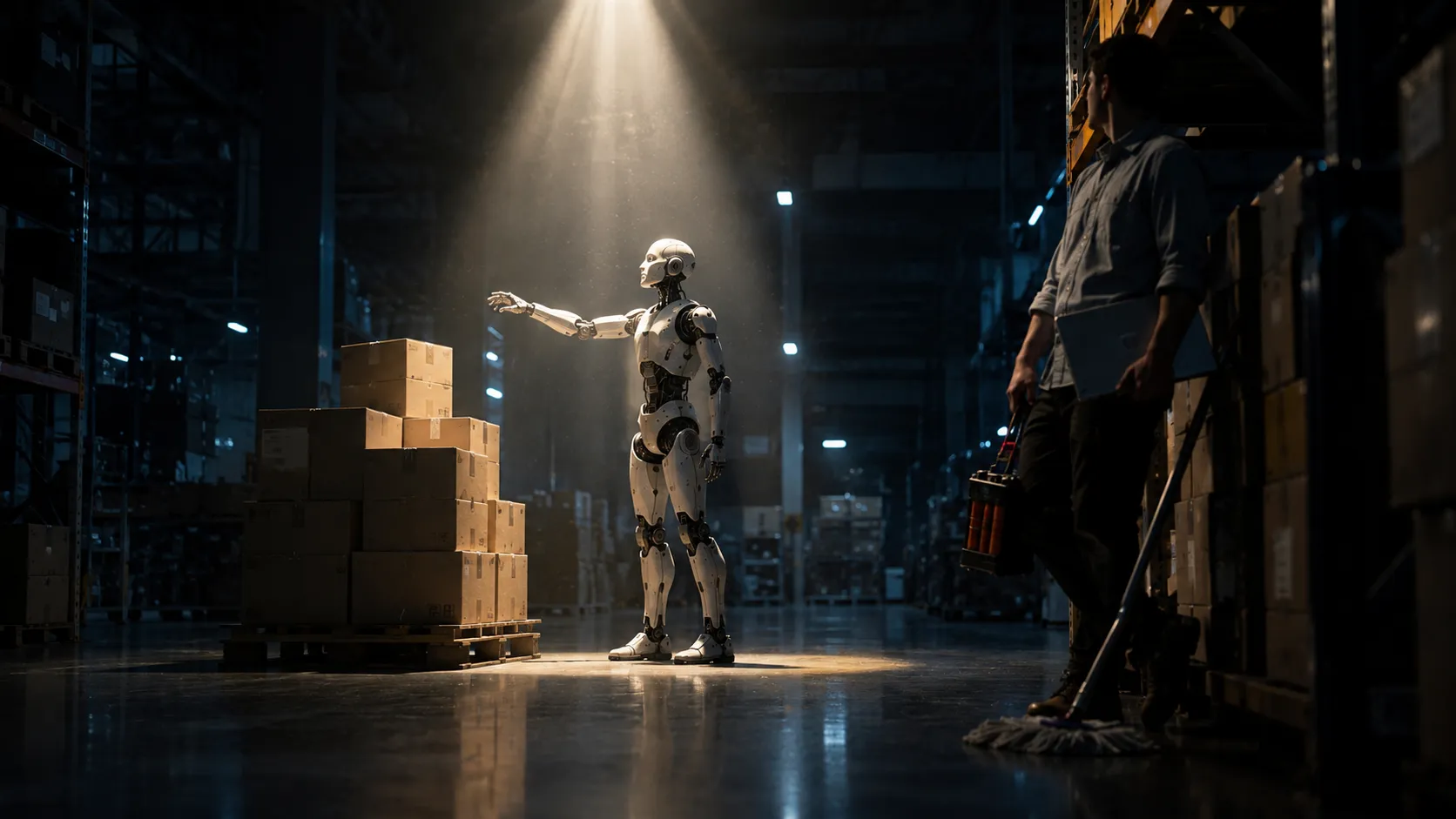
An essay in two voices — the wonder, and the raised eyebrow. Because somewhere just off-frame of every spotlit robot photograph, a very tired engineer is holding a laptop, a spare battery, and quite possibly a mop.
There is a particular species of photograph that has come to define our decade. In it, a humanoid robot stands in a spotlit warehouse, its posture uncannily poised, one hand extended toward a cardboard box as though it were reaching not for a parcel but for the future itself. The lighting is cinematic. The music, you feel certain, is orchestral. And somewhere just off-frame — this is the part the photograph never shows you — a very tired engineer is holding a laptop, a spare battery, and quite possibly a mop.
We are living through one of those rare and thrilling moments when something that lived for a century inside the pages of science fiction begins, haltingly and with a great deal of whirring, to walk into the room. It would take a heart of the most thoroughly rusted iron not to feel some flicker of wonder at it. Here is code — that abstract, weightless stuff of logic and electricity — given legs, given hands, given the audacity to attempt the physical world. And yet wonder, as any good scientist will tell you, is not the same thing as belief. The universe is under no obligation to arrange itself according to our press releases. So let us do something that the spotlit photographs never quite invite us to do: let us look closely, and let us look honestly.
The humanoid debate is usually staged as a shouting match between two camps: the believers, for whom the machines are about to remake civilisation, and the sceptics, for whom they are expensive theatre. Both, I think, are asking the less interesting question. Robotics manifestly already works — it transforms whole industries the moment the task, the environment, the safety case and the maintenance network have all been designed around what the machine can genuinely do. The real uncertainty is narrower and more human than “are robots coming”: it is whether the general-purpose humanoid can walk off the stage, survive the glorious disorder of ordinary life, and earn back the cost of all the people required to keep it standing. Hold that question in mind, and the rest of this essay is simply an attempt to answer it fairly.
The great humanoid gold rush
First, the money, because the money is genuinely astonishing and it is where the story properly begins. By my own count, publicly announced humanoid-robot funding rounds between roughly mid-2025 and mid-2026 total on the order of $6.5 billion — though that figure is best treated as an upper bound rather than a settled fact. It is an aggregate I have assembled from thirteen announced rounds, and aggregates of that kind flatter themselves: some rounds were described as “up to” a given sum, an announcement is not the same as money that has fully closed, and it is fatally easy to fold in extensions, debt, or general-robotics cash that was never strictly humanoid. Draw the line instead at the calendar year 2025, on firmer ground, and the total lands nearer $4.6 billion — still very nearly triple the year before. Both numbers are true; they merely disagree about where to stand, and honesty requires showing you both.
The individual rounds are real enough, and they are large. Germany’s NEURA Robotics raised up to €1.2 billion. Figure, the Californian darling of the sector, closed a round north of a billion dollars at a valuation of $39 billion — for a company whose robots you cannot yet buy. Apptronik has now gathered some $935 million; UBTECH secured a billion of its own; Agility Robotics, whose bipedal Digit actually shuffles about in real warehouses, took roughly $400 million. Behind them trails a small constellation of mostly Chinese names — Galbot, RoboTera, EngineAI, Fourier, Unitree — each hoovering up hundreds of millions apiece. It is the sort of ledger that separates a careful analyst from a breathless one, and we should like, on the whole, to be the former.
Publicly announced funding rounds, ~mid-2025 to mid-2026 (USD).
An upper-bound aggregate — some figures are "up to" amounts or extensions, and Galbot's total is cumulative across rounds rather than a single raise.
Sources — The Robot Report · TechCrunch · Forbes · New Market Pitch tracker.
Here is code given legs, given hands, given the audacity to attempt the physical world. And yet wonder is not the same thing as belief.
Two robots, and then a very long tail
Money, however, is not the same as machines that leave the loading dock. When we turn from investment to shipments — the robots that actually rolled out of factories in 2025 — the picture rearranges itself in an instructive way. The market-watchers at Omdia counted 13,318 humanoid shipments worldwide in 2025. Other trackers run higher, into the region of eighteen thousand, and the gap is itself revealing: there is not yet a universally agreed definition of what even counts as a humanoid, so estimates diverge depending on whether they sweep in wheeled platforms, educational toys, or units shipped to distributors rather than put to work. Take the most defensible single figure and the headline is still startling. Thirteen thousand — not thirteen million — for the entire planet, in the most hyped robotics category in history.
And the field is startlingly top-heavy. On Omdia’s count, China’s AgiBot alone shipped 5,168 units and held some 39 per cent of the market; its compatriot Unitree separately reported shipping more than 5,500. Between them, those two firms account for the overwhelming bulk of everything that moved. The famous Western names — Figure, Agility, and Tesla’s much-teased Optimus — each shipped on the order of 150 units. One hundred and fifty. Tesla, it is worth recording, had set itself a target of 5,000 and did not come close. And a necessary caveat sits under all of these: these are shipped or company-reported figures, not audited counts of robots doing productive work. A unit that has shipped may be earning its keep on a production line, or it may be sitting in a crate in a procurement department, awaiting a use.
2025 global humanoid shipments — Omdia counted 13,318 units in total.
Blends Omdia counts with company-reported numbers; mid-tier figures are estimates. "Shipped" is not the same as "put to productive work."
Sources — Omdia / IDC via Rest of World · SCMP (Unitree self-reported 5,500+).
There is a genuine revolution hiding inside these numbers, and it is not the one the headlines chose. Unitree’s cheapest full-size humanoid, the R1, launched in July 2025 at $5,900 — less than a decent second-hand motorcycle, and against rivals asking $20,000 to well over $40,000. If humanoids ever do become ordinary, it will likely be because someone drove the price into the ground, not because someone perfected the pirouette. The most consequential thing about the modern robot may turn out to be its receipt.
Sticker price of a full-size humanoid (USD).
Rival figures are a typical market range, not single named products; premium models run to $40,000 and beyond.
Source — South China Morning Post (Unitree R1 launch, July 2025).
The fact, the fiction, and the theatre in between
Now we arrive at the delicate part, where enthusiasm and evidence must be gently prised apart. Because a great deal of what the public has seen of humanoid robots is, to borrow a wonderfully deflating phrase from the roboticist Rodney Brooks, “humanoid theatre.” Brooks — who co-founded iRobot and has forgotten more about machines that move than most of us will ever know — looks at the glossy demonstration videos and sees not a technological milestone but the inflating skin of a classic bubble. It is his assessment, not a settled verdict on the whole sector; but it comes from a man with unusually good reasons to hold it.
Consider Tesla’s “We, Robot” event of October 2024, at which Optimus robots mingled with the crowd, poured drinks, and made charming small talk. It was captivating. Attendees and subsequent reporting also established that the robots relied heavily on remote human operation for those interactions — people standing out of sight, doing the actual thinking. For the behaviours that most impressed the crowd, then, the robots were closer to extremely sophisticated puppets than to autonomous workers. This is not fraud, exactly; it is showmanship. But it matters enormously, because the single hardest problem in robotics is precisely the one a human puppeteer quietly solves for the cameras: the problem of doing the thing on its own, in a world that refuses to hold still.
The deep reason for this was named decades ago and it has never stopped being true. It is called Moravec’s paradox, and it is one of those ideas that, once you have it, rearranges how you see the whole enterprise. We assumed, in our hubris, that the mark of intelligence was the difficult, cerebral stuff — chess, calculus, logic. Those, it turns out, are easy for machines. What is monstrously, fiendishly hard is the thing a toddler does without thinking: picking up an unfamiliar object, judging its weight, not crushing the egg, catching the glass before it falls. A billion years of evolution tuned our sensorimotor systems to a pitch that a century of engineering has barely begun to approach.
Brooks puts a fine and physical point on it. The human hand carries many thousands of specialised touch receptors — he puts the figure at around seventeen thousand — reporting pressure, slip, vibration, texture, and temperature, continuously, to a brain that integrates them faster than thought. The fashionable way to train a robot is to have it watch video and imitate. But the deeper difficulty is not that robotics ignores touch — modern systems can and do fuse vision with force, torque, and proprioception — it is that rich, large-scale tactile training data is far harder to gather than the oceans of video we already have. A robot taught mostly by watching is, as Brooks argues, a little like a pianist trained on footage of pianos: it can only ever be as good as the human who teleoperated its lessons, and that human, feeling nothing through the robot’s fingers, was already flying half-blind.
What is monstrously hard is the thing a toddler does without thinking: picking up an unfamiliar object, judging its weight, not crushing the egg.
Where the magic is quietly, genuinely real
Before we descend into the failures — and we shall, at length — it would be a grave disservice, and a betrayal of the wonder we started with, to let you imagine robots are all theatre and no substance. They are not. The trick is to notice where they succeed, because the pattern is as clear as anything in this field, and it has been clear for a very long time.
Robots have been welding and hauling on car assembly lines since the Unimate first swung its arm on a General Motors line in New Jersey in 1961 — sixty-five years of steady, unglamorous, wildly productive labour. Today the International Federation of Robotics counts some 4.66 million industrial robots at work around the world, with over half a million more installed every single year. Amazon, meanwhile, has deployed more than a million robots across upwards of 300 facilities, weaving them into an operating system in which machines transport, sort, and manipulate inventory alongside human workers. And in operating theatres worldwide, Intuitive’s da Vinci surgical systems have now assisted in over twenty million procedures — more than three million in 2025 alone — human surgeons wielding robotic instruments with a precision no unaided hand could match.
The proven base operates at industrial scale. The humanoid frontier is still measured in thousands.
The common thread — robots succeed in structured environments (the caged arm, the mapped aisle) or with a human in the loop (the surgeon at the console), precisely where the general-purpose humanoid is not yet.
Sources — IFR World Robotics 2025 · GeekWire · Intuitive Surgical · Omdia.
It helps, here, to say plainly what the marketing tends to blur: these are not all the same creature. An industrial arm bolted inside a safety cage, a warehouse robot gliding along a mapped aisle, a surgeon’s teleoperated da Vinci, a remotely driven military mule, and an aspirationally autonomous humanoid are wildly different propositions in autonomy, in how close a human stands, and in how mature they are. Lumping them together as “robots” is how one smuggles the proven success of the caged arm into an argument for the untested humanoid — and it is a sleight of hand worth refusing.
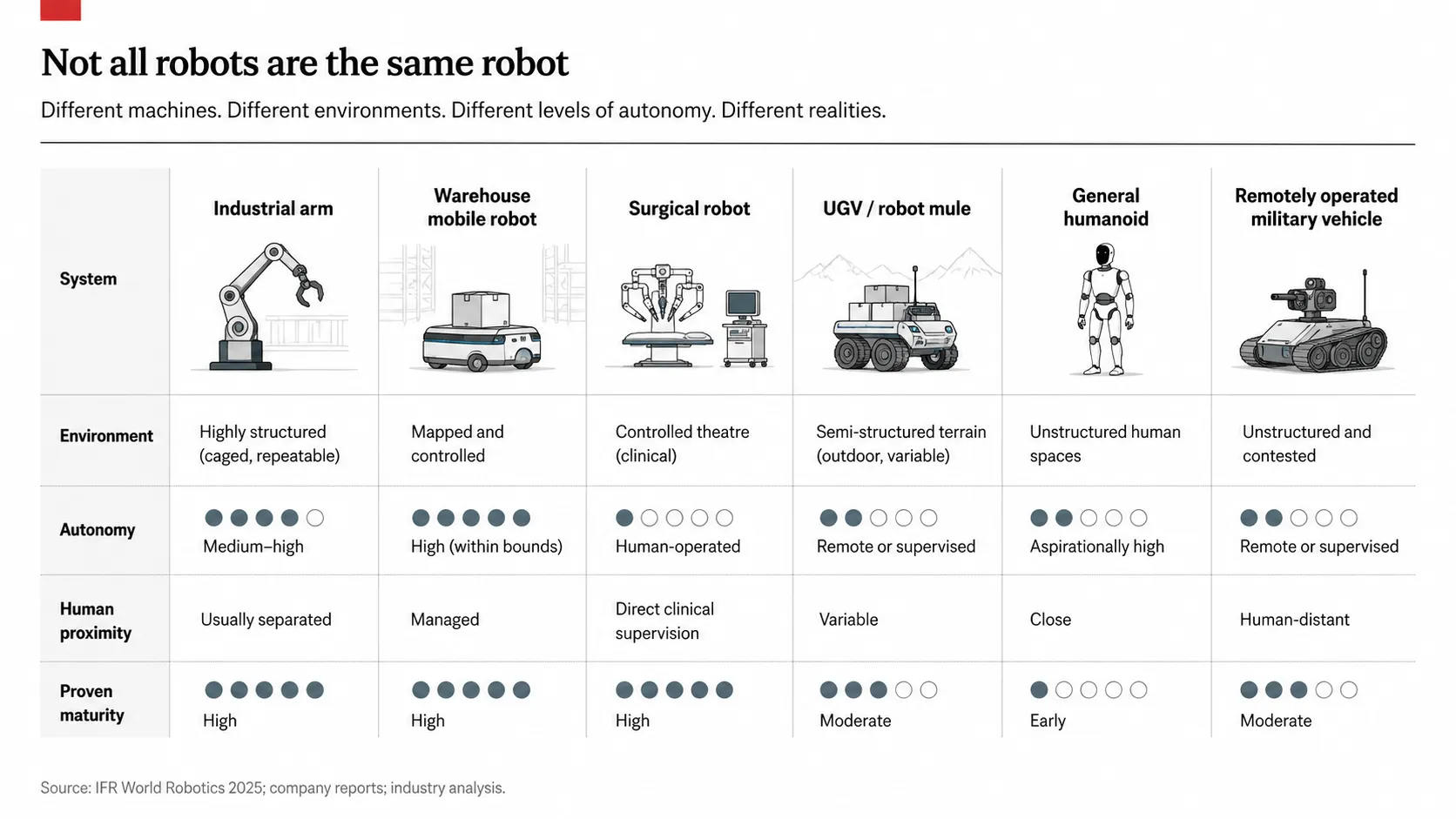
Six machines, five yardsticks. Read down the “proven maturity” row and the story tells itself — the robot succeeds precisely where the world has been tamed for it or a human supplies the judgement. The general-purpose humanoid, alone, is asked to do neither.
Because look at the triumphs and the common thread nearly hums. Every one of them happens either in a structured, bounded environment — the caged cell, the mapped aisle — or with a human firmly in the loop, as with the surgeon at the console. The robot is superb precisely where the world has been tamed for it, or where a person supplies the judgement it lacks. It struggles the instant the world turns wild and various and unforgiving — which is to say, the instant it is asked to be a general-purpose humanoid wandering your office. An inch of snow, it turns out, is still enough to defeat a fleet of six-wheeled delivery robots. The universe keeps its edge cases in inexhaustible supply.
What actually happens on Tuesday afternoon
Suppose, then, that we set aside the philosophy. Suppose you have bought your humanoid, or leased it, and it is standing in your facility on an ordinary Tuesday afternoon. This is where the questions you might reasonably ask — the unfashionable, deeply practical, entirely correct ones — come into their own. Because a robot is not a piece of software. It is a machine, and machines, like all of us, wear out.
Start with the joints. Many compact, high-torque robot joints rely on a beautiful bit of gearing called a harmonic drive, which lets a small motor produce enormous torque with almost no backlash — and which brings with it several well-understood failure modes. The flexspline, a thin flexing steel cup at the gear’s core, is prone to fatigue fracture; the bearings pit; the lubricant degrades and then, having degraded, sheds particles that contaminate everything downstream; and under overload the teeth can “ratchet,” skipping like a stripped bolt. No single one of these need be common for the problem to bite, because of arithmetic: a humanoid carries dozens of heavily loaded joints, and the machine is only available for work if every one of them stays within tolerance. Reliability that would be perfectly acceptable in a single arm becomes precarious when you multiply it forty ways.
Then there is the humblest tyrant of all: the battery. The demonstration videos never mention it, but published runtimes vary enormously by machine and by task, and many current humanoids manage only a few hours before they must charge or swap packs. Ask the machine to actually lift and carry, as one presumably bought it to do, and that figure falls materially; warm the room to a summer’s afternoon and it falls again, as the thermal-management system throttles the motors to keep them from cooking. Agility’s Digit copes with hot-swappable battery packs, which is a sensible engineering answer and also a quiet admission: your tireless mechanical worker needs, in effect, a tea break every couple of hours, and someone to bring it a fresh pack when it does.
And when — not if — something breaks, we arrive at the question that ought to be asked far more often than it is: who fixes it? The industrial-arm world has spent sixty years building the unglamorous scaffolding that makes automation actually work — FANUC, ABB, and KUKA run global field-service operations, preventive-maintenance contracts, and deep shelves of spare parts, backed by a whole secondary industry that refurbishes and re-stocks. For the shiny new humanoids, that scaffolding barely exists. There is no corner garage for your bipedal worker, no equivalent of the breakdown service to winch it home. This, more than any question of artificial intelligence, is why so many buyers prefer to lease rather than own. The winner of this whole race may not be the firm with the most beautiful launch video, but the dull, magnificent one that can deliver a replacement actuator to Birmingham, Bangkok, or Boise by Wednesday morning.
The arrangement even has a name — “robots-as-a-service” — and it can, over a full asset life, cost markedly more than owning outright. Buyers accept the premium anyway, and the reason tells you everything about the current state of trust: leasing hands much of the maintenance, uptime, and obsolescence risk back to the supplier. If the robots don’t work, you stop paying. The customer is not really buying a worker. The customer is buying the right to send the worker back.
The 300-pound question of trust
Would you, then, have a robot up here — in your workplace, your corridor, the space where actual humans walk and reach and occasionally trip? The question is not merely sentimental. In July 2016, a 136-kilogram Knightscope security robot in a Silicon Valley shopping centre knocked down and rolled over a sixteen-month-old child. The boy escaped with a scraped leg and a bad fright. And the robot simply continued on its programmed way — which is the truly instructive part, because it exposes the gap between possessing sensors and correctly interpreting, and safely acting upon, what those sensors report. A machine can be bristling with cameras and still fail to do the one thing that matters: stop. The manufacturer called it a “freakish accident,” which is precisely the phrase that ought to give a facilities manager pause, because freakish accidents are exactly what safety engineering exists to anticipate.
This is why Brooks advises people to keep at least three metres away from a full-size walking humanoid — his counsel, not a codified rule, but a well-reasoned one. A machine that walks by controlling its own falling, which is essentially what bipedal walking is, stores a frightening amount of kinetic energy, and doubling a robot’s height multiplies its mass roughly eightfold. The industry knows this. In 2025 the core international safety standard for industrial robots, ISO 10218, received its most substantial revision since 2011, folding in updated functional-safety and collaborative-application requirements. That is genuine progress — but it is an update to a discipline that has been maturing for decades, not the belated arrival of adult supervision. And it exposes a more consequential gap than it closes: ISO 10218 governs industrial robots specifically, and expressly excludes the military, medical, law-enforcement, and public-facing settings into which embodied machines are now wandering. The rulebook for the robot in the cage is being sharpened. The rulebook for the robot on the pavement, or the border, has scarcely been written.
The department of war, and the arithmetic of disposability
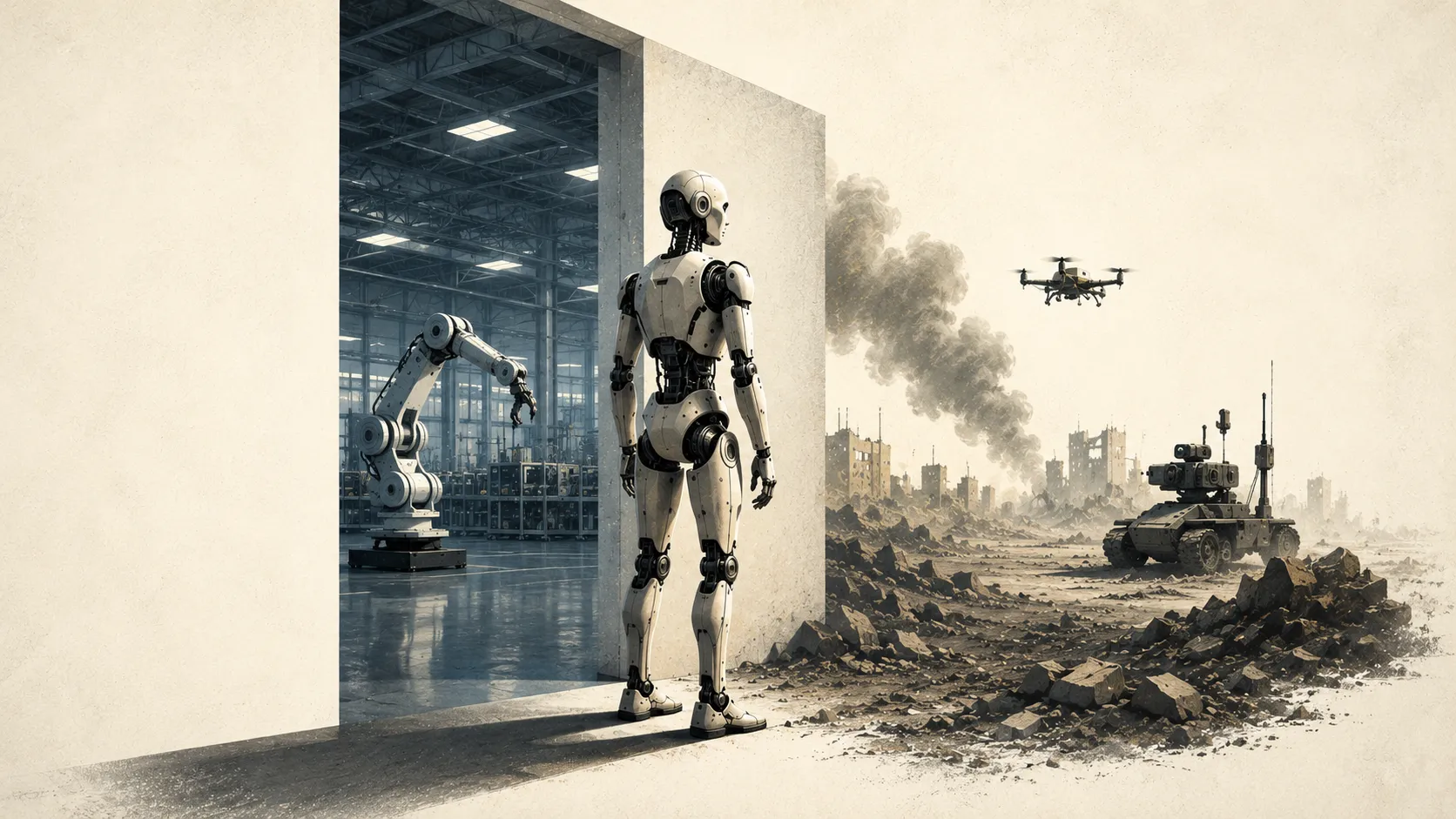
The same machine, two destinies. On one side of the threshold, the tamed and bounded factory where robots already thrive. On the other, the frozen frontier — where every disadvantage catalogued so far can suddenly flip into an advantage, and a colder arithmetic takes over.
And here, if we are being unflinching, we must turn to the darkest and perhaps the most consequential application of all — the one where the calculus of the tired engineer and his mop gives way to a colder arithmetic entirely. For there is one domain in which every disadvantage we have catalogued can suddenly flip into an advantage, and it is the domain of defence.
Take the disputed Himalayan frontier between China and India, about which alarming and much-repeated figures circulate. Reports dating to late 2021 claimed that the People’s Liberation Army had moved unmanned ground vehicles into Tibet in meaningful numbers — some 88 NORINCO “Sharp Claw” reconnaissance robots, a portion of them positioned near Ladakh, alongside roughly 120 “Mule-200” logistics platforms, each said to haul around 200 kilograms of supplies across fifty kilometres of punishing terrain. Those precise numbers have been repeated endlessly since; they should not be mistaken for a confirmed, current inventory, and the original source — the Central Tibetan Administration — is an interested party rather than a neutral defence authority. Around the same broad theme sit better-attested developments: the PLA has publicly trialled armed robot “dogs” and issued powered exoskeletons to help flesh-and-blood soldiers carry loads through thin, freezing air. The stated rationale is disarmingly candid: the plateau’s cold and altitude are hard on human troops. The machines do not suffer altitude sickness, though the cold visits engineering punishments of its own.
So how effective is any of this? That is exactly the right question to hold onto, and the honest answer is that we largely do not know. A great deal of what reaches us is drill footage, staged demonstration, and the strategic theatre of a state that very much wants its rivals to believe. The same brutal realities we have discussed — batteries that wilt in the cold, gearboxes that fatigue, sensors baffled by an inch of snow — do not politely suspend themselves at a national border. A robot mule that freezes solid at 5,000 metres is not a soldier; it is a very expensive sledge. The gap between the parade-ground demonstration and the shooting-war reality is, if anything, wider in defence than anywhere else, because the adversary is actively trying to widen it.
And here lies an irony almost too neat to be true, the sort a novelist would be told to cut for implausibility. The machine that costs a nation a million dollars and a supply chain can, in the right circumstances, be undone by the contents of a child’s party bag. A robot that navigates by watching — and, as we have seen, most of them fundamentally do — is blinded the instant its optics are fouled. A paint bomb or a fistful of glitter across the camera housing turns a state-of-the-art sentinel into an expensive, flailing statue; not one line of its magnificent neural network is any use when the lens is simply opaque. And then there is sand — the eternal nemesis of everything that turns. The very harmonic drives we admired for their precision are precision’s hostage: a few grains of grit past a worn seal will lap the gear teeth to ruin and seize a joint solid. The deserts and the frozen, dust-scoured plateaus — the two theatres into which these machines are most eagerly marched — are precisely the environments most saturated with the fine abrasive the mechanical engineer has feared since the first gearbox. The adversary need not out-code the robot. He need only throw sand, or paint, and wait. The universe, once again, keeps its cheapest defeats in inexhaustible supply.
(The child in me was sorely tempted to add stink bombs to that arsenal — a robot, after all, cannot be made to gag, however much the humans crewing its command post might. But that is a whole other story, and one best told over a glass of wine, once we know each other a little better.)
And yet the strategic logic is undeniable, and worth stating plainly even as it unsettles us. The grim appeal of the machine is precisely that it is disposable in a way a human being is not — or ought never to be. Steel can be written off on a spreadsheet; a life cannot, or should not. A robot sentinel that is destroyed costs a procurement officer a requisition form and a manufacturer another production order; it does not cost a family a son or a daughter, and it does not send a coffin home. There is a version of this argument that is genuinely humane: if machines must go into the killing zones, better they than people.
But we should be honest about the shadow the argument casts. History is disfigured by wars in which human capital was already treated as a number in a ledger, the individual soldier reduced to an entry in a casualty column with no more ceremony than an inventory write-down. The danger of the disposable machine is not only that it dies in our place, which is good, but that it lowers the threshold at which we are willing to start the dying at all. If a nation can wage a war — or provoke one on a frozen border — without the politically inconvenient business of body bags, the ancient, blood-paid restraint that has always made leaders hesitate begins, quietly, to erode. The robot that spares a life on the battlefield may, by that very mercy, make the battlefield easier to reach for. That is not an engineering problem. It is a moral one, and no service contract covers it.
The thoughts of humans employing robots
So where does all this leave the person — you, perhaps — standing in a facility, or a command post, holding a brochure and wondering whether to invite one of these things across the threshold? It leaves you, I think, in a place of clear-eyed and rather cheerful realism, which is a far better place than either the true believers or the sneering cynics manage to reach.
The honest calculus goes something like this. A robot today is not a person you hire; it is a capital asset you maintain, with all the servicing schedules, downtime, spare-parts anxiety, battery swaps, and safety-case paperwork that phrase implies. It will excel at the dull, the repetitive, the structured, and the dangerous — the tasks where its tirelessness is a gift and where its limited judgement has, in effect, been engineered out of the problem in advance. It will disappoint you, sometimes expensively, the moment the work demands the improvisational dexterity your least experienced human employee possesses without thinking. And the trust you are being asked to extend — to a heavy, fast-moving machine that cannot feel the toddler at its feet, nor the difference between a combatant and a child — is not yet fully earned. It is being earned, incrementally, standard by standard and service-contract by service-contract. But it is not there yet.
A robot today is not a person you hire; it is a capital asset you maintain.
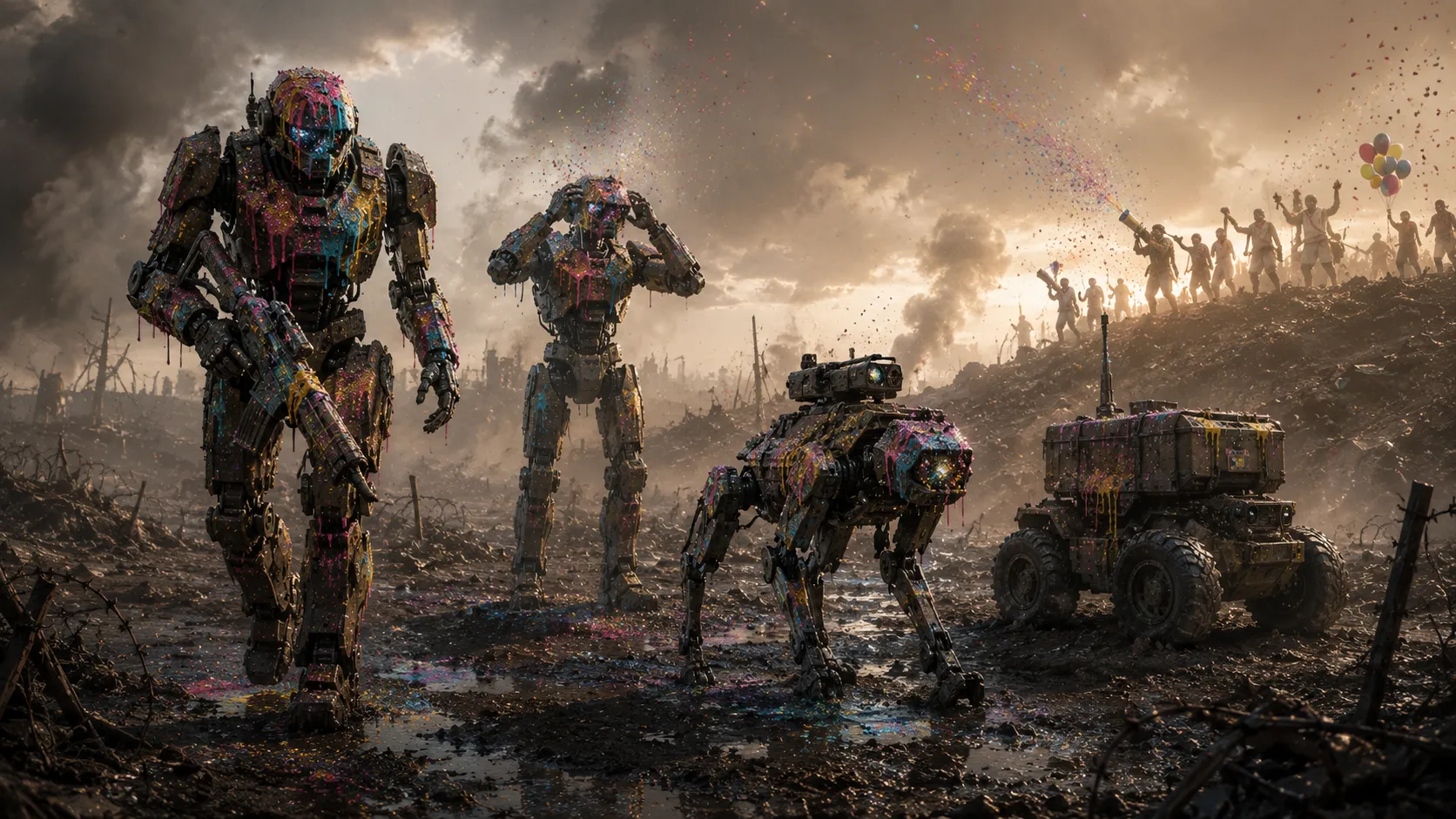
Paint over a battlefield cuts both ways. It is the confetti of a hype party that refuses to end — and, smeared across a lens or clogged into a joint, close to the cheapest weapon yet found against a million-dollar machine. The celebration and the defeat, as it happens, wear exactly the same colours.
And yet. And yet. It would be a failure of imagination, and a rather grey one at that, to end on the ledger. Because the thing that makes this moment genuinely thrilling is not the valuations or the shipment charts. It is the sheer, improbable audacity of the attempt — the taking of code, that ghostly abstraction, and pouring it into steel and actuator and sensor until it reaches out, clumsily, gloriously, and touches the physical world. We have done it before, in the caged arms and the warehouse movers and the surgical wrists, and each time the magic became so reliable that we stopped calling it magic and started calling it Tuesday. That is the true trajectory of every technology worth having: from miracle, to product, to plumbing.
The humanoids in the spotlit photographs are not there yet. They are, for now, a promise wearing a very good suit — overhyped, undercooked, and quietly overtaking their own marketing in ways that have nothing to do with dancing. The reality of deploying them is harder, slower, and more mundane than the videos will ever admit, full of dead batteries and stripped gears and the eternal question of who you call when it falls over. Whether that promise is used to unload a lorry or to hold a frozen frontier, the same stubborn physics applies, and the same hard moral questions wait patiently at the end of it. But somewhere in that unglamorous struggle — in the tired engineer with the laptop and the mop, in the price of the Unitree R1 falling through the floor, in the boring, beautiful safety standard growing sharper at last — the future is being built. Not with a flourish. With a spanner. And honestly, when you think about what it is we are actually attempting here, that may be the most wondrous thing of all.
Sources & verification
Figures in this essay were checked against the following as of July 2026. Where a widely-shared number proved to be a cumulative, estimated, or dated figure, it is flagged as such in the text.
- Humanoid funding (~$4.6B in 2025; “humanoid theatre” / Rodney Brooks) — Forbes. The ~$6.5B rolling-12-month total is my own aggregate of announced rounds, presented in-text as an upper-bound estimate.
- NEURA Robotics ~€1.2B Series C — The Robot Report
- Figure $1B+ Series C at $39B valuation — TechCrunch
- Apptronik $935M raised — TechCrunch
- 2025 humanoid shipments (Omdia 13,318 total; AgiBot 5,168 / ~39%; Unitree 5,500+ self-reported) — Rest of World / Omdia
- Unitree R1 humanoid at $5,900 — South China Morning Post
- Tesla Optimus reliant on remote human operation at “We, Robot” — TechCrunch
- Rodney Brooks, “Why Today’s Humanoids Won’t Learn Dexterity” (tactile-data argument; ~17,000 receptors; 3-metre advice) — rodneybrooks.com
- Moravec’s paradox (background) — Wikipedia
- Harmonic-drive / flexspline failure modes — PHM Society
- Humanoid battery runtime (a few hours; payload & thermal effects) — RobotWale
- Robots-as-a-Service risk-transfer economics — Robotomated
- Chinese PLA “Sharp Claw” UGVs & “Mule-200” logistics robots in Tibet — reports dating to late 2021, Central Tibetan Administration (interested party; treat numbers as unverified)
- PLA armed robot dogs & exoskeletons at altitude — Defense One
- Unimate / first industrial robot at GM, 1961 — IEEE Spectrum
- 4.66M industrial robots in operation — IFR World Robotics 2025
- Amazon passes 1 million robots across 300+ facilities — GeekWire
- da Vinci — 20M+ patients, 3.1M procedures in 2025 — Intuitive Surgical
- Knightscope robot injures toddler (2016) — ScienceAlert
- ISO 10218:2025 industrial-robot safety revision (scope excludes military/medical/public-facing) — The Robot Report
- Snow defeats sidewalk delivery robots (long-tail edge cases) — autoevolution