SEOboss
Audit, fix, prove — for search engines and answer engines alike.
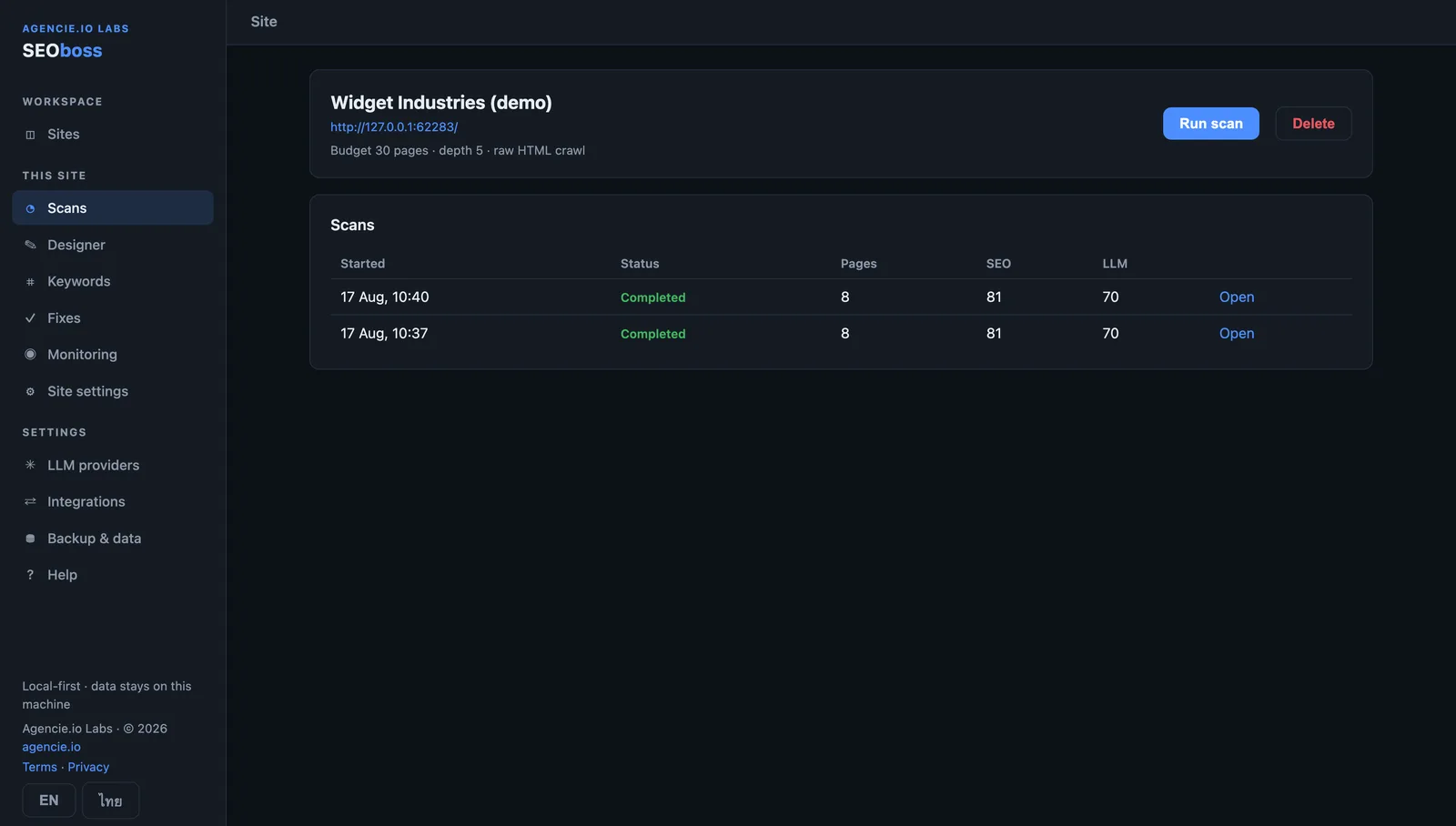
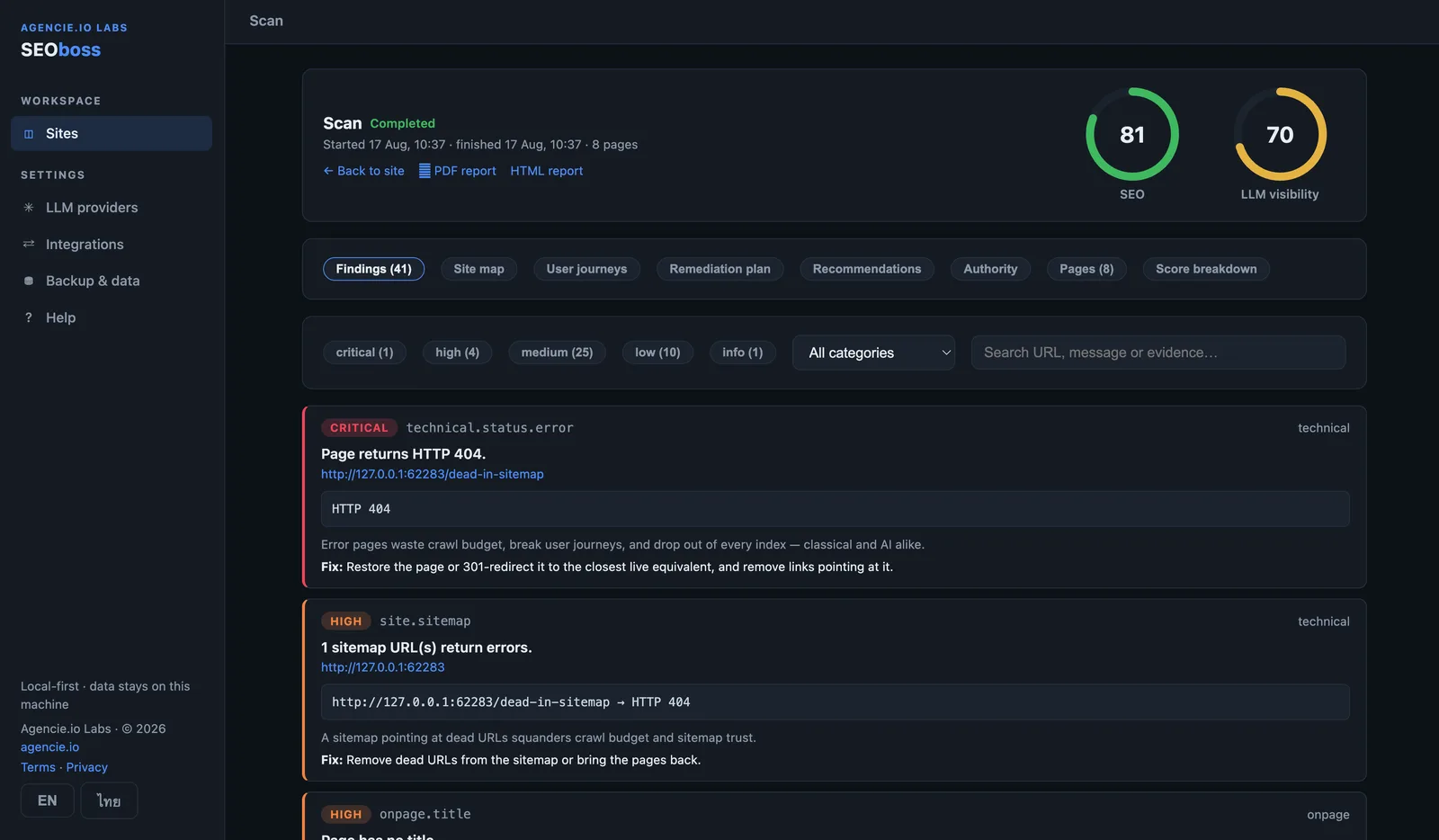
Classical SEO tools answer "will Google rank this page?". They say nothing about whether an assistant can fetch it without JavaScript, parse a clean claim out of it, and cite it. SEOboss covers both columns in one pass, scores them separately with the arithmetic exposed, and then closes the loop nobody else closes — draft the fix, approve it, apply it, verify it against the next scan. Runs on one machine, English or Thai, with a private console per client.
Why I built it
Because SEO got cheap, and pretending otherwise is how agencies die.
Ten years ago an audit was genuinely skilled work: someone who knew what they were looking at, a week of their time, and a spreadsheet nobody read twice. Today that audit is a crawl and a rule set. A competent model will draft your title tags, your meta descriptions, your schema blocks and your FAQ copy for pennies, at three in the morning, in Thai if you like. The activity has been commoditised, thoroughly and permanently, and it is not coming back.
The usual reaction is to be gloomy about this. I think it is straightforwardly good news, provided you are honest about which half of the work the machine took. It took the audit. It did not take the applying, and it certainly did not take the proving.
So SEOboss is built around the half that is left. Anyone can hand you a list of problems; the tool exists to make the problems go away and then show you, on the next scan, that they went. Draft, approve, apply, verify. It is much harder to explain in a sales call than “AI-powered SEO audit” and it is the only part clients actually value once the novelty has worn off.
The bigger picture
Two things follow from cheap SEO, and they point in the same direction.
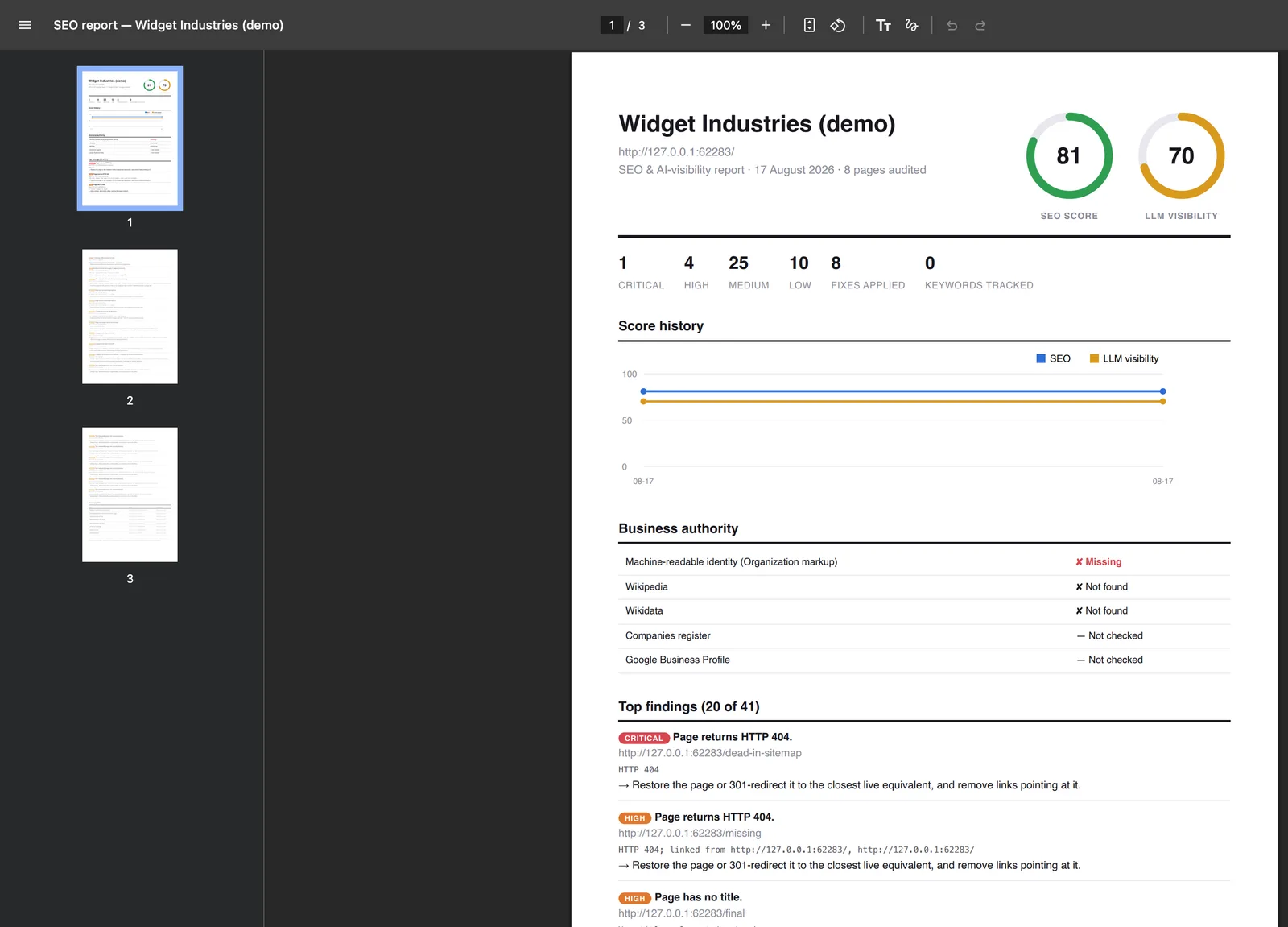
The first is that if the deliverable is a commodity, the margin has to come from delivering it at near-zero marginal cost inside something people already pay for. A client is a directory. Hosting is a dollar or three a month. Most of the work is automated. Fifteen clients on one small box, each with a private console and a monthly evidence-backed report, is a good business precisely because the underlying activity is a commodity — which is an uncomfortable sentence for anyone still billing by the hour for a crawl.
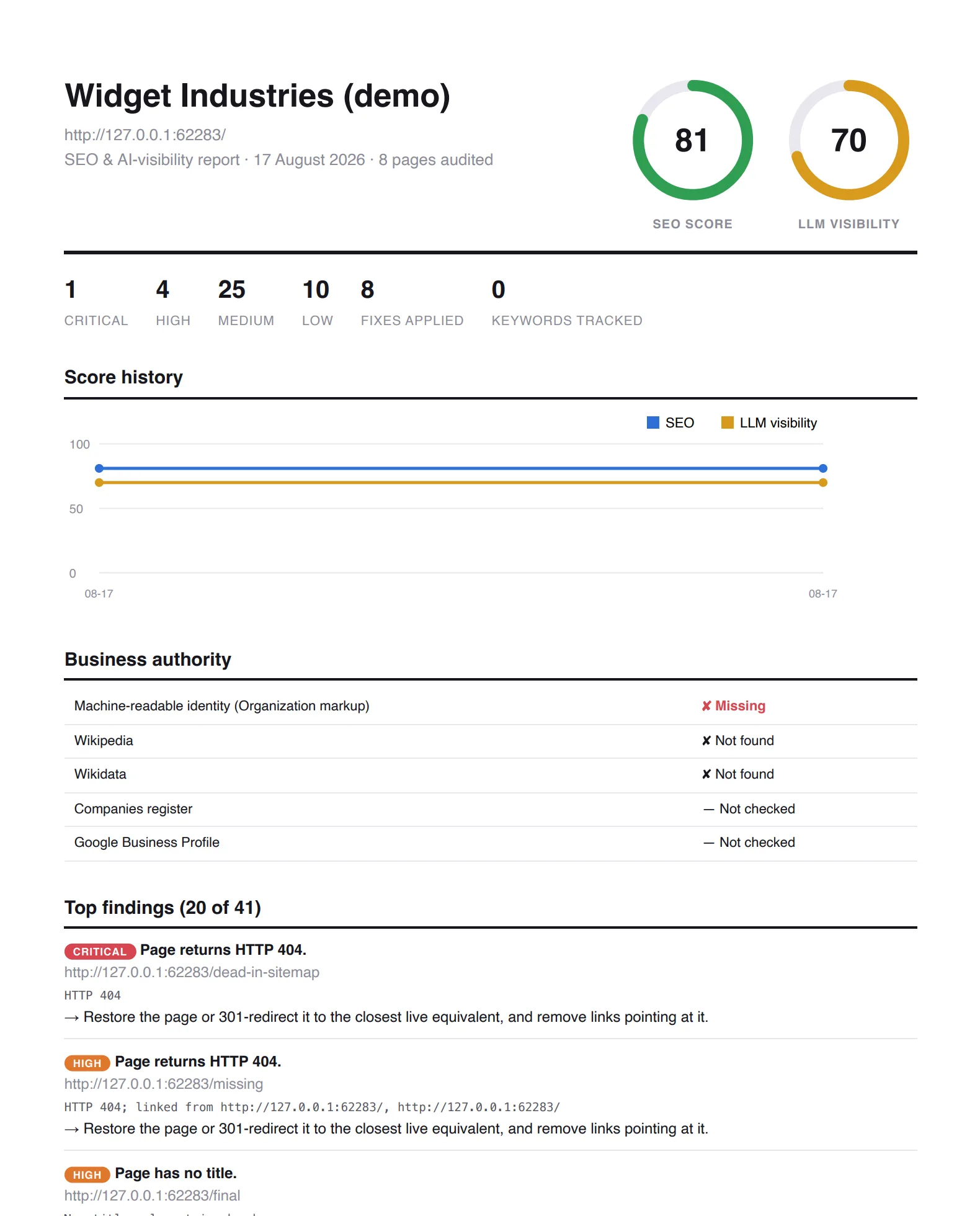
The second is more interesting. When ranking becomes cheap for everyone, ranking stops being an advantage. Every competitor’s titles are optimised too. Every competitor has schema. The scarce thing moves upstream, to whether an answer engine can find a clean, attributable, corroborated claim on your site and is willing to repeat it — which is a question about evidence and identity, not keywords. That is why the business authority report exists, and why the honest position on llms.txt is “an emerging convention worth publishing”, not “the assistants read this today”. They might. Nobody has shown they do.
And there is a third thing, which is really the reason this product sits in this portfolio rather than being sold on its own. If a machine can read a website and tell you where it contradicts its own claims, the same shape of machine can read a company and tell you where it contradicts its own strategy. That is Strategy as Software, and it started as a much better-funded idea the day I noticed I had already built the small version of it for web pages.
What I will not claim
Guaranteed rankings, guaranteed AI citations, or a proprietary index. Ranking data comes from Search Console and licensed providers like everyone else’s does. This tool will never win a fight about who has the biggest crawl of the web, and it should not try — it wins on the loop the index vendors have no reason to close.
I would also rather say plainly that the most exciting pillar is the most speculative one. AI visibility is what clients ask about unprompted; apply-and-verify is what actually earns the retainer. Riding the first to get to the second is fine. Believing your own pitch about the first is not.
Status
Release ready. v0.6, 381 tests, the full cycle running end to end on any reachable URL — audit, analyse, design the strategy, recommend, apply, monitor, report — from the dashboard, the terminal or an agent over MCP. Fix application ships for WordPress, Shopify and Cloudflare, with a copy-paste export bundle for everything else. AWS deployment shapes are documented; the operating model is single-tenant containers, one directory per client.
Screenshots