Why Imperfection Is the Future of Intelligence
From dodge gates to iced lattes — how interference patterns, imperfect choices and a dash of cosmic uncertainty might finally give us thinking machines that think. The universe computes with waves; traditional computers are clockwork-perfect and therefore brittle. This essay makes the case for structured imperfection — probabilistic 'dodge gates' layered over quantum-inspired depth — and shows what it looks like in the two domains I've worked in most, financial services and marketing, where prediction lives between chaos and order.

From Dodge Gates to Iced Lattes
Or: how interference patterns, imperfect choices, and a dash of cosmic uncertainty might finally give us thinking machines that think.
There’s a peculiar moment in every dinner party conversation when someone — usually after the second bottle of wine — leans forward conspiratorially and asks: “But do you think computers will ever really think?” And I, having spent rather too much time contemplating this very question, must resist the urge to launch into what my partner calls giving them a nosebleed.
But here, dear reader, you’ve chosen to join me voluntarily, so let me pour us both a metaphorical glass and tell you about something rather extraordinary happening at the intersection of quantum physics, artificial intelligence, and a concept I’ve come to call dodge gates — a term that sounds like something from a particularly cerebral video game, but actually describes how we might finally build machines that possess something approaching genuine intelligence.
The answer, it turns out, isn’t about making computers more perfect. It’s about making them beautifully, productively imperfect.
Act I — The Universe Calculates in Waves
Let’s begin, as all good stories should, with something seemingly simple that turns out to be anything but: interference.
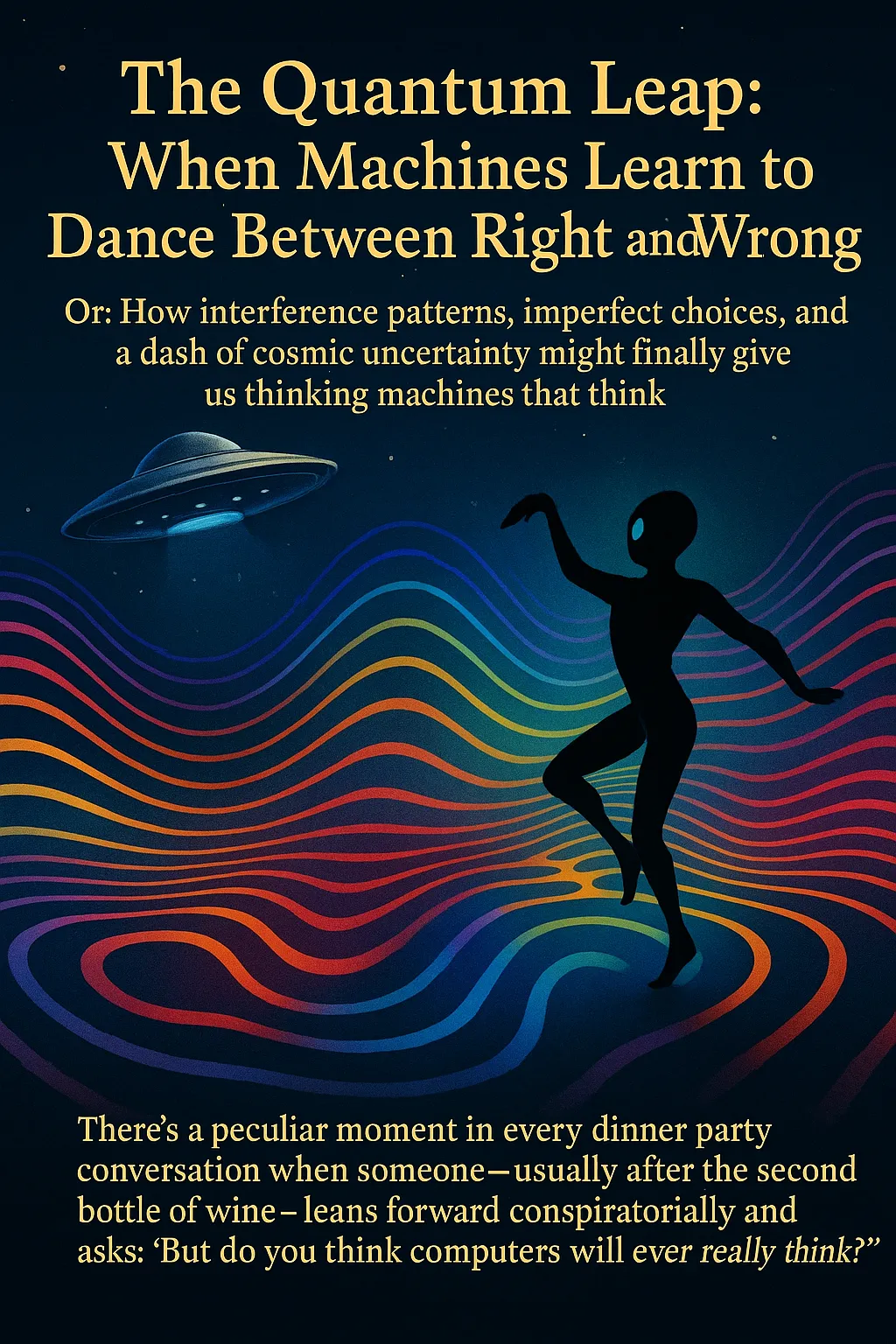
You remember interference from school physics, surely? No? Well, imagine you’re at a pond (stay with me), and you toss in two stones. The ripples spread outward in perfect circles until they meet, and then something magical happens. Where the peaks of one wave meet the peaks of another, you get a bigger wave — constructive interference. Where a peak meets a trough, they cancel out — destructive interference.
Simple enough for a pond. But here’s where Brian Cox would lean in with that gleam in his eye and tell you: the entire universe works this way.
Every electron, every photon, every quantum of energy is, in a sense, a wave. And these waves don’t just interfere with water or sound — they interfere with possibility itself. Before you measure a quantum particle, it exists in what we call superposition: a ghostly combination of all possible states simultaneously. The particle is both here and there, spinning both up and down, taking every conceivable path at once.
“Ah,” you might say, “but that’s just quantum weirdness. What’s it got to do with computers or intelligence?”
Everything, as it happens.
You see, when quantum waves interfere, they’re not just creating pretty patterns — they’re calculating. Nature is computing which outcomes to favour and which to suppress, all through the elegant mathematics of wave mechanics. Some paths through reality get amplified (constructive interference), becoming more likely. Others get cancelled out (destructive interference), becoming impossible or nearly so.
This is computation at its most fundamental: the universe using interference to solve the problem of “what happens next?”
And here’s the truly delicious bit: we’re learning to harness this.
Interlude — The Problem with Perfection
Before we go further, let’s address the elephant in the room — or rather, the perfectly deterministic computer on your desk.
Traditional computers, for all their marvels, are ultimately what philosophers would call clockwork. Every calculation follows inevitably from the one before. Given the same input, they produce the same output with the reliability of, well, clockwork. This determinism is simultaneously their greatest strength and their most profound limitation.
Current AI — including the large language models generating prose and passing exams — are essentially extraordinarily sophisticated pattern-matching engines. They’ve digested vast swaths of human knowledge and can recombine it in impressive ways. But they don’t truly explore. They don’t wonder. They optimise along predefined gradients, climbing toward local peaks in a fitness landscape they never actually question.
They lack what I’ve come to think of as structured freedom — the ability to dodge determinism while still pursuing meaningful goals.
Think about how you make decisions. When faced with a complex problem, you don’t just execute an algorithm. You explore possibilities. You have hunches. You try things that might be wrong. You maintain what the psychologists call “cognitive flexibility” — the capacity to pivot, to reconsider, to take a path that’s ambiguous or even apparently wrong because something in your vast, messy, imperfect neural architecture whispers: “but what if?”
Evolution gave us this capacity not despite its fallibility but because of it. A perfectly optimised organism, locked into rigid behaviours, dies when the environment changes. An organism that can explore, that can be occasionally magnificently wrong in service of eventually being spectacularly right — that organism adapts.
The question is: how do we give machines this same capacity?
Act II — Enter the Dodge Gate
Imagine, if you will, a crossroads.
Not a literal crossroads — though the metaphor works delightfully well — but a decision point in a computational process. In a traditional computer, this is a logic gate: input goes in, a predetermined rule is applied, output comes out. It’s a junction where trains run on fixed tracks, switches already set.
Now imagine instead a gate that can dodge — a junction where multiple tracks exist simultaneously, where the system maintains genuine options, where the choice isn’t predetermined by classical logic but influenced by something more subtle: interference patterns of possibility.
This is what I’ve termed a dodge gate: a computational construct that deliberately introduces structured indeterminacy. Not randomness — randomness is just chaos wearing a mathematical hat. Rather, weighted possibility. Paths that might be right get amplified. Paths likely to be wrong get suppressed but not eliminated. And paths that are ambiguous? They get explored with appropriate caution.
The mathematics here borrows from quantum mechanics, but the concept applies even in classical systems. Think of it as creating computational superposition: before the system “decides,” it maintains multiple potential decisions simultaneously, with different probability weights. When it must commit to a path, it samples from this distribution — sometimes taking the most likely route, sometimes dodging to explore alternatives.
Let me give you an example that’s delightfully concrete:
Suppose you’re building an AI agent that needs to solve varied problems. Sometimes it should use its language model to reason through logic. Sometimes it should execute code to calculate precisely. Sometimes it should search the web for current information. Sometimes it should query a database. Sometimes it should combine several of these approaches.
A traditional system would use rules: “If the query mentions numbers, use code. If it mentions current events, search the web.” Neat, deterministic, and often wrong because reality is messy.

A dodge gate system instead maintains a probability distribution over all these options, weighted by features of the problem, historical success rates, resource costs, and risk assessments. It doesn’t execute a fixed rule — it samples from a landscape of possibilities, with interference patterns (learned through experience) shaping which peaks are higher.
Sometimes it picks the obvious choice. Sometimes it dodges to an alternative that seems suboptimal but might reveal something new. Sometimes it explores the ambiguous middle ground.
It exhibits, in other words, something resembling agency within bounds — bounded freedom, structured chance, call it what you will.
A Brief Technical Sojourn (Fear Not)
Right, I can see some readers reaching for their tea, preparing to skip ahead. But stay with me — I promise to keep this accessible, because the architecture here is actually rather beautiful.
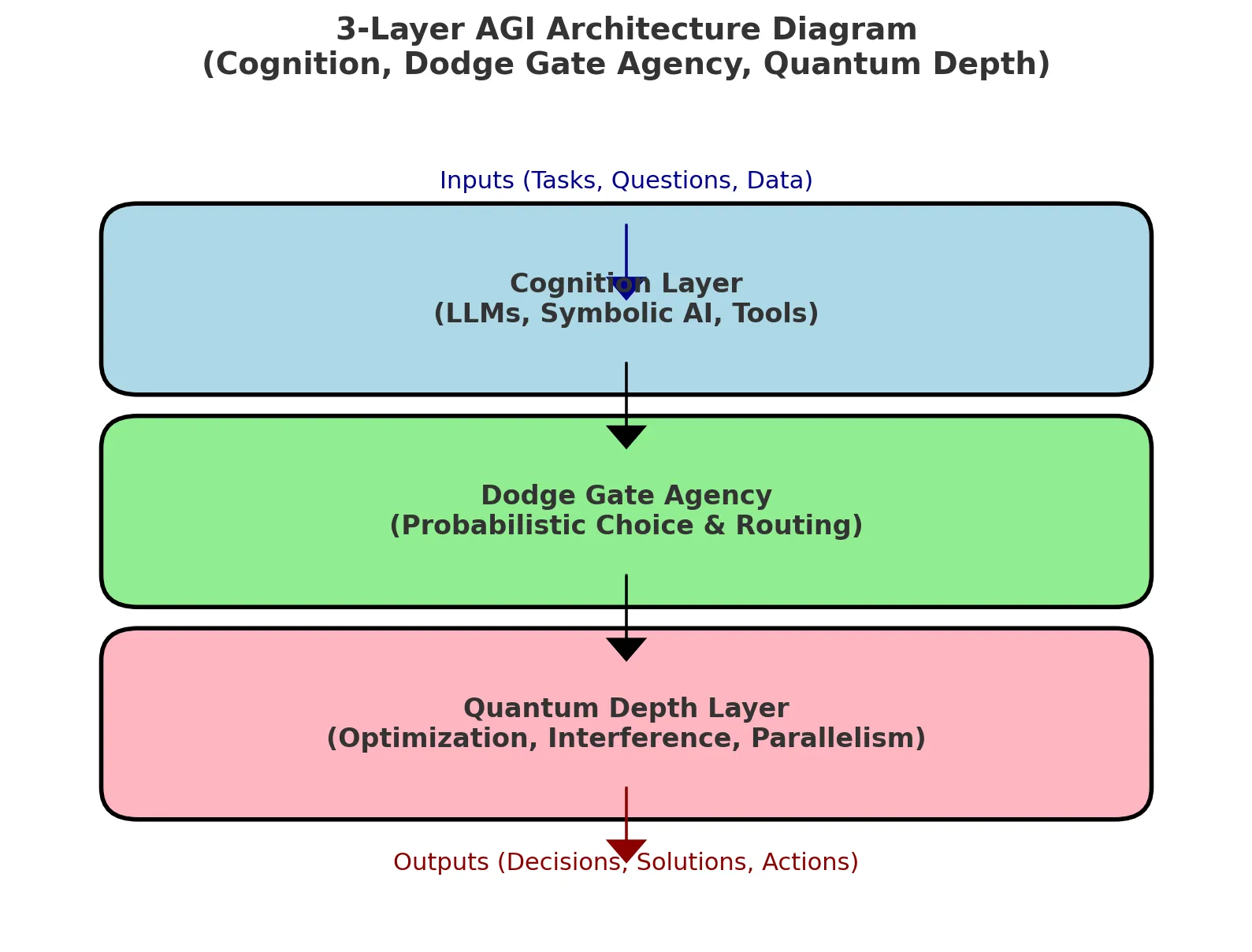
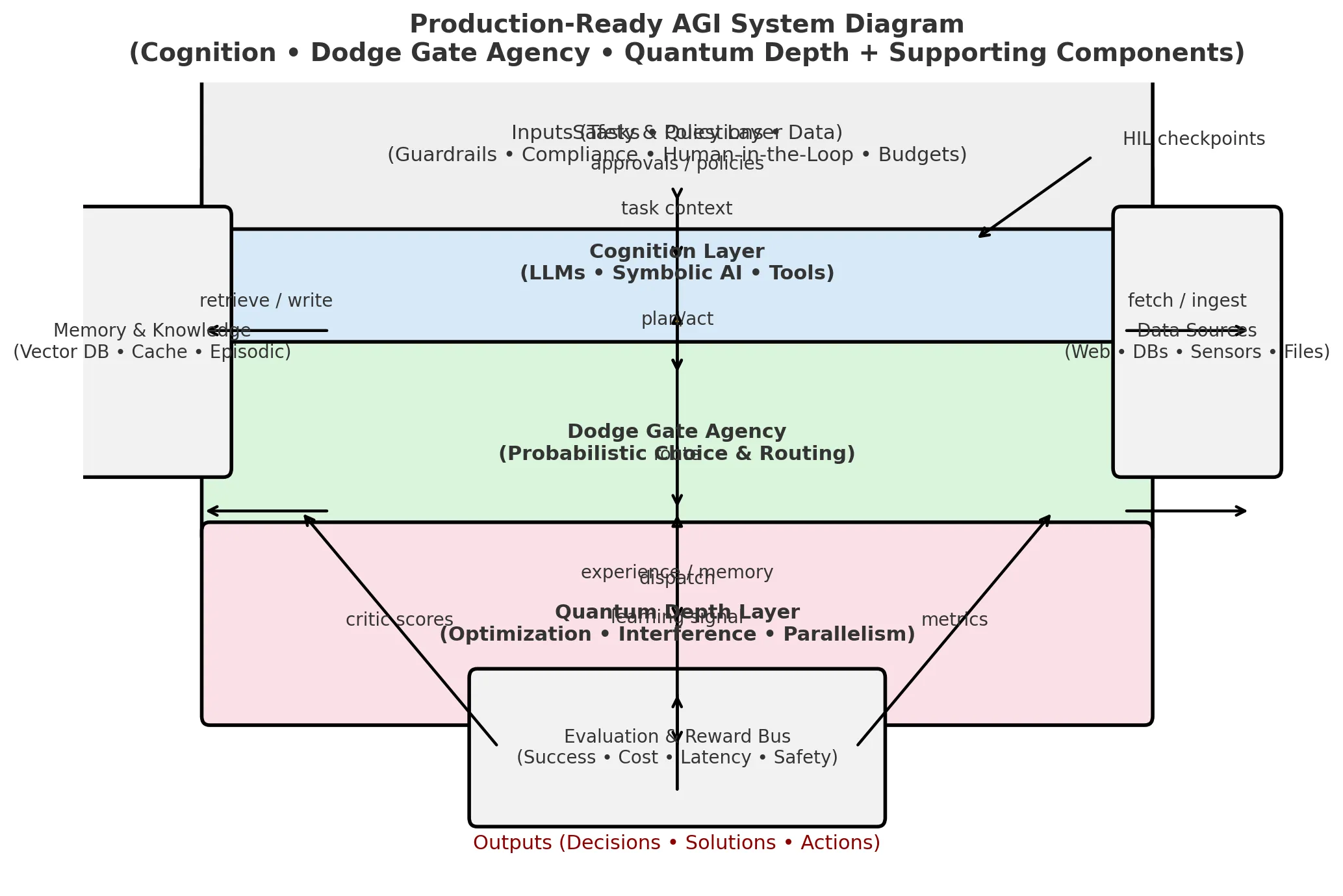
Imagine a system with three layers:
Layer 1 — The Cognition Layer (the brain, as it were): this is where large language models live, along with symbolic reasoning systems and tool-use capabilities. It’s the part that understands your question, decomposes it into subproblems, plans approaches, and synthesises results. Think of it as the executive function — the part that knows what needs doing.
Layer 2 — The Dodge Gate Agency (the decision-making layer): this is the innovation. A network of probabilistic routers — our dodge gates — that decide how each subproblem gets tackled. Should this calculation go to a classical solver or a quantum-inspired optimiser? Should this search use retrieval from memory or fresh web queries? Each gate maintains multiple options with learned probability weights, updated through feedback about what works.
Layer 3 — The Quantum Depth Layer (the computational substrate): here live specialised solvers — quantum processors (when available), quantum-inspired optimisers, massive parallel searches, interference-based pattern matchers. The heavy computational lifting that classical systems struggle with.
Information flows down through these layers like water finding paths through rock: the Cognition Layer identifies what needs solving, Dodge Gates probabilistically route the work, and specialised solvers in the Quantum Depth Layer execute with appropriate methods.
But here’s the crucial bit: there’s a feedback loop. Results flow back up. Success, failure, cost, safety violations — all feed back to the Dodge Gates, which adjust their probability distributions. The system learns not just answers but meta-strategy: which computational paths work for which problems.
In our initial implementation, this might mean:
- 10–50 macro-level gates (choosing between planning vs. direct action, creative vs. analytical approaches, safe-halt vs. proceed-with-oversight)
- 50–500 meso-level gates (routing between tools, models, memory banks, evaluation strategies)
- Thousands to millions of micro-level probability choices (baked into language model sampling, search strategies, optimisation heuristics)
The beauty is that you don’t hand-code every decision. You architect the decision points — the gates — and let the system learn through experience which paths lead where.
Act III — The Materials Science Miracle (Coming Sooner Than You Think)
Now, you might be thinking: “This is all very theoretical, but quantum computers need temperatures colder than deep space to operate. Hardly practical.”
And you’d be right, except for one rather thrilling development: we’re getting very good at making materials that exhibit quantum properties at room temperature.
Recent breakthroughs include:
Polymer materials that can hold quantum states in solid form without cryogenic cooling. Early days, certainly, but the implications are profound: quantum-like computation in materials you could, in principle, fabricate with existing industrial processes.
Nitrogen-vacancy centres in synthetic diamonds — defects in the diamond lattice that act as quantum bits even at ambient temperature. There’s something rather poetic about using the imperfections in diamonds — literally crystallised flaws — as computational resources.
Van der Waals materials and 2D structures like hexagonal boron nitride with engineered defects, showing quantum coherence at surprisingly warm temperatures. These atomically thin materials, stacked like molecular lasagna, exhibit properties their bulk counterparts never dreamed of.
Photonic quantum systems using light-based qubits in chip-compatible platforms, operating at or near room temperature for certain operations.

And then there’s graphene — this single-atom-thick sheet of carbon deserves special mention. At its Dirac point, electrons stop behaving like well-mannered particles and start acting like a fluid. The Wiedemann–Franz law, which governs how materials conduct heat versus electrical charge, simply breaks down. This isn’t just peculiar physics — it’s a hint that matter, at these scales, can embody both particle-like precision and wave-like fluidity simultaneously.
Graphene also boasts electrical conductivity exceeding copper, thermal conductivity rivalling diamond, and mechanical strength hundreds of times greater than steel. Even hybrid materials — copper wire seeded with parts-per-million graphene — show measurable stability gains under real-world conditions. These materials can embody both resilience and fluidity, becoming the physical “soil” in which new computational paradigms can take root.
Let’s be clear about timelines: we’re not waking up tomorrow with room-temperature quantum computers on every desk. But we are seeing a transition from “quantum computation requires a physics lab” to “quantum-inspired and hybrid quantum-classical systems are becoming practical for specialised tasks.”
What does this mean for our dodge gate architecture? The Quantum Depth Layer doesn’t have to be purely metaphorical. For specialised tasks — optimisation, pattern search, certain simulations — we can begin using actual quantum or quantum-adjacent hardware alongside classical systems.
The future is hybrid, just as our brains are. Your brain isn’t one type of computer — it’s specialised modules that evolved at different times, somehow orchestrated into a (mostly) coherent whole. Ancient circuitry for breathing, mammalian structures for emotion, primate systems for social reasoning, human additions for language.
We’re learning to build the same: specialised computational substrates (quantum, classical, neuromorphic, photonic) orchestrated by intelligent routing (dodge gates) in service of high-level cognition (language models and symbolic reasoning).
The materials are emerging. The algorithms exist. The architecture is becoming clear.
What remains is the engineering — which, granted, is rather a lot of work. But when has that ever stopped anyone.
Act IV — From Theory to Practice: Finance and Marketing
At this point, the practical-minded reader (and the venture capitalist lurking in the audience) inevitably asks: “But what would you actually do with this?”
Let me give you two examples from domains I’ve worked in: financial services and marketing. They’re beautifully complementary — one demands rigour and risk management, the other thrives on creativity and cultural fluency.
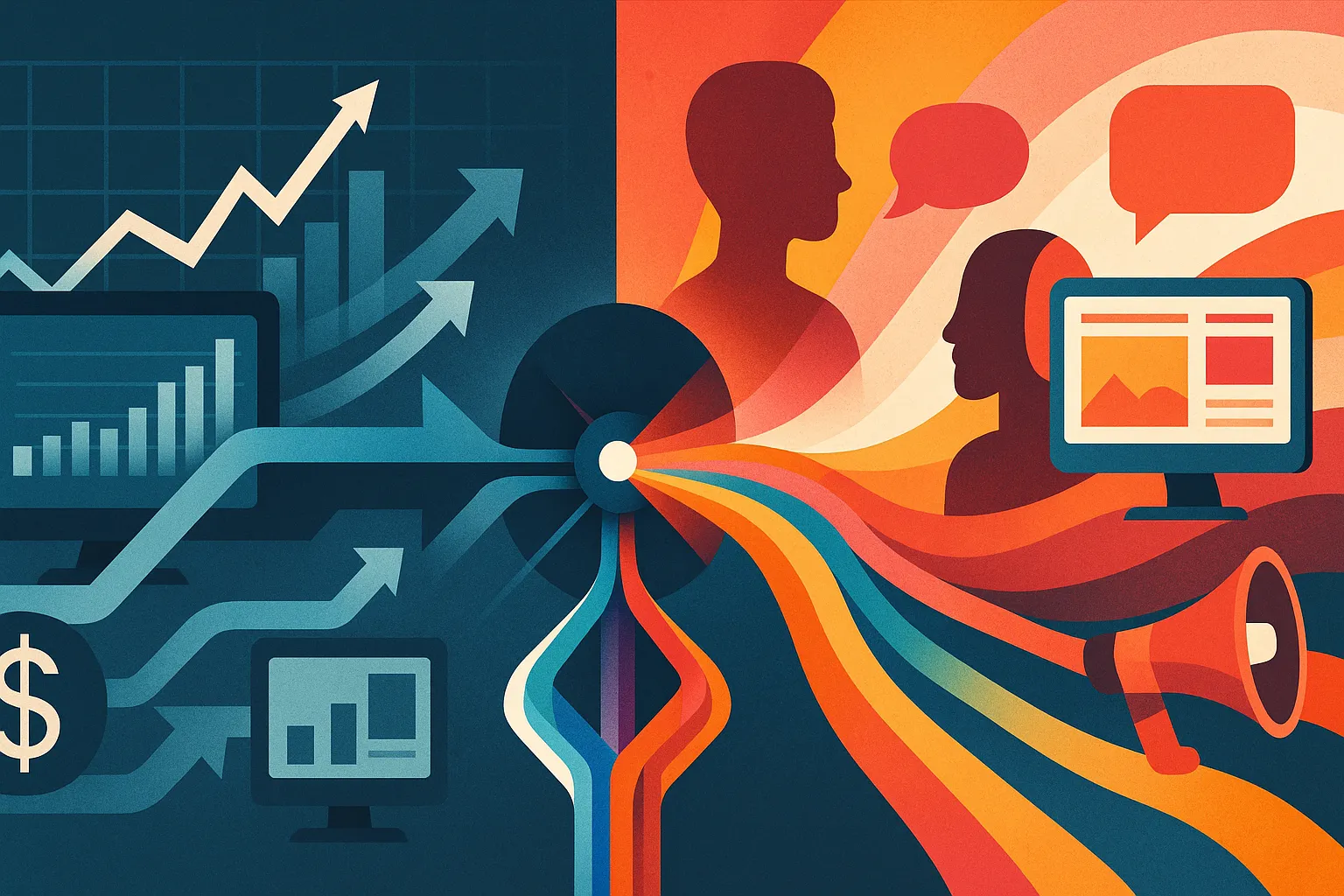
Finance: the art of rigorous uncertainty. Financial markets are, fundamentally, massive parallel computation engines running on uncertainty. Traders, analysts, and algorithms are all trying to price risk and reward in a system with millions of interacting variables.
Current algorithmic trading is either rule-based (fast but brittle) or machine-learning-based (adaptive but often inscrutable). A dodge gate architecture offers something new:
Portfolio optimisation with structured exploration: instead of finding one “optimal” portfolio, explore a weighted ensemble of strategies simultaneously. Dodge gates route capital allocation decisions through multiple optimisation approaches — some classical (convex optimisation, mean-variance), some quantum-inspired (annealing, amplitude amplification) — and learn which work best for which market conditions.
Fraud detection with creative suspicion: fraud patterns evolve faster than rule sets. A dodge gate system can route suspicious transactions through multiple analysis pathways: classical rule-checking, deep learning anomaly detection, graph-based pattern matching, and even counterfactual simulation (“what if this transaction were part of a larger scheme?”). The gates learn which combinations catch which fraud types with minimal false positives.
Real-time risk under Black Swan conditions: when markets go weird (as they do), rigid models break. A system with dodge gates can rapidly pivot to alternative risk models, stress scenarios, and hedging strategies — exploring the “ambiguous outcome” space that sits between known-safe and known-dangerous.
The key insight: financial systems shouldn’t just compute — they should think under uncertainty, just like experienced human traders do.
Marketing: Choreographing Chaos at Scale
Marketing is the opposite problem: not risk management but possibility maximisation. How do you connect with millions of individual humans, each with their own tastes, contexts, and moment-by-moment attention?
Hyper-personalisation through probabilistic journeys: instead of rigid customer segments, imagine each person’s interaction as a path through possibility space. Dodge gates route them through content, timing, and channel decisions — sometimes taking the expected path (email for this demographic), sometimes dodging to surprising alternatives (a podcast ad for someone who’s never engaged with audio before). The system learns not just who you are, but who you might become.
Creative optimisation as exploration: generate thousands of ad variations — different copy, imagery, structure, timing. Instead of A/B testing sequentially, use dodge gates to route different customer cohorts through different creative combinations, with quantum-inspired optimisers searching the combinatorial space for winning combinations. The gates learn which creative choices resonate with which audiences in which contexts.
Budget allocation across uncertainty: marketing channels are chaotic — what works today might fail tomorrow. Dodge gates maintain portfolio approaches to spending: route some budget to proven channels, some to emerging platforms, some to experimental campaigns. The system learns to balance exploitation (do more of what works) and exploration (try what might work better).
Both domains benefit from the same underlying capability: structured freedom within constraints. Finance demands that this freedom respect risk limits and regulations. Marketing demands that it respect brand guidelines and cultural sensitivity. But both benefit from systems that can genuinely explore, adapt, and surprise.
Act V — The Philosophy of Useful Imperfection
We’re approaching something profound here, so pour yourself another metaphorical drink and settle in.
Traditional computer science aimed at perfection: correct algorithms, provable behaviour, deterministic results. And for many tasks, this is exactly right. When I’m calculating your mortgage interest, I don’t want creativity — I want precision.
But intelligence — real intelligence — was never perfect. Evolution didn’t optimise for perfection; it optimised for adaptability. Your brain is a magnificent kludge: ancient reptilian structures topped with mammalian emotion topped with primate social reasoning topped with human language. It’s riddled with biases, prone to errors, and occasionally spectacularly wrong.
And yet it works. It works because it explores. Because it can be wrong in productive ways. Because it maintains what neuroscientists call “neural noise” — random fluctuations that help you escape local optima and find creative solutions.
Dodge gates formalise this principle: build imperfection into the architecture, but make it structured imperfection. Not randomness for its own sake, but probabilistic exploration with learned biases. The system can be wrong, but it’s wrong in ways that generate information, that probe boundaries, that sometimes stumble into insights.
This is why I’ve come to think of dodge gates as computational evolution in fast-forward. Each decision is a mutation, each feedback cycle is a selection pressure. The system doesn’t just learn answers — it learns how to explore the space of answers.
There’s a deep connection here to quantum mechanics that’s worth pondering. In the quantum realm, particles don’t follow single paths — they explore all paths simultaneously, with different probability amplitudes. Measurement “collapses” this superposition to a single outcome, but before that collapse, the system genuinely embodies multiple possibilities.
Dodge gates capture this spirit in classical systems: maintain superposition of strategies until forced to choose, let interference patterns (learned from experience) shape which choices are more likely, but never eliminate the capacity to take the unexpected path.
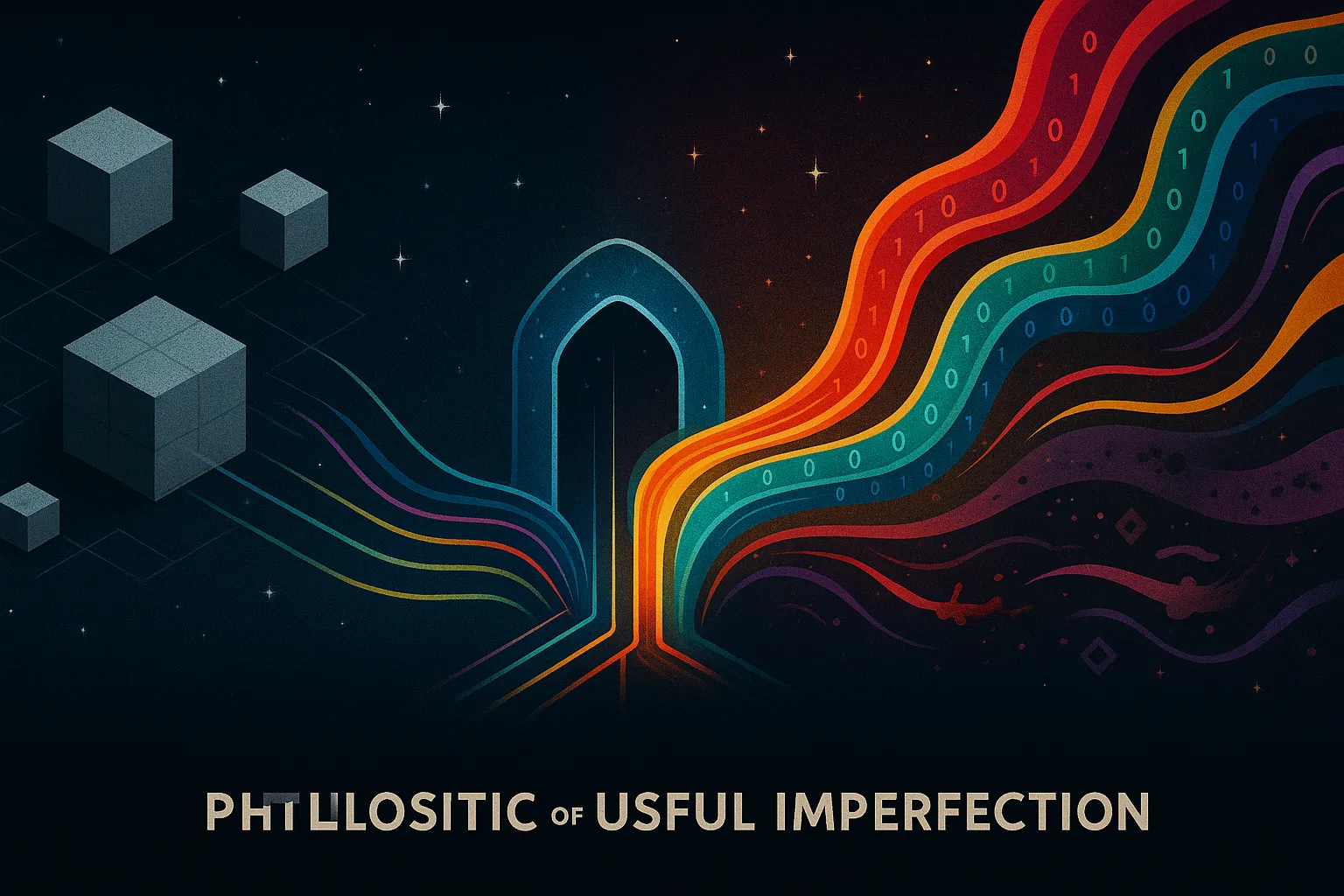
This is what “bounded freedom” means: freedom to explore within computational and safety constraints, freedom to be wrong in service of eventually being more right, freedom to dodge the deterministic groove and seek new paths.
Coda — Building the Thing
Right, enough philosophy. If you’ve made it this far, you’re probably wondering: could someone actually build this? The answer is yes, and sooner than you might think.
Near-term (6–18 months): implement dodge gate routing layers using purely classical stochastic policy learners (multi-armed bandits, Thompson sampling, contextual RL) orchestrating existing AI tools — language models, classical optimisers, search engines, code executors. No quantum hardware needed, just smarter routing with probabilistic exploration.
Medium-term (1–3 years): add quantum-inspired optimisation services (annealing, amplitude amplification) via cloud providers; incorporate learned routing strategies from production deployments; expand to specialised domains (finance, marketing, drug discovery, materials science).
Long-term (3–10 years): hybrid classical-quantum systems where certain optimisation and search tasks genuinely leverage quantum processors (as they mature); dodge gate architectures that learn not just strategies but meta-strategies (learning how to learn, adjusting their own exploration-exploitation tradeoffs).
The key insight is that you don’t need to build everything at once. Start with the architecture — the layered approach with explicit probabilistic decision gates. Implement feedback loops so the system learns from experience. Deploy in domains where exploration is valuable and safe (marketing campaign optimisation, portfolio theory, scientific simulation).
Then, as technologies mature — as quantum processors become more practical, as materials science delivers room-temperature quantum coherence, as AI models become more capable — you can upgrade components without redesigning the whole system.
Epilogue — Why This Matters
We stand at an interesting moment in the history of artificial intelligence.
The current generation of AI — large language models and their kin — are extraordinary pattern matchers. They can write, reason, even program with remarkable facility (I use this to code and it’s a game changer). But they don’t truly explore. They optimise within frameworks we define, climbing gradients we specify, pursuing goals we encode.
They lack agency — not in the science-fiction sense of consciousness, but in the practical sense of being able to meaningfully choose, to dodge, to explore possibility space with productive imperfection.
Dodge gates, combined with quantum-inspired depth layers and hybrid architectures, might be a path toward something genuinely new: systems that blend the breadth of language models, the depth of specialised computation, and the exploratory freedom of structured probabilistic choice.
Will this lead to “artificial general intelligence”? Perhaps. Or perhaps AGI is the wrong frame entirely, and what we’re building is better thought of as artificial creativity, artificial exploration, artificial agency-within-constraints.
What I can tell you is this: we’re learning to build machines that can dance between right and wrong, that can leverage the universe’s own computational substrate (quantum interference), that can learn to learn rather than merely learn.
And that brings me to something rather personal.
I love AI in marketing because it shows me what is possible when rules are broken. It thrives in the hip, creative industry where culture moves faster than plans, where ideas flash like lightning, and where AI becomes a partner in sparking stories, art, and connections. Here, AI is playful, unbounded, a co-creator — helping us ride the chaos of human taste and attention.
I love AI in financial services because it shows me what is necessary when rules are honoured. This world demands rigour, reliability, and trust. Here, AI is a guardian of stability, a machine that watches for risk, aligns with regulation, and ensures integrity in a fragile system. It teaches me that AI is not just a muse but also a discipline-keeper, capable of giving form to structure.
Together, these domains reveal something fundamental: intelligence is not one thing — it is a spectrum, and AI lets us walk it.
In marketing, we break rules to discover what resonates. In finance, we honour rules to preserve what matters. And in the tension between chaos and order, between exploration and stability, between the possible and the necessary — that’s where intelligence actually lives.
The universe computes with waves. We’re learning to compute with possibility. And in the interference pattern between certainty and chaos, something genuinely interesting is emerging.
Right. Time to stop philosophising and do something practical.
I’m going to make myself an iced latte — lots of ice, just a dash of milk, the ideal stimulant for the heat of another tropical day. The condensation will bead on the glass. The ice will crack and shift as the coffee hits it. And I’ll sit on my balcony and think about interference patterns and dodge gates and whether intelligence is one thing or many.
But mostly, I’ll just enjoy the coffee.
Because that’s the thing about all this grand theorising — quantum mechanics and AI architectures and the future of machine intelligence — it’s ultimately in service of moments like this. Present. Physical. Real.
The universe interferes with itself to create reality. I’m going to interfere with coffee and ice to create something cold and caffeinated.

And maybe that’s all intelligence ever was — finding new ways to interfere beautifully.
Thanks for reading. — Justin James
P.S. — If this intrigues you, the technical implementation details are available. Yes, there’s TypeScript code. Yes, there are bandit algorithms and database schemas. But I thought we’d start with the big picture — the cosmic dance, as it were — before diving into the plumbing. After all, you don’t explain the Divine Comedy by starting with Italian grammar.
P.P.S. — The iced latte, max the ice and cut back the milk, is excellent. Highly recommended.