The Risk Even the Best Investors Rarely Price
The founder's unfillable seat — and the quiet temptation to fill it for free — is where early-stage technology bets actually fail. Why the risk goes unpriced even in rigorous diligence, and six questions to put to any founder on a Monday morning.

The founder’s unfillable seat — and the quiet temptation to fill it for free — is where early-stage technology bets actually fail.
There is a quiet pleasure in watching a good investor work.
It is a particular kind of intelligence: pattern recognition refined across hundreds of companies, an instinct for the soft assumption nestled inside a confident slide, the ability to sit in a room, absorb a story, and sense — almost before the thought has fully formed — precisely where it does not hold. The market gets tested. The model gets tested. The moat, the margins, the founder’s pedigree, the route to market — all of it turned over by people who have seen this particular film a great many times and know exactly which reels tend to snap.
It is genuinely impressive, and I do not say so to flatter. I say it because it makes the gap I want to describe all the more peculiar. For all that scrutiny, there is one thing that consistently escapes it — and it is not a minor thing. It is, very often, the thing that decides the outcome.
Not the product vision. The capability that has to deliver it. Who, in plain fact, holds the technical risk in this company. Whether that person is real. And whether they are resourced well enough to still be in the building a year from now.
This piece is about why that risk goes unpriced even in the most rigorous of processes, why the most common way founders try to manage it quietly makes it worse, and what an investor — equipped with exactly the instincts described above — can do about it. There is a set of questions at the end you can put to any founder on a Monday morning, whether or not you have ever written a line of code.
The Seat That Isn’t on the Deck
Technology leadership has, over the past decade, quietly fractured into several distinct jobs: the deep builder, the operator who runs delivery, the strategist who can hold a board, the steward who owns risk, the recruiter who attracts talent, and now whoever carries the question of artificial intelligence. A mature company spreads these across several people. A company of five cannot. It needs a single head capable of holding nearly all of them at once, because there is simply no one else to hold them.
At the earliest stage, then, the founder genuinely requires a generalist who can do almost everything — and that person, for entirely structural reasons, is very nearly impossible to hire. The people who can credibly cover all of those seats tend, overwhelmingly, to become founders themselves, or to enjoy options considerably more attractive than early-stage equity. The genuine article is rare, expensive, and usually unavailable.
So the typical early company arrives at your table with that seat in one of three states: empty, half-filled by someone learning the role in real time, or — most dangerous of all, and most easily mistaken for thrift — filled by goodwill. By someone who is “helping out.”
That seat is the risk the deck never mentions. It is also, I would argue, the one most worth learning to see.
I Have Sat at Both Ends of This
I should be honest about how I come to think it matters, because the experience is the whole of the credential.
I have been the founder, gazing at that unfillable seat, drafting an advertisement for a person who does not exist in any reliable supply. And I have been the figure at the other end too — the experienced pair of hands invited in to hold a wobbling build together on the understanding that things would firm up in time. More than once, I have been the person who, when the goodwill on which the entire arrangement silently depended finally ran thin, gathered his things and walked out of the room. Not in any drama. Simply because goodwill, like any unpriced resource, is finite — and it is invariably spent long before anyone has thought to budget for more.
I mention it not as a complaint but as instrumentation. I have been moved around by the three forces at work here, from the inside, and so I can describe them rather precisely.
Why “Helping Out” Is a Red Flag, Not a Saving
When you see an early company running its most important capability on donated or indefinitely-deferred senior time, the natural reading is scrappy, capital-efficient, admirable. Read it the other way. There are three reasons it is fragility wearing the costume of thrift.
It selects for the available, not the able. The genuinely capable — the people who could actually hold that seat — have options, and working for nothing is rarely the best of them. The people most willing to work on goodwill are, disproportionately, those with the least pull elsewhere. So the very mechanism intended to save money quietly filters toward the weaker candidate and away from the one the company needs. It is a beautifully efficient way of optimising for the wrong thing.
Goodwill is not a service-level agreement. A favour has no deadline, no accountability, and no recourse. When it slips — and under pressure it always slips — there is nothing to enforce, because nothing was ever truly agreed. The company’s most critical work comes to rest on the single relationship with no contract behind it.
The dependency is invisible until the moment it fails. A build running on donated time looks wonderfully cheap on the page and is maximally fragile in reality. It is a single point of failure that does not even appear in the accounts. And single points of failure, in a world that keeps rearranging itself beneath the company, are precisely the things that give way.
A company that extracts its core capability rather than paying for it is not saving money. It is borrowing against goodwill it will eventually have to repay — usually in a currency far dearer than the salary it avoided.
The Same Instinct, Turned One Degree
Here is the part I find genuinely interesting, and it is an invitation rather than a reproach.
Everything that makes an investor good at this job — the nose for the unfounded assumption, the refusal to take a confident number at face value, the quiet pressure-test applied to everything that matters — is exactly the faculty required to see this risk. The skill is already there. It has simply, by long habit, been pointed at the market, the model and the money, and rarely at the seat that holds the build. Partly because probing it well asks for either a degree of technical literacy or a trusted advisor who has it; and partly because “strong technical team” is such a comfortable phrase that it tends to close the conversation rather than open it.
The best investors do two things at once. They affirm the vision — the “what a marvellous idea” that gets everyone into the room and is not to be sneered at, because conviction is itself a scarce resource. And they pressure-test the execution, which is the harder, less comfortable work that turns a cheque-writer into a trusted advisor. The first gets you the meeting. The second earns you the seat at the table for the next ten years.
All I am suggesting is that the same instrument, turned one degree toward the build, finds the risk that diligence usually walks past. You do not need to become an engineer to do it. You need the right questions, and the discipline to insist on real answers.
The Pressure-Test: Six Questions for Any Technology-Led Deal
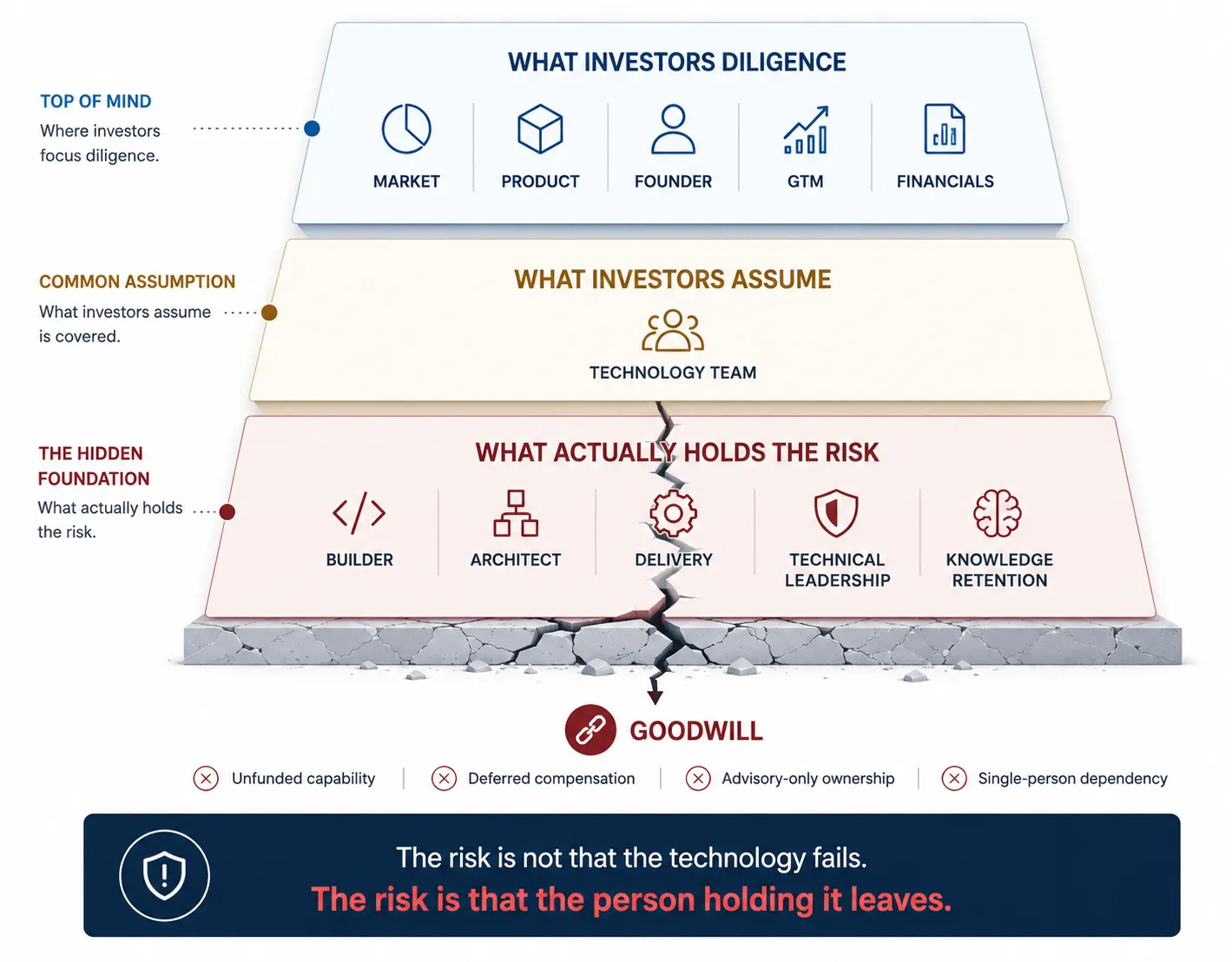
These work whether or not you are technical. Each converts a vague reassurance into a precise picture of where the risk actually sits. I have noted what a strong answer sounds like, and what should make you lean in a little harder.
1. Who holds the technical risk today, and on what terms? Strong: a co-founder with meaningful equity, or a properly contracted lead with real accountability. Lean in: “a friend is helping us out for now.”
2. If that person walked out tomorrow, what happens to the company? Strong: painful but survivable — the knowledge is shared and the system understood by more than one mind. Lean in: a pause, then a change of subject. The build lives in a single head.
3. Which capabilities does this stage actually need — and are they resourced, or is one person quietly expected to cover all of them? Strong: a clear-eyed account of the two or three that matter now, and how each is held. Lean in: a job description that is, on inspection, an advert for six people.
4. Is the plan to fill the seat a real hire, a co-founder, or a unicorn you are waiting to appear? Strong: something concrete and time-bound. Lean in: “we’re looking for someone who can do it all” — which is a hope, not a plan, and one with no date attached.
5. Where does the critical knowledge live — in people’s heads, or written down? Strong: decisions are documented; the architecture is legible to more than one person. Lean in: it all resides with the one soul who built it.
6. Are you paying for the capability that holds your biggest risk, or extracting it? Strong: it is a funded line item with a real relationship behind it. Lean in: it is running on goodwill, deferred comp, or “we’ll sort it out after the raise.”
The purpose of these is not to catch the founder out. It is to turn “strong technical team” — a phrase that means very nearly nothing — into a specific map of where execution might break. That map is de-risking. It is the part of diligence most decks are silent on, and the part your competitors are least likely to have done.
De-Risking Is Paying for the Right Thing, Early
Here is the reframe worth carrying out of all of this.
De-risking a technology bet is not the avoidance of cost. It is paying for the right thing early, while it is still cheap to do so. And the single most reliable thing to fund early is the seat that holds the build — converting the founder’s most dangerous dependency from a favour into a budgeted, accountable relationship.
That, concretely, is part of what a seed round is for. Not to defer the critical hire until the goodwill runs dry, but to make it real: a co-founder with genuine equity and skin in the game, or a fractional or interim leader on an actual contract with actual accountability. The cost of doing this is a number on a spreadsheet. The cost of not doing it is a stalled build, a rebuilt product, and a round that does not happen — a far larger number, arriving later, when it hurts most.
There is a limit worth naming, so none of this reads as special pleading for any one model. A fractional leader gives you judgement, not ownership; part-time attention, not a committed founder. Paid help is not automatically aligned help. The principle is not “spend more.” It is “stop pretending your largest risk is free.”
The Cheapest Line Item Decides the Outcome
So here is the thing to hold in mind the next time a founder gestures, almost in passing, at the seat they hope to fill for nothing.
The cheapest line item on an early-stage cap table is very often the one that decides whether the company lives. The investor who can see that — who can tell a funded, accountable plan from a hopeful one resting on goodwill — de-risks more effectively than any clause a lawyer can draft.
Goodwill is not a strategy. It is a loan the company takes from someone who will, in the end, want it back.
You cannot de-risk a build you are unwilling to fund.
So price the seat that holds the risk as though it matters. Because it is the one that does.
And because I suspect many of you have seen this from angles I have not, I will end where I began — with a question for the people who do this for a living:
What is the biggest hidden dependency you’ve seen inside an early-stage company, and how can a founder mitigate against this?