The Prediction Decade: Why Seeing the Future Just Became the Most Valuable Thing You Can Do
Every era of technology has a verb at its centre. The internet was about connecting. Mobile was about reaching. The last wave of AI was about generating. The next verb — the one quietly rewiring boardrooms, trading desks and product roadmaps right now — is predicting. Prediction markets, enterprise analytics and time-series foundation models are converging into an infrastructure layer, and the real product isn't prediction at all. It's calibrated confidence — increasingly consumed not by people, but by the agents acting on their behalf.
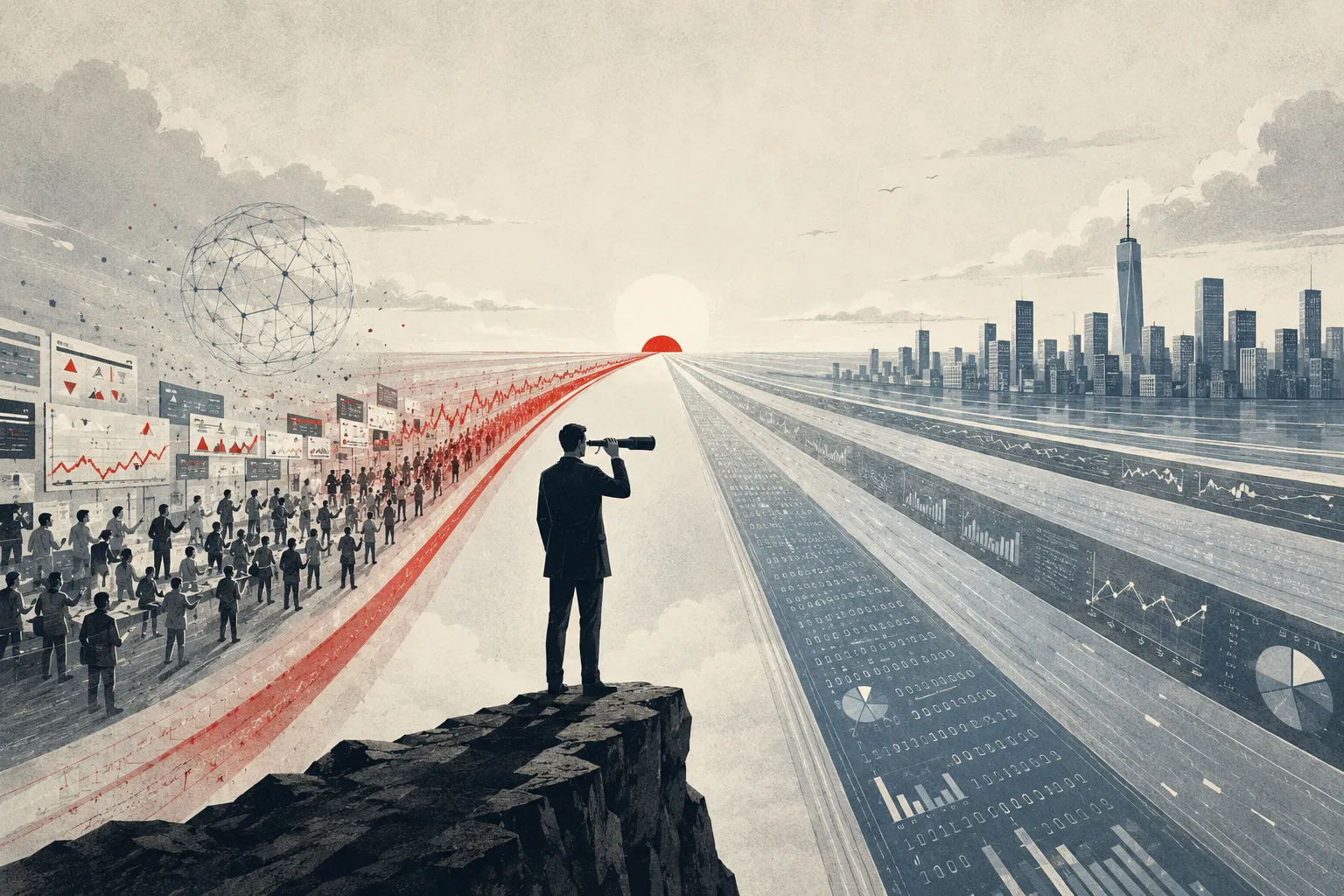
Prediction markets, forecasting platforms and time-series foundation models are converging into a new infrastructure layer. The real product is calibrated confidence.
Every era of technology has a verb at its centre. The internet was about connecting. Mobile was about reaching. The last wave of AI was about generating — text, images, code, all conjured from a prompt. The next verb, the one quietly rewiring boardrooms, trading desks and product roadmaps right now, is predicting.
We’ve always wanted to know what happens next. It is arguably the oldest human obsession — oracles, almanacs, actuaries, weathermen, the entire discipline of economics. Nor is machine prediction itself new: click-through models and credit scores built half the modern internet before anyone had heard of a chatbot. In a real sense, prediction was machine learning’s first commercial act. What’s changed is that prediction has stopped being a narrow art practised by priesthoods — quants, actuaries, ad-tech engineers — and become an infrastructure layer anyone can buy, build on, and put into production: general where it was bespoke, calibrated where it was gut-checked, and, for the first time, empowered to act. And in the last eighteen months, several separate worlds that were each chipping away at “what happens next” have started to converge into something that looks a lot like a new industry.
If you operate anywhere near data, and I do, this is the most exciting place to be standing right now. Let me tell you why.
Three worlds, one question
The word “prediction” hides at least three different things, and the interesting part is that they’re colliding.
The first is prediction markets — the world of Polymarket and Kalshi, where thousands of people put real money on the outcome of real events, and the price becomes a probability. For years this was a curiosity, a nerdy corner of crypto. It is not a curiosity anymore: monthly volume across the major platforms ran roughly 17x in a year, from about $1.2 billion in early 2025 to north of $20 billion by January 2026, and Polymarket took a $2 billion strategic investment from ICE — the owner of the New York Stock Exchange — at an $8 billion valuation. When the people who own the NYSE start writing nine-figure cheques for a prediction platform, the curiosity phase is over. Two honest caveats before the number dazzles, though: a meaningful share of that volume is sports — which a cynic will fairly call gambling reclassified with an API — and thin markets at the probability tails remain manipulable and bias-prone. The signal is real; it is just not evenly distributed across every market.
The second world is predictive analytics — the enterprise discipline of using your own historical data to forecast what your business does next. Churn. Demand. Fraud. Credit risk. Maintenance failures. This is the unglamorous, deeply valuable engine room, powered by platforms like DataRobot, Databricks, SAS, Google’s Vertex AI, AWS SageMaker and Azure ML. It rarely makes headlines, but it’s the version of prediction already sitting inside the P&L of most serious companies.
The third world is the newest and, to my mind, the most consequential: time-series foundation models. This is what happens when the “foundation model” idea that gave us ChatGPT gets pointed at the problem of forecasting. Amazon’s Chronos-2, Google’s TimesFM, Salesforce’s MOIRAI-2, and open efforts like Lag-Llama and Time-LLM are pretrained on vast quantities of temporal data, and they can produce zero-shot forecasts — predictions on a dataset they’ve never seen — that routinely beat statistical models you’d have spent weeks hand-tuning.
Markets crowdsource the future from human conviction. Analytics extrapolates it from your private history. Foundation models generalise it from the accumulated shape of time itself. Three different instruments, all now pointed at the same horizon.
The fourth engine: human judgement
There is, though, a fourth engine — although calling it a fourth is slightly cheating, because it isn’t really parallel to the other three. It’s the aquifer they all drill into: human judgement itself.
Here’s the thing people miss about prediction markets: they aren’t really markets. They’re information-aggregation systems. The market doesn’t predict anything. The crowd predicts; the market simply compresses millions of scattered convictions into a single, tradable number. Every price on Polymarket is a lossy compression of tacit human knowledge that exists nowhere in any database — the hunch of someone close to a supply chain, the read of a person who knows a courtroom, the instinct of a thousand people who each know one small true thing.
Once you see it that way, the pattern generalises. Prediction markets capture human judgement through prices. Foundation models capture it through training data — the fossilised residue of billions of past human decisions. Businesses capture it through customer interactions — every purchase, search, click and cancellation is a person casting a vote about the future. Three different instruments, all reaching for the same underlying signal: the collective intelligence hidden inside human behaviour.
The future may ultimately belong not to whoever has the best model, but to whoever can fuse all of these — market prices, model outputs, and behavioural exhaust — into a single forecasting layer. That’s the move that turns this from a technology story into an information-theory one.
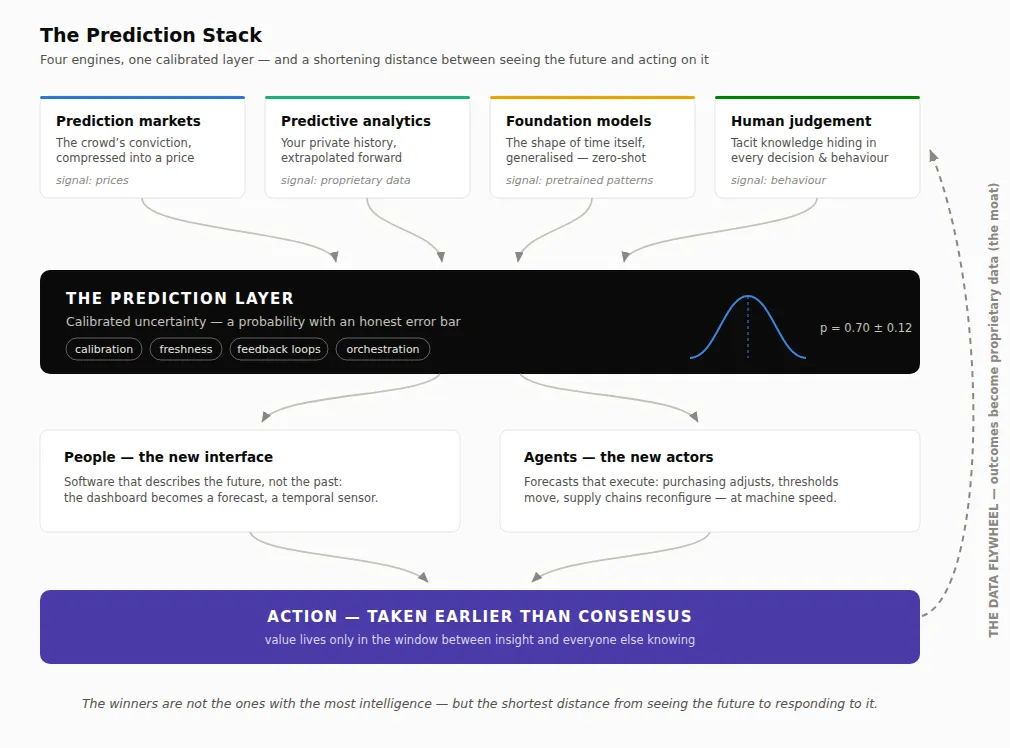
Figure 1 — The Prediction Stack. The four engines — markets, analytics, foundation models and human judgement — each capture a different form of the same underlying signal and converge into a single prediction layer whose real product is calibrated uncertainty: a probability with an honest error bar. From there the forecast flows to its two consumers, people (the new interface) and agents (the new actors), and finally to action taken earlier than consensus. The dashed return path is the flywheel: every outcome becomes proprietary data, enriching the moat.
Where prediction is going
Here’s the shift that matters, and it’s a subtle one. For thirty years, forecasting was a model training problem. You had a dataset, you picked an algorithm — ARIMA, gradient boosting, a bespoke neural net — and you spent weeks tuning it to that one narrow question. The expertise, and the cost, lived in the building.
Foundation models are turning that into a model selection problem. The heavy lifting has already been done in pretraining. Increasingly, the job is: point a capable general-purpose forecaster at your data, evaluate a couple of candidates, and ship. That is the same democratisation that happened in language — where you no longer train a model to understand English, you just call one — arriving now in the far less glamorous but far more monetisable domain of numbers over time.
Three consequences follow, and they’re the through-line of the whole space. Prediction is becoming ambient — it stops being a quarterly exercise a data-science team runs in a notebook and becomes a live signal wired into the product; your inventory system doesn’t get a forecast once a month, it is a forecast, continuously. Prediction is becoming composable — these are APIs now, not artisanal projects, and you can pull a probability from a market, a forecast from a foundation model and a risk score from your own analytics stack and blend them in a single decision. And prediction is becoming a market in its own right — when a probability has a price, hedging, information trading and entirely new financial products follow. We are watching “what will happen” turn into a tradable asset class in real time.
The economics of foresight
But we should be precise about why any of this is worth money, because it’s easy to wave at “prediction is valuable” and never say valuable compared to what.
A forecast isn’t valuable because it’s correct. It’s valuable because it’s correct before everyone else. If the entire market already knows demand will rise next month, that knowledge has already been priced in — into the inventory, the hiring, the share price — and the advantage has evaporated. Prediction only creates value in the window between insight and consensus. The narrower that window, the more the whole game shifts onto speed, freshness and continuous recalibration. This is why a stale forecast is worthless even if it’s accurate, and why the platforms that win will be the ones that compress the distance between “the world changed” and “your system knew.” Foresight is a perishable good. Its value is measured not in how right you are, but in how early.
One distinction keeps that argument honest, because it doesn’t apply everywhere with equal force. In traded contexts — markets, competitive bids, anywhere your gain is somebody’s loss — the decay is ruthless: foresight is alpha, and alpha dies on publication. In operational contexts the economics are gentler and far more durable: a maintenance forecast doesn’t stop being valuable because your competitor has one too — the machine simply doesn’t fail. Zero-sum foresight decays; positive-sum foresight compounds. Most businesses, happily, live on the compounding side of that line, which is exactly why the quiet use cases below outlast the loud ones.
Where prediction actually bites
A note on scope before we go further: I’m deliberately not covering financial trading systems in this piece. I’ve built one — the Signal Fabric inside Agencio Predict — and doing that world justice is an article of its own, which is now written. Here I want to make the opposite point: the trading desk is where people’s imagination tends to stop, and it’s the least interesting place this goes. Strip prediction down and almost every business use case is the same question wearing different clothes: where do we point finite time, money and attention? A forecast is simply a way of not spending them on the wrong thing.
Take tendering — the example closest to my own thinking. The most expensive part of a large bid is the one nobody puts on the invoice: the weeks a skilled team pours into an RFP you were never going to win. A win-probability model turns “should we chase this?” into a triage decision — pursue the ones you can genuinely take, decline the rest gracefully, and stop bleeding senior hours into lost causes. Layer on price-to-win modelling and a read on who else is likely to bid, and tendering stops being an act of nerve and becomes a portfolio you manage. The saving isn’t marginal; it’s the single most under-measured cost in a lot of businesses.
Marketing deserves its own paragraph, because it may be the discipline with the widest gap between how much is spent and how little of it is forecast. Most marketing budgets are still allocated on last quarter’s attribution — a rear-view mirror funding a forward journey. Prediction inverts that. Propensity models score which prospects are actually likely to convert, so acquisition spend chases the persuadable rather than the merely visible. Churn and lifetime-value forecasts tell you what a customer will be worth before you decide what they’re worth spending on — the difference between a discount that rescues a high-LTV customer and one that subsidises a defector who was leaving anyway. Marketing-mix models forecast the return of a channel before the budget is committed, campaign-response prediction kills the underperforming creative in hours instead of quarters, and demand forecasts tell the content calendar what audiences will care about next month rather than what they cared about last. The agentic version is already arriving: budgets that reallocate themselves toward the channels the forecast favours, in-flight, without waiting for the Monday meeting. Marketing has always been a bet on future attention; prediction just finally prices the bet.
The same shape repeats everywhere once you look for it. In R&D, forecasting which technologies actually mature — and when — is the difference between committing to the platform that becomes standard and the one that quietly dies, sparing you a fortune in dead-end bets. In hiring, flight-risk modelling flags the key engineer likely to walk before the resignation lands, when a conversation still costs less than a search. In the supply chain, predicting which supplier slips or which part runs short lets you buffer inventory exactly where the risk is rather than tying up capital everywhere just in case. In legal disputes, an early read on the likely outcome answers the only question that matters — fight or settle — before the seven-figure bill arrives. Maintenance, regulatory approvals, marketing spend, capital-project overruns, even the shape of a negotiation: each is a place where seeing the outcome a little sooner converts a gamble into a managed risk.
That’s the tell across all of them. Prediction does its best work not by being clever but by being early, and often by telling you where not to spend before the cost is sunk. The trading desk is the loud version. The quiet version — the tender you didn’t chase, the hire you didn’t lose, the part you didn’t run out of — is where most of the money actually is.
Six industries, six proofs
None of this is speculative. It’s already happening, in industries that could not be less alike — which is rather the point.
Insurance got here first, because insurance is prediction with a balance sheet attached; an insurer is simply a company that prices the future better than its customers can. What’s changed is the machinery. Lemonade runs AI through underwriting and claims end-to-end — pricing risk at quote time, flagging fraudulent claims in seconds — and the industry now watches its loss ratios as a live experiment in whether machine-priced risk beats actuary-priced risk. An experiment, note, that ran unprofitably for years before the curve began to bend — adoption came first, superiority is still being earned. The insurer of the next decade is less a financial institution than a prediction engine with a licence.
Construction is where optimism goes to die and overruns go to compound — and it’s being attacked with sheer data. nPlan trained graph neural networks on more than 750,000 as-planned and as-built project schedules, the largest such database in the world, to forecast which activities in a new schedule will slip before a single pile is driven. On a megaproject, knowing which three months of delay are hiding in the plan — while the contingency is still negotiable — is worth more than any efficiency gained on site.
Gaming may be the most prediction-saturated industry nobody thinks of. A free-to-play studio lives or dies on two forecasts: which players are about to churn, and what a new player will be worth over their lifetime. Studios mine play-log data to spot the player who’s three sessions from quitting — the drop in session length, the abandoned quest — and intervene with a nudge, an offer, a rebalanced difficulty curve, before the uninstall. The entire live-ops model is a churn forecast wearing a game as a costume.
Legal has quietly crossed the same threshold. Lex Machina reads the litigation history of every US federal civil court — judges’ behaviour, opposing counsel’s track record, time-to-ruling, damages awarded — and turns “how does this case likely end?” from partner intuition into data. A Lex Machina survey found lawyers now describe litigation analytics as “table stakes”: the fight-or-settle decision, the most expensive fork in any dispute, is increasingly made with a probability attached.
Pharma carries the highest-stakes version, because a failed Phase III trial can incinerate a decade and a billion dollars. Insilico Medicine’s inClinico, trained on more than 55,000 Phase II trials, predicted real-world Phase II outcomes with 79% accuracy and a 0.88 ROC AUC — a forecast of scientific success, made before the money is committed. Intellectual honesty — and my own engine’s sample-size discipline, which appears later in this essay — obliges a caveat: that prospective validation rests on seventeen public trial readouts, reported by the vendor. Treat it as promising, not proven. The same company took an AI-designed drug from target discovery to Phase I in thirty months, roughly a third of the traditional timeline. Prediction here doesn’t just save cost; it decides which cures get to exist.
And the wildcard: the weather — worth including precisely because it’s the prediction underneath everyone else’s predictions. DeepMind’s GenCast now out-forecasts the European Centre’s gold-standard ensemble on 97% of tested targets, producing a 15-day forecast in about eight minutes on a single chip instead of hours on a supercomputer. (Weather is, admittedly, the friendliest possible domain for this — physics-constrained, data-abundant, outcome-labelled daily — which is exactly why it industrialised first. Your domain will be harder. That’s the point of the other five examples.) Every industry above consumes this: the insurer pricing catastrophe risk, the construction schedule at the mercy of a monsoon, the supply chain routed around a typhoon. When the base layer of prediction improves that dramatically, the improvement compounds through every forecast stacked on top of it. That’s what it looks like when prediction becomes infrastructure — you stop noticing it, and everything built on it quietly gets better.
Six industries, one pattern: the forecast moves upstream of the decision, and the money follows it there.
The tools being used today
The specific tools matter less than the direction of travel, and the field moves monthly — but it’s worth knowing the shape of it. On the markets side, Polymarket and Kalshi are the heavyweights, increasingly exposing their odds as an API-accessible, and often startlingly well-calibrated, probability. On the enterprise side, the familiar analytics stacks — DataRobot, Databricks, SAS, and the hyperscaler platforms like Vertex AI and SageMaker — supply the pipelines, monitoring and governance that separate a demo from a system. And the newest layer, time-series foundation models like Amazon’s Chronos-2, Google’s TimesFM and Salesforce’s MOIRAI-2, will hand you a credible forecast with little or no training data of your own, resetting the economics of who gets to forecast at all.
The interesting builds sit across these categories: an operator who treats a market price, a foundation-model forecast and a proprietary analytics score as three inputs to a single confident decision.
Why the platform, and not just the algorithm
Founders sometimes ask why any of this needs a platform when the models are increasingly commoditised. The answer is that the model was never the hard part. The advantage a real prediction platform gives you is everything wrapped around the prediction: calibration and trust (a number is useless if you don’t know how much to believe it, so good platforms give you the uncertainty around a forecast and a track record of how past forecasts held up); latency and freshness (a prediction that arrives after the decision window has closed is a history lesson); feedback loops (the best systems watch what actually happened, score their own forecast against it, and improve); and orchestration (real decisions blend many signals with business rules and constraints, and the platform is where that composition happens safely and repeatably).
The model is the engine. The platform is the car, the road, and the ability to know where you’re going.
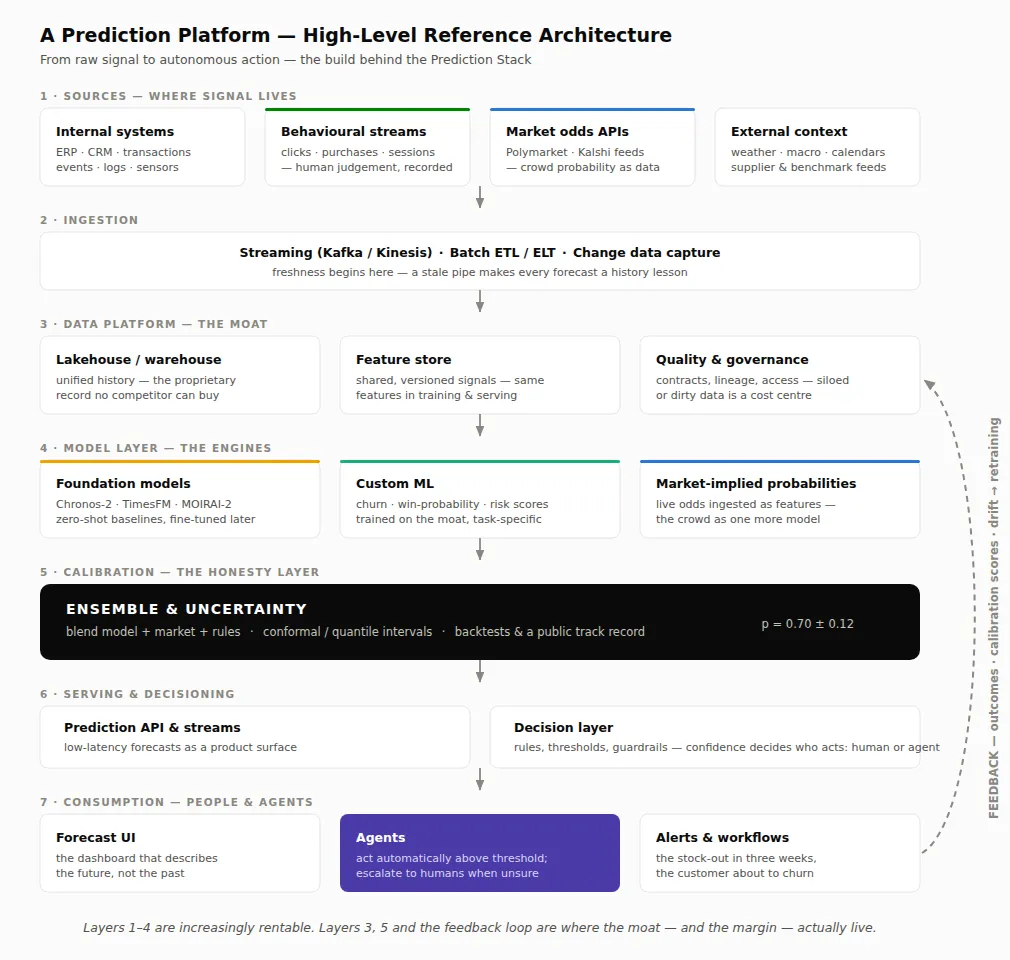
Figure 2 — What the stack looks like when you actually build it. Seven layers from raw signal to autonomous action: sources (note that market odds and behavioural streams arrive as data like any other feed), ingestion, the data platform — the moat itself — then the three model engines, a calibration layer that turns raw outputs into honest probabilities, serving and decisioning, and finally consumption by people, agents and workflows. The dashed feedback path — outcomes, calibration scores, drift, retraining — is the flywheel from Figure 1, rendered as engineering. Layers one through four are increasingly rentable; the data platform, the calibration layer and the feedback loop are where the moat and the margin actually live.
The thing that actually matters: data
Now the uncomfortable truth that underwrites all of it. The models are commoditising. Gartner is already classifying foundation models as “strategic commodities,” which is analyst-speak for your competitor can rent the exact same brain you can. Amazon, Google, Microsoft and a dozen open-source projects will all sell you a capable forecaster this afternoon. Differentiating on the model alone is a losing game with a shrinking time horizon.
This is also where an apparent contradiction earlier in the essay resolves itself. If zero-shot foundation models hand anyone a credible forecast with no proprietary data, doesn’t that make data matter less? At the baseline, yes — and that’s precisely the trap. Foundation models commoditise the generic forecast; they do not commoditise the last mile: the covariates only you observe, the outcomes only you can label, the feedback loop only your operation closes. The moat has simply moved — from “can you forecast at all?” to “can you forecast your world better than a rented model can?” — and that contest is won with data, not architecture.
What your competitor cannot buy, borrow or reverse-engineer is your data. The proprietary history of how your customers behave, how your supply chain flexes, how your market actually moves — that is the one input with no marketplace. This is why the durable moat in prediction isn’t the algorithm; it’s the dataset and the feedback loop that keeps enriching it. Better data yields better predictions, which win more customers, which generate more data. C.H. Robinson runs its logistics AI on north of 100 trillion proprietary data points across 75,000 customers — a position no newcomer can simply purchase into existence.
But — and this is the caveat that separates the people who talk about data moats from the people who have them — data sitting in a silo is not a moat. It’s a cost centre. Raw volume is worthless until it’s cleaned, connected, governed and actually wired into a decision. The moat isn’t having the data; it’s the discipline of turning it into a live, improving signal. That’s operational work, and it’s precisely where a well-built platform earns its keep.
Prediction is really about confidence
The future is not becoming more knowable. It is becoming more measurable.
Here is the reframe I’d ask you to sit with, because it’s the one most people miss. The real product of all this machinery isn’t prediction. It’s calibrated uncertainty.
The goal of modern forecasting was never certainty — anyone selling you certainty is selling you a story — it’s calibration. A system that says “there is a 70% chance demand rises by 10%” is infinitely more useful than an executive insisting demand will rise because they have a good feeling about it, and it’s more useful precisely because it’s honest about the other 30%.
Humans are famously terrible at probabilities. Most organisations are worse. Yet virtually every strategic decision — a bet on a market, a hedge, a hire, a launch — is at bottom a probability distribution that someone is collapsing into a single confident sentence. Prediction systems don’t eliminate that uncertainty; they quantify it. And this is the quiet revolution, because once uncertainty can be measured, it can be managed — priced, hedged, insured against, allocated for. A number with an honest error bar around it is a decision-grade instrument. A confident assertion without one is a liability wearing a suit.
Prediction as a new interface
There’s a quieter shift hiding inside all this, and it may outlast the louder ones. For decades, software existed to tell us what had happened. Dashboards described the past; reports were rear-view mirrors with good typography. The next generation of software increasingly exists to describe the future. The interface itself is moving from reporting to forecasting.
Think about what that does to a screen. The most valuable view in an organisation stops being the one showing last quarter’s numbers and becomes the one showing what’s about to happen — the stock-out three weeks out, the customer about to churn, the tender worth chasing. Prediction becomes a kind of temporal sensor: an instrument that lets an organisation feel the near future the way its dashboards once let it see the recent past. And once a company can sense forward, not just backward, the whole posture of decision-making tilts from reactive to anticipatory.
From forecasting to acting: the agentic turn
There’s one more shift, and it’s the one that turns all of this from interesting to economically enormous. Today, forecasts are consumed mostly by people. Tomorrow, they’ll be consumed increasingly by software.
A demand forecast won’t be emailed to a planner who reads it on Monday; it’ll trigger an agent that adjusts purchasing before the planner has finished their coffee. A fraud forecast won’t appear as a red row in a dashboard; it’ll alter transaction thresholds in real time, mid-swipe. An inventory prediction won’t sit in a report; it’ll reconfigure a supply chain automatically. The real economic impact arrives at the exact moment predictions stop informing decisions and start executing them — when the loop from signal to action closes without a human in the middle.
This is the bridge from the prediction layer to the autonomous enterprise, and it raises the stakes on everything above it. When a person reads a forecast, a bad one costs a meeting. When an agent acts on a forecast, a bad one costs money at machine speed. Which is exactly why calibration stops being a nicety and becomes the safety system: an agent that knows it’s only 55% sure can escalate to a human; one that mistakes a guess for a fact cannot.
And there’s a second-order risk that deserves naming before the triumphalism: reflexivity. A forecast that triggers action changes the very world it was trained on. When one agent reroutes around the predicted congestion, the forecast worked; when every agent acting on the same signal reroutes at once, the congestion simply moves — and the forecast helped cause the thing it predicted. Traders call this a crowded trade, and at machine speed it ends badly for everyone in it. Goodhart’s law patrols this whole territory: a prediction that becomes a target stops being a good prediction. The mitigation is the same discipline as everywhere else in this essay — measure your own feedback loops, and treat any signal your competitors can also see as already half-spent.
Prediction reduces uncertainty. It does not remove responsibility.
A word of maturity before the triumphalism, because there’s a tension running through this whole essay that deserves naming: prediction capability is exploding, and decision quality is not. They are not the same thing, and confusing them is how you build a very tall tower on no foundations.
A company can have near-perfect foresight and still fail through poor execution. A trader can know the exact probability and still blow up through bad risk management. A CEO can commission the finest forecasts money can buy and then ignore them because they’re inconvenient. Better forecasts do not automatically create better outcomes; they only widen the gap between organisations that can act well on them and organisations that can’t. Prediction reduces uncertainty. It does not remove judgement, discipline, or responsibility — and any pitch that implies otherwise is selling the map as though it were the journey.
Notes from the engine room: what building one taught me
I said at the outset that I wouldn’t cover financial trading systems here. I’ll keep that promise — but the lessons from building one belong in this essay, because the surprising thing about eighteen months of hardening a prediction engine is that almost none of the important lessons turned out to be about trading.
Strip the market vocabulary out of what I built and what remains is a governed decision engine: a system that turns messy evidence into an explainable probability, lets a human — or an LLM — express a policy over it, proves that policy on history before it is allowed to touch reality, rolls it out through graduated exposure (shadow mode, then advisory, then autonomous within bounds), wraps it in guardrails with a kill switch measured in milliseconds, and records every decision in an audit trail a regulator can actually read. Nothing in that sentence mentions a market. A bid/no-bid decision, an underwriting decision, a litigation-funding decision, a campaign-spend decision and an “is this security alert real?” decision all have the same skeleton: uncertain evidence, a policy, a need to be right before you commit, and a need to explain yourself afterwards. When we costed it honestly, roughly seventy per cent of the machinery — the policy evaluator, the validation gates, the guardrails, the audit — carries across domains unchanged. The thirty per cent that doesn’t is where the domain expertise lives, and the hardest part of it isn’t code at all: it’s defining the outcome model. What is “P&L” in your domain? Won-bid margin? Loss ratio? Analyst hours saved? Until you can score history with a number, every gate downstream of it is theatre.
A gate that computes on a wrong number is worse than no gate at all — because it manufactures confidence.
Three lessons cost the most, and I offer them to anyone building in this space. First: the validation chain is the product. In one audit we discovered a headline performance metric being computed roughly a hundred times wrong — in two engines, in opposite directions, so the errors cancelled and every dashboard looked plausible. Each individual safety mechanism was well designed; the chain feeding them numbers was broken. That is the sentence above, learned the expensive way. Second: fail closed, always. The dangerous defaults are the permissive ones — the fallback that quietly returns full size when the model meant to shrink it is down, the crisis check that reads zero during an actual crisis. When the system doesn’t know, it must do less, not more. And third, the question every serious buyer eventually asks: how do you let an LLM change a rule that decides who gets insured, funded, or bid on? Our answer became a jury — one model proposes, another critiques, a third judges; every claim must cite its evidence or refuse; every proposed change is cross-validated against the incumbent on identical history and rejected if it degrades. The LLM gets a pen, but never the last word.
This, concretely, is what the “honesty layer” of the architecture looks like when it has to survive contact with production. The prediction was never the hard part. Governing it was.
One last piece of honesty about these lessons, in the spirit they were learned: the seventy-per-cent claim is a thesis from one platform, not a track record across five. The fair status of every generalisation in this section is paid for once, portable in principle. I trust it because it cost so much to learn — and you’re entitled to discount it because it has been proven exactly once.
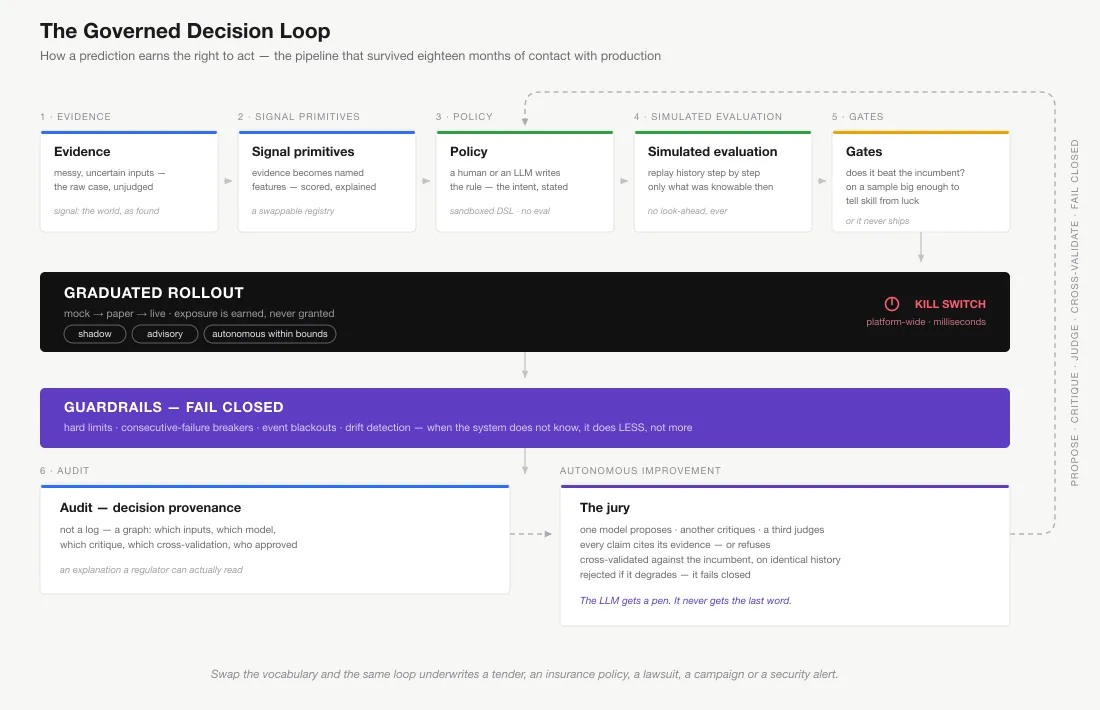
Figure 3 — The Governed Decision Loop. Evidence becomes an explainable probability, a policy is expressed over it (by a human or an LLM), and the policy is proven on history — with no look-ahead — before gates decide whether it beats the incumbent on a sample large enough to distinguish skill from luck. Only then does it earn graduated exposure: shadow, advisory, autonomous within bounds, always inside guardrails with an instant kill switch, always leaving a decision-provenance trail. The dashed loop is autonomous improvement: an LLM proposes a change, a jury critiques it, cross-validation against the incumbent decides — and it fails closed. Swap the vocabulary and the same loop underwrites a tender, an insurance policy, a lawsuit, a campaign or a security alert.
The full account of what that engine taught me — what generalises, what doesn’t, and the four lessons I paid for — is the companion piece to this one: The Things I Learnt Building Agencio Predict’s Signal Fabric.
Why this is a thrilling place to operate
Put the threads together and you can see the shape of the decade. Prediction is moving from a specialist craft to an infrastructure layer. The raw forecasting capability is getting cheaper and more general by the month. The durable advantage is settling firmly onto proprietary data and the systems that activate it. And the real deliverable is quietly shifting from raw prediction to calibrated confidence, consumed less by people and more by the agents acting on their behalf.
That is an extraordinarily good setup for anyone who builds. When the commodity layer gets cheap, the value migrates up the stack — to orchestration, to trust, to the specific data you own and the specific decisions you can make better than anyone else. The barrier to entry is collapsing while the ceiling on value keeps rising, which is the exact combination that mints new categories.
And notice what the whole story has actually been about. Not prediction, quite. Markets, models, data, agents — every one of them is a mechanism for converting uncertainty into action, and prediction is simply their most visible face. What we’re really watching is the industrialisation of judgement: the slow conversion of gut feel into something you can measure, price and wire into a system. We connected people. We reached them. We generated content for them. Now we are teaching machines to anticipate — and the value won’t live in the anticipation itself, but in how far it shortens the distance between uncertainty and action.
Prediction has been humanity’s oldest ambition and, until recently, its least reliable. For most of history, the future belonged to those who guessed well. Increasingly, it will belong to those who measure it better — and move on the measurement before anyone else.
The essay as a paper
The whole piece, typeset as a designed PDF — for reading offline, or sending to someone who needs the argument in one place.
Sources & further reading
- TRM Labs — How prediction markets scaled to $21B in monthly volume in 2026 — volumes, participant growth, category breakdown, the ICE/Polymarket deal.
- MachineLearningMastery — The 2026 Time Series Toolkit: 5 Foundation Models for Autonomous Forecasting — Chronos-2, TimesFM, MOIRAI-2, Lag-Llama, Time-LLM and the zero-shot shift.
- AI Ireland — The New Moat: Why Proprietary Data Is Your Only Durable Competitive Advantage in AI — the data-moat thesis, model commoditisation, the C.H. Robinson example.
- McKinsey (QuantumBlack) — From AI table stakes to AI advantage: Building competitive moats — where durable advantage actually accrues in the AI stack.
- Domo — Predictive Analytics Tools: Top 10 for Business in 2026 and Fivetran — The 8 best predictive analytics software & tools for 2026 — the enterprise analytics platform landscape.
- Kalshi and Trade Ideas — Prediction Markets 2026: Kalshi vs Polymarket — the two dominant markets and how they differ.
- nPlan — Our AI — graph neural networks trained on 750,000+ construction schedules to forecast delay.
- Drug Discovery Trends — Insilico’s inClinico — 79% accuracy / 0.88 ROC AUC predicting Phase II outcomes; Insilico — Phase I in 30 months.
- Lex Machina (LexisNexis) and LawSites — litigation analytics now “table stakes” — outcome analytics across US federal courts.
- Google DeepMind — GenCast — AI weather forecasting beating the ECMWF ensemble on 97% of targets.
- PLOS One — Churn prediction in mobile and online games — the play-log churn-forecasting literature behind live-ops.
- PYMNTS — Lemonade and the AI insurance model — machine-priced risk and loss ratios.
- Agencio Predict — The Governed Decision Engine (internal design note, July 2026) — the 70/30 reusability split, graduation gates, the jury pattern, and the fail-closed lessons behind “Notes from the engine room.”