The Lights of Manila
On typhoons, dark windows, artificial intelligence, and what a country must do before the storm makes landfall. A skyline that once blazed all night is going dark floor by floor — hollowed out by two forces arriving at once, AI and corruption. What follows is a diagnosis, a three-year national transition programme with numbers attached, and an honest chapter on why it will probably fail unless it is designed for distrust.

On typhoons, dark windows, artificial intelligence, and what a country must do before the storm makes landfall.
Also available in Tagalog: Ang mga Ilaw ng Maynila → — an AI-generated translation, so it may not be perfect; treat this English version as the factual reference. My five-year-old speaks better Tagalog than I do, and my chief translator — a.k.a. my wife — is busy with her day job; I am hoping she will review it later and send corrections.
I. The Veranda
There is a particular quality to the air in Manila before a typhoon arrives. The barometer drops, the birds go quiet, and the city — a place that ordinarily conducts itself at the approximate volume of a jet engine falling down a staircase — takes on an almost apologetic hush. It was in this hush that I found myself sitting outside with an old friend of mine, a Filipino businessman of the sort who has seen three currency crises, four presidents, and at least one coup attempt from the comfort of the same table, and who has therefore earned the right to be unimpressed by weather.
We were, in the fine tradition of men of a certain age, chewing the cud. The storm was inbound. The beer was cold. And at some point in the evening he lifted his bottle, gestured across the skyline toward the Philippine Stock Exchange, and said the thing that has been rattling around my skull ever since.
“Look at the buildings.”
I looked. And then I saw what he meant, which is a different thing entirely.
The towers were dark. Not all of them, and not entirely. But floor after floor of the great glass monuments of Makati and Ortigas — buildings I remembered, from visits past, blazing at two in the morning like vertical constellations — now stood with their lights out. Whole storeys of darkness, stacked like missing teeth.
II. A Word About Who Is Speaking
Before we go any further, let me deal with something directly, because it matters.
Yes, I am a foreigner — by passport. But my wife is Filipina. My son is Filipino, and he is five years old. This country is not a case study to me; it is a second heartbeat, a place I return to the way one returns to family, because that is precisely what it is. I did not put two days of my life into writing this because I enjoy poking holes in other people’s countries. Nobody writes several thousand words about a nation they don’t care about. I write from what I see — and I have been seeing it for years.
I will say something else, and I say it without pleasure. I have warned of this in public talks in the Philippines. More than once. The response was warm, the nodding was enthusiastic, the coffee afterwards was excellent — and nothing moved. The nodding, I have come to understand, is the problem. The Philippines is now feeling the bite of the very thing that was politely nodded at, and my message has therefore sharpened: get moving, not nodding. It is not too late. But be precise about the clock: the window for beginning is measured in months; the transition itself will take years — which is exactly why every month spent nodding is stolen from the years available to act. Build the framework. Own the intellectual property. Or be obsolete.
There. Declared. Now let us take the journey properly — because to understand why those windows are dark, you must first understand why they were ever lit.
III. A City at Night Is an Energy Diagram
Here is a rather beautiful way of thinking about it. When you look at a city at night, you are not really looking at buildings. You are looking at a map of where energy is being spent — and energy, in an economy as in a star, is only spent where work is being done. Every lit window is a transaction: electricity converted into labour, labour into wages, wages into rice and school fees and jeepney fares, and eventually into the small domestic constellations of a million family homes.
For over two decades, the Manila skyline at 2 a.m. was one of the most remarkable energy diagrams on Earth. Those blazing towers were lit because it was 2 p.m. in New York. Inside them sat hundreds of thousands of young Filipinos — headsets on, accents gently tuned to the American midwest — resetting passwords, tracking parcels, soothing the furious and refunding the wronged.
The Philippines earned that skyline through a combination of advantages that no other nation quite assembled in one place: superb English proficiency; a deep cultural fluency with Western customers; a vast, educated, young workforce; competitive labour costs; and — this one is underrated by economists and understood perfectly by anyone who has ever been on the receiving end of it — a national genius for empathy under provocation. Millions of Filipinos entered the modern workforce through a headset. Customer service became one of the country’s great export industries, a US$40-billion sector employing nearly two million people. The night shift was the skyline.

The gauge, not the lever. A tower still standing, still occupied, still profitable — and hollow from the middle up.
So when the lights go out, floor by floor, it is not a mood. It is a signal — and let me be honest about its limits. A skyline glimpsed from a veranda is not a statistical sample, and dark floors have more than one explanation: hybrid working, energy costs, tenancy churn, the hour of the evening. But a gauge does not need to be a proof; it needs only to prompt you to open the engine and look. And when you open this one, the instruments inside tell the same story the windows do: two forces have arrived at once.
IV. The First Force: The Machine Learns to Talk
Generative artificial intelligence has done to the call centre what the tractor did to the field — not maliciously, not even dramatically, but with the quiet arithmetic inevitability of a cheaper way of doing the same work.
Consider what actually filled those lit floors. Password resets. Order-status enquiries. Billing questions. Scripted troubleshooting. Standard live chat and basic email support — Tier 1, in the industry’s own language. This is precisely the work that modern AI now performs instantly, tirelessly, in any accent you please, at close to zero marginal cost. It answers the common questions, processes the refunds, tracks the deliveries, summarises the conversations, drafts the replies, searches the knowledge bases and completes the back-office workflows. Philippine service leaders themselves expect AI to be handling roughly half of all customer-service cases by 2027 — up sharply from today, and the curve is not slowing.[1]
Now, the industry’s aggregate numbers still look reassuring, and this is where the danger hides. Total revenue is still growing; industry bodies still report headcount in the millions; everyone at the conferences says soothing things. But an aggregate is a blanket thrown over a bed, and it hides the shape of what is underneath. Beneath the blanket:
- entry-level hiring has slowed sharply — the front door through which millions of Filipinos entered the formal economy is quietly narrowing;
- smaller teams are handling larger workloads;
- voice-based support is flattening;
- every remaining agent is expected to work alongside AI;
- the industry is migrating from generalist roles toward a much smaller number of specialists.
The middle of the job has been scooped out. What remains for humans is the difficult, valuable residue: escalations, emotional situations, fraud investigations, retention, complex technical support, regulatory decisions, high-value customers. This is better work — it demands judgement, empathy, accountability — but there is less of it, and it lives on fewer floors. The industry has not been destroyed. The traditional customer-service agent has been hollowed out from within, like a tree that still stands and still bears leaves while its heartwood quietly turns to dust.
If an AI agent can resolve seventy to ninety per cent of routine enquiries for a few dollars a month, then labour arbitrage — the entire founding premise of the sector — stops being compelling. The exposure is brutally concentrated: nearly nine in ten of the sector’s workers sit in exactly the contact-centre and business-process roles most exposed to automation, and two-thirds of firms have already deployed AI tools.[2] That is not a forecast. That is the present tense.
V. The Second Force: The Older Enemy
And then — because history has a taste for cruel timing — the second force arrived in the very same season. The homegrown one. Corruption.
In 2025, investigations and audits began exposing what had happened inside the country’s flood-control budget: projects inflated, substandard, or simply never built at all. Precision matters here, morally and legally, so let us use the right words. These are audit findings and allegations, not yet a ledger of convictions; the figures describe money exposed to irregularity rather than money proven stolen. But the independent estimates are sobering on any reading: alleged losses in the region of ₱42–118 billion a year since 2023,[3] with one analysis putting the climate-tagged funds potentially compromised at more than a trillion pesos — upwards of US$19 billion.[4] Ghost dams against real typhoons, in the most disaster-prone country on Earth.
The scandal did what scandals of that magnitude always do: it froze the bloodstream. Foreign direct investment fell by nearly 40 per cent to a five-year low.[5] Public construction seized up — the country’s own planning secretary estimated the collapse shaved more than a full percentage point off 2025 growth.[5] The World Bank cut its 2026 forecast from 5.3 to 3.7 per cent, and first-quarter growth came in at 2.8 per cent, the weakest since the pandemic, with investors described as “hesitant” — which is the institutional dialect for terrified.[6] Trust — external and internal alike — is scraping along the floor, and morale with it.
Here is the cruel elegance of the thing: both forces produce the same symptom. AI dims the towers because fewer agents are needed on the night shift. Corruption dims the towers because the capital that might have filled new floors is sitting on its hands, waiting to see whether anyone of consequence actually goes to prison. From the veranda, with a San Miguel in hand and a typhoon on the radar, you cannot tell which darkness is which. Two diseases, one fever. And two forces arriving together do not add. They compound.
VI. Where Everybody Went
Which raises the question my friend asked next, over the second bottle, and which turns out to be the one that actually matters: so where did they all go?
I went looking for the number expecting a bloodbath. I did not find one. What I found instead is stranger, quieter, and considerably more insidious.
The headcount has barely moved. The sector employed roughly 1.9 million people in 2025 and is forecast to sit at about 1.96 million in 2026 — up, note, not down.[9] There has been no mass redundancy. There have been no scenes outside the towers, no burning placards, nothing for the evening news. What there has been is this: the industry’s own 2022 roadmap projected 2.5 million workers by 2028. That projection has now been revised down to between 1.85 and 2.14 million.[9]
Set those two figures side by side and hold them there for a moment. Somewhere between four hundred thousand and six hundred and fifty thousand jobs — jobs that were planned for, counted upon, written into a national development story and quietly promised to a generation of school-leavers — will now simply never exist.
That is the answer, and it is precisely why nobody can find the bodies. The jobs were not lost. They were never born.
And an absence, unlike a redundancy, cannot be photographed. A redundancy has a date, a severance cheque, a press release and an aggrieved union official available for comment at short notice. A job that is never created has none of these things. It has no leaving party. It is simply a nineteen-year-old in Iloilo who applies for the role her cousin walked into four years ago, does not get it, applies for eleven more, and never once learns why. Multiply her by half a million and you have the most consequential economic event in the country’s recent history, occurring entirely in the passive voice.
The visible edge of it has a name, and the name is bureaucratic enough to be almost funny: workers are placed on “floating status” — the bench. Not sacked. Not working. Roughly four hundred at one provider’s Cebu operation; at least fifteen hundred across another’s sites.[10] Meanwhile the sector’s revenue grows at 5.3% while its employment grows at 3.6%, and the gap between those two numbers is not an accounting curiosity.[10] It is the blanket and the bed again. It is the machine, earning.
The second gauge
All of which brings me back to the veranda, and to something I had been noticing for the better part of a year without once thinking about it properly.
There are more motorcycles.
I should declare an interest here, because it is a cheerful one: I ride. Manila’s traffic is not merely bad, it is architecturally bad, a civic monument to the proposition that any two points may be separated by ninety minutes regardless of distance. Against this, a scooter is not a compromise; it is the single most rational object ever devised. I am delighted there are more of them. If this essay were about traffic it would be a triumphant one.
But it is not a subtle change, and that is the point. I would put it, from the saddle and entirely unscientifically, at twenty per cent more bikes on the road than there used to be. Possibly more. It is the sort of thing you feel at a junction before you could ever prove it — the density at the lights, the width of the gap you can filter through, the length of the queue of riders that forms in front of the traffic when it stops.
The numbers bear the impression out, and the way they bear it out is instructive. In the first quarter of 2026 the four major manufacturers sold 496,868 two-wheelers in the Philippines, against 445,047 in the same quarter a year earlier — a rise of 11.6%. The industry association attributes the surge to worsening traffic and rising fuel prices.[11]
Note that 11.6% is the sales figure, not the fleet. Sales are the water going in; the fleet is the level in the bath. Stack two or three years of double-digit sales growth on top of a fleet that was already enormous and barely retires, and a rider’s impression of a fifth more machines around them is not exaggeration — it is roughly what the arithmetic ought to produce. The eye got there first. It usually does, which is rather the argument of this entire essay.
And there, in that second reason the industry gives, the cheerful story turns over and shows you its underside.
Because consider what the sentence actually says. People are buying motorcycles because fuel has become expensive. The motorcycle is the hedge — the cheapest remaining way to keep moving. It is an entirely rational purchase, and it is being made by hundreds of thousands of people at once, which is what makes it a signal rather than a preference.
Now look at what fuel has been doing while they were buying. In the first half of 2026 alone, Philippine pump prices rose by a net ₱45.02 a litre for petrol and ₱31.56 for diesel. On a single Tuesday in July, diesel went up ₱10.68 a litre — in one week — as the Strait of Hormuz did what the Strait of Hormuz periodically does. By August petrol stood at ₱62.55 a litre.[12]
So here is the shape of the thing, and it is the reason I keep returning to it. A great many households have responded to a squeeze on income and a spike in fuel by acquiring a vehicle whose entire operating cost is fuel. Worse, a considerable number of them are riding it into platform work — delivery, ride-hailing — where they are classified not as employees but as “partners,” which is a word doing an enormous amount of quiet work. It means the fuel is their cost, not the platform’s. Research on Philippine riders finds that after fuel, mobile data, maintenance and vehicle loan repayments, many cannot clear the basic minimum wage; the government has already been distributing ₱5,000 fuel subsidies to affected transport workers.[13] When the state is subsidising the petrol of the people who replaced their salaries with a scooter, the shock is not a forecast. It has landed.
A salary is a fixed, dull, magnificently predictable monthly event. Fuel is a variable, set eight thousand kilometres away by people who have never heard of Iloilo. A household that has traded the first for exposure to the second has not merely lost income — it has swapped a stable input for a volatile one and agreed to absorb the volatility personally, in instalments, at the pump, every week, for ever.
That is the canary. Not the scooters themselves — the scooters are excellent, and I intend to keep riding mine. It is what the scooters are substituting for, and how little slack is left in the household once they have.
So: two gauges, and they read the same. The lights, up on the skyline, tell you where the work went. The traffic, down at eye level in the next lane at the same red light as you, tells you where the workers went — and precisely how thin the margin is they are now living on.
VII. Phase Transition
Before the diagnosis turns into a plan, let me say the obvious thing out loud, because plans in this area are so often written as though it were negotiable. You cannot stop this. Nobody has ever successfully prohibited a cheaper way of doing something; the attempt merely relocates the work and wastes the intervening years. Any programme premised on holding the line will fail, and deserve to.
But a force you cannot stop is not the same as a force you cannot aim. You cannot stop a river either. You can still decide whether it floods the town or turns the turbine — and that decision, taken early enough, is the entire difference between the two outcomes. Change is not the enemy here. Drift is. The question was never whether the Philippines gets an AI transition; it is getting one as we speak. The question is whether the country points it somewhere deliberate, or lets it point itself and calls the result fate.
A physicist would call what the Philippines is undergoing a phase transition — the moment a system stops being one thing and becomes another, the way water becomes steam. The crucial fact about phase transitions is that they are not gradual for the thing undergoing them. Energy pours in for ages and nothing appears to happen — and then, quite suddenly, everything happens at once.
The old phase was simple and rather glorious: the world’s businesses paid for Filipino hours. A million people, a headset each, hours sold in bulk. The new phase — if the country reaches it — is subtler and stronger: the world pays for Filipino judgement. The country stops being the world’s call centre and becomes the world’s AI operations centre — the place where humans supervise, improve, govern and correct the machines that now do the repetitive talking.
The new roles already have names: AI supervisors and trainers. Quality analysts who audit machine conversations. Conversation designers and prompt specialists. Knowledge-base managers. Compliance reviewers, trust-and-safety specialists, human escalation experts, customer-journey architects, AI governance teams. These roles depend less on repetition and more on contextual judgement, accountability, and the authority to intervene when the machine is wrong. And no — judgement is not permanently automation-proof; AI is already eating into evaluation and decision support. But consequential judgement is tethered to responsibility: when a decision touches a regulator, a courtroom or a grieving customer, someone must be answerable — and software cannot be summoned to a hearing.
Three honest complications, though, before anyone gets comfortable.
The education challenge. The existing education system was substantially designed to produce graduates for traditional BPO work. The coming roles demand critical thinking, writing, digital literacy, data analysis, fluency with AI tools, process design, business analysis, cybersecurity. All teachable — but teaching them at the scale of hundreds of thousands of workers is a national undertaking, not a seminar.
The timing problem. AI capability improves on a timescale of months. Education reform and workforce retraining move on a timescale of years. That mismatch creates a dangerous valley: companies need fewer entry-level agents, workers are still being trained for exactly those roles, and the new AI-centric jobs are not yet numerous enough to absorb everyone. The valley is where careers, and political stability, go to die.
The company the Philippines keeps. This is not a uniquely Filipino predicament. India, South Africa, Eastern Europe, Latin America — every major outsourcing destination is staring at the same shift. The countries that will come through are those that stop selling hours of labour and start selling expertise in operating AI-enabled systems. We have seen this film before, in manufacturing: when the industrial robots came, the countries that kept competing on cheap manual labour struggled; the countries that learned to design, build and maintain the robots stayed rich. The Philippines has the foundations to be in the second group — one of the largest English-speaking workforces on Earth, decades of deep customer-experience expertise, mature outsourcing infrastructure, multinational relationships already in place, and a young population that adopts new technology the way other nations adopt weather. The talent is not in question. The speed is.
Which brings us, at last, from thought to action. Because a diagnosis without a plan is merely eloquent worrying — and the Philippines has had quite enough of that from all of us. What follows is the plan I would put on the President’s desk. Not a vision document. A programme, with numbers attached, designed to be audited.
VIII. The Plan: A Philippine AI Services Transition Programme
Let us be clear about the objective, because objectives are where plans go wrong first. The Philippines should not attempt to preserve the traditional call-centre model unchanged. That would be spending public money defending work whose economic value is evaporating — subsidising candles against the electric light. The objective is this:
Move the Philippines from supplying customer-service labour to operating, supervising and improving AI-enabled global business services — and, ultimately, to owning the software that runs them.
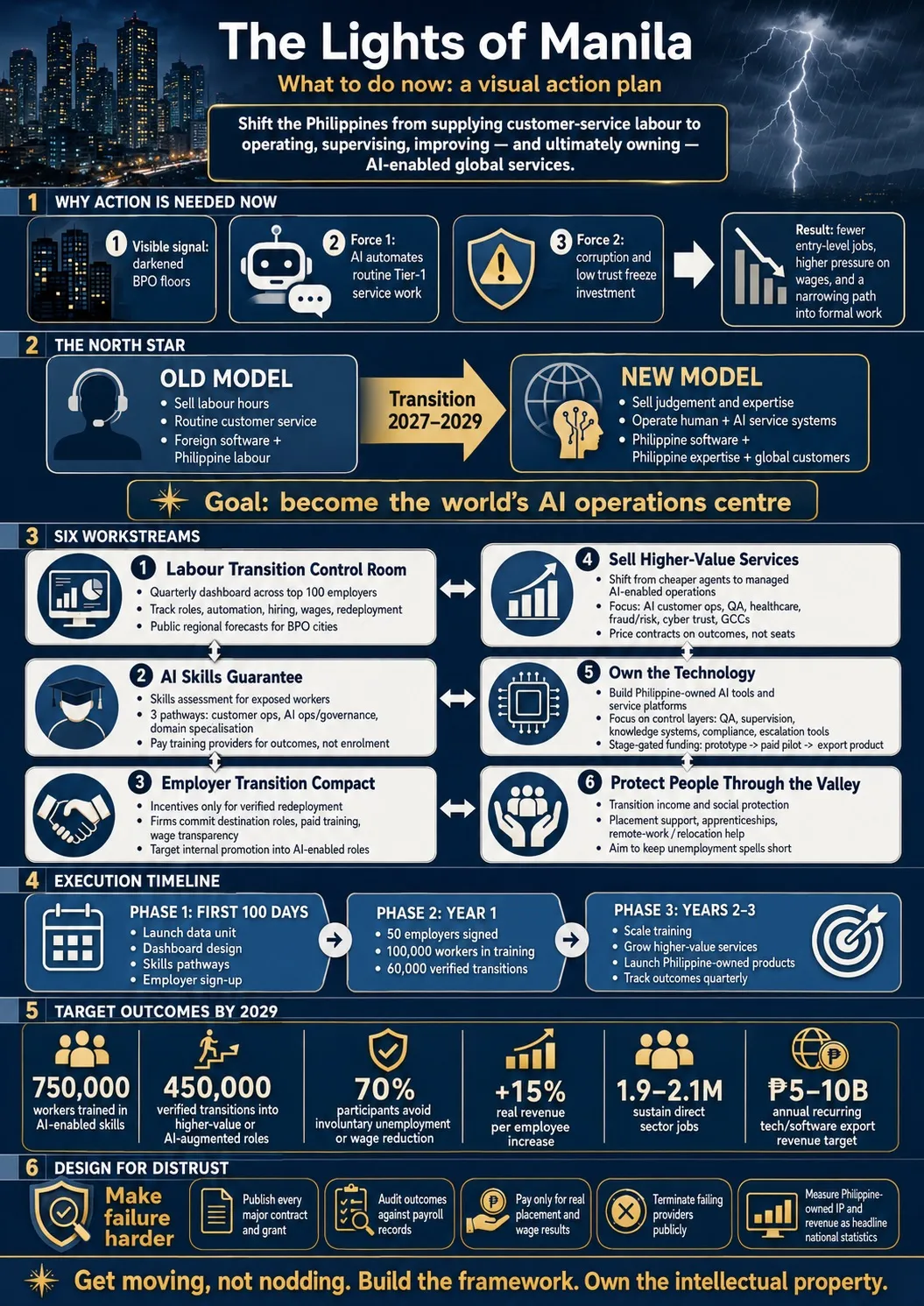
The whole programme on a single page — for the people who will only ever be handed one.
This is urgent but not lost. The sector generated roughly US$40.3 billion and employed 1.9 million people in 2025.[7] But the industry’s own body has already trimmed its 2028 workforce forecast to between 1.85 and 2.14 million, while explicitly targeting two million “AI-enabled” workers[7] — a tacit admission that the old growth engine is finished. I would establish a three-year national programme, 2027 to 2029, with five measurable outcomes. Not aspirations. Targets, against which people are paid or not paid:
- Train 750,000 existing and prospective workers in employer-validated, AI-enabled skills.
- Move at least 450,000 people into verified higher-value or AI-augmented roles.
- Ensure at least 70% of participants avoid involuntary unemployment or wage reduction.
- Raise industry revenue per employee by at least 15% in real terms.
- Sustain roughly 1.9–2.1 million direct jobs despite collapsing demand for routine work.
Six workstreams deliver it.
Workstream 1: A National Labour-Transition Control Room
You cannot steer what you cannot see, and at present the government is navigating this transition using annual industry headcount figures — numbers that can hold perfectly steady while entry-level hiring collapses underneath them. The unit of analysis must become the task, not the job title.
Within the first hundred days, DICT, DOLE, TESDA, CHED and IBPAP establish a common data unit. The hundred largest IT-BPM employers report quarterly, anonymised: headcount by role and location; recruitment and attrition; tasks automated; AI tools deployed; workers retrained and redeployed; starting and median wages; new roles created; contracts won and lost. The output is a public Philippine AI and Services Employment Dashboard — with automation-exposure scores for every major role and quarterly regional forecasts for Manila, Cebu, Davao, Clark, Iloilo and the other BPO cities. First-year bar: at least 80% of sector employment covered. If the dashboard is not public, it does not count.
Workstream 2: An AI Skills Guarantee for Every Exposed Worker
A two-hour webinar on generative AI is not reskilling; it is theatre. Every worker in an exposed role receives a funded skills assessment and entry to one of three pathways, each eight to sixteen weeks, taught on real employer systems, ending in a practical assessment — not a multiple-choice quiz.
Pathway A — AI-enabled customer operations, for those staying close to the customer: AI-assisted case handling, complex escalations, retention and complaints, fraud and vulnerability detection, knowledge-base management, conversation quality assessment, AI output verification.
Pathway B — AI operations and governance, for those moving into the machinery: AI evaluation and testing, hallucination and error detection, prompt and conversation design, data annotation and curation, model-risk monitoring, trust and safety, privacy and regulatory compliance, AI workflow supervision.
Pathway C — Domain specialisation, combining AI fluency with healthcare administration, banking and insurance fraud, cybersecurity, legal operations, logistics, accounting, software QA, sales operations.
TESDA already has AI competency standards and microcredentials; scale them and wire them directly to employer vacancies rather than building a new training bureaucracy. And here is the part that matters more than everything above it combined: providers are paid for outcomes, not enrolment. The bar: 80% completion, 70% practical certification, 60% placement within six months, 70% still employed at twelve months, no median wage reduction — and a 10% median wage increase for those entering specialist roles. The headline KPI of the entire national programme is the verified transition rate: the percentage of exposed workers who enter a less-automatable role, hold it six months, and lose no income. Everything else is commentary.
Workstream 3: An Employer Transition Compact
Government cannot retrain workers for jobs it merely imagines; employers must put destinations on the table. Companies receive training credits, wage subsidies or enhanced incentives only against measurable workforce outcomes — for instance, part-funding six months of training and salary when a firm moves a customer-service representative into AI quality assurance, knowledge operations, fraud investigation, healthcare administration, data stewardship or workflow automation. In exchange the employer commits: a defined destination role, paid training time, recognised assessment, a minimum employment period, and wage transparency.
The envelope: roughly ₱30–40 billion over three years — an illustrative planning figure, not a costed bill[8] — with at least half from employers themselves. Year-one bar: 50 major employers signed, 100,000 workers in training, 60,000 verified transitions; by year three, 750,000 trained and 450,000 transitioned, with participating employers filling at least half of new AI-enabled positions from within — because a compact that lets firms sack the many and hire a specialist few externally is not a compact, it is a subsidy for redundancy.
Workstream 4: Sell Higher-Value Services, Not Cheaper Agents
Training supply without building demand is pointless. A joint DTI–DICT–IBPAP sales force takes six propositions to the US, UK, Australia, Japan and Europe: AI customer-operations command centres; global AI evaluation and quality assurance; healthcare and insurance operations; fraud, risk and financial-crime services; cybersecurity and digital trust; and full Global Capability Centres spanning finance, HR, procurement, analytics and IT.
The pitch changes from “We can give you a thousand agents at lower cost” to “We will operate your entire human-and-AI customer system — quality, safety, escalation, compliance and continuous improvement included.” And the contracts migrate from seats-and-hours to outcomes: cases resolved, customers retained, fraud prevented, accuracy, compliance, resolution speed. Three-year bar: 50 major AI-enabled or GCC investments landed; a quarter of new large contracts priced partly on outcomes; high-value services up 15 percentage points as a share of revenue; revenue per employee up 15%; and at least 30% of new jobs outside Metro Manila — because a transition that only saves Makati has not saved the country.
Workstream 5: Own the Technology — the Sovereign IP Workstream
Now we arrive at the heart of it, the part I most fear will be nodded at and shelved. Everything above still leaves the Philippines operating other people’s machines. The old model was foreign software plus Philippine labour. The transitional model is foreign AI plus Philippine supervision. Both leave the margin — the compounding, recurring, sovereign margin — overseas. The end-state must be:
Philippine software + Philippine expertise + global customers.
If Philippine companies only staff the control rooms of foreign platforms, the country remains a tenant in its own industry.
One clarification first, before some ministry hears “sovereign AI” and commissions a national large language model or a state-owned data centre: that is emphatically not the proposal. The Philippines has no need to compete in capital-intensive frontier-model training; foundational models are fast becoming commodities, and the race to build them is a bonfire of other people’s capital. The prize is the control layer that sits on top of everyone’s models — the supervisory, evaluation, governance and industry-workflow software that makes AI safe, compliant and commercially useful, including multilingual and culturally specific customer systems. That layer is where the durable margin lives, and it is precisely where two decades of Philippine operational expertise apply. So: an AI Services Innovation Fund, targeted at the control-layer tools the country’s own operators already know the world needs, because they feel the pain daily:
- AI agent control platforms — fleet management for customer-service AIs: performance monitoring, escalation control, confidence scoring, automated quality testing, incident management, human-approval workflows, model and vendor comparison, complete decision records.
- AI quality-assurance tools — where old call centres sampled 2% of conversations, AI review covers 100%: surfacing wrong answers, hallucinations, policy breaches, missed sales, regulatory risk, abnormal behaviour — routing the riskiest cases to human specialists.
- Knowledge management systems — because an AI is only as honest as its sources: ingesting policies, catching contradictions and stale documents, version control, grounding tests, update approvals, gap measurement.
- Human escalation and supervisory tools — when the machine hands over, the human receives the full picture pre-assembled: summary, history, recommended actions, risk flags, emotional and vulnerability indicators, regulatory requirements, suggested responses. One skilled Filipino supervising the workload that once took a floor.
- Compliance and governance tooling — consent and privacy management, decision logs, policy enforcement, model-risk assessment, bias testing, audit reporting, human-override controls, data residency. Regulated industries will require this, and requirements are the best business model ever invented.
- Industry-specific platforms — insurance claims, healthcare administration, banking disputes and fraud, telecoms support, travel disruption, logistics exceptions, legal operations, procurement. Software plus models plus domain rules plus Philippine operational expertise, sold as one.
Because a list of categories is still an abstraction, and abstractions are what get nodded at, here is the second item on that list drawn out properly — as a product, with the money and the people marked on it.
A hypothetical, but not a fanciful one. Every component here is something Philippine operators already do by hand — at two per cent coverage, on someone else’s platform, for someone else’s margin. The proposal is only that they do it at full coverage, on their own software, and bill for the system rather than the seats.
Delivery through joint product partnerships — big BPO firms supplying problems, data and first customers; local software houses building; universities researching; regulators advising — with funding released in stages and cut off without sentiment: problem validation → working prototype → paid pilot → commercial product → export. No customer demand, no next cheque. Add national testing sandboxes: anonymised industry datasets, simulated conversations, red-team exercises, security testing, shared compute — so a startup in Cebu can develop what only a conglomerate could otherwise afford to test.
The commercial model shifts to blended contracts — software subscriptions, implementation fees, managed services, specialist human support, outcome incentives. Charge for the operation of the system, not for five hundred chairs.
Three-year bar: 100 products reaching paid pilot; 50 commercially deployed; 20 with overseas customers; ₱5–10 billion in annual recurring software and technology exports; 10,000 high-skilled product, engineering, security and governance jobs; 50 pieces of defensible IP; renewal rates above 80%; over 40% of product revenue earned abroad. And the single most important national metric: the share of industry revenue generated from Philippine-owned technology and intellectual property, rather than billed labour. That number is the country’s future, expressed as a percentage.
Workstream 6: Protect People Through the Valley
Even a successful transition will not save every role, and a plan that pretends otherwise is lying. Displaced workers who complete training receive transition income, continued health and social-insurance coverage, career assessment and placement support, relocation or remote-work assistance, apprenticeships in adjacent sectors. The aim is not to hide redundancies but to shorten the fall: median unemployment below twelve weeks; 70% re-employed within six months; no rise in long-term unemployment in the BPO cities; wage recovery within twelve months; and separate reporting for young workers, women and regional employees — because averages are where the vulnerable go to disappear.
The National Scorecard
Published quarterly. Independently audited — training claims verified against payroll and employment records, never self-reported attendance.
| Area | Primary measure |
|---|---|
| Worker transition | % entering a sustainable, less-exposed role |
| Employment | Net employment by role, region, experience level |
| Wages | Real median wage and post-transition wage change |
| Training | Certification, placement, twelve-month retention |
| Industry value | Export revenue and revenue per employee |
| Market shift | Revenue from AI-enabled and specialist services |
| Employer behaviour | Internal redeployment vs redundancy |
| New entrants | Entry-level vacancies and graduate placement |
| Innovation | Philippine-owned AI export revenue |
| AI quality | Errors, complaints, escalations, security incidents |
Done credibly, the result is not the old mass call-centre expansion reborn but a different sector: similar or moderately higher total employment, far fewer routine Tier-1 agents, many more specialists and supervisors, higher productivity and wages, tougher entry requirements — and, crucially, Philippine hands on the intellectual property. Which is why the country must measure verified worker transitions — not courses delivered, conferences held, or press releases describing people as “AI-ready.”
IX. Why It May Fail — and How to Design for That
And now the uncomfortable chapter. The plan above is economically plausible. Whether the institutions exist to execute it is another question entirely, and I would be insulting your intelligence — and this country’s recent experience — if I pretended otherwise. The greatest danger facing the Philippines is that it mistakes announcing an AI strategy for building an AI economy. The barriers are not technological. They are institutional, political and cultural. Let me name them.
One: trust is the scarcest resource. This transition requires government departments, universities, technology firms, BPO providers and workers to cooperate for years — in an environment where organisations instinctively guard their budgets, data and relationships. Providers will be tempted to hide redundancies, automation plans, falling recruitment and lost clients. Agencies will compete to control the programme rather than run it. Universities will mint courses nobody asked employers about. Employers will demand public training money while committing to nothing. The result: a dozen disconnected initiatives, each declaring victory, while the underlying problem worsens. And the sovereign-IP workstream suffers most, because shared platforms, datasets and tools require competitors to cooperate — which they will not do without trusted structures for data sharing and IP protection.
Two: procurement capture. A multi-billion-peso national programme is a feast, and this country has just watched, in the flood-control affair, precisely how such feasts are eaten: politically connected providers, inflated contracts, consultancies producing binders, training with no employment outcomes, technology bought and never deployed. The subtlest theft is not money stolen outright — it is money spent on activities that look legitimate and produce nothing. A provider reports 50,000 course completions; an agency calls it success. The only questions that matter are: did they get jobs, did wages rise, were they employed a year later, did employers value the credential? Without independent audit welded to payroll and employment records, the programme becomes one more distribution mechanism for public funds — ghost skills to stand beside the ghost dams.
Three: the culture of announcement without execution. The Philippines produces world-class launch events, memoranda of understanding and national roadmaps. What the transition actually requires is unglamorous: common occupational standards, accurate labour data, removing failing providers, integrating government databases, holding employers to commitments, tracking workers after training, improving quarterly, and continuing after the leadership changes. None of it photographs well. The danger is a country that declares its workforce “AI-ready” because a million people learned to write prompts — when knowing how to prompt is to operating AI in banking or healthcare what owning a stethoscope is to practising medicine. Without depth, the programme manufactures certificates, not capability.
Four: the seduction of the shiny. Semiconductor fabs, hyperscale data centres, technology parks, mining concessions — some genuinely valuable, none a substitute for replacing hundreds of thousands of service jobs. A data centre employs armies during construction and a skeleton crew thereafter: vast dark sheds of humming machines, tended by dozens. If the Philippines supplies the land, power, water and tax holidays while foreign firms own the compute, the models, the data and the IP, that is not digital development. It is digital resource extraction — the electricity leaves as someone else’s intelligence. The same trap awaits mining (raw minerals out, value-added processing elsewhere) and low-margin chip assembly. These can be part of a strategy. They cannot be the strategy.
Five: infrastructure is not capability. Servers located in the Philippines do not mean Philippine-owned AI, any more than hosting a library makes one literate. A genuine AI economy requires locally owned products, engineering and product-management depth, domain expertise, customer access, cybersecurity, commercial leadership, intellectual property — and institutions willing to buy from their own. Absent those, the country becomes the physical landlord of foreign technology, collecting electricity bills and rent while the margins emigrate.
Six: political time is shorter than economic time. This transition outlasts any administration. The government that plants it will not harvest it; successors will be tempted to rename, redirect or ribbon-cut something newer. The remedy is a delivery institution with political independence, transparent governance, multi-year funding, employer and worker representation, published performance data, and — rarest of all — the authority to kill its own failing programmes.
Seven: the people deciding have never touched the machine. This is the barrier I am least comfortable naming, because it reads as an insult and is not meant as one. A great deal of senior leadership — in government, in boardrooms, and emphatically not only in this country — is making consequential decisions about artificial intelligence having never seriously used it. Not played with it. Not pushed it until it broke, watched it produce a confident and beautifully worded falsehood, argued with it, caught it being wrong in a way that would have mattered. They have been briefed. They have seen the deck. They have approved the strategy and posed for the photograph. And a briefing is to understanding a technology roughly what a holiday brochure is to emigrating.
This produces a very particular species of error: decisions that are each individually defensible and collectively disconnected, taken by people running a mental model of the world that quietly stopped updating some years ago. They will fund the data centre and not the software, because a building is legible and a codebase is not. They will count the certificates and not the jobs. They will believe the vendor, because the vendor is fluent, and fluency is indistinguishable from competence to anyone who has never done the work. And they will underestimate the speed of all of it, every time, because the only honest way to feel how fast this is moving is to have used the thing eighteen months ago and used it again this morning.
I want to be precise about the diagnosis, because it changes the remedy. This is not malice. It is not even indifference — most of the people I have met in these rooms care a great deal, and several of them lie awake about it. It is obliviousness, which is a different condition entirely, and a far more treatable one. Nobody can govern what they have never handled. The fix is unglamorous and faintly undignified, which is precisely why it so rarely happens: the people signing off on a national AI programme should be made to spend a fortnight actually operating the systems they intend to govern — building something small and watching it fail, sitting on the escalation desk, reading the transcripts where the machine was confidently wrong. Not a demo. Not a site visit. The real thing, with their own hands, until the shape of it is in their fingers. Any leader who will not do that fortnight is not qualified to spend a peso of public money on this, and we should stop pretending otherwise out of politeness.
The Respectable Failure
Because the most likely failure will not look like collapse. It will look perfectly presentable, and it will unfold like this:
- A national AI workforce strategy is announced, to applause.
- Large numbers complete short online courses.
- Technology parks and data centres collect their incentives.
- BPO firms keep quietly automating routine roles.
- Entry-level recruitment sags, year on year.
- Government reports training numbers instead of employment outcomes.
- The valuable software and IP remain foreign-owned.
- Industry revenue looks healthy while opportunity for ordinary Filipinos gently, deniably, erodes.
Every institution claims success. The problem is never solved. Nobody is ever to blame. That is the failure to fear — not the bang, but the press release.
Design for Distrust
So the programme must be built the way engineers build for earthquakes: assuming the ground will move. That means publishing every major contract and grant; paying only against verified employment outcomes; auditing placement and wage data independently, against payroll records; requiring any employer taking incentives to report workforce changes; terminating what fails, in public; funding small commercial pilots before national rollouts; insulating technical appointments from political control; measuring Philippine-owned revenue and IP as headline national statistics; and refusing — flatly — to count megawatts of foreign compute as employment policy. The country does not need another vision document. It needs an institution capable of saying, out loud: “This programme did not work. The provider will not be paid. The money moves elsewhere.” That single sentence, spoken and meant, is the entire difference between a strategy and an announcement.
X. The Veranda, Again
The typhoon arrived on schedule, as typhoons do. The city took it, as the city does. And somewhere out in the dark, behind windows lit and unlit alike, sits the largest English-speaking, endlessly adaptable, professionally patient workforce on the planet — waiting, with rather more grace than the situation deserves, to find out what it will be asked to become next.
I return to what I said at the beginning, because it bears repeating without the varnish. I am not a foreigner poking holes. I did not spend two days of my life writing this out of contempt; contempt is briefer. I wrote it because my family is Filipino, because I have watched this country in snapshots for years, and because the snapshots now show something the daily view can miss. I stood on stages in the Philippines and said this was coming. The audiences nodded. The nodding was the answer, and the nodding was the problem — and the bite being felt now, in the dark floors and the frozen investment and the narrowing front door for graduates, is the cost of it.
It is not too late. That sentence is still true. The talent is real, the foundations are real, the window is real. But the window is measured in months of AI progress against years of institutional reform, and it will not be held open by goodwill.
Let me put my own stake on the table, since I have spent this entire essay asking everyone else to declare theirs. I have one child. He is five. He will be eighteen in 2039 — a full decade after the programme I have just described finishes, which means he does not benefit from a single line of it directly. He inherits only its consequences: whether the industry his country spent thirty years building still has a door he can walk through, and whether the software behind that door has Filipino names on it.
And this, I should say plainly, is not a Philippine problem wearing a Philippine costume. The uncertainty in front of young people is global, and nearly everywhere it is being managed by people who will have comfortably retired before the bill is presented. That is the thing that ought to keep the nodders awake. My son does not get a vote on any of this. Neither does anybody else’s five-year-old, in Manila or Manchester or anywhere in between. All any of them gets is whatever we could be bothered to build while they were busy learning to read.
So here is the whole of it, compressed to its final form. The lights are not the lever; they are the gauge. The lever is trust, and the hand on the lever must be an institution that pays for outcomes, publishes its failures, and cannot be captured. Get moving, not nodding. Build the framework. Own the intellectual property. Do that, and the towers fill again — different desks, better work, Filipino names on the software. Fail to do it, and the world will not punish the Philippines with drama or headlines. It will simply, quietly, stop calling.
And the lights will tell you which way it went, long before the statistics do.
Notes and Sources
[1] Salesforce, AI Expected to Resolve Half of Service Cases in the Philippines by 2027, Data Shows, 26 January 2026. https://www.salesforce.com/ap/news/press-releases/2026/01/26/ai-expected-to-resolve-half-of-service-cases-in-the-philippines-by-2027-data-shows/
[2] Bangko Sentral ng Pilipinas, Economic Newsletter No. 25-01: in 2024, approximately 1.6 million of the sector’s 1.8 million workers (88.5%) were employed in contact-centre and business-process services; 67% of surveyed IT-BPM firms had introduced AI tools; one major provider expected 30–40% of roles to be transformed. https://www.bsp.gov.ph/Media_And_Research/Publications/EN25-01.pdf
[3] East Asia Forum, Accountability Washed Away in Philippine Flood Control Corruption, 2 December 2025: estimated losses of ₱42.3–118.5 billion (US$713 million–2 billion) per year since 2023. https://eastasiaforum.org/2025/12/02/accountability-washed-away-in-philippine-flood-control-corruption/
[4] Transparency International, Philippines’ Flood-Control Drains Over PHP 1 Trillion from Climate Adaptation Funds, April 2026: climate-tagged flood-control funds exposed to alleged misappropriation potentially exceeding US$19 billion since 2023. https://www.transparency.org/en/projects/climate-governance-integrity-programme/philippines-flood-control-drains-over-php-1-trillion-from-climate-adaptation-funds
[5] Department of Economy, Planning and Development (Sec. Arsenio Balisacan), via Daily Tribune, 30 January 2026: FDI down nearly 40% since July 2025 to a five-year low (per the Makati Business Club); the public-construction contraction attributed roughly 1.1 percentage points of the decline in 2025 GDP growth (4.4% actual vs an estimated 5.5% counterfactual). https://tribune.net.ph/2026/01/30/corruption-dragged-phl-gdp-below-target-depdev
[6] World Bank, Philippines Economic Update, mid-year 2026 edition (via Rappler, August 2026): 2026 growth forecast cut to 3.7% from 5.3%, citing investor hesitancy around infrastructure procurement; Philippine Statistics Authority, Q1 2026 GDP growth of 2.8%, the weakest since the pandemic. https://www.rappler.com/business/world-bank-philippines-economic-update-midyear-2026-edition/ and https://www.rappler.com/business/gross-domestic-product-philippines-q1-2026/
[7] IBPAP industry figures: approximately US$40.3 billion in revenue and 1.9 million direct jobs in 2025; revised 2028 workforce forecast of 1.85–2.14 million and a stated target of two million “AI-enabled” workers (see also Philstar, IT-BPM Industry Lowers Outlook, 15 July 2026). https://ibpap.org/ and https://www.philstar.com/business/2026/07/15/2542137/it-bpm-industry-lowers-outlook
[8] The ₱30–40 billion programme envelope is the author’s illustrative planning estimate for the scale of a three-year national transition compact, not a costed government proposal. All programme targets in Section VIII are proposed objectives, not forecasts.
[9] IBPAP 2028 roadmap revision, via Philippine Daily Inquirer, Philippine BPOs Slash Growth Goals on AI Shift — the original 2022 roadmap target of 2.5 million workers by 2028 revised to a range of 1.85–2.14 million; sector employment of 1.9 million in 2025 with roughly 1.96 million projected for 2026. https://business.inquirer.net/600460/philippine-bpos-slash-growth-goals-on-ai-shift
[10] Nearshore Americas, The Philippine Paradox — Growth Without Jobs — 2026 revenue growth of 5.3% against employment growth of 3.6%; approximately 400 workers on floating status at Wipro’s Cebu operation and at least 1,500 across TTEC sites. https://nearshoreamericas.com/the-philippine-paradox-growth-without-jobs/
[11] Motorcycle Development Program Participants Association (MDPPA), via The Manila Times, 12 May 2026 — Q1 2026 sales of 496,868 units across Honda, Kawasaki, Suzuki and Yamaha against 445,047 in Q1 2025, a rise of 11.6%, attributed to rising fuel prices and worsening traffic. https://www.manilatimes.net/2026/05/12/fast-times/philippine-motorcycle-sales-rise-116-in-q1-2026-as-fuel-crisis-drives-demand/2340829
[12] Department of Energy oil price monitoring, via GMA News and Rappler, July–August 2026 — net year-to-date adjustments to 30 June 2026 of ₱45.02 per litre for gasoline and ₱31.56 for diesel; a single-week diesel increase of ₱10.68 per litre on 21 July 2026 amid Strait of Hormuz tensions; August 2026 Metro Manila pump price of ₱62.55 per litre for gasoline. https://www.gmanetwork.com/news/money/companies/995449/oil-price-hike-july-21-2026/story/ and https://www.rappler.com/business/fuel-prices-adjustments-july-21-2026/
[13] Fairwork Philippines Ratings 2025, Labour on the Edge — platform riders frequently unable to clear the basic minimum wage once fuel, mobile data, maintenance and vehicle loan repayments are deducted; see also Grab Philippines on driver-partner fuel support and the ₱5,000 government fuel subsidy for affected transport workers. https://fair.work/wp-content/uploads/sites/17/2025/09/Fairwork-Philippines-Report-2025-V4.pdf