The Founder's Dilemma: You Need a Unicorn You Cannot Buy
Early-stage is the one place the generalist is the right answer — and the one place you are least able to get one. Why the unicorn CTO is structurally unhirable, and what to build instead of waiting for one.
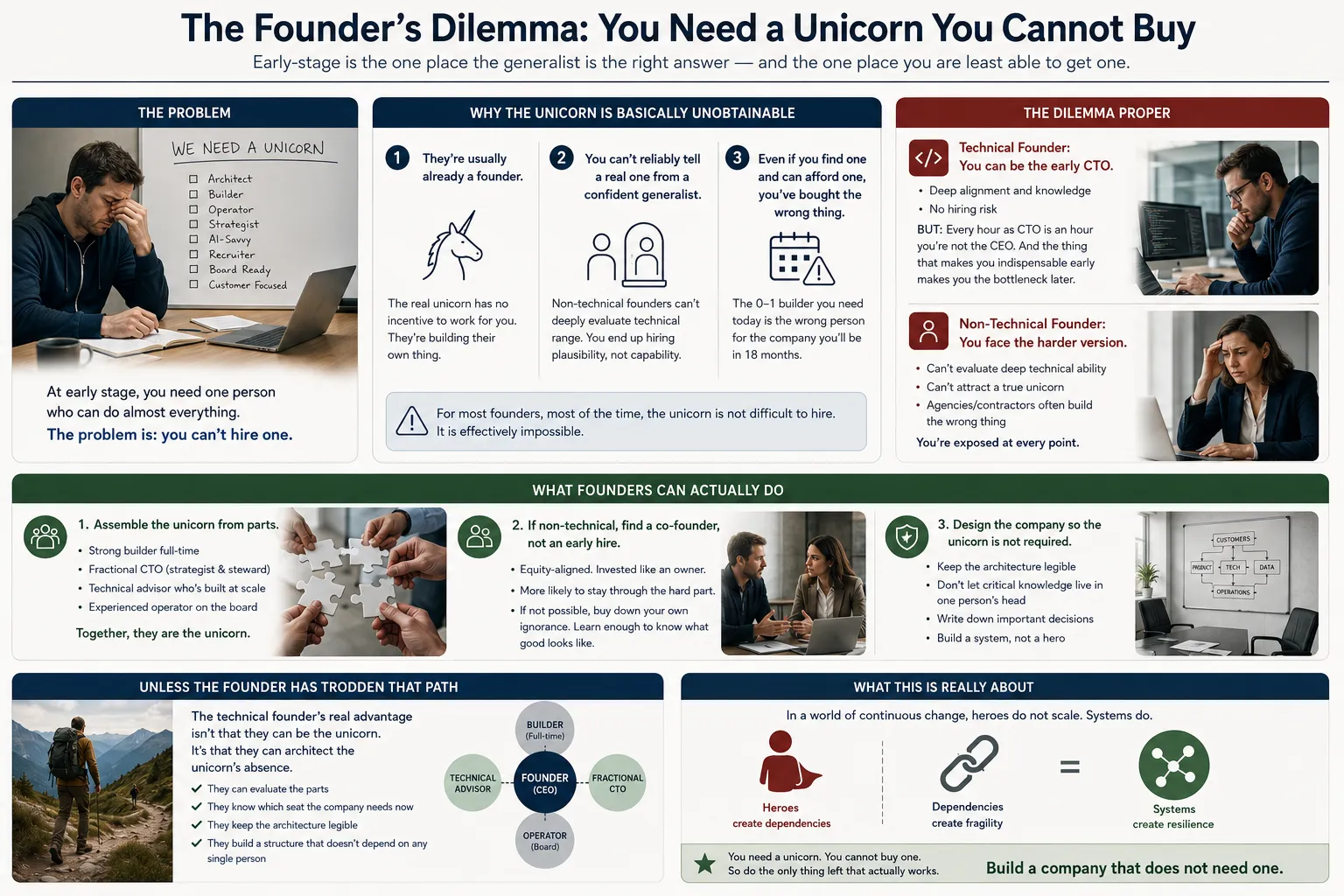
Early-stage is the one place the generalist is the right answer — and the one place you are least able to get one.
There is a particular look I have come to recognise on a founder’s face.
It usually arrives a few months after the company becomes real. The product needs to exist. Customers need to be talked to. The first engineers need to be hired and pointed in the right direction. Investors are asking about the technology roadmap. And somewhere in the middle of all of it sits a job nobody is doing — a job the founder can half-describe but cannot quite fill.
So they write a brief. And the brief, whether they realise it or not, is an advert for a unicorn. Someone who can architect the system and write the first version of it. Who can hire engineers and also recruit them. Who can sit with a customer in the morning and a board member in the afternoon. Who has a credible view on AI. Who is senior enough to lead and junior enough to still build.
They send it out into the market, and they wait.
I have sat on both sides of this. I have been the founder staring at that unfillable seat, and I have been the experienced hand brought in to sit in it. From both chairs, the same uncomfortable truth eventually becomes clear.
The founder is not wrong to want the unicorn.
They are simply wrong to believe they can hire one.
The Founder Is Right (And That Is the Cruel Part)
Most advice about this problem starts by telling the founder their expectations are unrealistic. That is the wrong place to start, because at the earliest stage, the expectation is correct.
Early-stage is the one and only moment in a company’s life where the all-in-one generalist is genuinely the right answer.
A larger company can — and should — split technology leadership into separate seats: a deep technologist, an operator who runs delivery, a strategist who talks to the board, a steward who owns risk, an evangelist who recruits, and now someone who holds the AI question. But a five-person company cannot carry five specialists. It needs one head that holds all of those concerns at once, because there is no one else to hold them.
So the founder’s instinct is sound. They really do need someone who can do almost everything, because at this size, almost everything lands on one desk.
The mistake is never the wanting. The mistake is believing the want can be satisfied by hiring.
Because the stage where you most need a unicorn is precisely the stage where you are least able to get one.
Why the Unicorn Is Basically Unobtainable
This is not bad luck. It is structural. Three forces work against the founder at once, and understanding them is the difference between waiting for a hire that will never come and doing something useful instead.
The real unicorn is usually already a founder. Think about who the genuine article actually is — a person who can architect, build, hire, sell, and lead, all in one head. That person has no structural reason to do all of that inside someone else’s company, for a salary and a thin slice of equity. They start their own thing. The market you are recruiting from has been quietly pre-drained of exactly the people you are looking for. The ones who remain are, disproportionately, the ones who could not or chose not to do it for themselves — which is not the same population you imagined when you wrote the brief.
You cannot reliably tell a real one from a confident generalist. This is the trap that catches non-technical founders hardest. To recognise genuine range across architecture, delivery, hiring, and strategy, you need to have enough depth yourself to test it. Most early founders do not have that instrument. So the process selects not for capability but for plausibility — the candidate who interviews well, has a confident opinion about everything, and uses the right words. You are not hiring a unicorn. You are hiring whoever is best at sounding like one.
Even if you find one and can afford one, you have bought the wrong thing. The 0-to-1 builder you need right now is the wrong person for the company you will be in eighteen months. The seat itself changes as you grow — the builder gives way to the operator gives way to the strategist. Hire a permanent, expensive, senior executive into a temporary seat and you have solved this quarter’s problem by creating next year’s. You have hired your Series-A problem early.
Put those three together and the conclusion is hard to avoid. For most founders, most of the time, the unicorn is not difficult to hire. It is effectively impossible.
The Dilemma Proper
This is where it becomes a genuine dilemma rather than a complaint — because the two ways out both have a cost, and which one you face depends entirely on whether you have trodden the technical path yourself.
If you are a technical founder, you can be the early CTO. You can sit in the seat yourself, and for a while that is the cleanest answer there is — no hiring risk, total alignment, deep knowledge of your own system. But every hour you spend being the CTO is an hour you are not being the CEO. You are not fundraising, not selling, not setting the vision only you can set. And you are walking, eyes open, straight into the trap that breaks so many founder-CTOs: you build the whole thing yourself, every critical decision routes through you, and when the company finally outgrows the seat, you cannot let go of it — because it is yours, and because no one else has ever been allowed near it. The thing that made you indispensable at five people makes you the bottleneck at fifty.
If you are a non-technical founder, you face the harder version. You must hire or partner for the one seat you are least equipped to evaluate. You cannot tell the real builder from the plausible one. You cannot attract a true unicorn, because they have better options. And the fallback — handing the build to an agency or a contractor — frequently produces something that ships on time, looks impressive in a demo, and is precisely the wrong thing, built on foundations you will spend two years tearing out. You are exposed at every point in the process, and the process knows it.
Neither branch is comfortable. But both become survivable the moment you stop trying to solve them by finding one perfect person.
What Founders Can Actually Do
The way out is not a better candidate. It is a different shape of solution.
Stop trying to hire the unicorn as a single person. Assemble it from parts. The capabilities you need do not have to live in one head — they have to be present, which is a different requirement. A strong builder full-time, who owns the code and the architecture. A fractional or part-time CTO who brings the strategist and steward judgement a few days a month. A technical advisor who has built at scale and will take your call. An experienced operator on the board as a non-executive. None of them is the unicorn. Together, they are. Assemble the creature from parts rather than waiting to find it whole.
If you are non-technical, look for a co-founder, not an early hire. The seat you cannot evaluate is the seat you most need someone to care about like an owner — and an employee, however senior, will leave when it gets hard. A technical co-founder is equity-aligned, emotionally invested, and far more likely to stay through the part where it stops being fun. That is worth more than a more impressive CV on a salary. And if a co-founder is not available, then spend real effort buying down your own ignorance — not enough to write the code, but enough to know what good looks like. You do not need to be technical to hire well. You need to be literate enough not to be fooled.
Design the company so the unicorn is not required. This is the same lesson the larger company has to learn, applied at seed. Keep the architecture legible. Refuse to let all the critical knowledge live in one person’s head — the single most common and most fatal early-stage failure. Write the important decisions down. Make the system the thing that holds the company together, not a hero. A company that only works while one irreplaceable person is present has not built a team. It has built a dependency with a desk.
Unless the Founder Has Trodden That Path
Here is the resolution, and it is not the one most people expect.
You might assume the technical founder’s advantage is that they can be the unicorn — that having walked the path, they can simply fill the seat themselves and skip the whole problem. That is the obvious reading, and it is wrong, because being the unicorn is the trap, not the escape.
The technical founder’s real advantage is subtler and far more valuable.
They can architect the unicorn’s absence.
Because they know the seats intimately, they can assemble the creature from parts and actually tell whether the parts are real. They can evaluate the builder they hire. They can judge which seat the company genuinely needs this quarter and which can wait. They can keep the architecture legible because they understand what legibility costs and why it pays. They have the one instrument the non-technical founder lacks — the ability to tell capability from performance — and they can use it not to do the job, but to build a structure that does not depend on any single person doing it.
The path does not make you the unicorn. It makes you the person who does not need one.
That is the quiet, transferable lesson for every founder who has not trodden it: your goal is not to acquire that instrument by becoming an engineer. It is to borrow it — through a co-founder, an advisor, a board — until your company is large enough to own it properly.
What This Is Really About
To be fair, the unicorn is not a complete myth. Occasionally a well-known, well-funded founder with the right network really does land one — and sometimes a technical co-founder genuinely is one. It happens. It is just not a plan you can rely on, any more than “win the lottery” is a retirement strategy. And the constellation model has its own limits worth naming plainly: a fractional CTO gives you judgement but not ownership, part-time attention but not skin in the game. Assembled parts are not a free substitute for a committed person — they are a bridge until you can afford the real thing.
But the deeper point stands, and it is the same law that governs the role itself once a company grows.
In a world of continuous change, heroes do not scale. Systems do.
The founder who survives this dilemma is not the one who finally finds the perfect person. It is the one who stops waiting for them — who accepts that the seat they cannot fill is a seat to be designed around, not a vacancy to be heroically filled.
You need a unicorn. You cannot buy one. So do the only thing left that actually works.
Build a company that does not need one.