Off Topic and Personal: The Annoyance and Delight of Being Human
Another personal one. Six weeks ago my hands staged a small rebellion — pompholyx, the itchiest eczema you have never heard of, which turned my own keyboard against me. On a word the ancients got poetically right and scientifically wrong, why heat and founder's stress are keeping a more honest diary than I am, the tool I built for one affliction that turned out to moonlight for another — and why, six weeks in, I am going back to the doctor. Please see a real one.
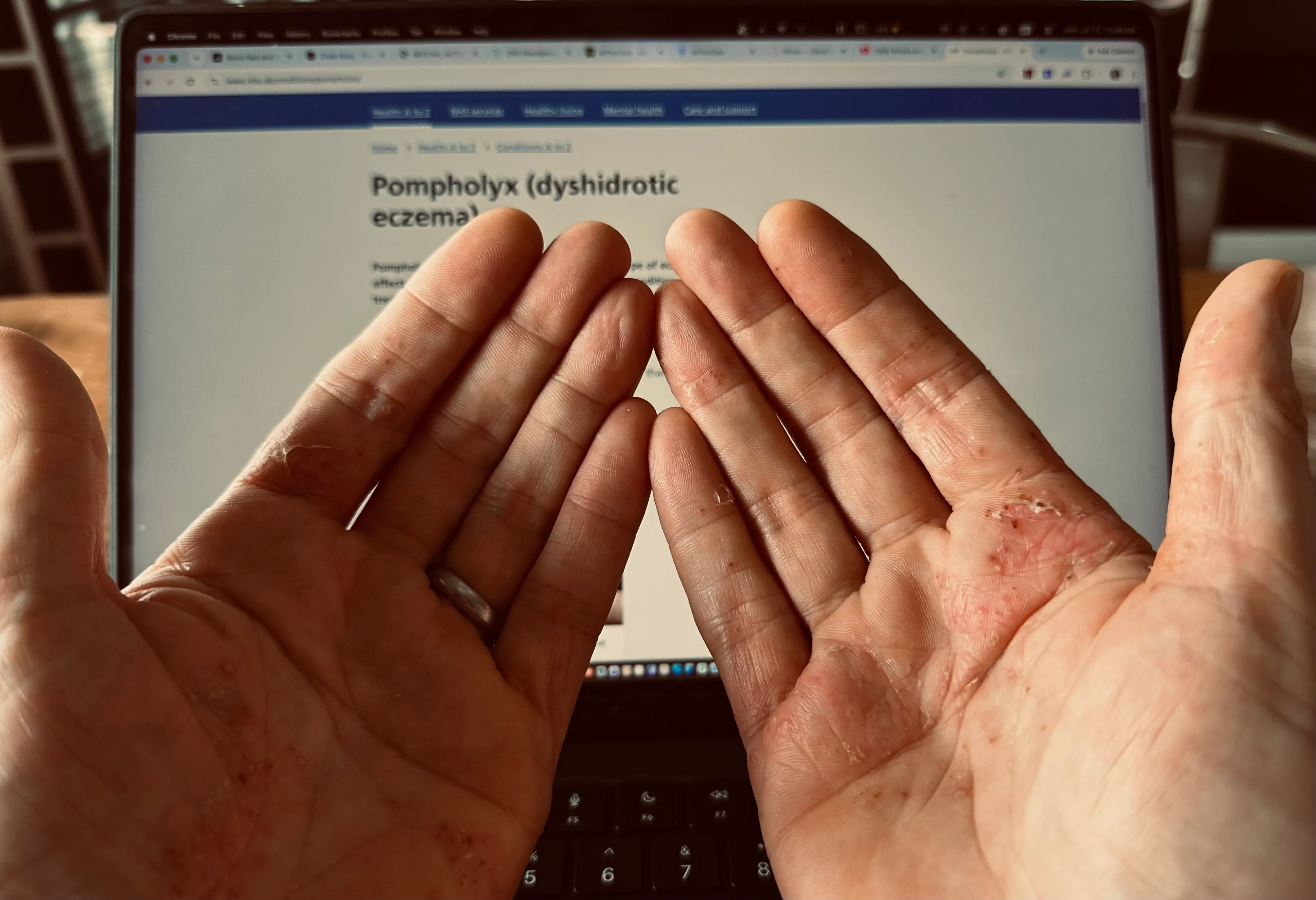
On the itchiest eczema you’ve never heard of, why it’s turned my own laptop against me, and why — six weeks in — I’m going back to the doctor.
There is a word — and I do love a word — that sounds like something a Victorian conjuror might pull from his hat with a flourish. Pompholyx. Say it aloud. Roll it about the mouth. It comes to us from the Greek pompholux, meaning “bubble,” and the ancients, who named it long before they had the faintest idea what it was, got the poetry exactly right even as they got the science entirely wrong. Because that is precisely what it is: bubbles. Tiny, maddening, gloriously misnamed bubbles that erupt along the sides of my fingers and across my palms with all the manners of an uninvited houseguest.
I am, as I write this, six weeks into hosting one. Six weeks. And I am typing about it. The irony is not lost on me — nor, more to the point, is the deadline it represents, but we’ll come to that.
What the extraordinary thing actually is
Pompholyx — or dyshidrotic eczema, if you prefer the white-coat name — is a variety of eczema that confines itself, with a specificity that would be admirable in almost any other context, to the hands and feet. Specifically the palms, the soles, and the tender flanks of the fingers. The first sign is not the blister but the warning of it: a burning, prickling heat beneath the skin, as though someone had lit a very small and very personal fire in the dermis. Then come the vesicles — clusters of clear, fluid-filled beads, deep-set, itchy beyond all reason and, crucially, sitting under skin far too thick to pop, which is the universe’s idea of a practical joke. An episode is supposed to run its course in two or three weeks: the bubbles rise, they weep, they dry, they crack, and the skin peels away like old paint. Then, if you are lucky, peace. Until the next time.
Mine, I should tell you, did not read the manual. Six weeks and counting is roughly double the textbook length — and that fact, unglamorous as it is, is precisely the point at which a sensible person stops nodding along to a webpage and books an actual appointment. More on that below, because it matters more than anything else in this piece.
And there is almost always a next time. This is the part they tell you gently. It is, for most of us, a recurring condition rather than a curable one — a tenant with a very long lease. But — and here is the wonder of it — it is manageable, and understanding it robs it of most of its menace.
Why me, why here, why now
Here is where the biology becomes genuinely fascinating, in that grand way that a distant supernova is fascinating right up until it is happening to your own solar system. Nobody knows the single cause of pompholyx, because there isn’t one. It is an amalgamation — a confluence of triggers, each pouring into the same small reservoir until it overflows. And in my case the two great tributaries are almost comically easy to name.
The first is heat. I first met these bubbles three and a half years ago, when I moved to Singapore — a city I adore, built one degree north of the equator inside what is essentially a warm, wet greenhouse. Heat and sweat are documented aggravators of pompholyx, and Singapore serves both in tropical abundance. I have since decamped to Bangkok, which, if anything, has taken one look at Singapore’s climate and said “hold my drink.” The sweat glands of the palms and soles are among the busiest in the body, and when the mercury climbs they work overtime. My skin, it seems, files a formal complaint.
The second tributary is stress — and here I must be honest with you, dear reader, because there is no dignity in pretending otherwise. I am a founder. Founder’s stress is a particular vintage: however serenely one manages it on the outside, however calm the Zoom face, the pressure underneath is real and it is high. Psychological stress is one of the best-documented triggers of this condition. My hands, it turns out, are keeping a more honest diary than I am.
Heat plus stress. A tropical greenhouse plus a start-up. The bubbles were, in retrospect, almost inevitable.
My hands are keeping a more honest diary than I am.
Why the computer became my enemy
You may wonder why a rash on the fingers should be worth an entire essay. Consider, then, what the modern knowledge-worker actually does all day: he presses ten fingertips against a machine, several thousand times an hour. The keyboard, that faithful servant, becomes an instrument of exquisite low-grade torment. Each keystroke lands on precisely the skin that least wishes to be landed upon. The mouse is a small furnace warming an already-inflamed palm. Typing my own name becomes a negotiation.
There is, mind you, an unexpected ally in all this, and it delights me that it should be the very same technology causing half the trouble. Voice-to-text has been — dare I say it — something close to a rescue. When each keystroke is a small negotiation, the simple act of speaking one’s words onto the page feels like cheating in the most wonderful way. And here the founder’s curse turns quietly into a founder’s gift: I built my own tool for exactly this — a little dictation-and-annotation helper — because I also carry a mild dyslexia, and marking up text by hand has never been my friend. It was born to smooth over the dyslexia; it turns out to be just as kind to a pair of blistered hands. A tool made for one affliction, moonlighting for another. I find that rather beautiful.
Which is why I will say — quietly, superstitiously, touching every piece of wood within reach — that I count myself lucky it has stayed on my hands and spared my feet. May I not speak too quickly. To have this on the soles, to press it fresh into the floor with every single step, to carry it about all day beneath one’s own weight — that is a torment of a different order. I have my inconvenience. I do not, thank heaven, have that one. Yet.
What to actually do about it
Now, I did what any curious modern creature would do. I typed my symptoms into a chatbot — yes, one much like the very sort you may be using to read this — and it gave me a tidy, confident, largely-correct little summary. Reader, do not stop there. Please, please see a real dermatologist. An online tool can hand you a plausible answer, and it may even be the right one, but it cannot look at your skin, rule out the infection hiding in a scratched blister, or tell your pompholyx apart from the fungal impostor that mimics it. I was formally diagnosed in Singapore at the National Skin Centre by a genuinely wonderful, deeply skilled doctor — and to that doctor, and that clinic, I remain quietly and sincerely grateful. That diagnosis was worth more than a thousand search results.
And here is the lesson landing in real time, on my own hands: this is the flare that has now outstayed the textbook by a full three weeks. A flare that refuses to settle on the usual routine is not a failure of willpower and it is not a thing to simply endure — it is the skin’s way of saying the plan needs changing. Perhaps the treatment needs stepping up. Perhaps a scratched blister has quietly turned into an infection. Perhaps there’s a contact trigger I haven’t spotted. A search box cannot tell me which; a dermatologist can. So back I go — and if your own flare has outlasted its welcome, or if any blister looks red, hot, crusted or is weeping yellow, you should go too, and promptly.
With that firmly established, the sensible measures are these. Moisturise relentlessly — a bland, fragrance-free emollient, applied more often than feels reasonable, is the unglamorous foundation of everything. For a flare, a doctor will typically prescribe a topical steroid to calm the fire, and for weeping skin, cool soaks (potassium permanganate is a classic) help it dry and settle. Keep the water lukewarm, never hot. Guard your hands from soaps, detergents and solvents; wear cotton or bamboo gloves for wet or dirty work. Stay as cool as the tropics permit. And treat the stress not as a character flaw but as a genuine input variable — because your skin, it turns out, is reading the spreadsheet over your shoulder.
The small consolation
There is a certain grace in a condition that writes your life back to you in a language you can’t ignore. My hands tell me when I am too hot and too wound-up, with a candour my calendar never manages. I would not have chosen them as my messengers. But I have learned to read the message — and, most of the time, to answer it.
And that, I think, is the whole of it — the annoyance and the delight of being human, arriving in the same envelope. A body that betrays you and informs you in the same gesture. The itch that will not be reasoned with, and the astonishing fact that skin knits itself quietly back together anyway, without being asked, while you sleep. We are marvellous and we are inconvenient, and I have never been able to decide which of the two I find more moving.
The bubbles will pass. They always do. And in two or three weeks the skin will knit itself quietly back together, as skin miraculously does, ready to begin the whole absurd cycle again.
Until then, I shall keep typing. Gently.
A necessary word of caution: this is one person’s experience wrapped around some general information, and nothing more. It is not medical advice. Online tools — chatbots very much included — can suggest one thing or another with great confidence and still be wrong about you specifically. If you have skin that blisters, itches, cracks, or simply worries you, see your GP or a dermatologist. A real one. Let a professional who can actually examine your skin make the call.
Useful links
For those who wish to read further — from reputable sources, not the comment section of the internet:
- NHS — Pompholyx — plain, trustworthy overview of symptoms, triggers and treatment.
- National Eczema Society (UK) — Pompholyx / dyshidrotic eczema — thorough factsheet with practical self-care advice.
- Cleveland Clinic — Dyshidrotic Eczema — clear clinical explainer, well pitched for the curious layperson.
- Harvard Health — Dyshidrotic eczema — management strategies — sensible, evidence-based tips for keeping flares in check.
- DermNet — Pompholyx — dermatologist-authored reference, with clinical photographs if you want to compare notes.
- National Skin Centre, Singapore — where I was diagnosed, and where I’d send anyone in the region without hesitation.
- Institute of Dermatology, Bangkok — Thailand’s national dermatology institute, for fellow BKK sufferers looking for a specialist.