Why Philosophy Is the Backbone of Critical Thinking in the Age of AI
In 1995 the smartest person in the room was often the one who knew the most. In 2026 that advantage has largely gone. AI hasn't made thinking unnecessary — it has made bad thinking harder to detect. As answers become abundant their value falls, and what rises is the ability to evaluate them. That ability has a name philosophy has used for two thousand years — judgment — and this is the case that philosophy isn't adjacent to critical thinking but its origin and infrastructure, and the single most valuable cognitive skill left when intelligence becomes artificial.

Introduction
In 1995, the smartest person in the room was often the person who knew the most.
In 2026, that advantage has largely disappeared.
Every student, manager, engineer, founder, and policymaker now carries a machine capable of generating explanations, arguments, reports, plans, and opinions in seconds. The problem is that these systems can produce the appearance of understanding far faster than they can produce understanding itself.
AI has not made thinking unnecessary. It has made bad thinking harder to detect.
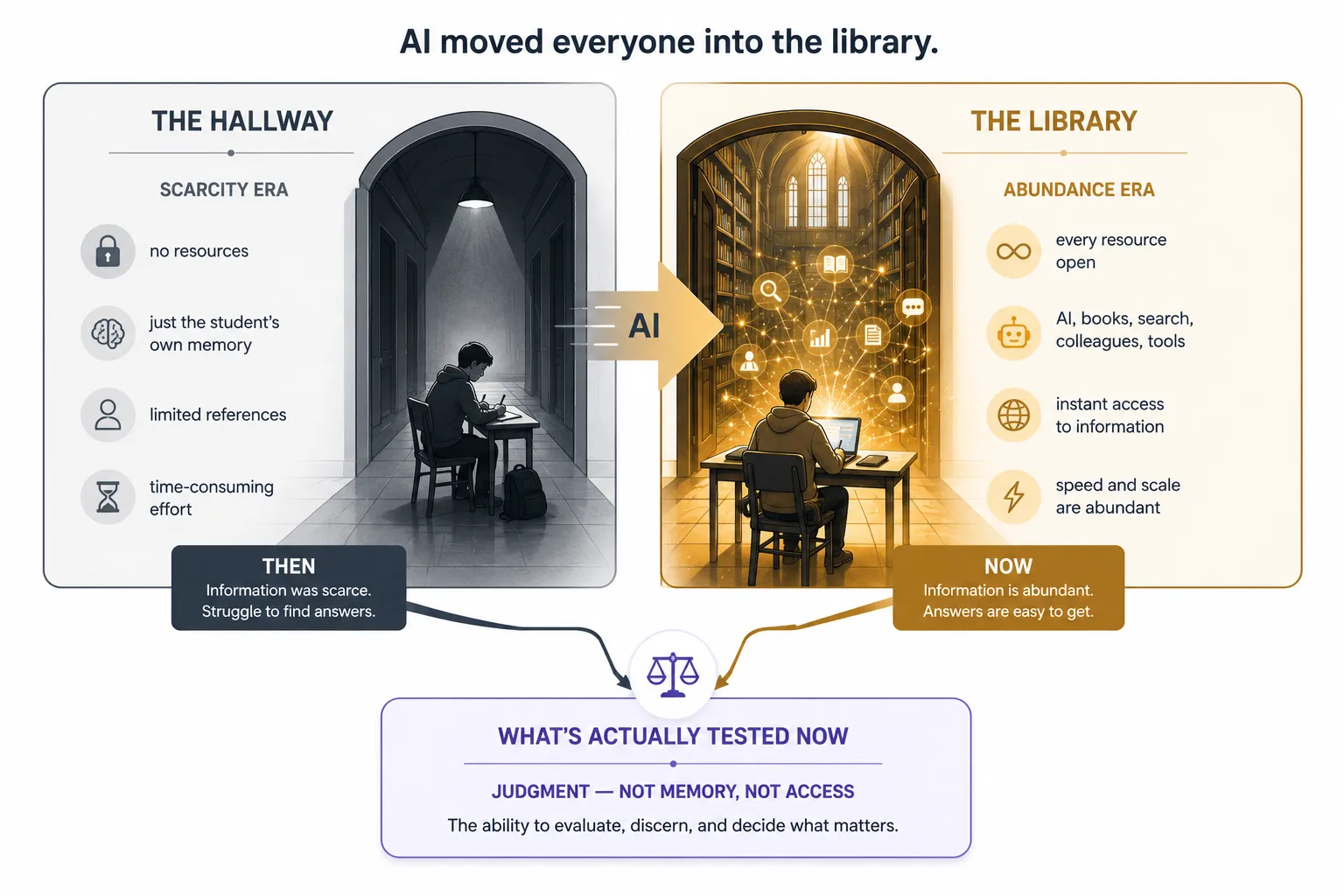
As artificial intelligence makes answers abundant, the value of answers falls. What rises in value is the ability to evaluate them. That ability has a name. For more than two thousand years, philosophy has called it judgment.
This article makes a specific case: that philosophy is not adjacent to critical thinking — it is the origin and infrastructure of critical thinking — and that in an age where AI can generate answers faster than we can generate questions, the philosophical habits of mind are becoming the single most valuable cognitive skill a person can have.
Part One: Every Information Revolution Creates a Judgment Crisis
To understand why this moment is different, it helps to see that it isn’t the first moment like this. Humanity has been here before, repeatedly, and each time the shape of the crisis was the same.
Writing reduced reliance on memory. Once ideas could be recorded, a person no longer needed to hold an entire oral tradition in their head to participate in it — but this also meant anyone could write something down and claim it as authoritative, whether or not it deserved to be. The printing press reduced reliance on local authorities, scattering texts far beyond the reach of any single priest or scholar who might have filtered them — and also scattered pamphlets, propaganda, and confidently wrong medical advice at the same volume as anything true. Newspapers industrialized opinion, delivering daily interpretation to mass audiences. Radio amplified persuasion through the sheer intimacy of a voice in your home. Television amplified narrative, teaching entire populations to trust whatever looked and sounded credible on screen. The internet amplified information itself, collapsing the cost of publishing to nearly zero. And now AI amplifies reasoning — or at least its surface — generating the texture of an argument, a summary, or an analysis on demand.
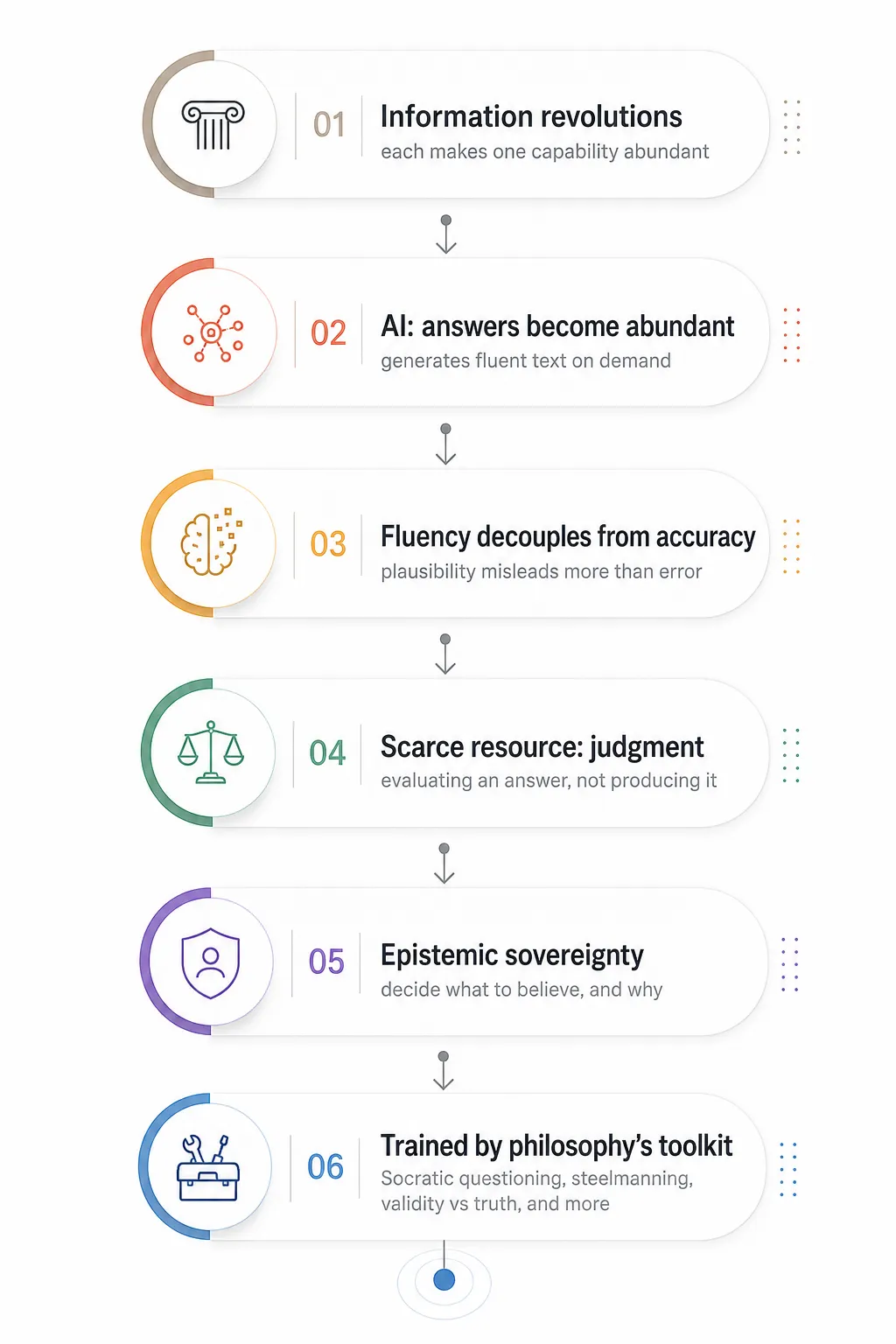
Each leap democratized a scarce capability. Writing democratized memory. Printing democratized knowledge. Broadcast democratized reach. Search democratized access. AI democratizes explanation.
And each time, the same pattern followed: whatever capability just became abundant stopped being the differentiator between people, and something else — usually harder to name, harder to teach, and harder to fake — became the new scarce resource. When memory became externalized through writing, the differentiator became the ability to interpret a text rather than simply recite it. When knowledge became cheap through printing, the differentiator became the ability to tell a sound argument from a persuasive pamphlet. When information became free through the internet, the differentiator became the ability to filter signal from noise.
In the age of AI, judgment becomes that resource. Not the ability to produce an answer — the machine does that — but the ability to know whether the answer produced is any good, what it’s built on, and what it’s quietly leaving out. This isn’t a new kind of problem. It’s the oldest problem in human cognition, arriving again in a new costume, at a scale and speed no previous revolution came close to matching.
Part Two: What Critical Thinking Actually Is (And Isn’t)
Before going further, it’s worth being honest about what critical thinking means, because the phrase has been worn smooth by overuse — a resume line, a syllabus objective, a slide in a corporate values deck — usually stripped of real content.
Critical thinking is not simply “thinking hard,” “being skeptical of everything,” or “having strong opinions.” Each of those is a common misreading, and each is actually a failure mode dressed up as the real thing. Thinking hard without structure often just produces elaborate rationalization; smart people are frequently the best at constructing sophisticated justifications for conclusions they reached emotionally. Blanket skepticism isn’t critical thinking either — it’s a pose that lets someone reject any inconvenient claim while committing to nothing themselves. And strong opinions are orthogonal to critical thinking entirely: you can hold a strong opinion reached through careful reasoning, or one absorbed wholesale from a feed. The strength tells you nothing about the process behind it.
Real critical thinking has identifiable components, and each one turns out to have a philosophical name and a philosophical history.
Distinguishing validity from truth. An argument can be logically airtight and still rest on a false premise; it can also rest on true premises and still fail to follow logically. Critical thinking holds these two axes — structure and accuracy — as separate questions, evaluated separately. This is the founding move of formal logic, a discipline invented by philosophers.
Identifying and examining assumptions. Every claim rests on assumptions usually invisible to the person making them. Critical thinking surfaces what’s being taken for granted and asks whether it deserves to be — the exact method Socrates used in the streets of Athens, and still the sharpest tool we have for locating what we don’t actually know.
Steelmanning before rejecting. Genuine critical thinking represents an opposing position in its strongest form before arguing against it, not its weakest. This discipline comes directly from the tradition of dialectic, where ideas are refined against their best available counterarguments, not their worst.
Tolerating unresolved uncertainty. Critical thinkers can hold a question open — “I don’t know yet, and here’s what would change my mind” — without ambiguity forcing a premature answer. Epistemology, the philosophy of knowledge, exists to formalize exactly this distinction.
Recognizing the difference between coherence and correctness. A story can hang together perfectly, every part fitting every other part, and still be entirely wrong about the world. Human beings are exceptionally good at building coherent narratives and comparatively bad at checking whether those narratives correspond to reality. Philosophy, especially in its analytic tradition, exists largely to hunt for the gap between the two.
None of these five is a personality trait. None is innate. All are trained capacities — and all were first systematized, named, and taught by philosophers. The phrase “critical thinking” isn’t its own subject. It’s philosophy with the branding removed.
Part Three: Philosophy Is Not a Body of Opinions — It’s a Method
Most people encounter philosophy, if at all, as a list of famous names and their positions: Descartes doubted everything, Kant believed in universal moral duties, Nietzsche declared God dead. Presented this way, philosophy looks like a museum of settled opinions — interesting trivia, not a living skill.
This framing misses the point almost entirely. The specific positions various thinkers held matter far less than the method by which those positions were reached, tested, and often overturned. Philosophy is not a catalog of answers. It’s the oldest continuously operating laboratory for how to ask questions and evaluate answers.
Strip away the jargon and philosophers spend their time: taking a claim that seems obviously true and finding where it breaks; taking two positions that seem to obviously conflict and checking whether they actually do, or whether the conflict is a trick of language; taking a word everyone uses confidently — “justice,” “freedom,” “knowledge,” “intelligence” — and showing that no one, including the speaker, has a clear account of what it means; constructing a scenario designed to isolate one variable in our intuitions and testing whether it survives; following a position’s logical consequences to their end, even an uncomfortable one, to see whether it can actually be held consistently.
This is a rigorous, transferable method for stress-testing ideas, and it works exactly as well on a business strategy, a hiring decision, an AI-generated summary, or a line of code as it does on the question of free will. An engineer doing rigorous root-cause analysis — refusing the first plausible explanation, tracing failure back through its actual causal chain rather than a convenient story, distinguishing correlation from cause — is doing philosophy, whether or not they’d call it that.
Part Four: Epistemic Sovereignty
There’s a concept that ties all of this together, and it deserves a name of its own: epistemic sovereignty.
Political sovereignty is the capacity of a nation to govern itself — to set its own laws rather than have them imposed from outside. Epistemic sovereignty is the equivalent capacity for a mind: the ability to decide what to believe, why to believe it, and what evidence would change that belief. It is self-governance applied to cognition rather than territory.
A person without epistemic sovereignty isn’t necessarily uninformed — they may consume enormous amounts of information. What they lack is an internal process for evaluating it. They believe what the most recent, most fluent, or most confidently delivered source told them, and their beliefs shift with whichever source spoke last and most persuasively. This isn’t a character flaw; it’s the default condition for anyone who hasn’t specifically trained the alternative, because outsourcing judgment to an authority is cognitively cheaper than doing the evaluative work yourself.
Historically, the authorities people outsourced judgment to were priests, monarchs, newspapers, or television anchors. Today they are increasingly algorithms — recommendation engines, search rankings, and now conversational AI systems that don’t just surface information but actively synthesize it into a finished-sounding conclusion. The mechanism hasn’t changed. Only the authority has, and this new authority is faster, more personalized, and more convincingly fluent than any of its predecessors.
Epistemic sovereignty doesn’t mean distrusting every external source — that would just be a different form of dependency, dependency on your own reflexive doubt. It means maintaining your own standards for what counts as good evidence, your own record of what you actually believe and why, and your own willingness to update that belief only when it’s actually warranted, rather than whenever the most recent confident voice suggests it. It is, in short, the practical, everyday output of a philosophically trained mind. And it is exactly the capacity that matters most when the confident voice in question is a machine that can generate a plausible-sounding case for nearly anything, on demand, tailored to whoever’s listening.
Part Five: What Cognitive Science Adds
Philosophy makes the normative case — how reasoning should work. Modern cognitive science supplies the mechanism — why human reasoning actually tends to go wrong, and why the philosophical discipline described above doesn’t come for free.
Daniel Kahneman’s distinction between System 1 and System 2 thinking is the starting point: System 1 is fast, automatic, intuitive, and pattern-matching; System 2 is slow, effortful, and deliberate. Most of daily cognition runs on System 1, which is efficient but highly susceptible to being hijacked by surface cues — fluency, confidence, familiarity — rather than by underlying accuracy. Philosophical reasoning is, almost by definition, an exercise in deliberately engaging System 2 at the exact moments System 1 wants to settle for a comfortable-sounding answer.
Philip Tetlock’s decades of research on forecasting adds a second piece: judgment quality is measurable, trainable, and highly uneven even among credentialed experts. His work on “superforecasters” found that the people who predict real-world outcomes most accurately share habits that map directly onto the philosophical toolkit — breaking big questions into smaller checkable ones, actively seeking disconfirming evidence, holding beliefs in explicit probabilities rather than binary certainties, and revising those probabilities incrementally as new evidence arrives. Good judgment, in other words, isn’t a talent some people simply have. It’s a discipline that can be specified and taught.
Jonathan Haidt’s research on moral psychology adds a humbling third piece: intuition typically arrives before reasoning, not after. People tend to feel a conclusion first and then construct the justification for it afterward, experiencing the whole sequence as if the reasoning came first. This is precisely why the philosophical habit of steelmanning an opposing view — deliberately, effortfully, before rejecting it — matters so much: it’s a corrective procedure for a mind that is otherwise wired to rationalize its gut reaction rather than examine it.
And Keith Stanovich’s distinction between intelligence and rationality closes the loop: raw cognitive horsepower and good judgment are measurably different things, and a high score on one doesn’t guarantee a high score on the other. Highly intelligent people are, if anything, often better at constructing sophisticated-sounding justifications for conclusions they reached badly — a phenomenon Stanovich calls “dysrationalia.” Intelligence supplies the capacity to reason; it does not supply the discipline to reason well. That discipline is trained separately, and it is what philosophy has always specifically trained.
Taken together, this research doesn’t compete with the philosophical case — it grounds it. It confirms that critical thinking is not an innate trait some people are lucky enough to have. It’s a specific, learnable override of default cognitive tendencies that otherwise favor speed, comfort, and confidence over accuracy.
It’s worth pausing on why this convergence matters, because it answers a skeptical question that naturally arises: if philosophy is really just describing what cognitive science later measured, why credit the older, less rigorous discipline at all? The answer is that philosophy supplied the map decades or centuries before science supplied the instruments to survey the territory. Aristotle’s catalog of logical fallacies described patterns of bad inference that Kahneman’s experiments would later quantify in a lab. The Pyrrhonist skeptics of ancient Greece built an entire practice around suspending judgment in the face of insufficient evidence — centuries before Tetlock would show, empirically, that calibrated uncertainty outperforms false confidence in forecasting competitions. Descartes’s method of systematic doubt, stripping away every belief that could possibly be questioned to find what remained, anticipated by three hundred years the finding that unexamined intuitions are a poor foundation for reliable belief. This is not coincidence. It’s what happens when a discipline spends two thousand years doing nothing but interrogating how minds go wrong; it eventually notices the same failure modes that instrumentation would later confirm.
There’s a further, more uncomfortable implication in this research worth naming directly: knowing about these biases does not make a person immune to them. Kahneman himself, after a career spent cataloguing cognitive biases, wrote candidly about still falling for many of them in his own daily judgment. This rules out the tempting shortcut of treating critical thinking as a piece of trivia learned once — “oh right, confirmation bias, got it” — and then considered handled. The philosophical tradition never treated its own method this way. Socratic questioning, steelmanning, reflective equilibrium — these are described in the source texts not as facts to be learned but as practices to be repeated indefinitely, precisely because the underlying cognitive tendencies they correct for don’t go away just because you’ve read about them. A person who has memorized the term “confirmation bias” and a person who has actually built the standing habit of searching out disconfirming evidence before settling on a conclusion are not in the same position, even though both would answer a quiz question about the bias identically. That gap is exactly what philosophy’s emphasis on practiced method, rather than acquired information, is built to close — and it’s the same gap that determines whether a person actually benefits from knowing an AI-generated answer might be fluent without being right, or merely nods along to the idea in the abstract while still trusting the next confident paragraph they read.
Part Six: Why the AI Risk Is Sharper Than It Looks
There’s a lazy version of the AI-critical-thinking argument that goes: “AI is risky because it sometimes gets things wrong.” That’s true, but it understates the actual problem and makes it sound like a bug that better models will eventually fix.
The deeper issue is not that AI is frequently wrong. It’s that it is frequently plausible — and plausibility, not accuracy, is what human cognition is actually built to detect.
Human beings did not evolve to evaluate probability distributions or statistical confidence intervals. We evolved to evaluate people. Over hundreds of thousands of years, the traits that reliably signaled trustworthy information were things like tone of voice, confidence, coherence, social standing, and fluency — because, for nearly all of human history, those traits correlated reasonably well with actual competence. A person who spoke fluently and confidently about hunting, medicine, or navigation usually did so because they’d earned that fluency through real experience. Confidence was a rough but usable proxy for expertise, because faking sustained fluency without underlying knowledge was hard and got exposed quickly in a small, repeated social environment.
AI breaks that correlation completely, and it does so at exactly the surface level our instincts are calibrated to trust. A language model can produce fluent, structured, confident, technically-worded text regardless of whether the underlying claim is accurate — because it is optimized to produce plausible-sounding continuations, not verified ones. The tone that used to be earned through real competence can now be generated instantly, with no competence requirement attached. Our instinct to trust coherence, confidence, and fluency as signals of underlying expertise doesn’t turn off just because we know, intellectually, that we’re talking to a machine. It’s a reflex, not a belief, and reflexes don’t update on being told they’re outdated.
This is why the philosophical habit of separating how something is said from what is actually being claimed and whether it’s justified is no longer an academic nicety. It is the specific cognitive override required to compensate for an evolved trust heuristic that AI has rendered unreliable. The danger isn’t that the machine lies. It’s that it never has to, in order to mislead — it simply never distinguishes between what it has verified and what it is fluently pattern-matching, and our instincts were never built to make that distinction for it.
Part Seven: Why Boards Are Buying Judgment, Not Information
This has direct, practical stakes for founders, operators, and investors — not just as citizens navigating information, but as decision-makers running organizations.
A modern CEO can obtain information almost instantly. Revenue forecasts, competitor analysis, legal summaries, customer sentiment, and technical recommendations can all be generated in minutes by tools that didn’t exist five years ago. Information acquisition, which used to require analysts, consultants, and weeks of research, has been substantially commoditized.
This changes what a board, an investor, or a team actually needs from the person at the top. The board does not need another source of information — it can generate that itself. What it needs is someone capable of deciding which information matters, which recommendation is actually sound versus merely well-formatted, and which confident-sounding forecast is built on a real signal versus a plausible extrapolation. The defining executive skill of the AI era is not knowledge acquisition. It is judgment under uncertainty — the capacity to look at ten AI-generated options that all sound equally reasonable and know which one actually deserves to be trusted, and why.
This reframes what founders are actually building and what investors are actually betting on. A founder who can generate a fluent strategy deck is no longer differentiated — that capability is now cheap and universal. A founder who can tell the difference between a strategy that sounds coherent and one that will actually survive contact with the market is differentiated, because that judgment doesn’t come from the tool; it comes from the operator. Investors, similarly, are no longer primarily buying access to information about a market or a team — diligence data is more available than ever. They are buying a bet on a specific person’s or team’s judgment, exercised repeatedly, under conditions where the easy, fluent, AI-assisted path and the correct path are not always the same path. In a market where everyone has access to the same tools, judgment is the only remaining differentiator, which means it is, increasingly, the actual product being evaluated at every stage — hiring, fundraising, and strategy alike.
This plays out concretely in a handful of recurring situations. A founder using an AI model to stress-test a go-to-market plan will often get back a confident, well-organized case for whichever framing they fed the model — because the model is completing a pattern, not independently verifying a market. The founder who treats that output as settled analysis has outsourced the decision to a system with no actual stake in whether the plan works. The founder who treats it as a first draft of an argument — then asks what assumption the whole case rests on, what the strongest counter-scenario looks like, and what specific evidence would prove the plan wrong within the first ninety days — is doing exactly the philosophical work described earlier in this piece, applied to a cap table instead of a syllogism. The tool accelerates the drafting. It does not do the judging. That distinction is the entire difference between a strategy that survives a board meeting and one that merely sounds like it would.
The same logic applies to technical decisions. An engineering leader can now get an AI system to produce a confident-sounding architecture recommendation, a security assessment, or a migration plan in minutes — complete with structured tradeoffs and a decisive final recommendation. The recommendation will often be reasonable. It will occasionally be subtly wrong in a way that only becomes visible under a load pattern, an edge case, or an organizational constraint the model was never given enough context to weigh. The leader who ships the recommendation unexamined has substituted fluency for verification. The leader who asks “what would have to be true about our actual traffic, team, and constraints for this to be the right call — and is it?” is exercising precisely the kind of assumption-testing philosophy has always specialized in, at the exact moment it’s needed most: not when information is scarce, but when a plausible-sounding answer is sitting right there, asking to be accepted without further work.
Investors face a parallel version of the same problem at the portfolio level. AI tools can now generate market sizing, competitive landscapes, and financial projections for a startup faster than any analyst could produce them by hand — which means an investor’s edge no longer comes from having better raw data than anyone else, since everyone increasingly has access to the same generative tools pointed at the same public information. The edge comes from knowing which of the generated numbers deserve scrutiny, which market-sizing assumption is quietly doing all the persuasive work in an otherwise polished memo, and which founder’s confident answer to a hard question is actually backed by lived experience versus a well-rehearsed, possibly AI-assisted narrative. This is judgment exercised under uncertainty with real capital on the line, and it is not a skill that improves by having more information delivered faster. It improves by practicing exactly the habits described throughout this piece — separating validity from truth, steelmanning the bear case before dismissing it, and refusing to let a confident-sounding deck substitute for an actually interrogated one.
Part Eight: Philosophy’s Toolkit, Applied
It’s worth making all of this concrete. Philosophy isn’t one skill — it’s a toolkit refined over millennia. A few of the most load-bearing tools, and what they look like in ordinary use:
Socratic questioning — the relentless pursuit of “why” and “what do you mean by that,” aimed at exposing hidden assumptions. In practice: asking “what would have to be true for this to be correct?” before accepting a claim from a colleague, an article, or an AI system.
Validity vs. soundness — separating whether an argument’s structure is valid from whether its premises are true. In practice: when a case is persuasive, asking separately whether the conclusion follows from what’s been said, and whether what’s been said is actually accurate.
Steelmanning — constructing the strongest version of a position before rejecting it. In practice: before dismissing a critique or a competing plan, restating it in the form its most thoughtful defender would recognize as fair.
Occam’s Razor and its limits — preferring simpler explanations only among those that already fit the evidence equally well, never as a license for unearned simplicity. In practice: resisting both needless complexity and convenient oversimplification when diagnosing a failure.
Category distinctions — noticing when an argument quietly slides between different senses of the same word. In practice: recognizing when a disagreement is actually about definitions rather than facts — a large share of arguments, traced back far enough, turn out to be exactly this.
Thought experiments as isolation tools — constructing a deliberately extreme scenario to test whether an intuition or rule survives at its logical limit. In practice: asking “would I still endorse this policy taken to its extreme?” as a test of whether it’s well-formed or just convenient in the ordinary case.
Reflective equilibrium — the ongoing process of adjusting general principles and specific judgments against each other until they cohere. In practice: this is how any person or organization actually refines its values over time, whether or not it uses the term.
None of this requires a philosophy degree. It requires deliberate practice, the same as any other trained cognitive skill — and every one of these tools was developed, named, and handed down by the philosophical tradition specifically because rigorous thinking about thinking has always been philosophy’s actual subject.
Part Nine: The Objection — “Isn’t This Just Science, or Just Common Sense?”
A fair challenge: why credit philosophy specifically? Isn’t rigorous reasoning also what science teaches, or what any thoughtful, well-educated person eventually picks up regardless of label?
Science does teach rigorous reasoning — hypothesis testing, controlled variables, updating on evidence — but its method targets empirical claims about the natural world. It has comparatively little to say about ambiguous, value-laden, or definitional questions, which make up an enormous share of the decisions people actually face: what counts as a fair outcome, what “safe” or “intelligent” really means in a given context, whether an action is justified. These are exactly philosophy’s specialty, and exactly where a purely scientific training leaves people under-equipped, because no experiment settles them.
As for “common sense” — the history of philosophy is, in large part, a history of common sense turning out to be wrong or incoherent once examined closely. Common sense once held that the sun orbits the earth, that some humans were naturally suited to servitude, that a “just” arrangement was simply whatever the existing order happened to be. Common sense is an excellent starting point and a poor final authority; it’s precisely the thing that needs testing, not the thing that does the testing. Philosophy is the discipline built around subjecting common sense to exactly that kind of scrutiny.
So the honest answer is: other disciplines contribute pieces of critical thinking, but philosophy is the discipline that made the evaluation of reasoning itself its explicit, systematic subject matter — not reasoning about the physical world or about numbers, but reasoning about reasoning. That makes it foundational, even when its fingerprints show up unlabeled in a physics classroom, a courtroom, or a boardroom.
Part Ten: What This Looks Like in Practice, Right Now
When reading an AI-generated summary of a complex topic, a philosophically-trained reader asks what it’s quietly leaving out, and whether the conclusion would change if that omitted part were included.
When using an AI tool to help make a decision — a strategy, an architecture choice, a hire — a philosophically-trained user separates “does this recommendation follow from the stated goals” from “are the stated goals themselves the right ones,” rather than accepting both bundled together.
When two AI-generated arguments reach opposite conclusions, which happens constantly since the same system can argue either side given a different prompt, a philosophically-trained thinker doesn’t default to whichever conclusion is more comfortable. They ask what evidence would actually distinguish the two, and go find it.
When a piece of AI-generated content leans on a word doing heavy persuasive work — “natural,” “efficient,” “optimal,” “safe” — a philosophically-trained reader pauses there specifically, because vague, positively-loaded terms are exactly where unexamined assumptions hide.
None of this requires distrust of AI as a categorical stance, and it shouldn’t tip into that. Used well, these tools are a genuine extension of human reasoning capacity. The philosophical habit isn’t opposition to the tool — it’s refusal to let the tool’s fluency substitute for the user’s own judgment. That is precisely the distinction philosophy has always drawn between rhetoric and reasoning, between persuasion and proof.
Conclusion
For centuries, education treated knowledge as the scarce resource. We built schools around remembering facts because facts were genuinely difficult to obtain, and the person who held the most of them held a real advantage.
AI changes that equation permanently. The question is no longer can you find an answer. It is can you recognize a good one.
That is not a technical challenge. It is a philosophical one, and it always has been — philosophy simply hadn’t yet been handed a machine capable of generating a thousand plausible-sounding wrong answers for every ten minutes it used to take a person to construct one.
The people who thrive in the coming decades will not necessarily be those with the most information, or even the most fluent access to AI-generated information. They will be those who retain the capacity for epistemic sovereignty — the ability to think independently, hold their own standards of evidence, and know their own mind, precisely when information becomes infinite and confident-sounding answers become free.
In an age where intelligence is increasingly artificial, judgment becomes profoundly, irreducibly human.