Entropy, and How to Postpone It
I bought a woman a refractometer. The long answer takes a detour past the Sun, through the physics of a jar, into the awkward business of helping someone who works for you, and ends at a hypothesis about the smallest viable food business there is.
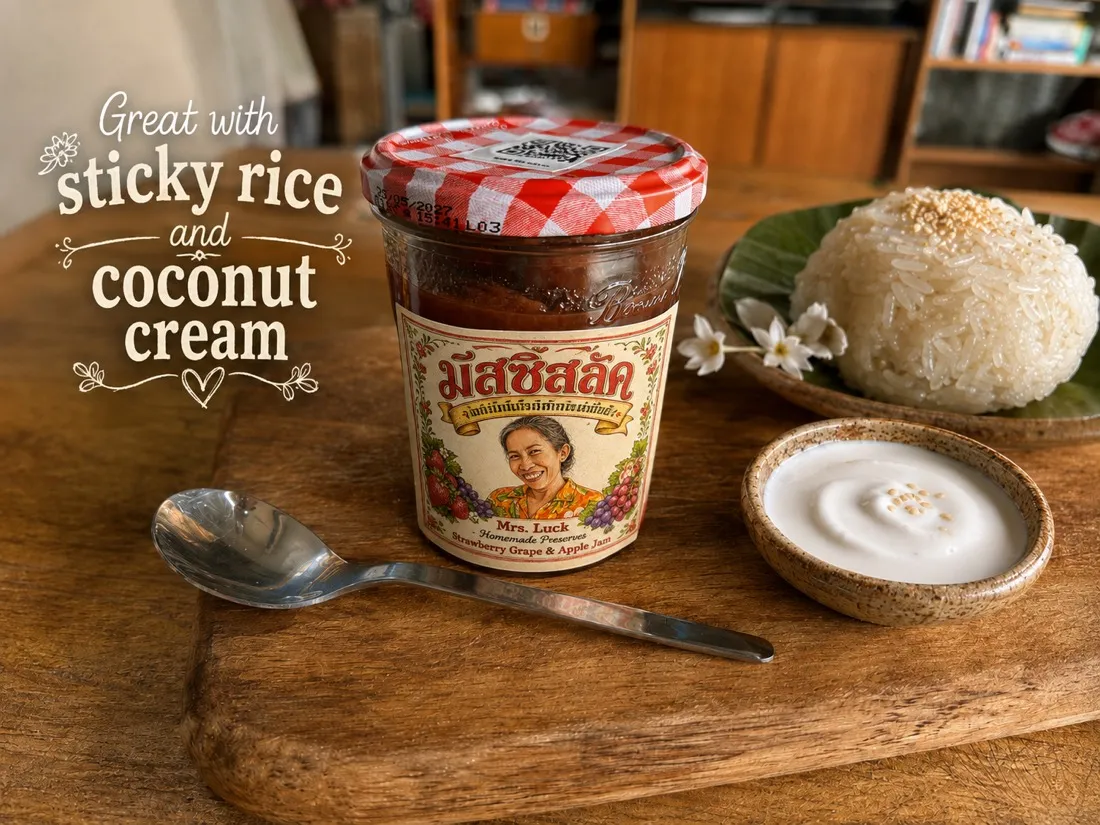
This one is off topic and personal. No architecture, no AI. Just sugar, acid, heat and time.
Several people have now asked me, with the particular delicacy the English reserve for a suspected breakdown, what exactly I think I am doing.
The short answer is that I bought a woman a refractometer.
The long answer requires a short detour past the Sun, which I hope you will forgive, because that is genuinely where this starts.
Somewhere near the centre of the Sun, a photon is made. It then spends anywhere from ten thousand to well over a hundred thousand years working its way outwards — absorbed and re-emitted, absorbed and re-emitted — in a random walk of monumental tedium. Then, having finally reached the surface, it crosses ninety-three million miles of almost nothing in eight minutes and twenty seconds. Some tiny fraction of those photons land on a mango tree outside Bangkok. The tree, which holds no opinions on the matter, uses them to turn carbon dioxide and water into sugar.
A ripe mango, then, is a battery. It is a fragrant, sticky, faintly absurd store of captured starlight, assembled over months and designed by evolution to be eaten quickly by something with legs. Ripeness is not a condition. It is a moment on a slope. From the instant the fruit is at its best it is already on its way to being compost, because the universe is under strict instructions to become less interesting over time, and a mango is a local and temporary act of insubordination.
Jam is what happens when someone decides to extend the insubordination.
The physics of a jar
Here is what is actually going on in the pan, and I make no apology for finding it beautiful.
Mould, yeast and the various bacteria that would like to get at your fruit need available water. Dissolve enough sugar into the mixture and much of that water becomes considerably less useful to them. Add sufficient acid and the environment becomes less hospitable still. Heat changes the fruit, drives off water and, with the right balance of pectin, acid and sugar, gives jam its gel.
Sugar, acid, heat, time. Four variables, one of which is free. People worked out how to manipulate them centuries before anybody could explain exactly why it worked.
The part I like best is that it is measurable. Mrs Luck now owns a refractometer, which is a sentence I did not expect to write this year. Put a small cooled sample on the glass and it tells you the Brix: roughly, how much of what you are holding consists of dissolved solids. For a traditional full-sugar jam, you are generally looking for something around the mid-sixties. She also has a pH meter, a thing like a fat pen, which lets us measure acidity rather than guess at it.
The precise numbers depend on the recipe and the preservation process. That is rather the point. Once you measure what you are doing, a batch made in March does not have to depend entirely on remembering what your hand happened to do last time. That is the difference I care about.
This is what instruments are for: not to take the romance out of a thing, but to let you repeat it on purpose.
Mrs Luck
Mrs Luck has cleaned our house, part time, for two years. That is how I know her, and it is the first awkward fact of this whole business, so let us have it out in the open early.
It is also how I know she cooks. She cooks the way people cook when they have been doing it for fifty years and were never once told they were doing anything remarkable: quickly, without measuring, and better than you. You do not know someone for two years without eventually eating something they made, and once you have, the question of what else that skill might be worth becomes rather difficult to put down.
Mrs Luck does not have much money. She works as a cleaner for a government printing company. She lives under a road, or as near to under a road as makes no difference, and last month the water came in and took what it usually takes. Bangkok is low, flat and slowly sinking, and the water knows exactly which houses to visit. It is rarely the ones with high floors and pumps. She has retirement coming, in the sense that the job will end. What arrives afterwards is an old-age allowance measured in hundreds of baht a month, which is a gesture in the direction of a pension rather than a pension.
And she is proud. This is the fact that governs everything else, and it is why the wording of the offer took longer than the shopping list.
Thailand produces, in relentless succession, mango, lychee, mangosteen, rambutan, longan, pomelo and sweet tamarind. At their peak they can be gloriously cheap, spectacularly good and very much in a hurry. Mrs Luck has spent decades watching that fruit arrive and then watching it go.

The label. Her name, her face, her fruit.
So I offered her a hob, a pan, some scales, a thermometer, a refractometer, a pH meter, jars, labels and the ingredients for the first batch. I offered to help make it with her, work out what each jar actually costs, put a price on it, and give some away to see whether anyone genuinely wanted another.
Then the less photogenic half, which is the half that usually decides these things: the costings and the pricing, a business plan and a twelve-month plan, a seasonal calendar saying which fruit to buy and when, the brand, the labels, a website, ordering over LINE, a loyalty scheme, and a way of keeping track of who bought what and whether they came back. All the machinery a small business needs and almost nobody is ever handed.
And then, in writing, came the part that mattered more than any of it.
There is no debt. No interest. No repayment schedule. No deadline. No share of the business. No obligation to continue. Nothing owed if she tries it and decides she would rather not. If it works, it is hers. If it does not work, the equipment is still hers, along with the recipes, labels and seasonal calendar, to use or ignore as she likes.
Let me be plain about what this is not, because it is the thing people assume. It is not an investment. I own none of it. I take no percentage, and nothing about paying for a pan gives me a claim on anything that ever comes out of it. The recipes, the brand, the plan, the labels, the website and the customers are hers from the first day. If she took the lot tomorrow and never spoke to me again, the arrangement would have worked exactly as designed. The support is the whole of my side of it. There is no commercial proposition underneath.
There is one outcome I quietly hope for, and I may as well admit it. I would like her, one day, to be able to pay me back. Not because I want the money — the money is gone as far as I am concerned, and she is under no obligation whatsoever, then or ever. But she could only repay it out of profit, and profit would mean the thing had worked. If she never returns a single baht, that is precisely what I agreed to and I will not think about it again. If she ever does, I will know it succeeded. And I suspect she would rather enjoy handing it over.
I want to be honest about why that mattered so much. There is a very old and very grubby tradition of the comfortable foreigner arriving somewhere warm and dispensing opportunity, while the currency he is really collecting is gratitude. It is not generosity, whatever it says on the tin. It is the purchase of a small permanent debt at a considerable discount. Hand a proud woman a gift she can never repay and you may not have helped her at all. You may simply have rearranged the hierarchy and made sure she remembers it every time she looks at the pan.
The fact that she also works for me makes this worse rather than better. An employer offering a favour is never quite offering only a favour. There is always the question, however unspoken, of whether refusing is allowed. So the offer had to say plainly, in her language, that she can say no; that saying no changes nothing about her job; and that if she says yes, the business is hers and not mine.
Ownership first. Jam second.
She brings the cooking, the palate, the knowledge of the fruit and the face of the thing. I bring a website, some labels and a spreadsheet. It is a genuinely humbling division of labour when you write it down.
What she said she wanted, when it came to it, was not really money. It was to be for something. To have a thing that was hers, with her name on it, that people would ask for again. I do not think that is a small request, and I do not think it is a sentimental one. It is the thing most of us are actually chasing, dressed up as whatever we happen to do for a living.
The experiment
I should admit the other half of my motive, which is curiosity, and which is not entirely noble.
I cook. I cook a great deal. I have been making jam at home for years, and I have watched the numbers on the back of the envelope with growing suspicion. Because jam, as a business, is oddly forgiving in ways that many other small food businesses are not.
The fruit does not have to be beautiful, only sound. The cosmetically imperfect grades nobody wants to photograph are often perfectly good once chopped into a pan. Sugar is cheap. The basic equipment is simple. And, properly made and processed, preserves have another rather useful characteristic: today’s unsold jar does not automatically become tonight’s waste.
That matters. A baker looks at unsold bread at the end of the day and sees tomorrow’s loss. A jam maker can look at unsold stock and, within its proper shelf life, see inventory. It does not remove the risks of a food business. There are still ingredients, packaging, labour, hygiene, regulation, distribution and the inconvenient question of whether anybody actually wants the stuff. But it changes the economics of being very small.
So there is a hypothesis here, and I would quite like to see whether it survives contact with reality. It is this: a small, seasonal, properly measured preserves business, run from an ordinary kitchen by one person with good hands, might be genuinely viable at a scale so modest that no economist would bother to look at it. Not a start-up. Not disruption. Not scale. Just a person, a pan, two instruments and a hundred jars.
I want to be careful about the word experiment. Mrs Luck is not the experiment. She is the cook. The experiment is the business model, and the person testing it is me, with my own money, on a hypothesis I already believe. If it fails, the finding is mine. The equipment is still hers.
On smallness
We are talking about perhaps a hundred jars a month at around 119 baht each. That is roughly twelve thousand baht in turnover.
Turnover is not profit. Fruit, sugar, jars, labels, fuel and the occasional mistake all have to come out of it. Part of the point of doing this properly is to discover what remains after they do.
But suppose the model works. Twelve thousand baht of monthly sales looks almost comically small written in the language of business. Nobody is raising a seed round for it. There will be no hockey-stick graph. McKinsey will survive without a slide.
And I have stopped being embarrassed by that. At this scale, a few thousand baht of genuine profit is not a rounding error in somebody’s life. It can matter. It can turn retirement from something that happens to you into a period in which there is still something that is yours: your product, your customers, your reputation, your name on the jar.
Business literature has developed a strange habit of treating smallness as an early symptom of largeness. Perhaps sometimes smallness is simply the correct size.
There may be two trillion galaxies in the observable universe, depending on which estimate you prefer, and the standard move at this point is to explain how insignificant that makes us. I have always thought that is exactly backwards. Scale is not significance. In all that expanding dark, the only place we have yet found where anything cares how the fruit turned out is here. Mostly in kitchens.
There is a version of this where the business grows and a version where it does not. I have deliberately built it so that neither outcome frightens me very much. That is the luxury of putting in an amount you can afford to lose, on a person you would back anyway.
The season is the point
The line we keep coming back to is: when the season is gone, that jam is gone. It sounds like marketing. It is actually just true enough to be useful.
There are months when mangosteen is piled absurdly high and sold for very little, and months when the good local crop is no longer there. A jar made at the height of the season is therefore something slightly more interesting than fruit with sugar added. It is a piece of that season deliberately held over.
Everything that makes the fruit good — its brief perfection and its rapid decline — belongs to the same physics that will eventually take apart the jar, the cupboard, the kitchen and the Sun. Preserving is not an escape from that. It is postponement. A small, sweet, entirely temporary refusal to go quietly. And I cannot think of a much better description of what people actually do with their lives.
At home, my jam comes out under a label called Mr Jam Man, made with an apprentice called Harvey who is mostly in it for the tasting. It began as a joke and then quietly stopped being one: a batch made for a charity stall a child at my son’s school was running, a label to go on it, and, inevitably, a small website. The jam turned out to be a surprisingly good way of raising money for something that mattered to somebody.
Mrs Luck has a site of her own now, with a door on it and a password. Behind that door, in English and in Thai, sits everything I have described here: the offer, the costings, the seasonal calendar, the twelve-month plan, and a plain-language guide to what a refractometer is for. None of it is mine to publish. It is hers to open.
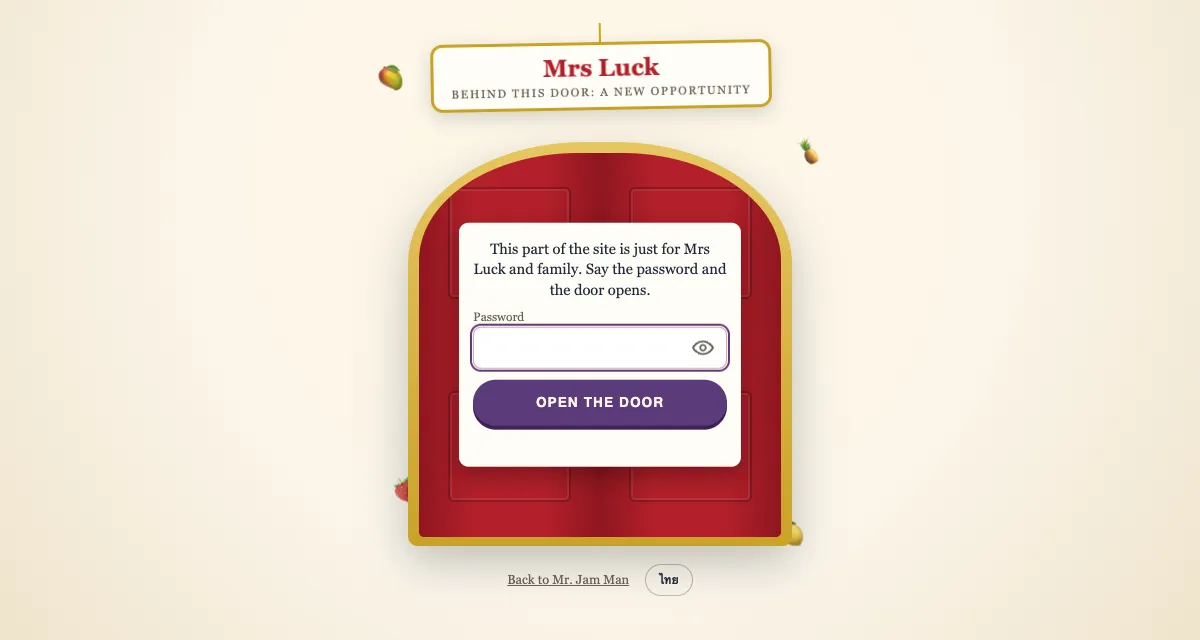
It is the same idea, taken further, and handed to someone who can genuinely cook.
So why did I buy Mrs Luck a refractometer?
The refractometer, you understand, is shorthand.
Because sunlight became sugar. Sugar became fruit. And fruit is on the clock. Because a woman who has known what to do with that fruit for fifty years had spent much of those fifty years cleaning up after people who did not. Because she has been cleaning my house for two years, and I would like, before that job ends, for something to be going the other way.
The flood will come again. The season goes past every year whether anybody catches it or not.
It seemed a waste to let another one through.